
You might be in that awkward stage where you know business analysis looks like a smart career move, but every search result seems to throw...
You might be in that awkward stage where you know business analysis looks like a smart career move, but every search result seems to throw a new acronym at you. BCS. ECBA. CBAP. PMI-PBA. AAC. Then job adverts ask for stakeholder management, requirements gathering, SQL, Agile, and sometimes Power BI as if all of that should already make sense.
That confusion is normal. I see it all the time with graduates, finance professionals, accounts assistants, payroll staff, and career changers who want a role with stronger progression. Many are capable of doing analytical work already. They just don’t yet know which professional business analysis certification fits the UK market, or how to connect certification with actual hiring outcomes.
The good news is that certification can give structure to what feels messy. Instead of guessing your next step, you can follow a path that builds recognised knowledge, clearer language for your CV, and more confidence in interviews. That matters whether you're moving from bookkeeping and VAT into wider business systems work, stepping out of advanced payroll into process analysis, or shifting from data analyst tasks towards a formal business analyst role.
Starting Your Business Analyst Journey in a World of Acronyms
You are reviewing month-end reports in a finance team and notice the same mismatch appears every week. You trace it back to a handoff between systems, speak to the people involved, suggest a better process, and help test the fix. At many UK employers, that is already business analysis in practice, even if your job title still says accounts assistant, payroll officer, operations analyst, or customer support executive.

The confusing part usually starts later. You search for a course or certification, and suddenly you are faced with BCS, ECBA, CCBA, CBAP, PMI-PBA, Agile, BABOK, requirements engineering, stakeholder mapping, and process modelling. It can feel like arriving at a train station where every departure board uses abbreviations you have never seen before.
A useful way to steady yourself is to separate the job from the labels. A Business Analyst helps an organisation work out what problem it is trying to solve, what a good outcome looks like, and what needs to change to get there. In a UK bank, that might mean improving onboarding checks. In a fintech firm, it could mean refining a payments process. In a council or NHS-related project, it may involve documenting workflows so a new system meets operational needs.
That is why the role shows up in so many places across the British job market. Employers are not only hiring people to write documents. They want people who can connect business goals, day-to-day operations, data, systems, and delivery teams.
What employers in the UK are really looking for
British employers often value practical clarity over impressive-sounding jargon. They want evidence that you can ask good questions, handle stakeholders professionally, organise messy information, and turn it into something a team can act on. Certification helps because it gives structure to those skills and helps you describe them in language hiring managers recognise.
BCS often carries strong recognition in the UK, especially with employers in financial services, public sector projects, consultancies, and organisations that prefer familiar British standards. IIBA qualifications also appear in UK job adverts, particularly in international firms, large change programmes, and companies with mature project or product functions. For international students and newcomers, that difference matters. Choosing a certification is not just about what is respected globally. It is also about what makes your CV easier for UK recruiters to place quickly.
Why certification helps early in your career
Certification works like a map. It does not do the journey for you, but it shows you where you are, what each stage means, and which route is likely to lead to the kind of role you want.
Early on, that structure can save a lot of wasted effort. Instead of saying, “I help out with projects,” you can explain that you gather requirements, map processes, support change, or validate outcomes. Those phrases are much closer to how BA roles are advertised in the UK. They also make your transferable experience easier to spot if you are moving from finance, accounting, payroll, operations, customer service, or junior data work.
According to IIBA’s Global State of Business Analysis 2023, 83% of certified professionals reported benefits within the first year, and heightened workplace confidence remained the top reported advantage. The confidence point is especially relevant for career changers. Many people already have the ability. They need a clearer framework, stronger terminology, and guidance on how to present that value in applications and interviews.
Practical rule: If your work already involves improving processes, clarifying requirements, solving cross-team problems, or explaining business needs to others, you may already be building BA experience.
If you are still testing whether the role fits your strengths, our guide to beginner-friendly business analyst courses will help you compare sensible first steps without getting lost in the acronyms.
Decoding the Major Business Analysis Certifications
One reason certification feels confusing is that several respected bodies offer qualifications that sound similar but serve different purposes. It helps to treat them like rail lines rather than a single ladder. They can all take you into business analysis, but they stop at different stations and are recognised differently by UK employers.
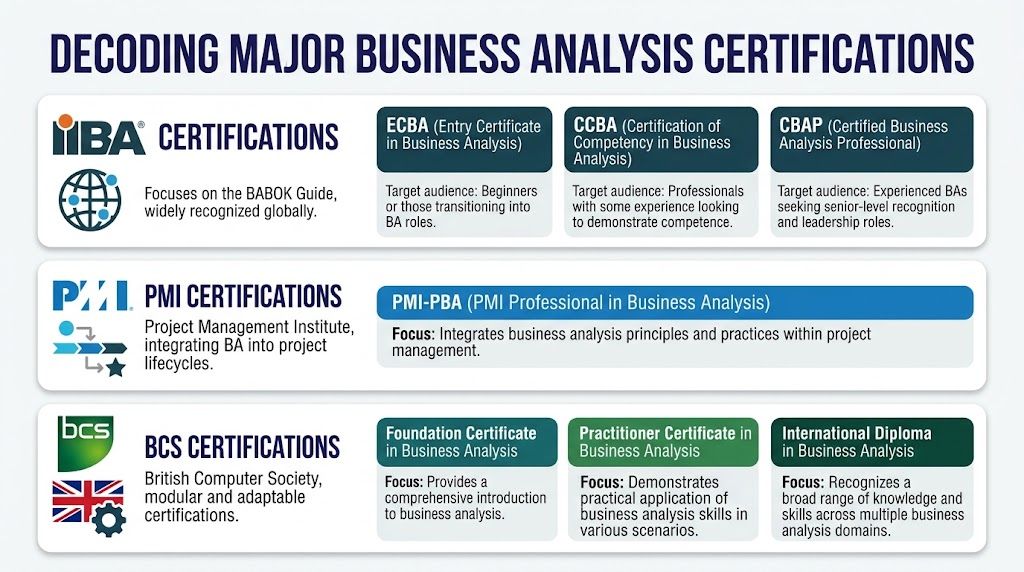
If you are applying in Britain, that distinction matters. A hiring manager in a London consultancy, a public sector team in Manchester, and a global bank in Canary Wharf may all value business analysis credentials, but they will not always read the acronyms in the same way.
The IIBA route
IIBA is widely known across international markets and is closely linked to the BABOK Guide. For candidates who want a structured route from beginner level through to senior professional recognition, it is often the first path they come across.
The core pathway includes:
- ECBA for people starting out or changing career
- CCBA for those with established hands-on experience
- CBAP for experienced professionals aiming to show senior capability
IIBA also offers specialist options, including Agile-focused certification. That can suit people working in product teams, software delivery, or change roles where requirements evolve as work progresses.
In UK terms, IIBA can be a strong choice if you want international portability or plan to target larger employers, multinational firms, or consultancies that use global frameworks. For international students and newcomers to the UK, that recognition can be helpful, but you may still need to explain the qualification clearly on your CV because BCS is often more immediately familiar to British recruiters.
The BCS route
BCS often has the clearest name recognition in the UK job market. You will see that most often in public sector hiring, financial services, consulting, and established corporate change teams.
The usual BCS route looks like this:
- Foundation Certificate in Business Analysis
- Practitioner-level study
- International Diploma in Business Analysis
BCS is modular, which makes it easier to build knowledge in stages. That suits career changers especially well. Instead of trying to prove senior-level capability too early, you can start with core BA methods, learn the language employers use, and add depth as your experience grows.
For readers comparing UK-facing entry routes, this guide to the BCS Foundation in Business Analysis explains what employers usually expect from a junior or entry-level BA.
A simple way to view BCS is this: it often works like a familiar local currency. In Britain, employers tend to recognise it quickly and understand roughly what level you are at without much explanation.
The PMI route
PMI is best known for project management, so its BA qualification usually appeals to people whose work sits close to delivery, governance, and structured change programmes. If your day-to-day role already involves supporting projects, coordinating stakeholders, or translating business needs into project activity, PMI-PBA can be a sensible fit.
It is less commonly the first choice for beginners in the UK than BCS or IIBA. Still, it can carry weight in project-heavy environments, particularly where business analysis is closely tied to formal delivery frameworks.
Agile and adjacent certifications
Some candidates assume they must pick one pure BA certification and ignore everything else. UK employers rarely hire that way. They usually look for a mix of analysis ability, business communication, and practical workplace tools.
For example:
- A junior BA might combine foundation-level BA study with Excel, SQL, and Power BI
- A finance professional might add BA training to existing knowledge of bookkeeping, VAT, payroll, and final accounts
- A data analyst might use BA certification to strengthen requirements gathering and stakeholder communication
A certificate shows that you understand the discipline. Your tools and examples show that you can do the work in a real team.
A UK comparison at a glance
| Certification | Experience Required | Best For | UK Market Recognition |
|---|---|---|---|
| ECBA | Entry level | Graduates, career changers, people new to BA | Useful, especially when paired with practical skills |
| CCBA | Some established BA experience | Analysts ready to formalise mid-level capability | Recognised, but often better understood in larger or global organisations |
| CBAP | Senior experience | Experienced BAs targeting leadership or senior posts | Strong recognition, especially in global firms and consultancies |
| PMI-PBA | Best suited to professionals close to project delivery | Project-based change roles | More niche, but credible in project-heavy environments |
| BCS Foundation Certificate in Business Analysis | Entry level | UK-based starters and career changers | Strong in the British market |
| BCS Practitioner and Diploma pathway | Progression route after foundation study | Professionals building a UK-facing BA profile | Very strong, particularly where employers value BCS familiarity |
Which name matters most in the UK
A common question is, “Which is better, BCS or IIBA?” The more useful question is, “Which one will make sense to the employers I want to work for?”
If you want broad international recognition, IIBA has clear appeal. If you want a qualification that British employers often understand quickly, BCS is usually easier to position. If your role sits inside formal project delivery, PMI-PBA may fit better.
Many people benefit from guided support. Professional Careers Training helps learners match the certification to the job market they are entering, not just the syllabus they are studying. That matters if you are changing career, returning after a break, or trying to translate overseas experience into terms UK employers will recognise.
Which Certification Path Is Right For You
Choosing a professional business analysis certification gets easier when you stop thinking about prestige first and start thinking about fit. The right route is the one that helps you get shortlisted, perform well at work, and explain your value clearly.

If you're a recent graduate
Graduates often assume they need the most advanced qualification available. Usually, they don’t. What they need is credibility, structure, and a way to translate university knowledge into employer language.
If that’s you, an entry-level path is often the best move. In the UK, BCS Foundation is often a practical starting point because recruiters recognise it easily. ECBA can also work well, especially if you want a globally recognised route and are willing to explain its relevance on your CV and in interviews.
Your biggest challenge isn’t lack of intelligence. It’s lack of evidence. Employers want signs that you understand requirements, process thinking, stakeholder communication, and change delivery.
If you're changing career from finance, operations, or admin
This group often has more transferable strength than they realise.
If you’ve worked in bookkeeping and VAT, you already understand controls, reconciliations, and process accuracy. If you’ve handled advanced payroll, you know how rules, exceptions, compliance, and system changes affect real people. If you’ve worked on final accounts or as an accounts assistant, you’ve probably chased missing information, fixed reporting issues, and translated finance needs for non-finance colleagues.
That background can map neatly into business analysis.
A UK-focused certification usually helps here because it gives you a familiar framework to describe work you’ve already been doing informally. Many career changers benefit from starting with BCS, then adding practical BA tools and software skills rather than jumping straight to a senior international credential.
Your past experience still counts. The real task is learning how to frame it in BA language.
If you're already doing BA work without the title
This is common in tech, finance, and change teams. You gather requirements, run workshops, document processes, test solutions, and support delivery, but your job title says something else.
In that case, a more established certification path can help formalise what you already do. You may be at the point where CCBA, CBAP, or a higher-level BCS route makes sense. The best option depends on how much demonstrable BA experience you can show and where you want your career to go next.
If you want senior posts in larger firms or international environments, a recognised senior credential can strengthen your profile. If your target is the UK market and especially roles where BCS appears often in job adverts, the BCS ladder may offer a more direct route.
If you're an international student or newcomer to the UK
This is the group that needs the most careful advice.
A global certification can absolutely add value, but it doesn’t always answer the recruiter’s silent question: “How does this map to the UK market?” That gap creates problems for many talented applicants. According to guidance referenced on the IIBA CBAP page, 45% of international business graduates face recognition barriers in the UK job market. That’s why local context matters so much.
In practice, that means:
- Use UK language on your CV such as requirements gathering, process mapping, stakeholder workshops, and UAT
- Pair global certification with UK-facing training so employers can place your skills more easily
- Show practical tools like Excel, SQL, Power BI, Jira, or Visio where relevant
- Understand sector expectations because a bank, council, consultancy, and software company may all describe BA work differently
A short explainer can also help some readers who are weighing their options:
A simple decision guide
| Your situation | Strong starting point | Why it often works |
|---|---|---|
| Graduate with little or no BA experience | BCS Foundation or ECBA | Builds core knowledge and signals commitment |
| Career changer from finance or operations | BCS Foundation, then practical tools | Easier to align with UK employers and transferable experience |
| Existing analyst without formal credential | CCBA, CBAP, or BCS progression | Helps validate hands-on capability |
| International newcomer targeting UK roles | Global cert plus UK-oriented positioning | Reduces confusion around recognition and relevance |
If you’re unsure, use job adverts as your compass. Read ten roles you would apply for. Note what qualifications, tools, and phrases appear repeatedly. That will tell you more than any generic ranking list.
The Tangible Rewards of Certification Career and Salary Impact
You apply for two UK business analyst roles. On paper, your experience is solid, but another candidate has a recognised certification. For a hiring manager who has to shortlist quickly, that credential can work like a clear label on a file. It helps them place your skills faster and with more confidence.
That matters in the UK job market, where employers often use certification as a shorthand for professional standards. BCS can carry strong recognition with British employers, especially in established organisations, while IIBA can help if you want international portability or plan to work with multinational firms. For international students and newcomers, this can be especially helpful because a certification gives recruiters a familiar reference point when your previous job titles or overseas experience do not translate neatly.
The financial case is real, but it needs careful reading. In IIBA’s review of the value of professional business analysis certifications, based on its 2020 global salary survey, certified professionals earned approximately 13% more than non-certified peers. In that same source, IIBA also reported an average US business analysis salary of $104,502, said 57% of respondents held at least one certification, and noted that 24% of certified participants named salary increase as a top benefit.
Those figures point in a useful direction. They are not a guarantee of a pay rise after an exam.
A certificate improves your market position because it changes how employers read your profile. It can help you get shortlisted, support a stronger salary discussion, and make promotion conversations easier because your capability is framed in recognised terms. Professional Careers Training builds on that by helping learners connect the theory to UK hiring expectations, interview language, and practical examples employers value.
The benefit often shows up before the pay increase does. A certified analyst may run a more structured workshop, write clearer requirements, or spot scope gaps earlier. In a bank, that can reduce delays in change delivery. In a software company, it can cut rework between product and development teams. In finance and tech, managers notice that quickly because cleaner analysis saves time and reduces confusion.
That is why certification works best as a signal plus a skill-builder.
It also helps to look sideways at related roles. If your path overlaps with reporting, data, or decision support work, salary comparisons in adjacent analysis jobs can give you a fuller picture. This overview of Business Intelligence Analyst Salary Ranges is useful for understanding how employers value analytical work when business insight and data reporting meet.
Certification can be especially helpful if you are trying to convert informal analysis work into a recognised BA identity. Someone in operations may already be improving workflows. Someone in finance may already be gathering requirements for reporting changes. A recognised certification helps turn that experience into a story employers understand more easily.
And that story leads to interviews.
Your Certification Roadmap A Sample Study Plan
Good intentions aren’t enough. Individuals who successfully earn a professional business analysis certification follow a simple routine and stick to it.

Phase one Choose the right target
Start with the role you want, not the exam you’ve heard about online. Search UK vacancies for Business Analyst, Junior Business Analyst, Change Analyst, Data Analyst, or Business Intelligence Analyst. Then compare the language.
You’ll usually find a mix of expectations:
- Business analysis skills such as requirements gathering, workshop facilitation, process mapping, and UAT
- Software and reporting tools such as Excel, SQL, Power BI, Jira, or Visio
- Sector knowledge in finance, retail, software, public sector, or operations
This tells you whether you need a BCS-first path, an IIBA path, or a blended plan with tool training.
Phase two Build the theory base
Now commit to one syllabus and one study rhythm. Don’t keep changing route every week.
For theory, keep your focus narrow:
- Learn the language of business analysis. Terms like stakeholder, requirement, process, scope, acceptance criteria, and business case should become familiar.
- Practise applied thinking. Don’t just memorise definitions. Ask how each concept would show up in a payroll system change, a bookkeeping workflow, or a reporting dashboard request.
- Use examples from your own work. If you’ve helped with final accounts, think about controls, exceptions, deadlines, and dependencies. That makes the material stick.
Phase three Add the workplace tools
This is the stage many candidates skip, then regret.
Certification teaches method. Employers often hire for method plus tools. If a job asks for SQL, Power BI, Advanced Excel, or experience with workflow documentation, the certificate alone won’t cover the full requirement.
That’s especially true for readers coming from accounting and finance support roles. If you want to move into analysis, the strongest profile often combines BA theory with practical software capability.
A good blend might include:
| Focus area | Why it matters in BA work |
|---|---|
| Excel | Used for analysis, gap checks, reconciliations, and quick reporting |
| SQL | Helps you query data and validate business issues |
| Power BI | Useful for reporting, stakeholder insight, and dashboard work |
| Process mapping tools | Helps you document current and future workflows |
| Accounting software knowledge such as Sage, Xero, or QuickBooks | Valuable when analysing finance-related systems and process changes |
Phase four Prepare for the exam properly
People often revise passively. They read notes, highlight pages, and feel productive. Then the exam exposes weak application skills.
A better approach is more active:
- Set a weekly plan with fixed study blocks
- Use practice questions and time yourself
- Write short summaries in your own words
- Review mistakes rather than only revising strong topics
Study advice: If you can explain a concept simply using a real workplace example, you probably understand it well enough to use it.
Phase five Translate study into employability
Before you even sit the exam, update your CV and LinkedIn profile. Add project language that reflects business analysis work you’ve already done.
Instead of writing “helped finance team with system changes,” write something more concrete such as “supported requirements gathering for finance process changes” or “mapped reporting issues between operations and accounts teams.” That kind of wording connects your past work to your future target role.
The most successful candidates treat certification as one part of a larger job-readiness plan, not as a standalone fix.
How Professional Careers Training Ensures Your Success
A certification route only works when it leads somewhere practical. That’s the point many learners miss. They study hard, pass an exam, then still feel unsure in interviews because no one helped them connect theory to the UK job market.
That’s where structured training support matters.
Professional Careers Training works with learners who need more than a textbook-only approach. That includes recent graduates, career changers, and international candidates targeting UK roles in business analysis, data analysis, accounting, and finance support. Their training model is particularly relevant for people building a blended profile, such as BA plus Excel and Power BI, or finance systems knowledge plus analysis skills.
Training that reflects real work
One of the biggest advantages is the focus on practical teaching rather than generic content delivery. Learners get 1-to-1 tuition with qualified practitioners, flexible timing, and support that fits around work, study, and family commitments.
That matters because many aspiring analysts don’t need more theory alone. They need someone to explain how a requirement looks in a live business setting, how SQL supports issue investigation, or how reporting tools such as Power BI help communicate findings to stakeholders.
This is also valuable for learners coming from adjacent paths such as:
- Bookkeeping and VAT
- Advanced payroll
- Accounts assistant work
- Final accounts preparation
- Business analyst training
- Data analyst development
Those routes overlap more than many people realise. A strong analyst in finance or operations often needs both process understanding and software confidence.
Support beyond the course
A second problem in the certification journey is that people often know more than their CV shows. They’ve improved workflows, worked with stakeholders, and supported reporting, but their profile still reads like a generic admin or finance support CV.
That’s where job-readiness support becomes decisive. Professional Careers Training explains this clearly in its guide to how courses help students get job-ready. The wider support includes CV preparation, LinkedIn optimisation, job hunting strategy, interview coaching, and references to employers.
That combination matters because UK employers rarely hire on knowledge alone. They hire when a candidate can present a credible story.
A certificate can open the door. A strong CV, practical examples, and interview confidence help you walk through it.
Why this matters for the UK market
The UK job market rewards clarity. Recruiters need to understand quickly what you can do, what tools you’ve used, and where you fit. If you’re an international student, a finance graduate, a payroll professional, or someone moving across from data work, that clarity becomes even more important.
Professional Careers Training’s broader offer supports exactly that transition. Their accountancy and software training can strengthen finance-side credibility. Their practical approach helps bridge the gap between learning and work. Their flexibility also makes it more realistic for adults who can’t commit to a rigid daytime schedule.
For many learners, that joined-up support is the missing piece. It turns a professional business analysis certification from a nice idea into a career step with a clear direction.
If you’re ready to move from confusion to a clear plan, Professional Careers Training can help you build practical skills, gain recognised training, and prepare for real UK job opportunities in business analysis, data analysis, accounting, and finance.