
If you're training to become a business analyst, or you already work as one, you've probably noticed AI tools turning up in more of your...
You’ve done the hard part already. You studied accounting, finance, business, or data. You’ve learned the theory. Then you start applying for jobs and see the same pattern in role after role: employers want practical software experience, not just classroom knowledge.
That’s where many candidates get stuck. They can explain double-entry principles, talk through accruals, or discuss financial statements. But when a hiring manager asks whether they can post supplier invoices in Sage, reconcile a bank account, process VAT correctly, or work with live bookkeeping records, confidence drops.
Sage accounting software training closes that gap. It turns accounting knowledge into work-ready skill. In the UK, that matters because employers often hire for what a candidate can do from day one. If you can use the software they already rely on, you become easier to shortlist, easier to train further, and easier to trust with real finance tasks.
Introduction Why Practical Sage Skills Matter in the UK Job Market
A lot of people reading this are in one of four positions. You may be a recent graduate trying to land your first finance role. You may be changing careers and need a practical route into accounting. You may be an international student trying to understand UK systems. Or you may already work in finance and want stronger software skills for promotion.
In each case, the problem is similar. Employers don’t just want potential. They want evidence that you can work inside a real accounting system and handle daily tasks accurately.
Sage has become one of the software names you will see again and again in UK accounting and bookkeeping environments. If you’re still getting familiar with the platform itself, this guide to what Sage accounting software is is a useful starting point before choosing a training route.
Why software training changes your job search
Practical training does three things that academic study often doesn’t.
- It builds task confidence so you can complete work such as customer records, supplier records, banking entries, and reconciliations without hesitation.
- It improves interview performance because you can talk about workflows, not just theory.
- It helps you target specific roles such as accounts assistant, payroll administrator, bookkeeper, finance officer, or junior analyst.
That last point matters. Many learners think Sage training is only for bookkeeping jobs. It isn’t. Strong Sage skills can support entry into bookkeeping and VAT work, payroll, accounts support, final accounts preparation, and data-focused finance roles.
Practical rule: Employers rarely reject candidates for lacking ambition. They reject them for lacking evidence of usable skill.
What makes Sage training worth your time
A good training path doesn’t stop at showing you where buttons sit on the screen. It teaches how the software connects to real business processes. That includes purchase ledger work, sales ledger activity, VAT handling, bank reconciliation, nominal codes, payroll processing, reporting, and compliance-related routines.
That’s why the best approach is to think beyond one course. Think in terms of a career map. Start with foundation modules. Add the areas linked to your target role. Then choose a provider that also helps you present those skills to employers through CV support, job-search guidance, and interview preparation.
If you take that broader view, Sage becomes more than software. It becomes a bridge between learning and earning.
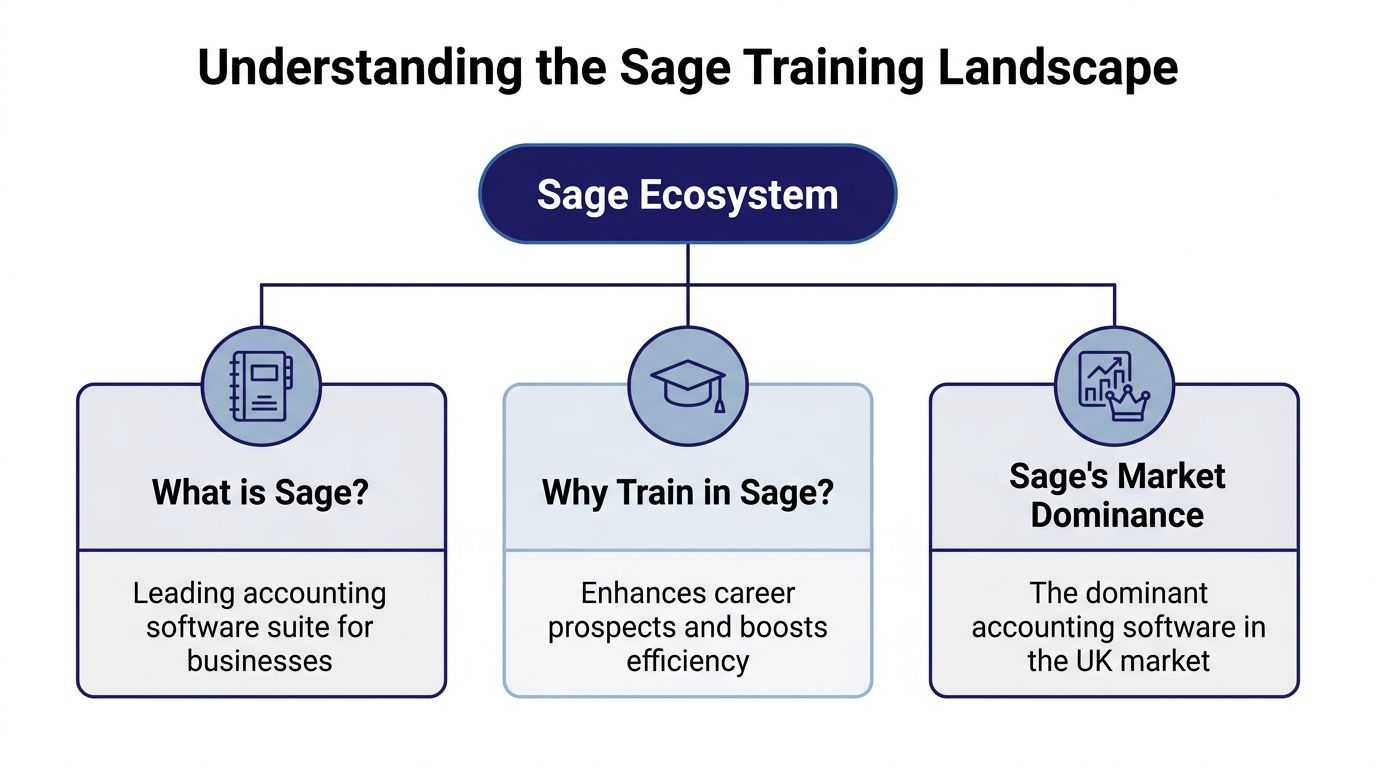
Understanding the Sage Training Landscape
Before choosing a course, it helps to understand the training options clearly. Many learners compare Sage courses only by price or length. That’s a mistake. You need to compare them by level, outcome, and career relevance.
The Sage ecosystem in simple terms
Sage is not just one screen or one bookkeeping tool. It is a wider ecosystem of accounting products and learning routes. For many learners in the UK, Sage 50cloud and related training modules are the most practical starting point because they connect closely to day-to-day finance work in smaller and medium-sized organisations.
The platform’s reach is one reason training has strong career value. Sage University for the UK and Ireland offers free access for 12 weeks to Sage 50cloud Accounts eLearning Stage 1, and Sage software has a 6.8% market share in the accounting category globally, with over 29,000 companies using Sage software according to Sage University for the UK and Ireland.
Beginner, intermediate, and advanced stages
Think of Sage training like learning to drive. You don’t start on a motorway. You first learn the controls, the rules, and how to move safely.
A similar pattern works well here:
| Training stage | What you usually learn | Typical career use |
|---|---|---|
| Beginner | Navigation, records, data entry, customer and supplier processing, banking basics | First step into bookkeeping, accounts admin, junior finance support |
| Intermediate | VAT routines, reconciliations, reporting, corrections, workflow accuracy | Accounts assistant, finance assistant, bookkeeper |
| Advanced | Final accounts support, reporting analysis, compliance workflows, data extraction | Senior finance support, analyst pathways, progression roles |
What confuses many learners is that they think “beginner” means “too basic to matter”. In practice, beginner training is where employability starts. If you can’t confidently enter transactions and understand the flow through ledgers, advanced modules won’t help much.
What official certification tells an employer
Certification matters because it shows structure and completion. It tells an employer that your knowledge wasn’t random or pieced together from videos. You followed a recognised learning path and proved your understanding.
CPD-accredited training has a different but related benefit. It shows that you are actively maintaining or improving your professional skills. That can be useful if you already work in finance, payroll, or admin and want to strengthen your profile for promotion or role change.
A certificate doesn’t replace ability. It signals that your ability has been trained and assessed in an organised way.
How to judge the value of a course
Use these questions before enrolling:
- Is the course mapped to a real job task? A strong course teaches actions employers need, not vague software tours.
- Does it include practical assessment? You need more than passive watching.
- Can you progress after it? A good starting course should lead naturally to higher modules or wider finance training.
- Is the content suited to UK work? That matters for VAT, payroll, and compliance expectations.
If you keep those questions in mind, the training market becomes much easier to understand.
Core Training Modules for Key Accounting Roles
Sage accounting software training becomes concrete. Different jobs need different combinations of skills. The mistake many learners make is choosing a course title that sounds impressive without checking whether it prepares them for daily work.
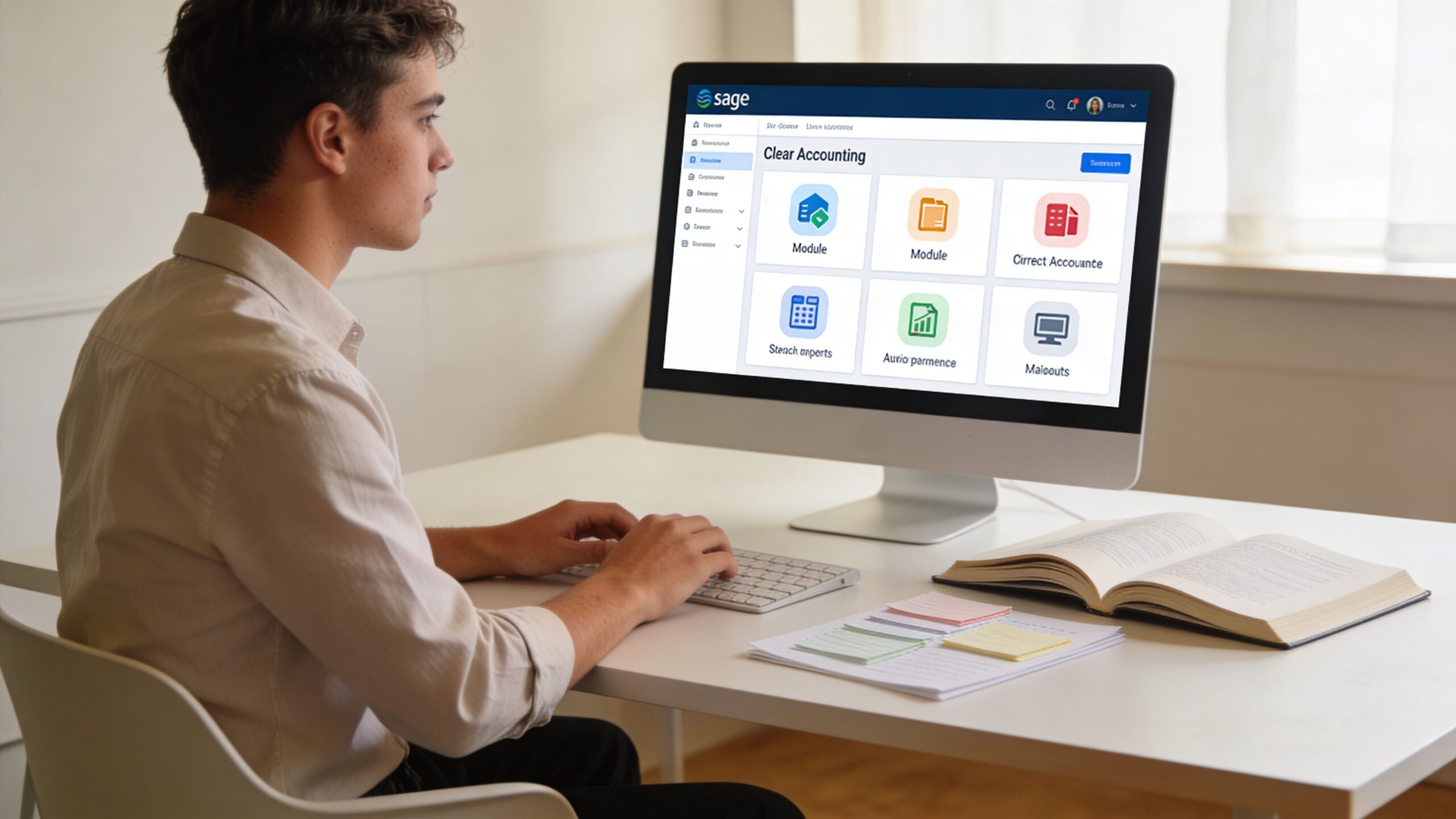
A solid foundation often starts with the Sage 50c Computerised Accounting Level 1 course. Sage states that this course requires about 4 hours of study per week over 6 to 8 weeks, includes 6 months of initial access to the software and portal, and leads to an official certificate on successful completion through Sage UK’s Level 1 training page.
Bookkeeping and VAT
Bookkeeping is often the best entry point because it teaches the flow of financial information across the business. In Sage, this means learning how sales, purchases, receipts, payments, and banking activity are recorded properly.
Before training, a learner often understands accounting terms but struggles with the sequence. They may know what an invoice is, but not where it is entered, how it affects customer balances, or how it later connects to bank activity and reporting. If that distinction still feels blurry, this short guide on the difference between an invoice and a receipt is especially useful because confusion here causes errors early on.
After training, the same learner should be able to:
- Create customer and supplier records with confidence and accuracy
- Post sales and purchase invoices to the right ledgers
- Record receipts and payments so balances stay clean
- Handle banking transactions and identify mismatches
- Support VAT processes through organised records and software-based workflows
For learners comparing entry routes, this overview of a Sage 50 accounts course helps show how bookkeeping tasks translate into training outcomes.
Career insight: Bookkeeping skill is not “small” skill. It is the base layer for almost every finance support role.
Advanced payroll
Payroll sits slightly differently from general bookkeeping. It combines routine processing with strict accuracy. A payroll error affects employees directly, so employers value candidates who can work carefully and follow process.
Before payroll training, many learners see payroll as just entering wages. In practice, payroll work involves maintaining records, checking pay elements, understanding reporting routines, and using software confidently under deadline pressure.
A good Sage-related payroll pathway helps you move from theory to reliable process. It prepares you for tasks such as:
- Maintaining employee records
- Processing regular payroll runs
- Checking deductions and pay details
- Producing payroll-related outputs for review
- Working in an organised way during busy payroll periods
This is also where UK-specific learning matters. Generic software lessons aren’t enough if they ignore local payroll realities.
A short visual walk-through can help if you want to see Sage in action:
Accounts assistant training
Accounts assistant roles are popular because they sit at the centre of finance operations. They usually involve a mix of sales ledger, purchase ledger, bank work, reconciliations, record maintenance, and support for month-end routines.
This path suits graduates and career changers because it offers broad exposure. You aren’t limited to one narrow task. You learn how the finance function operates across several daily responsibilities.
A simple before-and-after view shows the shift clearly:
| Before training | After training |
|---|---|
| Knows accounting terms in theory | Can process transactions in Sage |
| Unsure how ledgers connect | Understands customer, supplier, and bank flow |
| Nervous about live data | Works with more confidence and control |
| Struggles to describe practical experience | Can discuss real software tasks in interviews |
Which module should you start with
That depends on your target job.
If you want a first office-based finance role, bookkeeping and accounts assistant training usually make the most sense. If you already enjoy detail-heavy processing and deadline work, payroll can be a strong specialist route. If your long-term goal is analyst or management accounting work, you still need these foundation layers first.
Most careers in finance don’t begin with strategy. They begin with transaction accuracy.
Advanced Pathways for Analysts and Final Accounts
Many people think Sage training ends once you can post invoices or reconcile a bank account. That’s too narrow. For ambitious learners, Sage can become the base for more analytical and senior work.
Final accounts as a progression step
Final accounts training matters because it lifts you from routine data entry to financial interpretation. At this stage, you’re not only processing transactions. You’re starting to understand how those transactions affect the overall financial position of a business.
That makes final accounts especially relevant for learners who want to move towards assistant accountant roles, management accounting support, or a longer-term chartered pathway. It also strengthens your judgement. You stop seeing entries as isolated tasks and start seeing them as part of a complete reporting cycle.
Why compliance-focused Sage skills are rising in value
In the UK, Sage Business Cloud Accounting training is especially relevant for HMRC compliance work. According to Sage’s T Level Accounting qualification information, trained users report up to 40% faster period-end closings and achieve 98% compliance accuracy. The same source notes that Making Tax Digital for Income Tax Self Assessment is scheduled to begin in April 2026.
That matters for two reasons. First, compliance knowledge is becoming more valuable, not less. Second, employers increasingly need staff who can work accurately inside software-driven reporting routines.
Strong Sage skills become more valuable when they help you complete compliant work, not just enter data faster.
Business analyst and data analyst links
Sage also supports progression into analyst roles. Not because Sage replaces Excel, SQL, or Power BI, but because it often provides the financial data those tools rely on.
If you move into a business analyst or data analyst path, you need to understand where the numbers came from. You need to recognise sales data, supplier trends, cost categories, payment timing, and reporting logic. Sage experience helps because it gives context to the data.
A learner with only dashboard skills may be able to visualise numbers. A learner with Sage and finance system knowledge can often explain them better.
Here are common progression links:
- From Sage to Advanced Excel for reporting, cleansing, and trend review
- From Sage to Power BI for management dashboards and performance tracking
- From Sage to SQL-based analysis where finance data feeds wider reporting environments
- From Sage to final accounts work for deeper accounting progression
A smarter long-term view
If your goal is a strategic role, don’t skip the software foundation. Analysts who understand source systems are often stronger than analysts who only know presentation tools. In the same way, accountants who can connect bookkeeping, compliance, and reporting tend to progress faster than those who learn each topic in isolation.
Sage is not the final destination for every learner. But for many, it is the platform that makes the next step possible.
Tailored Learning Paths for Your Career Stage
The right training route depends less on your age and more on your starting point. Two people can want the same job and still need very different learning plans.

If you are a recent graduate
Graduates often know the theory but need software confidence and interview-ready examples. The best route is usually broad first, specialised later.
Start with bookkeeping and Sage fundamentals. Then add accounts assistant tasks such as bank reconciliation, sales ledger, purchase ledger, and month-end support. If your degree included tax or reporting subjects, final accounts can become a useful next step once your base is strong.
A graduate pathway often works well in this order:
- Foundation Sage training
- Bookkeeping and VAT practice
- Accounts assistant workflow training
- CV and interview preparation linked to software tasks
If you are changing careers
Career changers often need speed, structure, and clarity. You don’t want a course that assumes too much prior knowledge, but you also don’t want months of theory before touching the software.
You’ll usually benefit from practical training that shows how finance work is done in an office. Sage can give you one strong route in, especially if paired with other software exposure and clear job-search support.
Good priorities for career changers include:
- Learning the language of finance administration
- Practising real transaction entry
- Building confidence with reconciliations and routine checks
- Preparing for entry roles such as accounts assistant or payroll support
Your previous career is not wasted. Employers often value transferable strengths such as organisation, communication, deadlines, and client handling once you can pair them with software skill.
If you are an international student or newcomer to the UK
This group often faces a double challenge. You may need practical software skills and UK-specific context at the same time.
That means your training path should focus on software use inside local working practices. Bookkeeping alone may not be enough if you also need help understanding employer expectations, finance job titles, and UK recruitment norms.
A sensible route is to combine Sage training with:
| Need | Why it matters |
|---|---|
| UK bookkeeping processes | Helps you understand how employers organise finance tasks |
| VAT and compliance awareness | Supports job-readiness in UK roles |
| CV and LinkedIn support | Helps your profile translate well to local employers |
| Interview coaching | Builds confidence when discussing practical skills |
If you already work in finance
If you’re already in a finance, payroll, or admin role, your training should be targeted. Don’t start again from scratch unless your software confidence is very low.
Focus on the modules that remove bottlenecks in your current work or support your next promotion. That might mean deeper reporting, final accounts support, payroll improvement, or a move towards analyst tools that build on Sage-held data.
The key is to match your training to your next role, not just your current one.
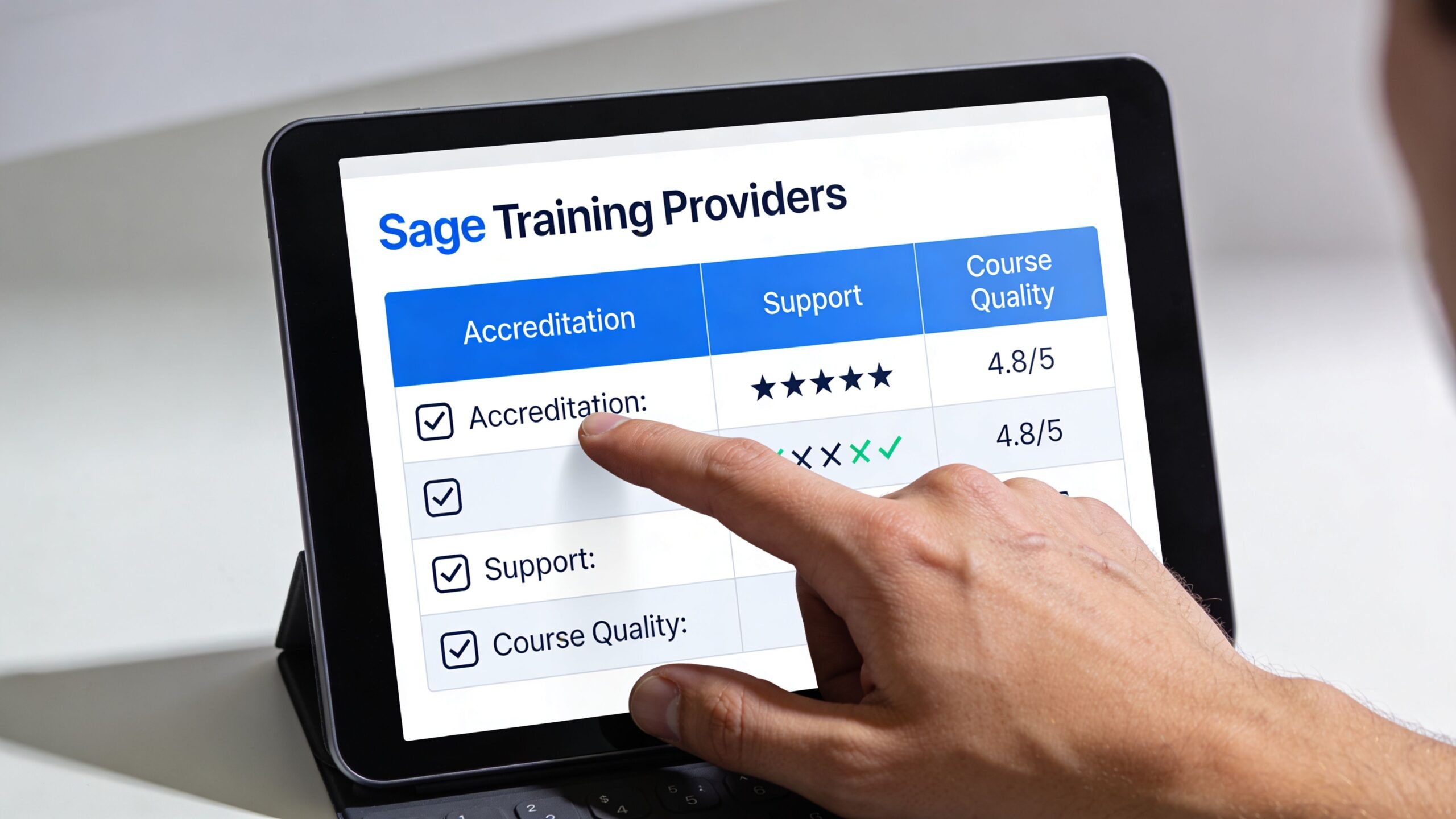
How to Choose the Right Sage Training Provider
Course content matters. The training provider matters just as much. Two providers can offer “Sage training” and deliver completely different outcomes.
The problem with generic software-only courses
Some providers offer little more than screen recordings and basic exercises. That can help with familiarisation, but it often falls short when learners need UK job-readiness.
A significant gap in generic Sage training arises because some courses overlook UK-specific compliance topics such as HMRC processes, Making Tax Digital, and PAYE requirements, as noted in this overview of the gap in generic Sage training for UK compliance.
If a course ignores those realities, you may finish with software exposure but still feel unprepared in interviews.
A practical checklist for choosing well
Use this checklist before paying for any programme:
-
Official certification path
Make sure the training leads to recognised proof of learning where possible. -
1 to 1 or live tutor support
Sage looks simple until you hit an error, reversal, or reconciliation issue. Tutor access makes a big difference. -
Flexible timetable
Evening and weekend access matters if you’re working, studying, or changing careers. -
Hands-on software access
You need practice time, not just demonstrations. -
UK-relevant content
Look for payroll, VAT, HMRC, and compliance context suited to UK roles. -
Recruitment support
CV preparation, interview coaching, job-search strategy, and LinkedIn guidance can be as important as the software itself.
Compare the provider, not just the syllabus
A useful way to judge options is to compare the learning experience side by side.
| Feature | Strong provider | Weak provider |
|---|---|---|
| Support | Tutor-led help and feedback | Mostly self-service |
| Practical focus | Real job tasks | Generic walkthroughs |
| Career help | CV and job support | Little or none |
| UK context | Compliance-aware | Broad and non-specific |
| Progression | Clear next steps | One-off learning only |
If you’re still trying to understand Sage as an accounting software before choosing a provider, it helps to review the platform from a practical business-use perspective as well as a training one.
You should also look closely at whether the provider teaches how to use the software in a way that maps to real tasks. This kind of practical guidance on how to use Sage is often more valuable than broad marketing descriptions.
Choose a provider that cares what happens after the course ends. That’s where the real value often shows.
What ambitious learners should prioritise
If your goal is your first job, your next role, or a move into a more specialist path, don’t choose training based on convenience alone. Choose based on outcome.
The best provider for you is not always the cheapest or the fastest. It is the one that helps you build usable skill, prove it properly, and present it well to employers.
Conclusion From Training to Your First Job in Finance
Sage accounting software training works best when you treat it as part of a bigger career plan. The software matters, but the job outcome matters more.
For some learners, the right first step is bookkeeping and VAT. For others, it is payroll, accounts assistant training, or final accounts support. If your long-term goal is business analysis or data analysis, Sage can still play an important role because it gives you the financial system understanding behind the reports.
The key is to choose training that matches your current stage and your target role. If you’re a graduate, focus on practical confidence. If you’re changing careers, focus on structured, job-ready modules. If you’re already in finance, focus on the skill gaps that will enable progression.
A good course teaches software. A strong training path builds employability.
That is why your choice of provider matters so much. You want more than access to lessons. You want guided learning, relevant UK context, recognised certification where possible, and support that helps you move from training into interviews and employment.
If you’ve been hesitating because the whole process feels confusing, keep it simple. Start with the role you want. Work backwards to the Sage skills that role needs. Then choose a training route that helps you learn those skills properly and present them with confidence.
If you're ready to turn Sage training into a real job plan, Professional Careers Training offers practical accountancy training with 1 to 1 support from ACCA-qualified trainers, flexible scheduling, official software certification, software support, and career-focused help with CV preparation, job hunting, LinkedIn optimisation, and employer referrals.