
If you're training to become a business analyst, or you already work as one, you've probably noticed AI tools turning up in more of your...
You may already have a decent qualification, some software knowledge, and a CV that looks respectable on paper. Yet the job search still feels crowded. You apply for accounts assistant roles, bookkeeping posts, junior analyst jobs, or payroll positions, and the same question hangs in the air: what makes you stand out from the next person who also knows Excel and has studied finance?
That’s where being six sigma trained starts to matter.
Employers don’t only want people who can do a task. They want people who can make the task run better. In finance and data roles, that might mean fewer invoice errors, cleaner payroll checks, smoother month-end routines, or reports that arrive on time and make sense.
If you can show that you don’t just process information, but improve the process itself, you become more valuable. That is the career advantage behind Six Sigma.
The Hidden Advantage in Your Finance or Data Career
A lot of ambitious people hit the same wall early in their career. They’ve learned Sage, Xero, QuickBooks, Excel, or Power BI. They may even be working towards ACCA or another accountancy route. But when they sit in front of a recruiter or hiring manager, they struggle to explain the business value they bring.
Knowing software is useful. Knowing bookkeeping rules is useful. Understanding payroll, VAT, or reporting is useful too. But employers often remember candidates who solve problems in a structured way.
That’s why six sigma trained professionals often come across differently. They don’t just say, “I can process invoices.” They say, “I can identify where invoice errors happen, measure the pattern, find the root cause, and improve the workflow.”
Practical rule: Skills get you considered. Problem-solving gets you hired.
This matters across several common UK career paths:
- Bookkeeping and VAT: You need accuracy, consistency, and a clear checking routine.
- Advanced payroll: You need dependable processes because payroll mistakes affect trust quickly.
- Accounts assistant work: You need to handle reconciliations, journals, expenses, and month-end support without creating avoidable rework.
- Final accounts: You need organised data, clean handovers, and fewer last-minute surprises.
- Business analyst and data analyst roles: You need more than reporting. You need to explain why a problem is happening and what should change.
Six Sigma gives you a language for all of that. It helps you think like someone who improves operations, not just someone who follows instructions.
There’s another reason this matters. The UK market can feel especially difficult if you’re a recent graduate, changing careers, or still building local experience. In those situations, a practical improvement mindset can help bridge the gap between study and work. It shows that you understand how real businesses operate.
What Being Six Sigma Trained Actually Means
You are in your first finance role. Month-end is tight, a supplier calls about a late payment, and you find the problem fast. The invoice was entered twice, approved once, and then held up because two team members followed different checking steps. You fixed the immediate issue, but a hiring manager will care about something else too. Could you stop that same error happening again next month?
That is what being Six Sigma trained means.
It means you can look at routine work, spot where errors and delays come from, measure the pattern, and improve the process behind it. For an accounting, finance, or data professional in the UK, that matters because employers do not only want accurate work. They want people who can help the business run with fewer corrections, cleaner data, and less wasted time.

A pantry is a useful comparison. If every item is labelled, stored in the right place, and checked before it runs out, the household works smoothly. If tins are misplaced, labels are unclear, and nobody follows the same system, people buy duplicates, miss what they already have, and waste money. Finance processes work in much the same way. Small inconsistencies create expensive confusion.
In a business setting, those inconsistencies often show up as invoice errors, wrong VAT treatment, payroll corrections, duplicated records, or dashboards built on messy source data. Six Sigma gives you a method for treating those issues as process signals, not random bad days.
Defects in a finance setting
In Six Sigma language, a defect is any output that fails to meet the required standard. If you come from an ACCA, bookkeeping, payroll, or data background, that idea is easier to grasp when you translate it into everyday work:
- Bookkeeping: a transaction posted to the wrong nominal code
- VAT: an incorrect tax treatment on a purchase or sales entry
- Payroll: an employee paid late or with the wrong deduction
- Final accounts: missing schedules, unreconciled balances, or inconsistent support
- Reporting and analytics: a Power BI dashboard built from incomplete, duplicated, or outdated data
The key lesson is simple. A defect is not just a mistake. It is a measurable failure in a process output.
That distinction matters for your career. A junior candidate may say, “I can use Sage.” A stronger candidate says, “I can use Sage, spot where posting errors repeat, and tighten the workflow so month-end runs faster.” The second person sounds more valuable because they connect software skills to business improvement.
Why the term Six Sigma sounds technical
The name comes from statistics, which can make it sound more intimidating than it really is. Six Sigma is primarily about reducing variation.
Variation is the amount of inconsistency in a process. In finance, variation might mean one staff member codes expenses one way, another person uses a different rule, and a third skips a check completely. In data work, it might mean reports pull from different date ranges or source fields. The result is the same. Outputs become less reliable.
One common benchmark used in Six Sigma is Defects Per Million Opportunities, or DPMO. The standard benchmark for Six Sigma quality is 3.4 DPMO with a 99.99966% yield, as explained in Six Sigma statistics guidance from Six Sigma Online. You do not need to memorise that for an interview. You do need to understand the principle behind it. Better processes produce fewer errors, and fewer errors mean lower cost and more trust in the numbers.
A finance manager feels that immediately. Fewer invoice mistakes mean less chasing and rework. Fewer payroll corrections mean fewer complaints and less risk. Cleaner reporting data means management can make decisions with more confidence.
What training changes in practice
Being Six Sigma trained does not mean you walk around quoting formulas. It means your approach to work becomes more disciplined and more commercially aware.
You start asking:
- Where exactly is the problem happening?
- How often does it happen?
- What pattern links the errors together?
- What is causing them?
- Which change will prevent the issue, not just patch it?
That way of thinking is useful in nearly every finance or data role. It also pairs well with qualifications and tools UK employers already recognise. If you already have ACCA knowledge, AAT training, payroll experience, or hands-on skill with Sage, Excel, SQL, or Power BI, Six Sigma helps you apply those skills in a more structured way. You are no longer just producing reports or processing entries. You are improving the reliability of the system that produces them.
Employers notice that because process improvement has direct business value. The American Society for Quality explains that organisations use Six Sigma to improve quality and reduce waste across core operations, including transactional and service processes such as finance and administration: ASQ’s overview of Six Sigma.
That is why “Six Sigma trained” carries weight on a CV. It signals that you can do the work and improve the way the work gets done.
A short visual can help make the idea easier to remember.
Understanding the Six Sigma Belt Levels
The belt system often confuses people at first. They hear Yellow Belt, Green Belt, or Black Belt and assume it works like martial arts. The idea is simpler than that. Each belt level reflects how thoroughly you understand the method and how much responsibility you can take in improvement work.
In finance and data roles, the right level depends on the kind of contribution you want to make.
A quick comparison
| Belt Level | Role & Focus | Typical Project Example (Finance/Data) | Recommended For |
|---|---|---|---|
| Yellow Belt | Supports improvement work and understands the basics | Spotting repeated bookkeeping errors in purchase invoices and helping document the process | Beginners, accounts assistants, payroll juniors, bookkeeping learners |
| Green Belt | Leads smaller projects and applies Six Sigma tools directly | Improving month-end close steps, reducing delays in invoice approvals, tightening VAT checking routines | Team members who want to lead improvement work in finance or reporting |
| Black Belt | Leads larger, cross-team process improvement projects | Redesigning a reporting workflow across finance, operations, and management teams | Experienced professionals, analysts, managers, and process leads |
Yellow Belt for operational confidence
A Yellow Belt is a strong starting point if you’re early in your career. It helps you see process problems that many people miss.
In bookkeeping, for example, you might notice that supplier invoices are entered correctly by one person but often need corrections when another person covers the task. A Yellow Belt approach would prompt you to compare the steps, look for inconsistency, and standardise the routine.
This level suits people in:
- Bookkeeping and VAT support
- Payroll administration
- Accounts assistant roles
- Entry-level data roles
It’s especially useful if you want interview-ready examples of how you think, not just what software you’ve used.
Green Belt for project ownership
A Green Belt usually means you can run an improvement project within your area.
Suppose month-end close always becomes stressful because one report arrives late, which then delays reconciliations and management accounts. A Green Belt doesn’t just work harder at month-end. They investigate where the delay begins, measure the pattern, and test a better process.
The strongest junior-to-mid-level candidates often show one thing clearly. They can improve a workflow, not just survive it.
For business analysts and data analysts, Green Belt knowledge fits naturally with process review, root cause analysis, and stakeholder work. For accounts staff, it strengthens the move from task-doer to trusted improver.
Black Belt for wider change
A Black Belt is usually for people who lead significant change across a team or department. In a finance setting, that could involve redesigning reporting handovers, reducing recurring compliance defects, or improving how data moves between systems.
This level makes sense if your role is becoming more strategic. It is less about doing isolated tasks and more about leading structured, measurable change.
If you’re still choosing where to start, a simple guide works well:
- Start with Yellow Belt if you want practical awareness and stronger interview examples.
- Choose Green Belt if you want to lead improvement in your current or next role.
- Aim for Black Belt if you already have experience and want authority in process transformation.
Your Blueprint for Improvement The DMAIC Framework
A finance team notices the same pattern every month. Supplier queries pile up, approvals slow down, and someone stays late fixing invoice errors that should not have happened in the first place. DMAIC gives you a way to sort that kind of problem methodically, which is why it matters so much for UK accounting, finance, and data professionals who want stronger results on the job and better evidence on their CV.
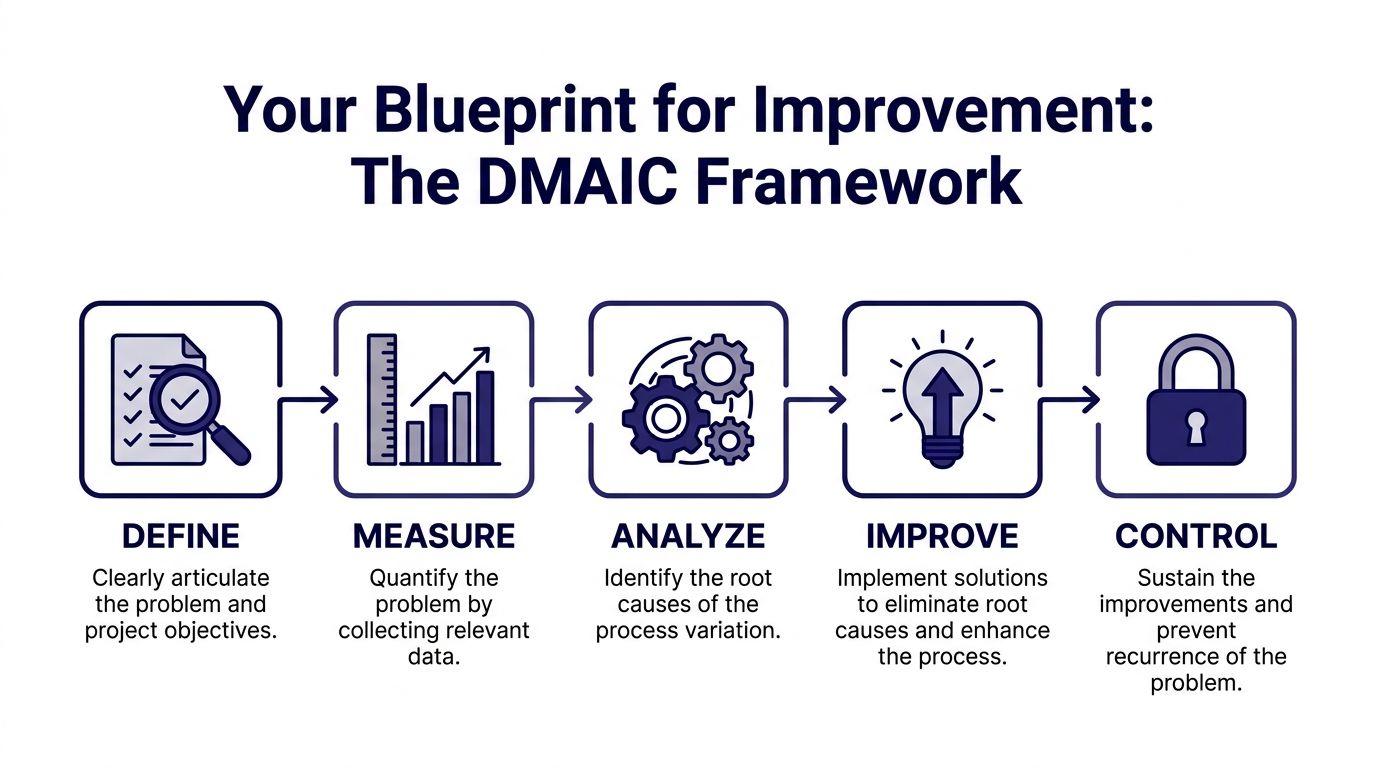
DMAIC stands for Define, Measure, Analyse, Improve, Control. It is the working method behind many Six Sigma projects. If ACCA helps you understand financial standards and Power BI helps you report what is happening, DMAIC helps you improve the process causing the issue in the first place.
Take a familiar example. A business keeps finding errors in invoice processing. Some invoices are coded wrongly. Others are duplicated. A few sit unapproved for too long, which affects cash flow and supplier relationships.
Define the problem properly
The first step is to name the problem in business terms. A loose complaint such as “invoice processing is messy” is too broad to fix well.
A stronger definition sounds more like this: invoice processing errors are creating rework, delaying payment approvals, and increasing supplier queries.
That wording matters. It turns frustration into a problem you can examine, assign ownership to, and improve.
At this stage, process mapping helps. A plain-English guide to business process mapping can show you how to turn a routine with hidden gaps into visible steps. If you want to go further, this resource on modelling business processes is useful for analysts and finance staff who want to connect process design to systems work.
Measure what is really happening
After defining the issue, you need a baseline. In finance terms, this is similar to checking the numbers before explaining a variance report. Without that baseline, every fix is partly guesswork.
You might measure:
- how many invoices need rework
- which suppliers generate the most exceptions
- how long each approval stage takes
- whether manual entries fail more often than imported data
This does not have to start with advanced statistics. A careful spreadsheet, a simple dashboard in Power BI, or export data from Sage can be enough to show where errors cluster.
Analyse the source of variation
This is the point where Six Sigma becomes especially useful for accounting and data students. It teaches you to separate a one-off error from a repeated pattern.
Variation is the key idea. In a healthy process, results stay within a predictable range. In an unhealthy one, the same task produces very different outcomes depending on who handles it, which system is used, or what type of transaction arrives. For normally distributed data, 99.73% of outcomes fall within ±3σ of the mean, as explained at https://blog.masterofproject.com/six-sigma-statistics/. The practical lesson is simple. If invoice processing times swing from minutes to days without a clear reason, the process is unstable.
That instability creates cost. In finance, variation often shows up as rework, delayed approvals, inconsistent coding, avoidable VAT corrections, or extra time spent answering supplier emails.
A team might find that:
- one supplier sends invoices in a format the system reads poorly
- manual VAT coding causes repeated classification mistakes
- approvers apply different rules to similar invoices
- data transfers badly between systems
A good analyst or finance professional asks what in the process makes the error likely, not just who touched the transaction last.
Improve the workflow
Once the cause is clearer, the fix becomes more precise. That is what makes DMAIC attractive to employers. It shows that you can improve a process with evidence instead of relying on opinion.
A finance team might standardise invoice entry fields, add validation checks in Sage or Xero, set approval rules by invoice type, or remove duplicate manual entry between systems. A data analyst might automate exception reporting in Power BI so the team spots issues before month-end pressure builds.
Small tests work well here. If one change cuts errors for a single supplier group, you have evidence before rolling it out more widely.
Control the gains
The last stage keeps the improvement from fading after a few busy weeks.
Control usually means a documented process, clear ownership, regular checks, and visible measures. In practice, that could be a monthly exceptions dashboard, a checklist for new suppliers, or an approval tracker reviewed by the finance manager.
This is also where Six Sigma becomes career-relevant. Employers in the UK often value people who can make an improvement stick, especially if they can combine process discipline with recognised qualifications and software skills. An ACCA trainee who can tighten controls around invoice approvals, or a data analyst who can monitor process drift in Power BI, offers something more valuable than technical knowledge alone. They show they can improve how the business runs.
Real-World Benefits for Accounting and Data Roles
Theory only matters if it changes day-to-day work. The best way to see the value of being six sigma trained is to look at what changes inside common roles.
Bookkeeping and VAT
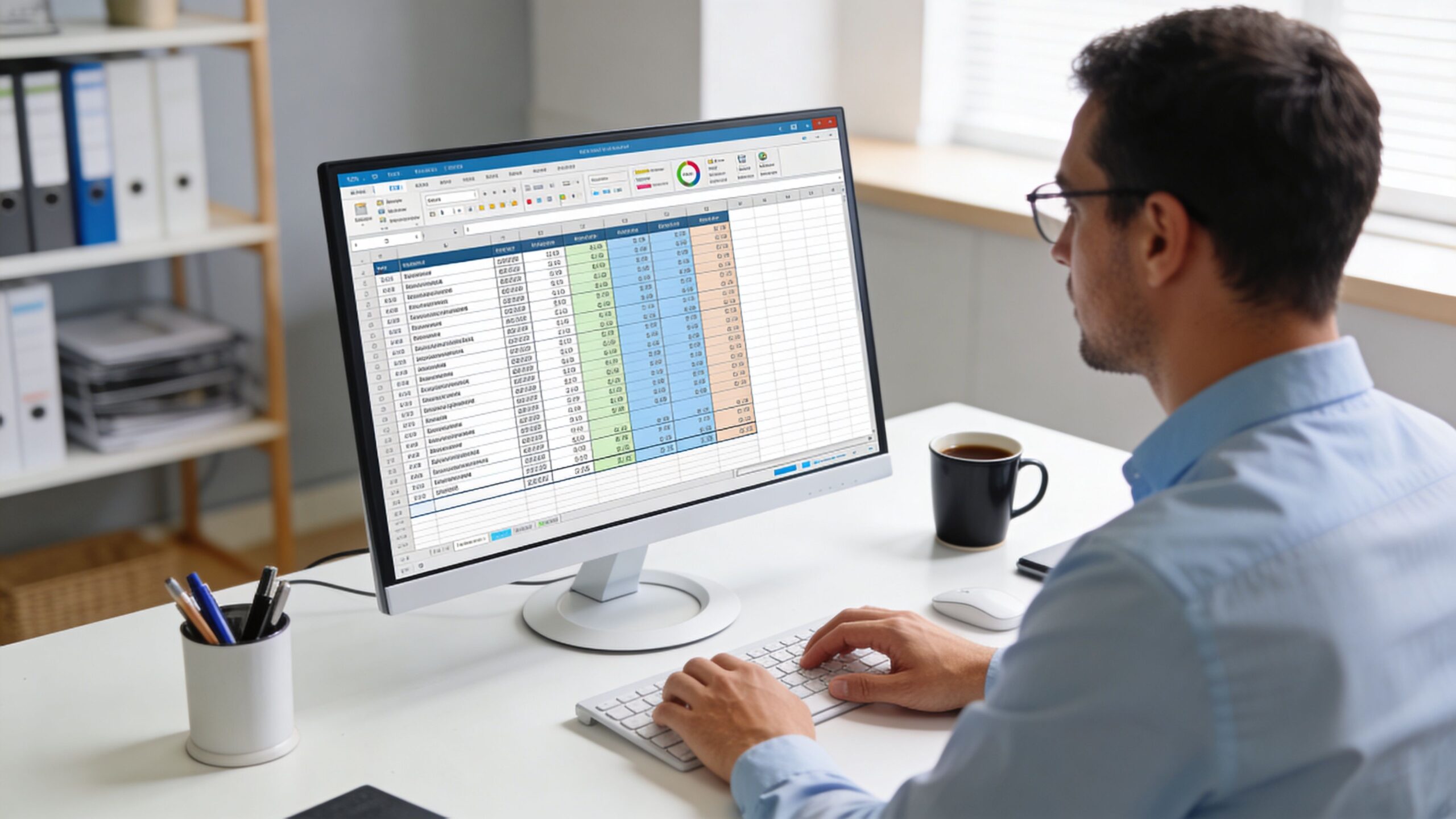
A bookkeeper without process thinking often spends time cleaning up after avoidable mistakes. One day it’s duplicate entries. The next day it’s a mismatch between bank records and posted transactions. VAT review then becomes stressful because every correction feels urgent.
A six sigma trained bookkeeper works differently. They look for repeated error points. They ask whether the chart of accounts is being used consistently, whether bank feed rules need tightening, and whether supplier coding needs standardisation.
The result is not just cleaner records. It is calmer work.
Advanced payroll
Payroll mistakes damage confidence quickly. People notice if their pay is late or wrong.
Someone with a Six Sigma mindset treats payroll as a controlled process, not a monthly rush. They review where variation appears. Do timesheets arrive in different formats? Are manual adjustments causing confusion? Are approval cut-offs unclear?
That kind of thinking improves reliability. It also makes you more trusted, because payroll teams are judged on accuracy and consistency.
Accounts assistant and final accounts support
Accounts assistants often sit close to the busiest operational pressure points. They handle journals, expenses, reconciliations, and support work that feeds into final accounts.
Before Six Sigma thinking, many people in these roles become good at firefighting. They can cope with problems, but they keep seeing the same ones. After training, they start questioning why the same suspense items appear each month or why one reconciliation always causes delay.
That shift matters. It makes you look organised, commercial, and ready for more responsibility.
Business analyst
A business analyst with no process discipline can end up producing attractive documents that don’t fix the problem. Meetings happen. Notes are written. Yet the same operational issue stays alive.
A six sigma trained analyst is more likely to ask:
- what is the actual defect
- where in the workflow does it start
- what evidence shows the root cause
- how will we know the improvement worked
That approach fits well with broader analyst practice. If you want to strengthen that side of your skill set, this guide to business analysis methods and techniques is a useful companion to Six Sigma thinking.
Data analyst
Data analysts often get hired for reporting, but strong analysts do more than build dashboards. They explain patterns, isolate causes, and support better decisions.
A six sigma trained data analyst doesn’t stop at “the numbers changed”. They look at process variation, compare groups, and ask what in the workflow created the outcome. In business terms, that makes their analysis more actionable.
A dashboard tells people what happened. Process analysis helps them change what happens next.
Across all these roles, Six Sigma training helps you become the person who improves quality, not just the person who processes work.
How Six Sigma Training Boosts Your CV and Employability
You are applying for two junior analyst roles in Manchester. Both candidates know Excel. Both have used Sage or Power BI. One CV says “detail-oriented” and “familiar with finance processes.” The other says they reduced reporting errors by reviewing the process, measuring where mistakes appeared, and standardising the checks.
Recruiters remember the second person.
That is the CV value of being six sigma trained. It gives you a way to describe your work in business terms. For an accounting, finance, or data student, that matters because employers are rarely hiring software buttons alone. They are hiring someone who can spot waste, reduce errors, and help the team run with fewer surprises.
What employers hear when you phrase it well
Six Sigma changes how your experience sounds.
A weak CV entry often reads like a list of duties:
- used Excel and accounting software
- helped with reconciliations and reporting
- supported finance processes
A stronger entry shows judgement:
- reviewed invoice approval delays using DMAIC and identified repeat bottlenecks
- checked reporting workflows for recurring data quality issues
- helped standardise payroll, VAT, or bookkeeping steps to reduce avoidable errors
The difference is similar to the difference between saying “I can use a calculator” and “I used the calculator to find where the margin leak was.” One describes a tool. The other shows commercial value.
Why this matters in the UK job market
This guide takes a more useful angle than the usual Six Sigma article. For UK candidates, the skill becomes much more valuable when it sits beside something you already have or are building, such as ACCA studies, bookkeeping knowledge, Power BI, Excel, Sage, Xero, or SQL.
That pairing helps employers place you faster. They can see where you fit. An ACCA student with Six Sigma training can look stronger for finance operations, audit support, or reporting improvement work. A data candidate with Power BI and Six Sigma can look more credible for analyst roles where the employer wants someone who can explain why the numbers go wrong, not only display them.
According to the Six Sigma Council at https://www.sixsigmacouncil.org, Six Sigma-trained finance professionals see an average salary bump of £10,000 and achieve promotions 22% faster. The same source, https://www.sixsigmacouncil.org, reports that job postings combining Six Sigma with Power BI skills have surged by 41% in the last year.
How to present Six Sigma on your CV
Place it where employers naturally scan for evidence.
-
Professional profile
Mention that you are six sigma trained, then connect it to the role you want. For example, say you apply process improvement methods to finance operations, reporting quality, payroll accuracy, or workflow analysis. -
Skills section
Group Six Sigma with the tools and qualifications that make sense together. Good pairings include ACCA modules, Excel, Power BI, Sage, Xero, SQL, and bookkeeping systems. That combination is often stronger than listing each skill in isolation. -
Achievement bullets
Focus on what changed because of your work. Did you reduce delays, improve consistency, identify a root cause, or document a better process? Those are stronger signals than general claims about being organised.
If you are still a student or early in your career, project work still counts. A classroom exercise, placement task, or training project can show the same thinking if you explain the problem, the measure, the cause, and the improvement clearly.
If your target role also involves project delivery or organisational change, knowledge of change management methods used alongside process improvement can strengthen your profile further. For a broader view of how employers assess technical ability, this guide to hard skills for resume success is also useful.
What to say in interviews
Keep your example simple and structured:
- what was going wrong
- how you measured it
- what caused it
- what improved after the change
Interviewers follow that format easily because it mirrors how businesses judge performance. In finance terms, it works like explaining a variance. You do not stop at “the number changed.” You explain why it changed, where it started, and what you did to control it.
That is why Six Sigma helps employability. It makes your CV and interview answers sound like someone ready to improve a process, protect quality, and contribute sooner than a candidate who only lists software.
Your Practical Path to Getting Six Sigma Trained
A good training route should feel like preparing for the job you want, not memorising a new set of terms. If you already have finance knowledge, data skills, or a qualification such as ACCA in progress, Six Sigma works best when it is taught in a way that connects directly to the work UK employers pay for. That means spotting why a month-end process slips, why payroll errors repeat, or why a dashboard produces inconsistent numbers.
Generic online courses
A broad online course can still help. It usually gives you the vocabulary, the belt structure, the main tools, and the logic behind DMAIC.
The problem is transfer.
If the examples stay focused on factory output or abstract case studies, you may finish with a certificate but still struggle to explain how Six Sigma improves VAT checks, purchase ledger accuracy, reconciliations, or Power BI reporting. For an accounting or data student, that is like learning ratio analysis without ever opening a real set of accounts. You know the method, but not yet how to apply it where employers need it.
That gap matters in the UK job market. A 2025 ICAEW report referenced by 6Sigma.us noted that demand for finance analytics roles grew 28% year-over-year in the UK, while only 12% of accountants hold a process improvement certification like Six Sigma. If you are pairing process improvement training with software skills and finance knowledge, you are positioning yourself in a smaller pool of candidates.
Integrated finance and data training
For many learners, the stronger route is training that combines process improvement with the work they already do or want to do. That mix is where Six Sigma starts to become commercially useful.
A practical route usually brings together:
- process improvement methods
- finance workflows
- software practice
- career-focused support
That matters because employers rarely hire for Six Sigma in isolation. They hire someone who can use Sage more accurately, build cleaner reports in Excel or Power BI, reduce rework in accounts payable, or improve the consistency of payroll and month-end processes. In other words, Six Sigma becomes more valuable when it sits beside the tools and qualifications you already have.
If you are studying ACCA, AAT, accounting, business, or data analytics, this pairing is especially useful. It helps you show that you do more than process transactions or build reports. You can examine variation, find the cause of repeated errors, and improve how work flows through a business. That is the kind of step that can support movement from junior processing roles into analyst, finance operations, reporting, or improvement-focused positions.
Change also matters. A better process only delivers results if people follow it, which is why learning the basics of APMG change management for business improvement can complement Six Sigma well.
How to choose wisely
Before you enrol, check whether the course helps you build proof, not just knowledge.
Ask:
- Will I practise Six Sigma on finance or data tasks, not generic examples?
- Will I use software such as Sage, Excel, SQL, Xero, QuickBooks, or Power BI?
- Will I finish with project examples I can put on my CV or discuss in interviews?
- Will this fit into a clear professional development plan for the UK role I want next?
A useful way to judge any programme is to treat it like an investment decision. The best option is not always the cheapest or fastest. It is the one most likely to improve your day-to-day capability, strengthen your CV, and help an employer see how your current skills, whether that is ACCA study, bookkeeping knowledge, or reporting experience, convert into better business performance.
Begin Your Transformation with Professional Careers Training
The value of becoming six sigma trained is not the label. It is the change in how you think and work. You start spotting repeated errors earlier. You ask better questions. You become more systematic. In accounting and data roles, that makes you more dependable and more useful.
That matters whether you want to move into bookkeeping and VAT, advanced payroll, accounts assistant work, final accounts support, business analysis, or data analysis. The common thread is the same. Employers want people who can improve quality, reduce waste, and work with structure.
If you’re planning your next step, it helps to write it down clearly. A simple professional development plan can help you connect your current skills, your target role, and the training that closes the gap.
Professional Careers Training is built for that kind of practical progress. Its approach combines one-to-one support, training with qualified accountants, recognised software skills, flexible study options, and job-focused guidance. That is a strong fit if you want more than theory and need training that turns into employable capability in the UK market.
The strongest career move is often not adding another random certificate. It is choosing training that makes your existing knowledge more valuable. Six Sigma does that when it is paired with real finance tasks, modern software, and clear career coaching.
If you want a practical route into accounting, finance, business analysis, or data analysis, Professional Careers Training offers the kind of hands-on support that helps you become job-ready. Their programmes combine software training, accountancy skills, flexible one-to-one learning, and recruitment support so you can turn knowledge into a stronger CV and a better job opportunity.