
If you're training to become a business analyst, or you already work as one, you've probably noticed AI tools turning up in more of your...
That doesn’t mean you’ve failed. It usually means you’ve outgrown the version of your career that got you this far.
A successful move now isn’t about throwing away experience and “starting from zero”. It’s about making a deliberate switch into work that values the judgement, discipline, and commercial awareness you already have. In the UK, that often means practical routes into bookkeeping and VAT, advanced payroll, accounts assistant work, final accounts, business analysis, and data analysis. These paths tend to reward maturity, process thinking, and reliability far more than people expect.
Why Now Is the Perfect Time for a Change
If you feel late, you’re not. You’re in the middle of your working life, not the end of it.
Many professionals reach 40 and realise their old definition of security no longer works. A role can be familiar and still be the wrong fit. A decent salary can still come with poor flexibility, low growth, or skills that are becoming less relevant. That tension is often what pushes change.
In the UK, 28% of people aged 35-44 are actively seeking new roles, often because they want better work-life balance and skills that stay relevant as technology changes, according to career change statistics for UK mid-career professionals. That matters because it shows this isn’t a fringe decision. It’s a normal response to a changing job market.

Why finance and data make sense now
When people search “change career at 40”, they often jump straight to motivation. Motivation helps, but it won’t get you hired on its own. You need a path with clear entry points.
That’s why I often point mid-career changers towards finance and tech-adjacent roles with practical training routes. Examples include:
- Bookkeeping and VAT if you like structure, reconciliations, deadlines, and clean records
- Advanced payroll if you’re organised, detail-focused, and comfortable working with rules and compliance
- Accounts assistant roles if you want a broader finance entry point with progression
- Final accounts if you enjoy accuracy, process, and understanding how business numbers fit together
- Business analyst work if you’re good at communication, requirements gathering, and improving processes
- Data analyst roles if you like evidence, reporting, Excel, SQL, and visual storytelling
These are not fantasy career pivots. They’re grounded routes with recognisable software, trainable skills, and a clear line between study and employment.
What makes 40 an advantage
At 40, you’ve usually built something younger candidates haven’t. You’ve handled people, pressure, deadlines, trade-offs, awkward conversations, and consequences. Employers don’t always say it directly, but that experience shows up in interviews and on the job.
Practical rule: Don’t think in terms of “starting over”. Think in terms of repositioning.
That shift matters. It changes how you choose training, how you write your CV, and how you speak about yourself.
If you need help thinking through the pivot before choosing a course, this guide on advice for career changers is a useful starting point.
The Foundation Phase Assessing Your Transferable Skills
A career change usually goes wrong at the same early point. People underestimate what they already know, then overestimate how different the new role will be.
That’s why the first job isn’t applying. It’s translation.
UK data shows strong momentum here. 55% of workers aged 40-49 say they intend to switch careers in the next three years, and 82% of over-40s achieve successful transitions, drawing on their 15-20 years of experience, according to UK career change statistics. The important part is not just the intent. It’s the fact that experience is part of the reason people succeed.
Audit what you already do well
Start with your actual work, not your job title.
A retail manager may think, “I’ve only worked in shops.” In practice, they may already handle rotas, cashing up, stock reports, supplier issues, staff training, target tracking, and problem resolution. That can translate into payroll, bookkeeping support, accounts administration, or operational analysis.
An administrator may think, “I just keep things organised.” But that often includes data entry accuracy, report preparation, diary management, invoice handling, customer communication, and process control. Those skills travel well into accounts assistant and payroll roles.
Use this simple audit:
-
List your recurring tasks
Write down what you do every week, especially tasks involving numbers, records, systems, reporting, deadlines, or stakeholder communication. -
Identify the underlying skill
“I chase overdue payments” becomes credit control awareness.
“I prepare weekly figures” becomes reporting and data accuracy.
“I train junior staff” becomes coaching and process leadership. -
Match it to target roles
If your current work involves checking, reconciling, recording, or reporting, finance roles may fit.
If your work involves investigating issues, gathering requirements, or spotting patterns, analyst roles may fit.
Transferable skills that matter in finance and data
The strongest mid-career applications usually combine technical readiness with evidence of workplace judgement.
Skills that carry real weight include:
- Attention to detail for bookkeeping, VAT returns, payroll processing, and final accounts preparation
- Confidentiality for payroll, finance administration, and handling sensitive data
- Excel confidence for accounts and analyst roles
- Stakeholder communication for explaining figures, chasing documents, or clarifying business needs
- Problem-solving for reconciliations, reporting errors, and process improvements
- Time management when monthly deadlines stack up
- Commercial awareness when numbers need context, not just accuracy
Many career changers miss this point. Employers don’t hire “potential” in the abstract. They hire someone who can connect old experience to a new job clearly and calmly.
Reframe your past instead of apologising for it
Weak career changers often describe their background defensively. Strong ones frame it as preparation.
Compare these examples.
| Old wording | Better wording |
|---|---|
| Worked in customer service for years | Built strong client communication, issue resolution, and record-keeping skills in a fast-paced environment |
| Managed an office team | Led workflows, trained staff, maintained reporting accuracy, and improved administrative efficiency |
| Did admin support | Supported invoicing, document control, scheduling, and data handling with high attention to detail |
That same principle applies to interviews. Don’t say, “I know I don’t have direct experience.” Say, “My background gave me a strong base in process control, reporting, and stakeholder communication, and I’ve now added targeted training in the tools used in this field.”
Spot the patterns in your own story
A good self-assessment usually reveals one of three routes.
You’re finance-leaning
You like order, rules, accuracy, and closing tasks properly. You don’t mind repetition if it leads to clean outcomes. You may enjoy bookkeeping, VAT, payroll, accounts assistant work, or final accounts.
You’re analysis-leaning
You ask why things happen, not just what happened. You like reports, trends, systems, and improving inefficient processes. Business analyst or data analyst paths may suit you.
You’re hybrid
A lot of people sit between both. They enjoy numbers but also like process improvement and decision support. That can open options in finance systems, reporting, commercial analysis, or business support roles.
Use your self-audit to narrow down direction, not to lock yourself in forever. At this stage, clarity beats certainty.
Choosing Your New Path Training for In-Demand UK Roles
Some career changes fail because the target role is too vague. “Something in finance” or “something in tech” won’t help you choose the right training or explain your move to employers.
You need a specific destination.
For many UK career changers, structured retraining works well because it replaces guesswork with a sequence. That matters in accountancy and finance especially. Career changers aged 40+ moving into accountancy and finance through structured reskilling programmes achieve a 75% success rate in securing employment within 12 months, according to this summary of ICAEW-backed career change data.
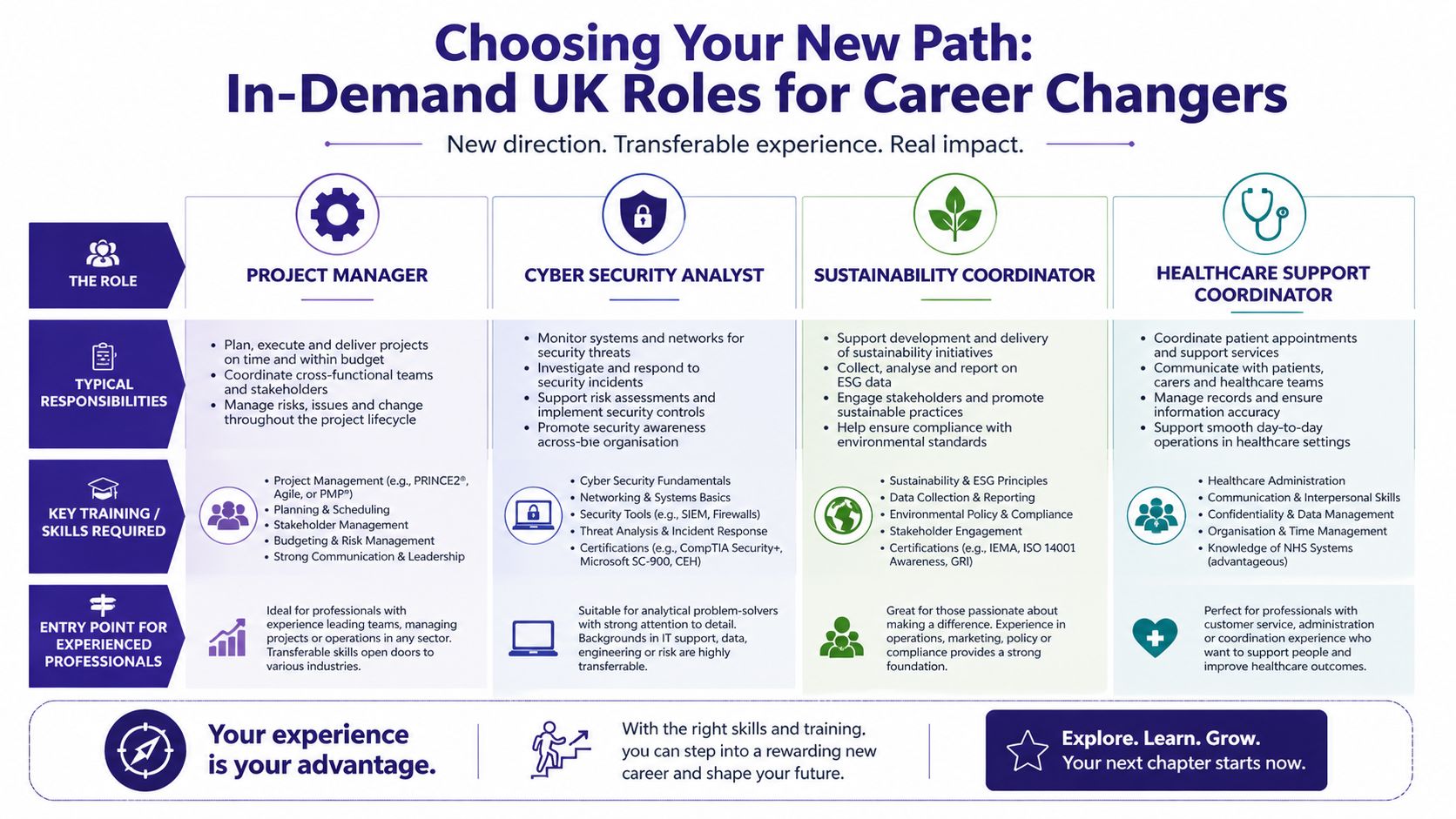
UK Career Path Comparison for Career Changers
| Career Path | Core Focus | Key Software | Typical Starting Salary (UK) |
|---|---|---|---|
| Bookkeeping and VAT | Recording transactions, reconciliations, VAT work | Sage, Xero, QuickBooks, Excel | Salary varies by employer, location, and prior experience |
| Advanced Payroll | Payroll processing, compliance, pensions, records | Sage Payroll, Excel | Salary varies by employer, location, and prior experience |
| Accounts Assistant | Day-to-day finance support across ledgers and month-end tasks | Sage, Xero, QuickBooks, Excel | Salary varies by employer, location, and prior experience |
| Final Accounts | Preparing and reviewing accounts work | Excel, accounting software | Salary varies by employer, location, and prior experience |
| Business Analyst | Requirements gathering, process mapping, stakeholder communication | Excel, Power BI, SQL, documentation tools | Salary varies by employer, location, and prior experience |
| Data Analyst | Reporting, dashboards, querying data, insight generation | Excel, SQL, Power BI, Python | Salary varies by employer, location, and prior experience |
Bookkeeping and VAT
Bookkeeping is often the cleanest entry point into finance for someone changing career at 40. The work is practical. It has a visible output. You can learn the systems, understand the rhythm of the month, and build confidence quickly.
Typical responsibilities include:
- Recording transactions accurately and consistently
- Reconciling bank accounts and checking ledgers
- Processing invoices and maintaining purchase and sales records
- Supporting VAT work and keeping audit-ready records
- Using accounting software such as Sage, Xero, and QuickBooks
This route suits people who like method, routine, and tidy records. It also works well for career changers coming from admin, operations, retail, or small business backgrounds.
Advanced payroll
Payroll is a specialist track. It can be a very smart choice for people who are careful, discreet, and comfortable with deadlines. One mistake affects real people’s pay, so employers value reliability.
The day-to-day work often includes processing pay runs, checking deductions, handling starters and leavers, maintaining records, and dealing with payroll queries. If you’ve ever managed schedules, confidential data, or compliance-heavy admin, payroll may feel more familiar than you expect.
Payroll can also be a strong fit if you want a defined niche rather than a broad finance role.
What works: choosing payroll if you like rules, consistency, and responsibility.
What doesn’t: choosing it because you think it’s “just admin”. Good payroll staff need precision and calm under pressure.
Accounts assistant and final accounts
Accounts assistant roles give you range. You may touch purchase ledger, sales ledger, bank reconciliations, expenses, month-end support, and reporting. For many career changers, this is the best all-round launchpad into finance.
Final accounts training becomes useful when you want to move beyond processing and understand how financial records come together into formal accounts work. It can open progression into broader accounting responsibilities.
Good candidates for this route often enjoy:
- seeing how the whole finance function connects
- understanding the story behind the figures
- building from transaction-level work into reporting and accounts preparation
Business analyst
Business analysis attracts professionals who are good with people and process. If you naturally ask, “Why do we do it like this?” you may already think like an analyst.
The role usually involves gathering requirements, clarifying business problems, mapping current processes, supporting change projects, and helping teams define workable solutions. Strong business analysts often come from operations, customer service leadership, project support, logistics, education, or office management because they already understand messy real-world workflows.
Useful skills include:
- clear written communication
- meeting facilitation
- process mapping
- structured thinking
- confidence with Excel and reporting tools
Data analyst
Data analysis is often attractive to career changers because it blends logic with practical decision-making. You don’t need to be a mathematician. You do need to be curious, organised, and willing to learn tools properly.
Common tools include Excel, SQL, Power BI, and sometimes Python. Your job is to turn raw data into something a business can use. That might mean cleaning data, writing queries, building dashboards, checking trends, or answering commercial questions.
If you’re exploring this route, this guide on landing a data analyst job without prior experience gives a practical view of how beginners can build credibility.
Choosing the right route for your ROI
When people talk about return on investment, they often focus only on salary. That’s too narrow. Good training ROI also includes:
- Speed to employability
- Clarity of job target
- Fit with your existing strengths
- Cost of the transition period
- Long-term progression
If you need the shortest practical bridge into work, bookkeeping, payroll, or accounts assistant routes often make sense. If you can invest more time in building a portfolio and technical fluency, business analysis or data analysis may offer broader options.
A good decision rule is simple. Pick the path where your past experience gives you a believable head start. Then train specifically for the tools employers actually ask for.
If you want a deeper look at retraining routes, this page on retraining after 40 is worth reading.
Building Your New Professional Identity on CV and LinkedIn
Once you’ve chosen a direction, your next job is packaging. Not spinning. Packaging.
Recruiters don’t have time to decode a career change for you. Your CV and LinkedIn profile have to do that work fast. They should show three things clearly: what you’ve done, why it matters in the new field, and what recent training proves your commitment.

For analyst routes especially, fresh, certified skills matter. UK-specific data shows that 68% of career changers aged 40+ into data analytics and business analysis reach equal or higher salaries within 18 months, and certified candidates outperform non-certified peers with a 71% success rate versus 45%, according to UK data on career change outcomes in analytics and business analysis.
Rewrite the CV summary first
Most career changers bury the lead. Their CV opens with a title from the old world, then spends half a page proving they belong in the old world.
Change that.
A better profile is short, direct, and aimed at the new role. For example:
Before
Experienced retail professional with many years in customer-facing roles seeking a new opportunity.
After
Detail-focused operations professional retraining for accounts assistant roles, with hands-on experience in reporting, cash handling, reconciliation support, and process accuracy. Recently completed practical training in Sage, Xero, QuickBooks, and Excel.
Another example for analytics:
Before
Project coordinator looking to move into data.
After
Process-driven project support professional transitioning into data analyst roles, combining stakeholder management and reporting experience with recent practical training in Excel, SQL, and Power BI.
Change the order of evidence
A chronological CV alone can work against you if it hides relevant training. Put the most persuasive evidence near the top.
A useful structure is:
- Targeted profile
- Key skills
- Relevant training and software
- Selected achievements from past roles
- Career history
- Education and additional information
This approach helps employers see your pivot as intentional rather than confused.
Build a LinkedIn profile that speaks plainly
LinkedIn often matters more than career changers realise because it gives recruiters context that a CV can’t always show. Your profile should be consistent with your target role, not split between old identity and new ambition.
Useful upgrades include:
-
Headline
Use a destination-led line such as “Accounts Assistant Trainee with Sage, Xero and Excel training” or “Aspiring Data Analyst with Excel, SQL and Power BI training”. -
About section
Explain the transition in a few lines. Focus on transferable strengths, recent training, and the type of role you’re pursuing. -
Featured section
Add dashboards, spreadsheet projects, portfolio work, or training certificates where appropriate. -
Experience section
Rewrite older jobs to surface relevant tasks such as reporting, reconciliation, process improvement, coordination, or stakeholder communication.
If you want a clear checklist, this guide on how to optimize LinkedIn profile covers the fundamentals well.
A quick video can also help if you’re overhauling your profile and CV together:
What to say about the career change
You do not need a dramatic personal story. You need a coherent professional reason.
Try this framework:
-
Past
“My background has been in operations and client support, where I developed strong skills in reporting, process control, and stakeholder communication.” -
Pivot
“Over time I realised the parts of the work I enjoyed most were the analytical and systems-focused elements.” -
Present
“I’ve now completed focused training in the tools used in this field and I’m looking for a role where I can apply both my prior experience and my new technical skills.”
Keep your explanation calm and matter-of-fact. A career change at 40 sounds strongest when it sounds considered.
Networking that actually helps
Sending connection requests without context doesn’t help much. Better networking is smaller and more specific.
Try these:
-
Ask for role insight, not a job
Message a payroll officer, accounts assistant, BA, or data analyst and ask what their day usually involves. -
Comment like a peer-in-training
Share a short takeaway from a bookkeeping exercise or a Power BI dashboard you built. -
Follow recruiters in your chosen niche
Niche recruiters often reveal what software and experience employers are asking for right now. -
Reconnect with old colleagues
Former contacts can be useful because they already know your work ethic.
Securing Your New Role Interview Strategy and Your First 90 Days
The interview stage is where many capable career changers hesitate. They assume they need to hide their age, soften their background, or apologise for not following a straight line.
That usually weakens the application.

However, the situation is more nuanced. Workers over 40 often bring strong productivity and maturity, but they can also face discrimination in hiring. UK career changers need practical responses to that risk, including understanding protections under the Equality Act 2010 and presenting the move as a strategic evolution, as discussed in this guide to career change after 40 and age bias in UK hiring.
Deal with age bias directly but professionally
You don’t need to mention age bias in every interview. You do need to remove easy excuses for employers to dismiss you.
That means:
- Show recent learning so nobody can assume your skills are outdated
- Use current software names such as Sage, Xero, QuickBooks, Excel, SQL, or Power BI naturally
- Signal adaptability with examples of learning systems, handling change, or improving processes
- Keep your language current and avoid talking as if your best work is behind you
Don’t try to appear younger. Present yourself as current, capable, and ready.
A mid-career pivot sounds strongest when you frame it as a decision, not a crisis.
Use STAR answers with a career changer twist
The STAR method works well because it keeps answers grounded.
For “Why are you changing career?”
A strong answer might sound like this:
Situation
In my previous roles, I consistently found myself drawn to the reporting, process, and analytical side of the work.
Task
I wanted to move into a role where those strengths were central rather than occasional.
Action
I took targeted training in the relevant software and started applying those skills through practical exercises and portfolio work.
Result
I’m now making a deliberate move into this field with both transferable experience and up-to-date technical training.
For “You don’t have direct experience. Why should we hire you?”
Focus on judgement plus readiness.
Talk about handling deadlines, resolving issues, training others, managing sensitive information, or producing accurate work under pressure. Then connect that to the target role.
For “How will you adapt to a junior position?”
Be honest. Many career changers do need to accept a title reset, at least initially. The strongest answer is usually that you understand the difference between seniority and value. You may enter at a lower title, but you’ll contribute maturity, reliability, and faster judgement from day one.
Budgeting for the transition
Generic advice often fails in this situation. A career change at 40 affects real bills, not just LinkedIn updates.
Be realistic about:
- Training costs
- Possible income disruption
- A lower title on entry
- Time needed for study, applications, and interviews
Some people can move while staying employed. That’s often the least risky route. Others may need more flexibility, especially if they’re retraining intensely or managing health needs alongside work. If neurodiversity support would help during employment, this guide to ADHD Access to Work grants is a useful UK resource.
Your first 90 days in the new role
Getting hired is only half the transition. The first three months matter because that’s when employers decide whether you’re trainable, dependable, and worth backing.
A practical first-90-days approach looks like this:
| Period | Focus |
|---|---|
| First month | Learn the systems, note recurring tasks, ask sensible questions, and avoid pretending you understand what you don’t |
| Second month | Take ownership of repeatable work, improve speed without losing accuracy, and build trust with colleagues |
| Third month | Spot small process improvements, tighten your workflow, and show that your past experience helps the team |
A few habits help a lot:
- Keep a learning log of systems, shortcuts, and common errors
- Ask for feedback early rather than waiting for formal review
- Protect accuracy first because speed comes later
- Notice team dynamics before trying to “fix” everything
Your job in the first 90 days isn’t to prove you know everything. It’s to prove you learn quickly, deliver reliably, and improve steadily.
Frequently Asked Questions About Changing Career at 40
Should I accept a pay cut to change career at 40
Sometimes yes. Sometimes no.
A temporary drop can be sensible if the new role gives you a clearer route into a stronger field, better long-term progression, or work that fits your life better. It’s a poor decision if you haven’t calculated the effect on your household budget or if the role doesn’t lead anywhere meaningful.
The better question is whether the short-term sacrifice buys you something concrete. That might be recognised software experience, access to a finance team, analyst exposure, or a pathway into broader responsibilities.
Is contract work better than a permanent role for a career changer
It depends on your situation.
Contract work can help if you need fast exposure, want to build recent experience, or are confident selling yourself quickly. It can also be useful if you’re moving into project-based analysis work or short-term finance support.
Permanent roles usually suit career changers who want structured onboarding, a steadier income, and space to grow into a new profession. If you’re entering bookkeeping, payroll, accounts assistant, or final accounts work for the first time, a permanent role often gives you a firmer base.
Do I need a degree to change career into finance or data
Not always.
For many practical UK roles, employers care more about whether you can do the work than whether you followed a traditional academic route. In finance, software knowledge and practical accuracy can matter a lot. In analyst roles, employers often want proof that you can work with data, explain findings clearly, and use tools such as Excel, SQL, or Power BI.
A degree can help in some contexts, but targeted professional training is often the more direct route for mid-career changers. The strongest applications usually combine relevant training with evidence from previous work that already shows discipline, communication, and sound judgement.
If you’re ready to change career at 40 and want structured support in bookkeeping, VAT, advanced payroll, accounts assistant work, final accounts, business analysis, or data analysis, Professional Careers Training offers practical training built for real career changers. Their programmes focus on job-ready software, flexible study options, and the kind of recruitment support that helps turn learning into employment.