

You might be in one of these positions right now. You’re a bookkeeping assistant who fixes the same invoice errors every month. You’re an accounts...
You’re in a finance or data role. Then one day a manager asks you to help with waste reporting, energy use, supplier compliance, or an ESG spreadsheet that no one fully understands. You weren’t hired as an environmental specialist, but the task still lands on your desk.
That’s becoming normal.
An accounts assistant may need to code environmental charges correctly. A payroll professional may support travel and mileage data for internal reporting. A business analyst may be asked to map a process that creates avoidable waste. A data analyst may need to clean sustainability data before it goes into a board report. In each case, the technical job stays the same, but the business context changes.
That shift matters for your career. Employers increasingly value people who can connect operational data, compliance, and commercial decision-making. If you already work with numbers, systems, controls, and evidence, you’re closer to environmental work than you might think. Many of the top financial analyst skills needed now overlap with environmental reporting and process improvement, especially when businesses want staff who can explain risk in plain English.
Introduction Why Environmental Skills Matter for Finance and Data Roles
Environmental work often sounds technical and distant, but in most businesses it shows up as ordinary operational pressure. Costs rise because of waste. A tender asks for environmental evidence. A client wants cleaner reporting. A regulator expects records to be complete and defensible. Someone has to organise the information behind those demands.
For finance teams, that usually means tracking costs, checking controls, and explaining variances. For analysts, it means finding patterns, validating data, and helping teams improve performance. Environmental knowledge strengthens those tasks because it gives you the language to describe what the numbers mean in a practical context.
Where readers often get stuck
A common misunderstanding is this. People assume environmental qualifications are only for site managers, safety officers, or engineers. That’s too narrow.
If you work in bookkeeping and VAT, advanced payroll, accounts assistant work, final accounts, business analysis, or data analysis, you already deal with records, compliance, workflows, and decision support. The nebosh environmental certificate adds a framework for handling environmental risk and responsibility inside those same business processes.
Environmental competence isn't separate from business competence anymore. In many organisations, they now sit in the same workflow.
Think about a few everyday examples:
- Bookkeeping and VAT: You may need to separate environmental costs, support audit trails, or help the business understand where waste-related spending sits.
- Advanced payroll: You might support travel, mileage, benefits, and workforce data that feeds wider reporting.
- Accounts assistant work: You often see supplier invoices, disposal costs, utilities, and stock issues before anyone else spots a trend.
- Business analysis: You map how work gets done, where delays happen, and where material or energy use could be reduced.
- Data analysis: You turn messy operational records into dashboards that managers can act on.
That’s why environmental training can become a smart career move, even if your current title doesn’t mention sustainability.
What Exactly Is the NEBOSH Environmental Certificate
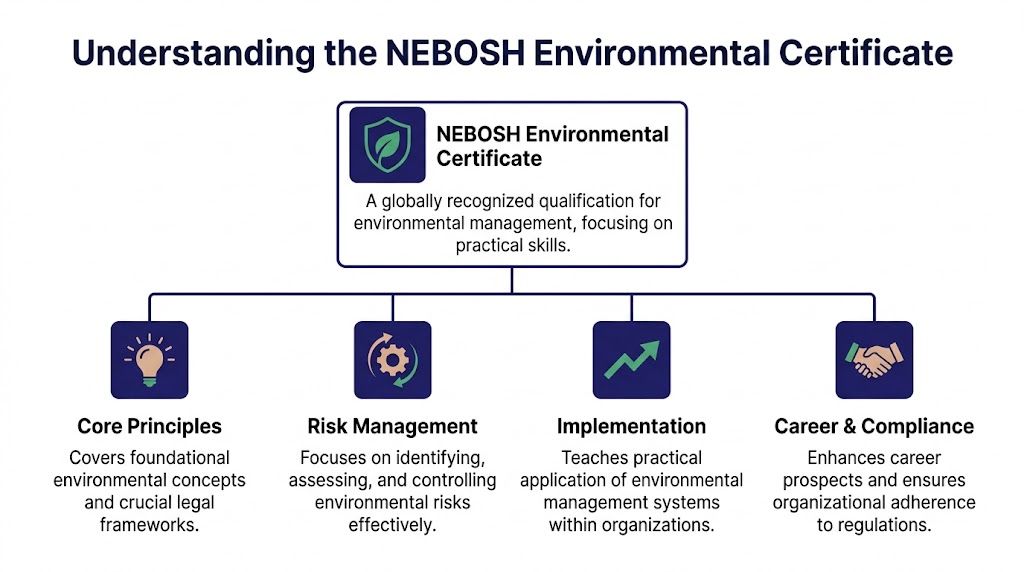
The nebosh environmental certificate is a practical environmental management qualification. The easiest way to think about it is this. It’s like a business-focused first aid course for environmental issues. It doesn’t turn you into an environmental scientist, but it does teach you how to spot problems, assess risk, support compliance, and recommend sensible action.
What it gives you in practice
This qualification is designed for people who need usable workplace knowledge. It helps you understand how environmental management systems work, how environmental impacts arise from normal operations, and how businesses can control those impacts in a structured way.
That’s useful if you’re the person who has to ask questions like:
- Where is the business exposed to environmental risk?
- Which activities create waste, emissions, or inefficiency?
- How should those issues be recorded and reviewed?
- What evidence would management need before changing a process?
What it is not
It’s not a deep academic course in environmental science. You won’t need to become a chemist or policy specialist. The focus is on workplace management, legal awareness, practical review, and continuous improvement.
That matters for finance and data professionals because your value often comes from interpretation rather than specialism. You don’t need to become the in-house environmental expert on every issue. You need to understand enough to contribute confidently, challenge weak reporting, and support better decisions.
Why people in adjacent sectors look at it
This qualification also makes sense if you want to move closer to regulated or infrastructure-heavy sectors. For example, people exploring environmental routes linked to utilities often compare qualifications and role requirements with wider industry pathways such as these essential credentials for water careers. That kind of comparison helps you judge where NEBOSH fits if you’re planning a more specialised move later.
A strong point in the certificate’s favour is its structure. It’s accredited at SCQF Level 6 with 6 credit points by Qualifications Scotland, and the total learning time is approximately 67 hours, made up of 34 taught hours, 25 hours private study, and 8 hours assessments according to this course overview.
Practical rule: If you want a qualification that helps you work with environmental issues without leaving your core finance or analysis background behind, this sits in a useful middle ground.
Who Should Pursue This Environmental Qualification
Some qualifications only make sense if you plan a full career change. This one has a wider reach. The nebosh environmental certificate works well for people who want to deepen their existing role and for people who want a route into something new.
A major reason is employer recognition. A 2025 analysis of 117 UK health and safety job listings found that over 85% explicitly referenced NEBOSH qualifications, according to the NEBOSH Jobs Barometer findings. That doesn’t mean every finance or analyst job will ask for it. It does mean the brand carries weight in roles where compliance, risk, operations, and environmental responsibility overlap.
For accountants and bookkeepers
If you work in accounts, you already know that business decisions rarely sit neatly in one department. Environmental issues often appear first as invoices, cost centres, provisions, supplier questions, or reporting adjustments.
You might benefit from this qualification if you want to:
- Interpret environmental costs better: Waste disposal, utilities, compliance activity, and remediation costs all need clearer business context.
- Support stronger reporting: Environmental issues often sit behind provisions, notes, explanations, and management commentary.
- Add value beyond processing: Employers notice when a finance professional can explain why a cost is rising, not just that it has risen.
For someone in bookkeeping and VAT or final accounts, that can become a clear differentiator.
For payroll professionals
Payroll specialists don’t usually think of environmental qualifications first. But payroll sits close to workforce data, travel records, benefits, hybrid working patterns, and policy implementation. Those areas often feed wider business reporting.
If your role is evolving, environmental literacy can help you speak more confidently with HR, finance, and operations teams. It can also strengthen your profile when you’re moving into broader business support or compliance roles.
For business analysts
Business analysts are often a strong fit because the logic is familiar. You review processes, identify waste, document controls, and recommend change. Environmental management uses the same discipline, just with environmental aspects and impacts added to the picture.
A business analyst with this qualification can contribute to:
- process redesign
- risk reviews
- policy implementation
- supplier and workflow assessments
- operational improvement projects
For data analysts
Data analysts already work with evidence, inconsistencies, and reporting quality. Environmental reporting depends on exactly those skills. The challenge is usually not the spreadsheet itself. The challenge is understanding what should be measured, what counts as material, and where the risks sit if the data is weak.
That’s where the qualification helps. It gives your analysis more context.
If you can clean a dataset, trace a variance, and explain a pattern, you already have part of the mindset needed for environmental management.
For graduates and career changers
If you’re early in your career, the qualification can help you stand out in a crowded market. If you’re changing direction, it can provide a credible bridge between your previous experience and a new type of role.
That’s especially valuable for people with backgrounds in:
- Accounts assistant work: strong controls and record handling
- Final accounts preparation: disciplined reporting and evidence
- Business analysis: process logic and change support
- Data analysis: structured interpretation and dashboard thinking
Deconstructing the Syllabus and Key Learning Outcomes
The strongest part of the nebosh environmental certificate is that the syllabus isn’t abstract. It’s built around workplace application. The course focuses heavily on Environmental Management Systems aligned with ISO 14001:2015 and teaches learners to manage issues governed by UK rules such as the Waste (England and Wales) Regulations 2011. The syllabus guide also notes skills that have been shown to improve a company’s EMS audit scores by an average of 25% in the supporting material from the NEBOSH learner guide.

Environmental management systems in business terms
An Environmental Management System, or EMS, can sound intimidating. In plain language, it’s a structured way for a business to control environmental effects instead of dealing with problems only after they happen.
For a finance or data professional, an EMS is familiar territory. It’s a control framework. It helps an organisation define responsibilities, record evidence, review performance, and improve over time.
Here’s a simple comparison:
| Business function | Similar EMS idea |
|---|---|
| Month-end controls | Scheduled environmental checks |
| Variance analysis | Reviewing environmental performance gaps |
| Audit evidence | Compliance records and documented actions |
| Process improvement | Corrective and preventive environmental action |
Aspects and impacts
This is one area where learners often pause. An aspect is an activity that interacts with the environment. An impact is the effect that follows.
For example:
- electricity use is an aspect
- wasted energy is an impact
- poor waste segregation is an aspect
- increased disposal risk or inefficiency is an impact
That distinction matters because it trains you to look beyond symptoms. Analysts often do this well. You don’t stop at “costs are high”. You ask what process is driving that outcome.
Waste, pollution, and energy use
The syllabus also covers practical topics businesses deal with every day, including waste management, pollution control, and energy efficiency. That’s where the qualification becomes commercially useful.
A finance professional may connect these themes to spend, overheads, and procurement. A business analyst may link them to workflow design. A data analyst may connect them to trend reporting and performance review.
Good environmental management often starts with the same question good analysts ask. What is actually happening in the process?
Legal awareness without legal overload
Another strength of the syllabus is that it introduces legal and regulatory expectations in a way working professionals can use. You’re not expected to become a solicitor. You are expected to recognise when activities may be subject to environmental controls and when weak processes create risk.
That’s especially relevant in businesses with:
- manufacturing or warehousing
- transport and logistics
- facilities-heavy offices
- waste contractors
- regulated suppliers
For readers who want broader policy context around environmental priorities beyond the workplace, this summary of G7 ocean conservation efforts is a useful example of how environmental action is discussed at international level. It helps put day-to-day business controls into a wider policy frame.
Why this matters for finance and analyst careers
The course content maps surprisingly well to commercial roles. You learn how to identify risk, justify action, and support continual improvement. Those are not niche abilities. They are business abilities.
A person working in final accounts may become better at spotting environmental exposures behind numbers. A business analyst may become stronger at process redesign. A data analyst may build more credible reporting because they understand what operational issues sit underneath the data.
Navigating the NEBOSH Exam Format and Assessment
The assessment format worries many learners more than the subject itself. That’s understandable, especially if you’ve been out of formal study for a while. The good news is that the nebosh environmental certificate is designed to test practical competence rather than memory alone.
The two-part structure
The qualification has two units.
Unit EMC1 is a scenario-based open book exam. It takes place within a 24-hour window and has a provisional pass mark of 45%, with further grading bands for credit and distinction set out in the official NEBOSH unit information.
Unit EMC2 is a practical workplace review. You need a Pass in both units within five years to achieve the qualification, which sits at SCQF Level 6 and is described in the same NEBOSH source as enabling holders to conduct ISO 14001-aligned risk assessments.
Why the open book format suits working professionals
Open book doesn’t mean easy. It means realistic.
In most professional jobs, no one expects you to solve a problem from memory with no documents, no policy, and no notes. They expect you to find the right information, apply it properly, and explain your reasoning. That’s exactly the kind of judgement this assessment format supports.
For accountants, that mirrors how you use standards, schedules, and evidence. For analysts, it mirrors how you use source material, assumptions, and logic.
The exam rewards application. It doesn't reward copying notes without understanding them.
What the practical review involves
EMC2 tends to feel more approachable once learners realise it’s grounded in a real workplace or a realistic setting. You review environmental aspects and impacts, evaluate controls, and justify actions.
That makes the course feel relevant very quickly.
A candidate working in an office might look at paper use, energy use, waste streams, and contractor controls. Someone in warehousing might review packaging, fuel use, storage, and emergency planning. Someone from a finance background can still do well because the task is about structured observation and sound reasoning.
A simple way to prepare
A calm preparation approach usually works best:
- Read the scenario carefully: Most lost marks come from weak interpretation, not weak effort.
- Link answers to practical business activity: Keep bringing your points back to what the organisation does.
- Use evidence and logic: Don’t write vaguely when you can explain cause and effect.
- Practise concise writing: Strong professional answers are clear, not overlong.
If you already write reports, document findings, or explain issues to managers, you’re not starting from zero.
Your Career and Salary Impact with the NEBOSH Certificate
The primary concern isn’t whether the qualification is interesting. It’s whether it improves career options in a practical way. For finance, accounting, and data professionals, the answer is often yes, because it adds a second layer of commercial relevance.

Roles it can support
The qualification can help open doors to roles such as Environmental Officer and can also support progression towards the NEBOSH National Diploma in Environmental Management, according to the University of Hull course page.
That same source notes typical UK starting salaries in environmental roles in the £22,000 to £28,000 range. Salary data specifically tied to certificate holders is still emerging, so it’s best to treat that as directional context rather than a guaranteed outcome.
How it strengthens existing career tracks
The value isn’t only in moving into a new job title. It can also sharpen your current path.
For example:
- Accounts assistant to broader compliance support: You may become the person who understands cost records and environmental implications together.
- Bookkeeper or finance officer to ESG-aware finance role: You can contribute more confidently to internal reporting and management queries.
- Business analyst to sustainability-focused improvement work: You can support projects tied to efficiency, waste reduction, and operational control.
- Data analyst to environmental reporting specialist: You can move from producing dashboards to shaping what the dashboard should measure.
Hybrid roles often become the most resilient. Employers don't always want a narrow specialist. They often want someone who can connect finance, process, risk, and reporting.
Salary conversations need strategy
A qualification by itself doesn’t force a pay rise. You still need to frame your value well. If you’re moving roles or negotiating after training, it helps to present your skills in business terms, not just qualification terms. This guide on how to negotiate salary in a job offer is useful if you want to position new environmental knowledge alongside your existing technical experience.
Employers usually pay more readily for applied value than for theory alone.
Where the qualification can make the biggest difference
It often has the most impact when paired with an existing strength.
| Your current strength | What the certificate adds |
|---|---|
| Financial control | Better understanding of environmental cost and compliance issues |
| Excel, SQL, Power BI, reporting | Better judgement about environmental data quality and meaning |
| Process mapping | Better ability to identify environmentally risky activities |
| Audit support | Better awareness of evidence, controls, and corrective action |
A short explanation often helps here. If you’re already skilled in payroll, final accounts, business analysis, or data analysis, the qualification doesn’t replace that. It makes your existing skill set more useful in organisations dealing with sustainability pressure, client scrutiny, and regulatory expectations.
Here’s a helpful overview if you want to hear more about career possibilities in environmental work:
Progression can be lateral before it becomes vertical
Not every career gain shows up as an immediate promotion. Sometimes the first benefit is lateral movement into better projects, stronger responsibilities, or more visible work.
That can still be a strong return. A business analyst who starts supporting environmental process work may become more valuable to operations leadership. A data analyst who becomes trusted on ESG reporting may gain board-facing exposure. An accountant who understands environmental risk may become more useful in advisory, reporting, or governance-focused roles.
How to Choose the Right Training Provider for You
Choosing a provider matters almost as much as choosing the qualification. A weak provider can leave you with notes but no confidence. A strong provider helps you turn the course into practical skill.

A common learner problem is the gap between theory and workplace use. Guidance in the market often lacks sector-specific examples or help with current UK regulatory changes, including post-2024 REACH amendments. The article at Training First Safety on choosing a NEBOSH course highlights that a good provider bridges this gap and makes the material more relevant for both SMEs and larger organisations.
What to look for first
Start with fit, not branding.
- Flexible delivery: If you work full-time, look for options that fit around evenings, weekends, or changing shifts.
- Strong tutor support: You want tutors who can explain the difference between passing an assessment and using the knowledge well at work.
- Practical examples: Ask whether the provider uses scenarios relevant to offices, finance teams, warehouses, services, and operations.
- Clear assessment guidance: You should know how EMC1 and EMC2 work before the course starts, not after.
Questions worth asking before you enrol
Different providers sound similar on a website, so it helps to ask direct questions.
| Question | Why it matters |
|---|---|
| Can I study around work? | Flexibility affects completion and stress |
| Will I get feedback on application, not just theory? | This determines workplace confidence |
| Are examples relevant to non-engineering roles? | Finance and analyst learners need contextual teaching |
| Is support available if I’ve been out of study for years? | Many career changers need structured guidance |
Don’t ignore career context
If you’re changing career or broadening your profile, think beyond the syllabus. You may also benefit from understanding how green work develops in other markets and sectors. This article on exploring green jobs in Canada is useful for perspective, especially if you’re comparing transferable skills and international career themes.
Match the provider to your long-term goals
Your best provider depends on what you want the qualification to do.
If your aim is internal progression, choose a provider that helps you apply learning to your current workplace. If your aim is a career pivot, choose one that explains role pathways clearly. If you’re already in finance or data and want to add environmental knowledge without losing your core identity, look for teaching that respects your existing skill set.
A final checkpoint helps. Before you commit, compare the provider against your wider learning plan using this guide on how to choose the right training course for your career goals. It’s a sensible way to avoid choosing a course that sounds good but doesn’t move your career forward.
Choose the provider that helps you use the qualification, not just pass it.
Conclusion Your Next Step Towards a Sustainable Career
Environmental knowledge is no longer a niche extra for a small specialist team. It now touches finance, reporting, process improvement, procurement, operations, and data work across the business. If you already work with numbers, systems, controls, or analysis, you’re in a strong position to build on that foundation.
The nebosh environmental certificate stands out because it’s practical, recognised, and closely linked to real workplace activity. It helps you understand environmental risk in business terms, contribute to compliance and improvement work, and strengthen your value in roles that increasingly mix financial, operational, and sustainability responsibilities.
For accountants, bookkeepers, payroll professionals, accounts assistants, business analysts, and data analysts, that can create two advantages at once. It can open new career routes and make your current skill set more valuable.
If you’ve been looking for a qualification that adds substance to your CV without pulling you away from your existing strengths, this is a strong option to consider next.
If you want practical, job-focused support for building your career in finance, accounting, business analysis, or data, Professional Careers Training offers flexible training, 1-to-1 support, software learning, and career coaching designed to improve employability. Explore the available courses and choose the path that fits your next move.