

You might be in one of these positions right now. You’re a bookkeeping assistant who fixes the same invoice errors every month. You’re an accounts...
You might be in one of these positions right now.
You’re a bookkeeping assistant who fixes the same invoice errors every month. You’re an accounts assistant who knows the month-end process is clunky but can’t prove where the delay starts. You’re a business analyst who gathers requirements well, yet struggles to push process changes through because stakeholders want harder evidence. Or you’re a data analyst who builds solid reports in Excel or Power BI, but still gets pulled back into firefighting bad data.
That’s where six sigma green belt courses become useful. Not as another line on your CV. As a way to move from “the person who does the work” to “the person who improves how the work gets done”.
For UK finance and analysis roles, that distinction matters. Employers don’t just want people who can reconcile, report, process payroll, or build dashboards. They want people who can reduce errors, tighten controls, improve turnaround times, and explain changes with data.
Moving Beyond Spreadsheets to Strategic Influence
You’re closing the month end, fixing the same coding errors again, and wondering why nobody asks for your view on improving the process. That usually has nothing to do with effort. It comes down to evidence.
Early-career finance and analysis professionals often become known as dependable operators. They learn Sage, Xero, QuickBooks, Excel, VAT rules, payroll workflows, reconciliations, journals, and reporting routines. That gets trust. It rarely gets influence on how the work should change.
A Green Belt gives you a method that managers recognise. You stop sounding like someone with a reasonable opinion and start sounding like someone who can define a problem, measure it properly, test causes, improve the process, and keep the fix in place. In UK accounting, bookkeeping, business analysis, and data analysis roles, that shift changes how people use you.

What strategic influence looks like in practice
Take a payroll team under deadline pressure. Errors keep appearing near submission day. Queries pile up. Amendments bounce between HR, payroll, and line managers. A solid payroll administrator works hard to keep up. A Green Belt-trained professional maps the handoffs, measures where delays begin, separates one-off mistakes from repeat failure points, and puts controls in place for the next cycle.
The same approach works across finance and analysis work:
- Bookkeeping: find why duplicate invoices or coding errors keep returning
- Accounts support: reduce month-end bottlenecks and approval delays
- VAT and compliance work: tighten controls and cut rework before review
- Business analysis: back change recommendations with process evidence
- Data analysis: trace bad inputs, inconsistent fields, and reporting failures to the source
That is the real jump. You go from reporting problems to proving what should change.
If you want a clearer view of how employers value this skill set, review the roles and benefits outlined in this guide to Six Sigma-trained professionals in the UK job market.
Why this matters in UK finance and analysis jobs
UK employers increasingly want hybrid capability. They still need people who can process transactions, reconcile accounts, support audits, and build reports. They also want people who can improve the process behind those outputs.
That is especially true in jobs that sit between finance, systems, and reporting. A bookkeeping assistant who can reduce repeat errors is more useful than one who just clears them. An accounts assistant who can show why month-end stalls has a stronger case for promotion. A business analyst who uses DMAIC well can push change through faster because the case is grounded in facts, not opinion. A data analyst who pairs process improvement with Power BI becomes far more credible in operations-focused teams.
Recruiters have made that shift clear in UK analysis hiring. The demand is not just for technical reporting. It is for people who can investigate causes, improve workflows, and explain recommendations clearly. If you are working on developing analytical skills for MDB roles, Six Sigma gives that skill set a practical structure employers can recognise.
My advice is simple. If your work involves repeat transactions, recurring delays, audit pressure, broken handoffs, or unreliable data, six sigma green belt courses are worth serious attention. They help you get beyond spreadsheet output and into the conversations about how the business should run.
What a Green Belt Means for Your Finance and Data Career
The easiest way to understand a Green Belt is this. It’s a business detective’s toolkit.
You already notice symptoms in your work. A bookkeeping team sees duplicate invoices. A payroll officer sees recurring corrections. An accounts assistant spots late approvals. A business analyst hears complaints about slow onboarding. A data analyst sees inconsistent fields breaking reports.
A Green Belt helps you move past the symptom and find the cause.
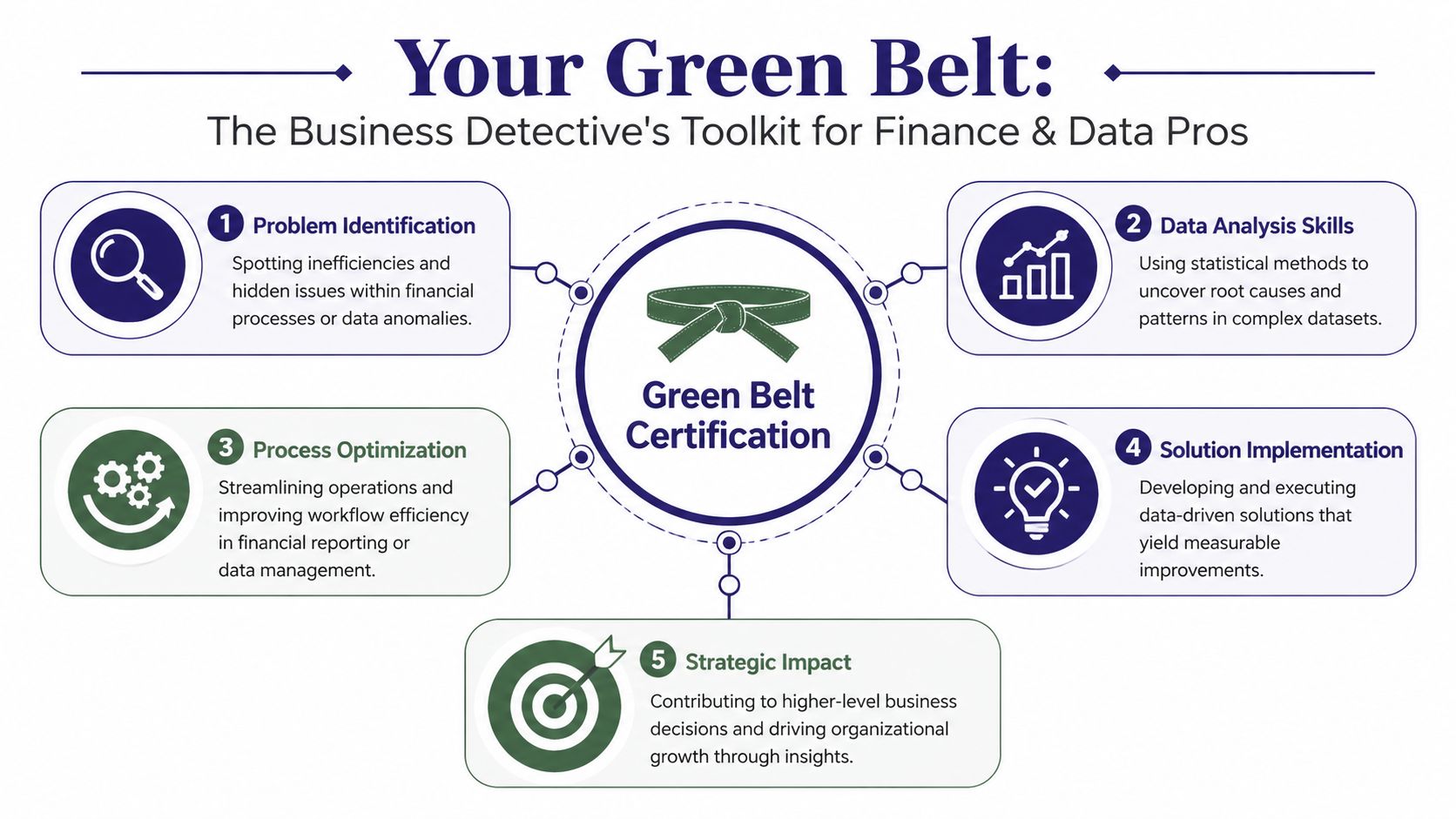
The shift from operator to improver
Without Green Belt training, many people solve problems by instinct. They patch things. They chase the team for missing information. They add another manual check. Sometimes that works. Often it just creates more admin.
Green Belt training gives you a proper framework.
- You define the problem clearly
- You measure what’s really happening
- You analyse the likely causes
- You improve the process
- You control it so the issue doesn’t come back
That matters in finance because finance teams live with repeatable processes. Invoice processing. VAT coding. payroll approvals. Expense claims. Purchase ledger controls. Month-end close. Fixed asset updates. Accruals and prepayments. Reporting packs. Reconciliation cycles. If a process repeats, it can be improved.
How the method fits specific job paths
In bookkeeping and VAT, a Green Belt helps you reduce posting errors, improve supplier invoice flow, and build cleaner approval routes. If you’ve ever had to fix the same coding issue over and over, you already know why this matters.
In advanced payroll, the value is even clearer. Payroll mistakes damage trust fast. Green Belt tools help you trace input errors, handoff failures, and inconsistent checks before they hit employees.
For an accounts assistant, this can be the credential that shifts you towards process analyst, finance operations, or management accounts support. You stop being seen only as the person who reconciles. You become the person who helps the team reconcile faster and more accurately.
For final accounts work, Green Belt thinking strengthens variance analysis, review workflows, and audit-readiness processes. It pushes you to ask where bottlenecks and quality failures sit.
For business analysts, it gives you more than stakeholder workshops and process maps. It gives you evidence. If you want a useful companion resource for thinking more sharply in analyst-style roles, this guide on developing analytical skills for MDB roles is worth reading because the core discipline overlaps strongly with problem definition, structured reasoning, and evidence-based decisions.
For data analysts, Six Sigma adds operational context to your technical skills. You’re not only reporting what happened. You’re helping the business reduce the causes of bad outcomes.
Why employers pay attention
UK professionals with Six Sigma Green Belt certification command average salaries between £70,000 and £90,000, representing a 20% to 30% premium over non-certified peers in similar roles, based on UK-adjusted Six Sigma salary benchmarks.
That salary figure doesn’t mean every new Green Belt walks straight into that pay band. It does mean employers place real value on the skillset when the certification is paired with practical experience.
The strongest candidates don’t just say they can improve a process. They can explain the baseline, the root cause, the fix, and the control plan.
If you’re trying to understand how Six Sigma-trained professionals are positioned in career terms, this overview of Six Sigma trained roles and employability gives useful context.
What you actually gain
A good Green Belt course should leave you able to:
- Diagnose process problems in finance and reporting workflows
- Use data properly rather than relying on opinion
- Run small improvement projects with clear business value
- Communicate findings to managers in plain English
- Support promotions into analyst, senior operations, or improvement-focused roles
That is the core value. Not jargon. Better judgment, stronger credibility, and more career options.
Inside a Typical Green Belt Course Syllabus
Most solid six sigma green belt courses are built around DMAIC. That stands for Define, Measure, Analyse, Improve, and Control. It sounds technical at first, but the logic is straightforward. You identify a process problem, prove what’s happening, fix the cause, and stop the issue returning.
Define the problem properly
The Define phase stops you from solving the wrong problem.
Say you’re a business analyst working on slow client onboarding in a finance firm. Everyone thinks the problem is “operations are too slow”. That’s vague and useless. In Define, you narrow the issue into something workable. Which part of onboarding is delayed. Which team owns it. What the customer impact is. What a successful outcome looks like.
In accounting roles, this could be a project charter around delayed supplier payments, recurring payroll corrections, or slow month-end reconciliations.
Useful tools often include:
- Project charters to set scope and ownership
- SIPOC maps to show suppliers, inputs, process, outputs, and customers
- Voice of the customer thinking to connect process issues to user impact
Measure what’s actually happening
Many teams get exposed. People usually have opinions. They often don’t have a baseline.
An accounts assistant might feel that purchase ledger approvals take too long. A Green Belt approach measures cycle time, rework volume, number of touchpoints, and common failure points. You need a current-state picture before you can claim improvement.
For bookkeeping, payroll, and final accounts roles, Measure might include checking how long tasks really take, where documents wait, and how often corrections happen.
If you can’t show the current state, your improvement claim won’t carry much weight with a finance manager.
A practical process modeller’s mindset helps here. This guide on modelling business processes is useful because strong process maps make bottlenecks easier to spot before you jump into solutions.
Analyse the root cause
Analyse is where Green Belt training starts to separate serious problem-solvers from busy people.
If payroll errors keep appearing, you don’t assume the payroll system is bad. You investigate. Is the source issue incomplete starter forms. Manual override mistakes. Late manager approvals. Incorrect overtime data. Confusing process ownership.
A core part of Green Belt training is statistical process control. Candidates learn to use control charts to detect special cause variation and hypothesis testing with p-values less than 0.05 to validate root causes, which are key skills for the 100-question certification exam, according to the Six Sigma Green Belt certification overview.
That sounds heavy, but in practice it means learning how to verify if a suspected cause is linked to the problem.
Common Analyse tools include:
- 5 Whys for drilling into repeated failures
- Fishbone diagrams for structured root cause thinking
- Control charts for spotting unusual variation
- Hypothesis testing for checking whether a change or factor is statistically meaningful
Improve the process without creating more mess
This phase matters because bad improvement work often adds new admin instead of removing waste.
In a VAT or bookkeeping workflow, Improve might involve standardising invoice coding rules, redesigning approval steps, cleaning up supplier master data, or introducing a simpler exception-handling route. In payroll, it might mean changing cut-off rules, simplifying handoffs, or creating a better data validation step before processing.
The best improvements are boring in the best way. They make the right action easier and the wrong action harder.
Here’s where Green Belt students often start applying tools they already know in a better structure:
- Process mapping to remove duplication
- Cause-and-effect thinking to match fixes to real issues
- Pilot changes before rolling them out fully
- Simple standardisation so teams work the same way
Control the gains
A lot of workplace “improvements” fade because nobody owns the follow-through. Control fixes that.
If your team reduces month-end reporting errors, you need a way to monitor whether the process stays stable. That might mean a control chart, a checklist, an exception log, or a dashboard in Excel or Power BI. The point is consistency.
For finance and analysis professionals, this is one of the most practical parts of the course. It teaches you how to lock in gains so managers trust your work.
What you’ll usually study in a course
A typical Green Belt syllabus for UK learners often includes:
- DMAIC methodology and project structure
- Process mapping and SIPOC
- Root cause analysis
- Basic statistics
- Control charts and variation
- Hypothesis testing
- Improvement planning
- Control plans and handover
You’re not training to become a mathematician. You’re training to become more convincing, more systematic, and more useful in real business settings.
Choosing Your UK Green Belt Training Path
You finish a month-end task in half the time, spot why invoice queries keep bouncing between teams, and build a cleaner reporting process in Power BI. That is the kind of shift a good Green Belt course should help you make. If a provider cannot connect the training to work like that, skip it.
Some six sigma green belt courses are built for generic operations roles. That is not good enough if you want jobs in bookkeeping, payroll, accounting support, business analysis, or data analysis in the UK. Choose training that shows how DMAIC applies to reconciliations, reporting errors, handoff delays, data quality checks, and process bottlenecks in finance teams.
Choose a format you will finish
Pick the learning format that matches your routine, energy, and attention span.
| Format | Typical UK Cost Range | Average Duration | Best For |
|---|---|---|---|
| Online self-paced | Varies by provider | Often around 50 hours self-paced | Busy professionals who are disciplined and need flexibility |
| Classroom | Varies by provider | Often delivered as 4 days intensive | Learners who want structure, live discussion, and direct trainer support |
| Blended | Varies by provider | A mix of scheduled sessions and self-study | Career changers who want flexibility without losing accountability |
UK providers often deliver Green Belt training either as a short intensive course or as self-paced study spread over several weeks. The exact structure varies by provider, so check the timetable before you pay.
My recommendation by career stage
If you are a recent graduate, go for blended learning. You need deadlines, tutor input, and enough flexibility to fit applications, part-time work, or other study around the course.
If you already work in accounts, payroll, or finance operations, self-paced online training can work well. Treat it like a live project with fixed study slots in your calendar.
If you are switching into business analysis or data analysis, choose classroom or blended delivery. You will need examples, feedback, and a trainer who can show how DMAIC fits requirement gathering, reporting defects, process mapping, and root cause work. This business analyst training tools and techniques guide gives a useful picture of the overlap.
Check whether the course includes digital tools
On this point, many providers fall short.
A Green Belt course aimed at the UK job market should not stop at flipcharts, fishbone diagrams, and theory slides. Employers increasingly want people who can improve a process and measure the result in the systems teams already use. For finance and analysis roles, that usually means Excel, Power BI, SQL, and accounting platforms such as Sage, Xero, or QuickBooks.
Look for training that shows you how to:
- use Excel to baseline errors, cycle times, or rework
- build Power BI dashboards to track control measures
- pull cleaner process data with SQL
- connect improvement work to finance systems and reporting workflows
- present findings clearly to managers and non-technical stakeholders
A course that treats digital tools as optional is behind the UK hiring market.
Judge the provider on substance, not branding
Ignore polished websites and vague promises. Check what the provider teaches, who teaches it, and how clearly they explain outcomes.
A strong provider usually offers:
- alignment with recognised standards such as IASSC, BQF, CQI, or CPD expectations
- trainers with real project experience in finance, operations, analysis, or process improvement
- practical assignments based on real workplace problems
- UK-relevant case studies in reporting, payroll, accounts payable, controls, or data quality
- career support for CVs, LinkedIn profiles, and interviews if you are changing direction
- delivery options that fit around work and family commitments
If you plan to freelance later in process improvement or project support, it is also worth understanding the contracting side early. The Umbrella Company comparison portal is a useful starting point.
My blunt advice
Do not buy a course just because it says "internationally recognised" or "fast-track certification."
Buy the course that can show you, in plain English, how DMAIC helps reduce payroll errors, shorten month-end close delays, fix broken reporting inputs, and improve handovers between finance and operations. That is the training that will help you get better work in UK accounting and analysis roles.
Career Pathways and Real-World Impact After Certification
A Green Belt is useful because it changes the type of work you can credibly do.

After certification, you’re better positioned for roles that sit between operations, data, and improvement. That’s where a lot of UK employers now need stronger people.
Roles that fit especially well
A Green Belt can strengthen your case for moves into roles such as:
- Finance operations analyst
- Process improvement analyst
- Business analyst
- Data quality analyst
- Payroll process specialist
- Accounts process coordinator
- Reporting and controls analyst
- Continuous improvement support roles
These aren’t fantasy titles. They’re the natural next step for people who already understand finance or data work and want more ownership.
For example, a bookkeeping professional with Green Belt training can help standardise invoice workflows and reduce avoidable rework. An accounts assistant can support reconciliation process redesign. A business analyst can produce better evidence when recommending process changes. A data analyst can improve the quality and stability of reporting inputs rather than only visualising the output.
Why recruiters notice it
According to LinkedIn data, UK business analysis professionals with a Green Belt are 40% more likely to secure roles at top-tier firms. The same source reports that 68% of certified Green Belts in finance and data analytics roles achieve ROI greater than 300% on their projects, based on this Green Belt requirements and skills guide.
That gets attention because hiring managers like evidence of business impact. Green Belt gives you a language for that. You can talk about reducing variation, improving process reliability, and controlling outcomes. That sounds stronger than saying you “helped streamline operations”.
Where the certification pays off day to day
The return isn’t only in job titles. It shows up in the kind of tasks you get trusted with.
You’re more likely to be asked to:
- investigate recurring finance errors
- support system or process changes
- lead smaller internal improvement projects
- work across departments
- present findings to managers
- help define controls after a new process goes live
If you later decide to contract or consult on process improvement projects, practical admin matters too. For that route, an Umbrella Company comparison portal can be a useful starting point when you’re comparing ways to handle contract work in the UK.
Pair the badge with tools employers already use
Certification alone isn’t enough. The strongest combination is Green Belt plus hands-on capability in the tools teams already rely on. That often means Excel, Power BI, SQL, finance systems, and process mapping.
If you want a broader sense of the practical toolkit used in analyst-facing training, this guide to tools and techniques taught in business analyst training is worth reviewing.
There’s also value in seeing the method discussed in a more visual way:
The strongest career move
The best use of a Green Belt is simple. Don’t treat it as a certificate hunt. Treat it as proof that you can solve one valuable business problem properly.
That’s how it turns into interviews, promotions, and better-quality roles.
Answering Your Key Questions on Six Sigma
Do I need to be strong at maths
No. You need to be comfortable with logic, patterns, and following a method.
Green Belt includes statistics, but you’re learning applied business analysis, not pure maths. Good courses teach the tools in context. You won’t be expected to think like an academic statistician. You will need to understand what the output means and how to use it in a process decision.
Is Green Belt worth it for bookkeeping and payroll roles
Yes, if you want to move beyond processing work.
In bookkeeping and VAT, it helps you improve control, reduce rework, and support cleaner workflows. In payroll, it helps you identify recurring causes of mistakes and tighten handoffs. If you only want to stay in a narrow transactional role forever, it may be less urgent. If you want progression, it’s useful.
Is it better than Agile or business analysis training
That’s the wrong comparison.
Six Sigma, Agile, and business analysis training solve different problems. Six Sigma is strongest when you need structured process improvement and evidence-based root cause work. Agile helps with delivery and iterative change. Business analysis training strengthens stakeholder work, requirements, and solution design. In many UK roles, they complement each other well.
Can recent graduates take six sigma green belt courses
Yes. You don’t need decades of experience to start.
Graduates in accounting, finance, business, economics, maths, or data-related subjects can benefit a lot, especially if they want a practical framework that makes them more employable. The key is choosing a course that uses realistic business examples, not abstract manufacturing-only language.
Does it help career changers
It can help a lot because it gives you a recognised method and a more credible story.
Career changers often struggle because employers aren’t sure how previous experience translates. A Green Belt helps you explain that you can analyse processes, work with data, and support measurable operational improvement. That’s easier for employers to understand than broad claims about being “organised” or “good at problem-solving”.
You don’t need the perfect background. You need a clear skills story and evidence you can apply the method.
Should I do Green Belt or Black Belt
For many readers, Green Belt is the right move first.
Black Belt is more advanced and suited to people leading larger projects or specialising extensively in process improvement. Green Belt is the practical middle ground. It’s strong enough to influence your career without demanding the same level of depth and commitment.
Your Next Step to Becoming a Certified Green Belt
If you work in bookkeeping, VAT, payroll, accounts, business analysis, or data analysis, Green Belt isn’t a random add-on. It’s one of the clearest ways to become more valuable in the UK job market.
It gives you a method for solving the kinds of problems employers already pay people to fix. Delays. Errors. Rework. Poor handoffs. Weak controls. Unreliable reporting. If those issues show up in your current role, the training is relevant.
My recommendation is simple.
Choose a course that is UK-relevant, practical, and tied to real job outcomes. Make sure it covers DMAIC properly. Make sure it connects with finance and analysis workflows. Make sure it doesn’t ignore digital tools like Excel, Power BI, and SQL. And make sure you’ll finish it, not just enrol in it.
Start with three actions:
- Decide your target role. Accounts assistant progression, payroll improvement, business analyst, or data analyst.
- Shortlist providers that offer practical projects, flexible study, and recognised certification alignment.
- Ask one hard question before enrolling. “How will this course help me improve a finance or data process in a UK role?”
If the answer is vague, keep looking.
The right Green Belt course can do more than teach a framework. It can change how employers see you, how managers trust you, and how confidently you can move into better work.
If you want training that connects certification to real employability, Professional Careers Training is a strong place to start. They offer flexible evening and weekend learning, 1-to-1 support from ACCA-qualified Chartered Accountants and CPD-approved trainers, plus practical help with CV preparation, LinkedIn optimisation, job hunting strategy, and references to employers. For recent graduates, career changers, and UK newcomers who want hands-on finance and analysis training with career support, that combination is hard to ignore.