
You’re at your desk, the deadline is close, and a task that looked manageable this morning now feels heavy. Maybe you’re checking VAT entries, reconciling...
You’re at your desk, the deadline is close, and a task that looked manageable this morning now feels heavy. Maybe you’re checking VAT entries, reconciling payroll figures, drafting final accounts, or cleaning a messy data set in Excel or Power BI. You know the work. The problem is that your mind won’t stay steady long enough to do it well.
That experience is common in UK professional life, especially in accounting, finance, bookkeeping, payroll, business analysis, and data analysis. It’s also easy to misread. People often think stress is a personal weakness, a lack of resilience, or just part of “earning your stripes”. It isn’t. Stress is a workplace performance issue, and that’s why stress management courses matter.
For people building careers in bookkeeping and VAT, advanced payroll, accounts assistant work, final accounts, business analyst roles, and data analyst positions, stress management isn’t separate from technical success. It sits underneath it. If your attention slips, your judgement narrows, or your memory becomes unreliable under pressure, your software skills alone won’t protect your work.
Why Stress Management Is a Core Skill in Modern Finance and Data
A lot of learners tell me the same thing in different words. They can do the work when they feel calm, but pressure changes everything. An accounts assistant may know the process for month-end, yet still make avoidable mistakes when multiple deadlines land at once. A trainee bookkeeper may understand VAT rules, but panic when they need to explain a discrepancy. A new data analyst may know SQL or Power BI, but freeze when presenting findings to a manager.
That isn’t a sign that someone has chosen the wrong career. It’s a sign that the job demands more than technical knowledge.
In the UK, workplace stress affects 79% of workers, with 17.9 million workdays lost in 2022/23. For people entering UK accounting roles, 62% report burnout within the first two years, and trainees who complete stress management training showed 28% higher job retention rates and 15% faster promotion timelines according to the HSE data on working days lost and related findings. Those figures matter because they move stress out of the “soft skill” category and into the career strategy category.
Why this matters in practical roles
Finance and data work looks technical from the outside, but much of it depends on mental steadiness.
- Bookkeeping and VAT: You need concentration for repetitive checking, categorising transactions, and spotting anomalies.
- Advanced payroll: You need calm judgement because payroll mistakes affect real people and often carry urgency.
- Accounts assistant and final accounts work: You need accuracy when reviewing journals, reconciliations, supporting schedules, and reporting deadlines.
- Business analyst roles: You need emotional control during stakeholder meetings where priorities shift.
- Data analyst roles: You need focus to interpret patterns correctly and communicate findings without confusion.
Stress control is part of professional readiness
If you’re preparing for a new role, stress management belongs beside your technical course list, not after it. It should sit next to Sage, Xero, QuickBooks, Excel, SQL, Python, and Power BI. Strong professionals don’t just learn how to do the task. They learn how to stay effective while doing it under pressure.
Practical rule: If a skill helps you stay accurate, dependable, and employable under deadline pressure, it’s a core skill.
That’s why many professionals now look at wider support around work stress, not just isolated coping tips. Resources on holistic well-being at The Lagom Clinic can be useful alongside formal training, especially when you want to understand the broader habits that support day-to-day resilience.
Leadership also plays a part. If you move into supervisory or team-based work, stress doesn’t stay personal. It affects communication, delegation, and decision-making. That’s one reason training in leadership and managerial skills often complements stress management so well.
The Science of Stress on Professional Performance
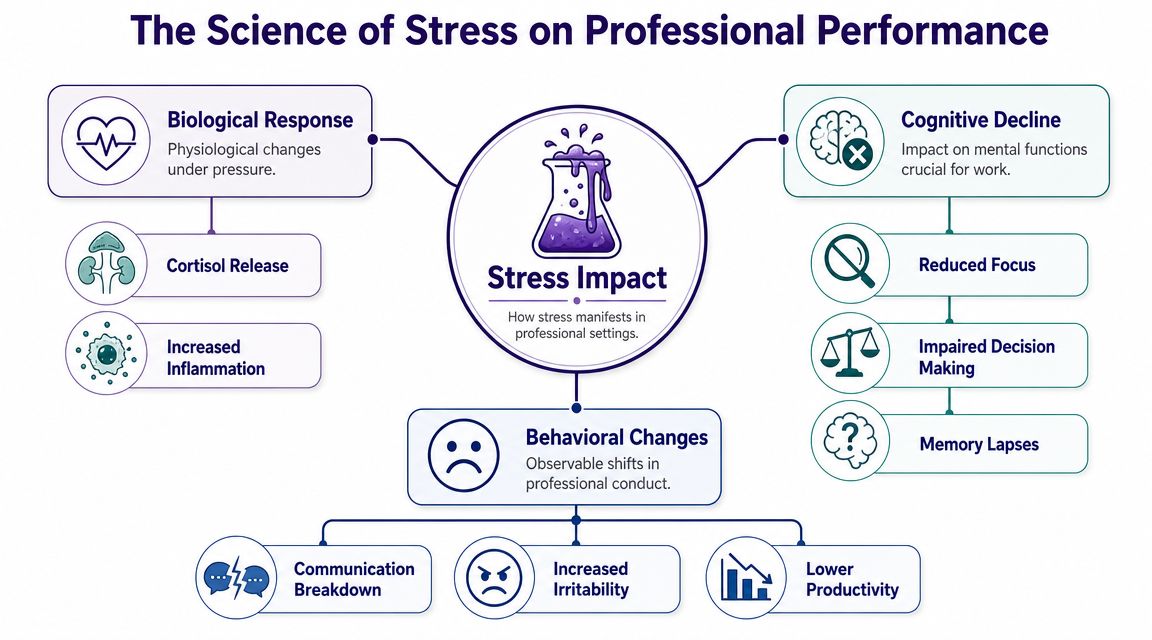
Stress feels emotional, but its effects are also biological. That matters because many professionals blame themselves for symptoms that have a clear physical basis. When you understand what stress does inside the body, the “brain fog” starts to make sense.
What happens under pressure
When your brain reads a situation as threatening, it prepares you to react quickly. That response can help in a genuine emergency. It’s less helpful when the “threat” is an inbox full of queries, a payroll deadline, an audit file, or a dashboard that still doesn’t reconcile.
In high-pressure professional settings, that repeated activation builds allostatic load, which means the wear and tear created by ongoing stress. UK finance and accounting sectors show a 2.5x higher incidence of extreme work-related stress due to deadline pressure and allostatic load, according to the ONS-linked analysis on sickness absence and related findings.
How that affects your work
The body’s stress response changes the quality of your thinking. In finance and data roles, that often shows up in ways that are easy to recognise:
| Work demand | What stress can do | What it looks like on the job |
|---|---|---|
| Attention to detail | Narrows focus in an unhelpful way | You miss an obvious mismatch in a report |
| Working memory | Makes it harder to hold several steps at once | You lose track of a process halfway through |
| Decision-making | Pushes you towards rushed judgement | You approve a number before checking context |
| Communication | Reduces patience and clarity | You answer sharply or explain poorly in meetings |
A trainee working on final accounts might know every stage of the process but still forget a small adjustment because their mental bandwidth is already overloaded. A business analyst might understand the data but struggle to explain it clearly when challenged by stakeholders. A payroll professional might reread the same screen several times without absorbing it.
That’s why stress management courses need to do more than tell people to “relax”.
Why evidence-based training works
The good news is that the same brain and body systems involved in stress can also be trained in healthier ways. The verified evidence here is especially relevant to data-heavy roles. Neuroplasticity-based protocols such as mindfulness-based stress reduction were linked to 30% error rate drops in data analysis tasks in King’s College London trials referenced in the same ONS-linked source.
That’s a striking point for analysts, finance staff, and accounts teams. The value of stress management isn’t abstract. It can show up in fewer mistakes, steadier concentration, and clearer judgement.
Stress changes performance long before it becomes a visible crisis.
If you’re already feeling worn down, it can help to read practical guidance on effective strategies for burnout. That kind of support is useful, especially when you need language for what you’re experiencing. But in professional training, the key step is turning that understanding into a repeatable skill set.
Inside a Professional Stress Management Course
A strong course doesn’t stop at general advice. It teaches methods you can apply in the middle of real work. That’s the difference between a career-focused programme and a vague wellness session.

The techniques that make a difference
Professional stress management courses often use a combination of cognitive, behavioural, and physiological tools. The aim is simple. Help you notice pressure earlier, regulate your response faster, and protect the quality of your work.
According to NICE guidance on workplace mental health interventions, expert-level courses using biofeedback and heart rate variability training have been shown to reduce absenteeism by 25% in finance sector pilots and support 15 to 20% productivity gains. That makes these methods highly relevant for deadline-led work.
What each part solves at work
Cognitive techniques for thought pressure
A course may include methods drawn from cognitive behavioural practice. These help with patterns such as perfectionism, catastrophising, and impostor thinking.
For example, an accounts assistant might think, “If I make one error, I’m not good enough for this role.” A structured exercise teaches them to test that thought, replace it with something more accurate, and keep working without spiralling. That protects both confidence and output.
This is especially useful in:
- Final accounts preparation, where one issue can make you feel that the entire file is wrong
- Advanced payroll, where urgency can trigger fear of getting everything wrong
- Business analysis, where stakeholder challenge can feel personal if confidence is shaky
Biofeedback for physical control
Biofeedback sounds technical, but the idea is straightforward. You learn to notice physical stress signals and bring them down with deliberate practice. That might involve breathing patterns, pacing, and awareness of tension.
For a payroll learner before a deadline, or a data analyst before presenting a dashboard, this can stop the body from tipping into panic. Instead of trying to think your way out of a stress response, you regulate the response directly.
Workplace application: The best technique is the one you can use during a real task, not only after work has finished.
Mindfulness for task accuracy
Mindfulness in a professional course isn’t about emptying your mind. It’s about training attention. In bookkeeping, VAT work, and spreadsheet-heavy analysis, that matters a lot.
A learner reconciling transactions in Xero or Sage doesn’t need vague calm. They need the ability to keep attention on the line in front of them, notice distraction quickly, and return to the task without frustration building.
What a useful course should include
A high-quality course usually feels practical. You should see a clear connection between the lesson and your working day.
Look for content such as:
- Scenario-based practice: Exercises linked to month-end, payroll deadlines, reporting pressure, or stakeholder meetings.
- Short repeatable routines: Techniques you can use in five or ten minutes before an interview, exam, or deadline.
- Application to software work: Support for staying focused while using Sage, Xero, QuickBooks, Excel, SQL, or Power BI.
- Reflection tools: Simple ways to spot your own stress triggers and early warning signs.
Some courses also help with communication under pressure. That matters if you need to ask for clarification, report a problem early, or explain findings with confidence. Managing stress well often improves professional presence, not just internal wellbeing.
Choosing the Right Training Format for Your Career Stage
The best course format depends on your life as much as the syllabus. A recent graduate, a career changer, and an international student may all need stress management training, but not in the same way.

Comparing the main options
Some people learn best with a fixed classroom routine. Others need the freedom to study around work, family, or job applications. The format shapes whether you complete the training and use it consistently.
| Format | Best for | Strengths | Watch for |
|---|---|---|---|
| Online | Busy learners, job seekers, working professionals | Flexible, easier to fit around life, accessible from home | Needs self-discipline |
| In-person | Learners who prefer structure and direct interaction | Immediate feedback, clear routine, social accountability | Less flexible |
| Blended | People who want both flexibility and human support | Combines convenience with guided practice | Quality varies between providers |
What works for different learners
If you’re a recent graduate
Graduates often juggle applications, interviews, technical upskilling, and uncertainty about where they fit. Online or blended stress management courses tend to work well because they let you learn without adding more travel and scheduling pressure.
Flexible timing matters here. Evening and weekend study can make the difference between “I should do this” and “I completed it”.
If you’re changing career
Career changers usually carry a different kind of pressure. They may already be working while retraining in bookkeeping, payroll, accounts assistant work, or data analytics. In that case, a rigid model can become another source of stress.
Blended learning often suits this stage because it gives space for self-paced study while still offering real support. If you’re weighing formats, this comparison of online training vs classroom learning is a useful place to start.
If you’re new to the UK job market
International students and newcomers often need more than a standalone course. They may need support with confidence, communication, and adapting to local expectations. Verified data is especially helpful here. A UCL study from 2025 found that integrating stress management into career coaching cut acculturation stress by 37%, with 65% securing roles within 3 months versus 41% in control groups, as described in UCL’s discussion of international student mental health support.
That points towards a strong model for this group. Not stress training in isolation, but stress training linked with employability support.
Features that matter more than people expect
When learners compare courses, they often focus on the title and miss the delivery details that shape results.
A good format should support:
- Consistency, so you can show up even during a busy week
- Privacy, if you’d rather practise sensitive topics one-to-one
- Real-world application, so the training connects to payroll runs, reconciliations, reporting, and interviews
- Support between sessions, especially if you struggle with follow-through
Digital tools can also help when they’re used well. The most useful ones don’t replace human teaching. They reinforce habits, prompt short exercises, and make practice easier to maintain.
The Tangible Career Outcomes of Managing Stress
A lot of people think stress management only matters if they’re already close to burnout. That view is too narrow. In professional life, the bigger value often appears earlier. Better concentration. More stable output. Fewer avoidable absences. Stronger interviews. Better appraisals.
That’s why stress management courses deserve a place in career development planning, especially in finance and data roles where small errors can have oversized consequences.
Better focus shows up in visible performance
A 2024 CIPD report found that 73% of professionals taking CPD-certified stress courses reported enhanced focus and productivity, and this correlated to a 22% average rise in performance appraisal scores. The same evidence set also notes that a King’s College London trial found intervention groups were 40% less likely to take sick leave, according to the CIPD health and wellbeing at work report.
Those findings matter because appraisals and attendance are visible to employers. They affect trust. They affect progression. They often shape who gets more responsibility.
How this plays out in specific roles
For a bookkeeper or VAT professional, stress management can mean fewer slips in repetitive processing and better communication when a client query appears late in the day.
For someone in advanced payroll, it can mean staying calm enough to work methodically when urgency is high and emotions are involved.
For an accounts assistant, it can support steadier month-end work, clearer responses to managers, and greater confidence when handling adjustments or reconciliations.
For people working towards final accounts, it can help them pace themselves across detailed tasks instead of swinging between overwork and mental shutdown.
For a business analyst, the gain may show up in stakeholder handling. It’s easier to ask sharper questions, listen properly, and present recommendations without sounding defensive.
For a data analyst, the benefit often appears in concentration and communication. Cleaner thinking leads to cleaner interpretation.
Employers don’t only reward technical knowledge. They reward reliability under pressure.
Why this is an investment, not an extra
Many learners hesitate because stress management training can feel less urgent than software or exam preparation. But if unmanaged stress weakens your performance, then every other skill becomes harder to use at full value.
Think of it this way:
- Technical training teaches you what to do
- Stress management teaches you how to stay effective while doing it
- Career coaching helps you present that value to employers
That combination matters in competitive hiring markets. Employers want people who can learn, deliver, and stay steady. They also notice professionals who communicate calmly, recover from setbacks, and maintain standards during busy periods.
The strongest return often comes from consistency. One interview handled calmly. One deadline completed without mistakes. One month-end processed with more control. Those moments build a reputation, and reputations shape careers.
How to Evaluate and Choose the Right Course
Not all stress management courses are designed for professional outcomes. Some are broad and reflective, which can still be helpful. But if your goal is to succeed in bookkeeping, payroll, accounts assistant work, final accounts, business analysis, or data analysis, you need a course that fits the realities of those roles.
Start with relevance, not branding
A polished website doesn’t tell you whether the course will help when you’re facing a payroll query, interview nerves, or a reporting deadline. Relevance matters more.
Ask whether the training is built around workplace situations such as:
- deadline pressure
- accuracy-heavy tasks
- presentation nerves
- perfectionism
- workload planning
- communication under stress
If the course only talks in general terms about calm and balance, it may not go far enough for professional use.
A simple checklist for choosing well
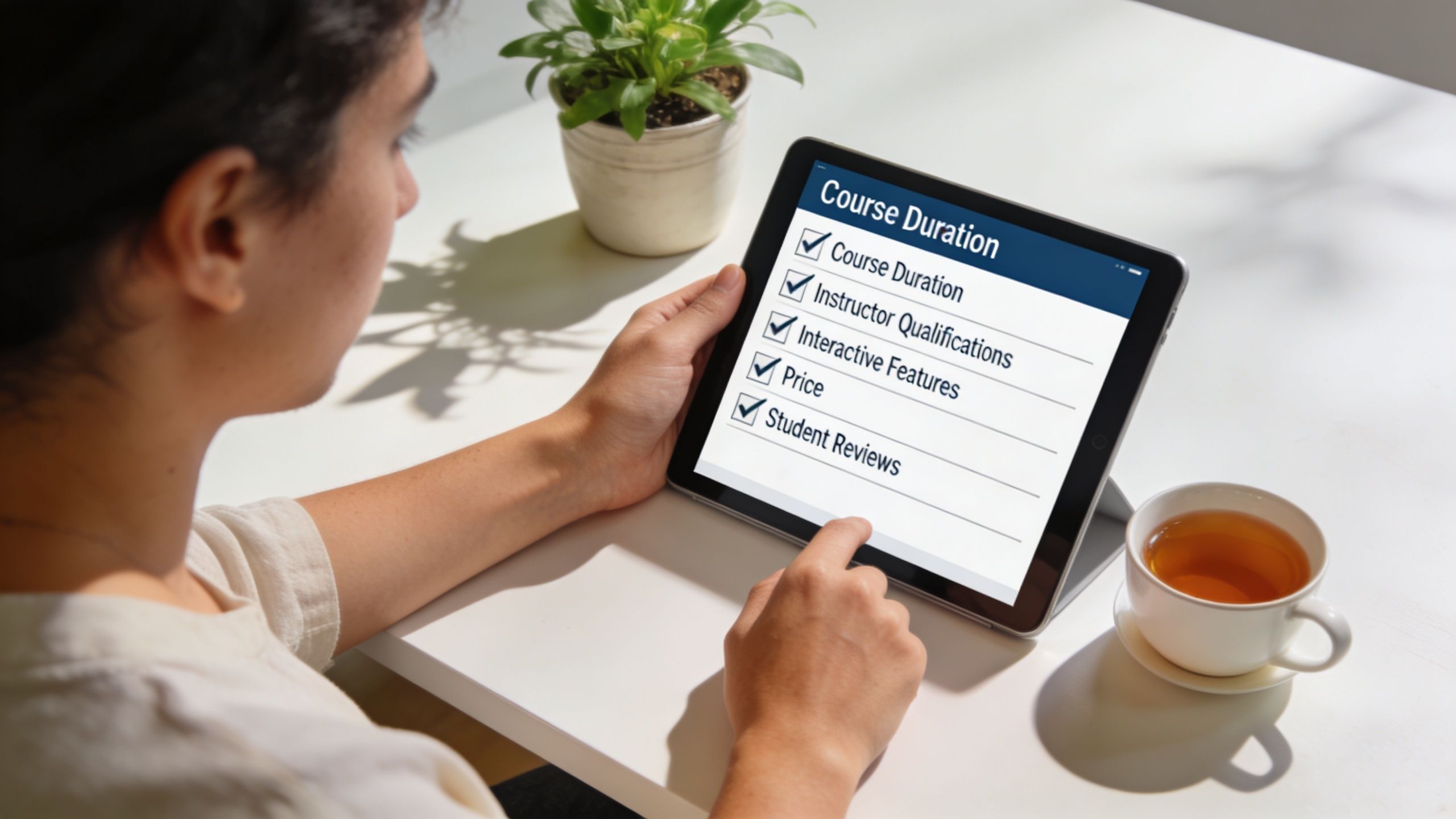
Use these criteria when comparing stress management courses.
- Trainer credibility: Look for trainers who understand professional pressure, not only general wellness language. In finance-focused training, it helps when teaching is connected to people who know accounting, reporting, payroll, or analytical work.
- One-to-one support: Some learners need privacy and direct feedback to apply techniques properly. This is particularly useful for graduates, career changers, and anyone who loses confidence under pressure.
- Flexible delivery: Evening, weekend, or adaptable scheduling helps you stay consistent.
- Practical application: The course should show how techniques fit into real tools and workflows, including Sage, Xero, QuickBooks, Excel, SQL, Python, or Power BI where relevant.
- Career integration: Support with CV preparation, LinkedIn, interviews, and job search can make stress training more useful because it tackles pressure where many learners feel it.
A broader guide on how to choose the right training course for your career goals can help you compare providers more methodically.
Ask what happens after the lesson
A course can sound excellent in the room and still fail in practice if there’s no follow-up. Real change usually comes from repeated use, not one good session.
That means you should ask:
- Will I get exercises I can use during work?
- Is there feedback on how I’m applying the tools?
- Does the course connect stress management to employability and job readiness?
- Will I leave with a routine I can maintain?
This short video can help you think more clearly about what strong training support looks like in practice.
Choose support that fits your next move
If you’re aiming for your first UK finance role, choose training that supports transition. If you’re already working and trying to stabilise performance, choose training that you can use immediately in your current job. If you’re building towards business analyst or data analyst roles, make sure the course recognises the pressure that comes with concentration-heavy, presentation-heavy work.
The right course should leave you more capable at work, not just more informed about stress.
That’s a true test.
Your Next Step Towards a Resilient and Successful Career
Stress is common in accounting, finance, and data work. Burnout doesn’t have to be. That distinction matters.
If your work depends on accuracy, concentration, judgement, and communication, then your ability to manage pressure is part of your professional skill set. It belongs alongside bookkeeping knowledge, VAT understanding, payroll accuracy, final accounts preparation, and data analysis tools. You don’t need to wait until stress becomes unmanageable before taking it seriously.
A good stress management course gives you more than relief. It gives you a method. You learn how to catch the early signs, steady your thinking, protect your performance, and keep your career sustainable over time. That’s valuable whether you’re applying for your first accounts assistant role, moving into business analysis, or retraining for a data-focused job.
Some people will also benefit from therapeutic support outside a training setting, especially if stress has become intensely personal or persistent. In those cases, services such as Interactive Counselling Vernon can be a useful reminder that support can take different forms depending on what you need.
What matters now is taking your stress seriously without treating it as a personal flaw. It’s a skill area. Skills can be learned. Skills can be strengthened. Skills can change the course of a career.
If you’ve been trying to cope, this is the point to do something more useful than coping. Start building the kind of resilience that helps you work well, think clearly, and stay in the profession long enough to grow in it.
If you want career-focused training that supports both technical ability and employability, explore Professional Careers Training. Their approach includes 1-to-1 support from ACCA-qualified Chartered Accountants and CPD-approved trainers, flexible evening and weekend study, official certification in software such as Sage, Xero, and QuickBooks, plus recruitment support with CV preparation, LinkedIn optimisation, job hunting strategy, and employer referrals.