
If you're training to become a business analyst, or you already work as one, you've probably noticed AI tools turning up in more of your...
In finance and data roles, technical ability matters. So does the ability to transfer that ability clearly, consistently, and in a way that sticks. If you want better accounts assistants, more confident bookkeepers, stronger payroll staff, or junior analysts who can build and explain reports, train the trainer is one of the most practical ways to scale expertise without lowering standards.
Why Your Best People Cannot Always Teach
A senior payroll manager may know statutory payments, year-end processes, and reporting deadlines without checking a note. A data analyst may build clean Power BI dashboards and SQL queries quickly. That doesn’t mean either person can teach a graduate, career changer, or new starter how to do the same work well.

The problem shows up in familiar ways. Experts skip steps because the process feels obvious to them. They explain outcomes instead of methods. They correct errors after the fact rather than designing practice that prevents the error in the first place. The learner leaves the session with notes, but not with competence.
That matters even more in technical subjects. If you’re teaching bookkeeping and VAT, one missing explanation around coding or reconciliation creates bad habits. If you’re teaching advanced payroll, weak instruction around process order can lead to repeated compliance errors. If you’re teaching SQL or Power BI, learners can copy a result without understanding why the logic works.
What weak internal teaching looks like
You can usually spot it quickly:
- Knowledge dumping: The expert talks through everything they know instead of focusing on what the learner must do next.
- No structure: A session jumps from Xero bank reconciliation to VAT returns to supplier ledgers with no sequence.
- Little practice: Learners watch demos but don’t complete realistic tasks themselves.
- Inconsistent methods: Each trainer explains the same process differently, which creates confusion across the team.
Practical rule: If the learner can’t repeat the task alone within a short time, the session was probably informative, not instructional.
A proper train the trainer approach fixes that bottleneck. It gives subject matter experts a way to teach with structure, consistency, and measurable outcomes. In UK accountancy training, the model achieves 85% knowledge retention and 92% application rate among trainees when standardised materials from ACCA-approved programmes are used, compared with 60% retention in non-standardised peer training. The same approach also supports pre- and post-assessment tracking, with 78% average improvement in tasks using SQL and Power BI, according to the TWI Institute train the trainer model summary.
Why this matters for career growth
Good instruction doesn’t just reduce confusion. It turns technical ability into employable ability.
That is the difference between someone who has watched a Sage demo and someone who can process transactions correctly, explain their decisions, and perform the task under pressure in a real role. Teams grow faster when experts stop acting as walking helpdesks and start acting as capable instructors.
Understanding the Train the Trainer Model
Think of train the trainer as building a reliable teaching system inside a technical team. The first output isn’t a workbook or a slide deck. It’s a trainer who knows how to teach the work properly.
In finance and data environments, that matters because quality depends on repeatable standards. A bookkeeping process should be taught the same way each time. A VAT lesson should follow the same logic. A final accounts session should move through adjustments, structure, and review in a way that learners can follow and repeat. The same applies to advanced Excel, SQL, and Power BI.
A teaching factory for technical skills
The simplest way to understand the model is this. You aren’t only training employees. You’re training the people who will train employees.
That changes the focus. Instead of asking, “Does this person know payroll?” you ask better questions:
- Can they break payroll into teachable stages?
- Can they explain why each step matters?
- Can they spot where a learner is stuck?
- Can they assess whether the learner can perform the task alone?
A strong train the trainer programme gives experts practical teaching methods. They learn how adults absorb new information, how to structure technical content, how to run guided practice, and how to give feedback that improves performance rather than just pointing out faults.
Why it fits UK accountancy and CPD settings
This model isn’t new. Its roots in UK vocational training trace back to the 1964 Industrial Training Act. In modern accountancy CPD, it has become a practical way to scale quality. A 2018 ICAEW study found that organisations using TtT models for CPD saw a 32% increase in trainer effectiveness, measured by trainee pass rates in Sage, Xero, and QuickBooks certifications rising from 68% to 90% post-implementation, as outlined in this review of train the trainer advantages and disadvantages.
When the method is standardised, learners don’t depend on who happened to teach them that day.
That point often gets missed. Many firms think they have a training process when they have a few helpful senior staff doing their best. A real train the trainer system is different. It uses common materials, clear lesson goals, practice tasks, and observable standards.
What the model includes in practice
For bookkeeping, payroll, accounts assistant, business analyst, and data analyst pathways, the model usually includes:
- Subject expertise in the task itself.
- Teaching skill so the trainer can explain and sequence the work.
- Assessment skill so progress can be measured.
- Coaching skill so learners improve with targeted support.
That combination is what turns expertise into a repeatable capability across the team.
The Key Benefits for Accounting and Data Teams
Most managers don’t need another vague promise about learning culture. They need training that improves consistency, reduces avoidable errors, and helps staff become productive sooner.
Train the trainer works best when you judge it by those outcomes.
Consistency and compliance
In accounting and payroll, inconsistency is expensive. If one trainer teaches VAT treatment one way and another trainer explains a shortcut that skips key checks, the learner carries that confusion into live work. The same issue appears in data teams when analysts learn reporting logic by copying someone else’s dashboard without understanding the rules behind it.
A structured train the trainer model reduces that drift. It creates common language, shared examples, and a standard for what good performance looks like. That is especially useful for:
- Bookkeeping and VAT: coding, reconciliations, invoice handling, VAT review habits
- Advanced payroll: process order, evidence checks, exception handling
- Final accounts: adjustments, supporting schedules, review discipline
- Business analysis: requirement gathering, stakeholder questioning, documentation quality
- Data analysis: clean data handling, query logic, dashboard explanation
Better scale without losing quality
One of the strongest advantages is reach. TTT programmes in UK professional services yield a 3.2x multiplier in trainer scalability, allowing one expert to certify 15 to 20 accounting trainees annually. They also lead to a 76% reduction in CPD compliance audit failures and 22% higher learner engagement, according to the Erasmus+ TTT guide and ICAEW benchmark summary.
That doesn’t mean every expert should become a full-time trainer. It means one well-prepared internal trainer can support more people effectively than a brilliant expert who teaches ad hoc.
Stronger internal capability
There is also a cultural gain, but only when the training is practical. Teams become less dependent on one or two senior people. Junior staff ask better questions because they’ve been taught the process properly. Managers can spot gaps earlier because expectations are clearer.
A team with trained instructors usually spends less time rescuing people and more time developing them.
That shift is valuable in roles where software confidence matters. Internal trainers who can teach Sage, Xero, QuickBooks, Excel, SQL, or Power BI in a structured way become a real operational asset.
What doesn’t work
Some organisations still make the same avoidable mistakes:
- They promote expertise, not teaching ability.
- They treat training as a side task with no standards.
- They rely on slide-heavy delivery with little hands-on practice.
- They measure attendance instead of competence.
If you want better outcomes, the trainer needs a method. Technical knowledge alone won’t carry the programme.
Designing a Core TtT Curriculum for Your Experts
A finance-focused train the trainer curriculum should feel like a practical workshop, not a theory-heavy lecture. The aim is to help subject matter experts teach real tasks well. That means bookkeeping entries, payroll workflows, final accounts adjustments, SQL logic, and report interpretation all need to be broken down into learnable steps.
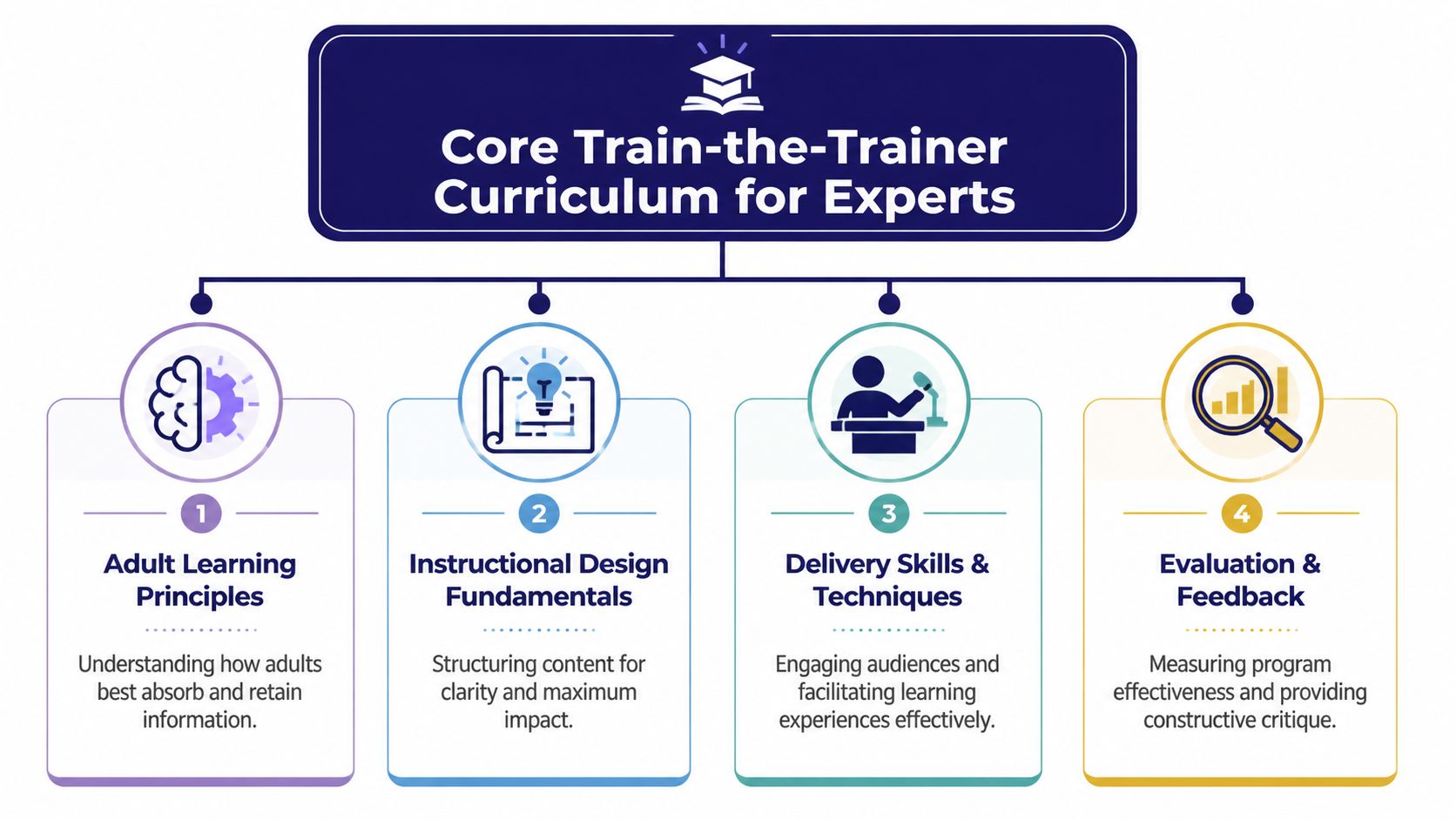
A useful curriculum usually has four core pillars.
Adult learning principles
Adults learn best when they can see the job relevance quickly. A trainee bookkeeper doesn’t need abstract theory first. They need to understand what the transaction is, why it matters, where mistakes happen, and how to complete it correctly in software.
So trainers should learn to start with context, then move to action. In practice, that means:
- Show the business task: for example, posting supplier invoices or checking VAT codes.
- Explain the risk: what goes wrong if it is done badly.
- Use short practice cycles: teach, demonstrate, attempt, correct, repeat.
This is also where trainers learn pacing. New instructors often overload sessions. A better approach is to teach one complete task well before adding complexity.
Facilitation and engagement skills
Technical trainers often default to talking. Good facilitation is different. It gets learners doing the work.
For advanced payroll, that might mean giving trainees a small scenario to process and asking them to explain each decision. For business analysts, it might mean a role-play where one learner gathers requirements and another plays the stakeholder. For data analysts, it could be a guided SQL exercise followed by a short explanation of the output in plain English.
On the training floor: If learners stay passive for most of the session, the trainer is doing the work instead of the learners.
Visual planning helps here. Teams that want more structure often benefit from examples of structured success for creators because the same principle applies to technical teaching. A session needs a clear sequence, a visible outcome, and enough practice built in.
Trainers who want to sharpen delivery can also benefit from focused support on training presentation skills, especially when they know the content well but need to improve clarity, room control, and explanation style.
Content structuring
Many experts struggle most with sequencing. They know the topic, but they haven’t learned how to sequence it.
A strong lesson for final accounts might move like this:
- Start with the finished picture so learners know what they are building.
- Break the process into stages such as trial balance review, adjustments, presentation, and checks.
- Use worked examples before asking for independent completion.
- Add common error traps so learners recognise weak entries early.
A weak lesson usually does the reverse. It starts deep in detail, assumes background knowledge, and leaves the learner trying to work out the overall purpose halfway through.
Assessment and feedback
If there is no assessment, there is no clear evidence that teaching worked.
For accounts assistant and data analyst pathways, assessment doesn’t need to be elaborate. It does need to be specific. Ask the learner to complete a bank reconciliation, process a payroll scenario, build a simple report, or explain a variance. Then mark against a standard.
Feedback should be direct and usable. Not “needs more confidence”. Better: “You completed the journal correctly, but you didn’t explain why the VAT code changed. Re-run the task and talk through that decision.”
That style of feedback builds job readiness because it links performance to action.
How to Choose a Provider for Finance Professionals
If you bring in external support for train the trainer, generic delivery isn’t enough. Finance and data teams need providers who understand the technical work, the software, and the pressure points that sit behind instruction.

A broad corporate trainer might be polished in the room but still miss what matters in a bookkeeping class or a data workshop. If they can’t teach from real finance tasks, they won’t prepare your experts to teach them either.
What to check before you buy
Start with capability, not marketing language. Ask direct questions.
- Technical credibility: Can the provider work confidently across bookkeeping and VAT, advanced payroll, accounts assistant tasks, final accounts, business analyst methods, and data analyst tools?
- Software familiarity: Can they train around Xero, Sage, QuickBooks, Excel, SQL, Power BI, and related workflows in a practical way?
- Adult teaching method: Do they teach your experts how to explain, demonstrate, observe, correct, and assess?
- Assessment design: Will the programme include measurable tasks rather than attendance-only completion?
- Flexibility: Can delivery fit around employed learners, graduates, career changers, and evening or weekend needs?
The need for sector-specific training is clear. A 2025 ICAEW survey found that 68% of UK SMEs struggle with digital accounting skills shortages, and only 22% of trainers possess practical software certification. A 2024 CIPD report also highlighted that 45% of UK finance graduates lack hands-on software training, which is why generic TtT programmes often miss the mark, as noted in this overview of specialised train the trainer needs in UK finance.
Warning signs of a poor fit
Some providers sound strong until you test the detail. Be cautious if you hear any of the following:
- “We can adapt to any sector.” Adaptable is good. Specific experience is better.
- “The focus is on confidence.” Confidence matters, but without technical teaching standards it fades quickly.
- “We don’t need access to your workflows.” In finance training, process detail matters.
- “We mainly teach presentation.” Useful, but not enough on its own.
A trainer who can motivate a room but can’t teach a VAT adjustment or a data-cleaning workflow won’t help your team perform better.
Delivery matters as much as content
Format affects adoption. In technical roles, trainers improve faster when they can practise in small groups or 1-to-1 settings, deliver short teaching segments, receive feedback, and repeat. Programmes also work better when they reflect how learners consume training now, including recorded practice, screen-led demos, and feedback on delivery clips.
If you’re comparing digital options for blended delivery, this guide to best video training software is useful for thinking through recording, review, and coaching workflows.
The strongest providers usually combine domain knowledge, practical software use, and realistic employability outcomes. That matters for graduates, career changers, and newcomers who don’t just need instruction. They need instruction that connects to the job market.
Measuring the Impact of Your Trainer Programme
A trainer programme isn’t successful because people enjoyed it. It is successful when teaching quality improves and learners perform better at work.
A simple way to measure that is to adapt the Kirkpatrick model into a finance and data context. Keep it practical. Use evidence that managers can observe.
Four levels that matter in real teams
Start with reaction, but don’t stop there. Ask whether the session was clear, relevant, and paced properly. That helps you improve delivery, but it doesn’t prove skill transfer.
Then move to learning. Use short pre- and post-assessments on live topics such as VAT coding, payroll steps, Excel lookups, SQL filtering, or Power BI interpretation. You want to see whether the learner can do more after the training than before it.
Behaviour is more important again. Look at what changes in the workplace. Does the accounts assistant complete reconciliations with less prompting? Does the junior analyst explain report logic more clearly? Does the payroll trainee follow the right checking process?
Results sit at the top. In practice, that may mean fewer corrections, smoother onboarding, stronger consistency across trainers, and better readiness for client-facing or employer-facing work.
Inclusive measurement is not optional
This is especially important when your audience includes international students, newcomers, or career changers. Data-driven TtT using tactile and visual aids like Sage simulations improves knowledge retention by 50% for underserved groups, yet a 2025 Universities UK report found that 61% of international students drop out of vocational training due to inadequate culturally responsive methods, as summarised in this discussion of training employees from underserved populations.
That means your measures should include more than technical scores. Track whether learners understand instructions, engage with scenarios, and can apply the task in a format that matches real work expectations in the UK.
Teams that want a stronger CPD framework for this can align trainer assessment with broader guidance on continuing professional development for accountants.
Good measurement should tell you who can perform the task, who can explain the task, and who still needs support.
Sample skill assessment template
Here is a simple format for bookkeeping and VAT training.
| Skill Area | Task to Assess | Pre-Training Score (1-5) | Post-Training Score (1-5) |
|---|---|---|---|
| VAT coding | Select correct VAT treatment for sample transactions | ||
| Bank reconciliation | Match items and clear differences accurately | ||
| Purchase ledger | Enter supplier invoices correctly in software | ||
| Error spotting | Identify and correct misposted entries | ||
| Explanation skill | Explain why a posting decision was made |
A template like this helps in two ways. It shows whether the learner improved, and it shows whether the trainer taught the skill in a way that transferred to practice.
Embedding a Culture of Expert Teaching
One strong train the trainer course helps. A teaching culture sustains the improvement.
That culture starts when organisations stop treating teaching as an informal extra and start recognising it as a professional capability. In finance and data teams, that means good trainers are not only accurate. They are organised, clear, observant, and able to turn software tasks and business processes into repeatable learning.
Make teaching visible inside the team
Internal trainers improve faster when their work is recognised and reviewed. That doesn’t need a complex scheme. It can be as simple as scheduled observation, peer feedback, shared lesson plans, and a small internal forum where trainers compare what worked in sessions on payroll, accounts preparation, or dashboard teaching.
Useful habits include:
- Create a shared standard: one template for lesson outcomes, exercises, and assessment.
- Reward teaching quality: recognise trainers who improve learner performance, not just trainers who are available.
- Keep materials current: update examples when software workflows or reporting expectations change.
- Build progression: let strong trainers mentor new trainers.
Protect the practical focus
The biggest risk over time is drift back into informal teaching. Notes get reused without review. Trainers improvise too much. Sessions become explanation-heavy and task-light.
Keep the bar clear. A trainer should be able to teach the task, observe the learner doing it, and decide whether the learner is ready to perform it independently. If any one of those steps is missing, quality slips.
Leaders also need to support trainer development. Strong subject experts still need room to refine communication, coaching, and judgement. That leadership side matters, especially for managers who are responsible for developing others as well as delivering results. This resource on leadership skills for managers is a useful complement when you want training capability to become part of day-to-day management practice.
Teaching excellence grows when teams treat it as part of performance, not as an optional favour from senior staff.
Done well, train the trainer creates something bigger than a course. It creates a repeatable way to build bookkeepers, payroll professionals, accounts assistants, final accounts staff, business analysts, and data analysts who are ready for real work.
If you want support building that kind of training capability, Professional Careers Training offers practical accountancy and finance-focused development with 1-to-1 training, flexible evening and weekend options, support from ACCA qualified Chartered Accountants and CPD approved trainers, software training in Sage, Xero and QuickBooks, plus recruitment support including CV preparation, career coaching, job hunting strategy and LinkedIn optimisation.