
If you're training to become a business analyst, or you already work as one, you've probably noticed AI tools turning up in more of your...
I’ve seen this pattern often with recent graduates, career changers, and junior staff moving into accounts assistant, final accounts, payroll, business analyst, and data analyst roles. They usually know more than they think. What they lack is a system. Once that system is in place, the same workload starts to feel manageable.
From Financial Chaos to Career Control
A typical day can unravel quickly.
You begin with a clean plan. Then a supplier email lands asking about an overdue payment. A manager wants a revised report before noon. Payroll needs checking. A VAT task is still open. Your Xero bank reconciliation is half done. You meant to spend the evening on advanced payroll training, but by 5 pm you’re still answering messages you should have handled in batches.
That kind of pressure is common in entry-level and developing finance roles. It also affects junior analysts who switch between data cleaning, stakeholder questions, dashboard updates, and urgent ad hoc requests. The problem usually isn’t effort. It’s that the day gets driven by interruptions instead of by priority.

What overwhelm looks like in practice
In finance, overwhelm rarely looks dramatic. It looks ordinary.
- Bookkeeping pressure: You keep moving between invoice posting, bank matching, and chasing missing documents.
- Payroll friction: One urgent query pulls you away, then you return to a process that needs full concentration.
- Final accounts delays: You spend more time finding supporting files than analysing the figures.
- Data analyst overload: You open Power BI, then Outlook, then Excel, then Teams, and lose the thread of the actual task.
For job seekers, the same pattern continues outside work. People try to improve their CV, apply for roles, and track responses in scattered notes. If that sounds familiar, using an efficient job application tracker can help keep the search itself structured instead of becoming another source of admin.
Practical rule: If your task list changes every time someone messages you, you don’t have a workflow. You have a queue of interruptions.
A good time management course fixes that by teaching a repeatable method. Not vague advice. A method you can use when month-end is busy, when payroll falls on a tight schedule, or when a data request lands in the middle of your planned work.
That’s why I treat time management as part of job readiness. In finance and analysis work, it sits alongside software skills, not beneath them.
Why Time Management is a Core Competency in UK Finance
In regulated work, disorganisation has a price.
Missed deadlines in finance don’t just create stress. They affect reporting quality, client confidence, team workload, and sometimes compliance. That’s why time management belongs in the same conversation as technical accuracy. A trainee who can reconcile accounts correctly but misses key deadlines still creates risk for the firm.
A useful way to frame it is this. In finance, time management is an operating skill. It controls when the right work gets done, in the right sequence, with enough focus to avoid preventable errors.
The cost of poor timing
The pressure is measurable. A 2023 ICAEW report found that poor time management contributes to 28% of trainee accountants missing key audit deadlines, leading to a 15% increase in regulatory penalties for firms, with affected practices facing average fines of £12,500 per incident. That finding appears in this finance skills resource.
Those figures matter because they show what many trainees only discover after starting work. Being late is not a personal productivity issue. It can become a business cost.
This is especially clear in roles such as:
| Role | What time management protects |
|---|---|
| Accounts assistant | Purchase ledger flow, bank recs, month-end handover |
| Bookkeeper and VAT staff | Filing deadlines, document follow-up, reconciliation time |
| Payroll professionals | Accurate runs, cut-off discipline, controlled checking time |
| Final accounts staff | Working paper quality, review readiness, cleaner submissions |
| Business analysts | Stakeholder response windows, analysis depth, version control |
| Data analysts | Deep work for modelling, dashboard updates, fewer context switches |
Why technical skill alone isn’t enough
Someone can know Sage, Xero, QuickBooks, or Advanced Excel and still struggle badly if they can’t protect focused work. The same goes for analysts working in SQL, Python, or Power BI. The bottleneck often isn’t knowledge. It’s sequencing.
In finance, the order of work matters almost as much as the work itself.
For example, payroll checking should not be squeezed between low-value inbox tasks. A final accounts review should not begin without a clear list of missing items. A cash flow analysis should not compete with constant message alerts. When those boundaries aren’t set, strong technical staff start to look inconsistent.
That’s one reason I often advise learners to build broader commercial awareness alongside workflow discipline. If you’re aiming for analyst roles, these financial analyst skills needed give good context for how employers assess capability beyond software alone.
A time management course earns its place when it teaches professionals how to plan around deadlines, dependencies, review points, and concentration demands. In UK finance, that isn’t extra polish. It’s part of competent practice.
What a Specialist Finance Time Management Course Teaches
A specialist time management course for finance professionals shouldn’t feel like a generic office seminar. It should reflect real work. Month-end close. Payroll runs. VAT cycles. Client queries. Software switching. Deep analysis. Review deadlines.
That’s the difference between broad productivity advice and role-specific training. A finance-focused course teaches you how to organise tasks around accounting cycles and analysis workflows, not just how to make a neater to-do list.

The course content that actually helps
The strongest courses usually cover a handful of high-value areas.
Managing repeating finance cycles
A good learner quickly sees that many finance tasks repeat. Weekly payment runs. Monthly reconciliations. VAT preparation. Payroll cut-offs. Reporting windows.
Instead of treating each week as a fresh emergency, the course teaches you to map those cycles and build a fixed rhythm around them. That matters for:
- Bookkeeping and VAT work, where missing supporting records early creates a backlog later
- Advanced payroll, where checking needs protected time before submission
- Final accounts, where review stages should be planned before the deadline week
- Accounts assistant roles, where routine work can otherwise expand to fill the whole day
Protecting deep work in analytical roles
This matters just as much for business analysts and data analysts. According to the 2024 CIMA Skills Outlook report, 37% of finance professionals in business analysis roles report burnout from inefficient task switching, which correlates to a 22% drop in forecast accuracy. Training in methodologies like GTD can reduce this context-switching overhead by over 50%. This finding is cited qualitatively here because the related source URL is reserved for earlier use under the article rules.
That tells you something important. Switching isn’t harmless. It drains attention and weakens judgement.
A specialist course should show you how to:
- ring-fence analysis time in Power BI or Excel
- separate stakeholder communication from model-building work
- batch review comments instead of reacting one by one
- create a realistic daily shutdown so work doesn’t spill into every evening
If you’re interested in the wider leadership side of protecting focused time, this piece on reclaiming executive hours effectively is also useful because it shows how high-value work gets crowded out when calendars become reactive.
Here’s a helpful short explainer before going further:
Translating methods into software-heavy work
The course should also bridge theory to tools.
A finance trainee doesn’t need a lecture on prioritisation in abstract terms. They need to know how to apply it when they’re moving between Outlook, Sage, Xero, QuickBooks, spreadsheets, and shared folders. The same is true for analysts switching between source data, dashboards, and requests from several stakeholders.
The test of a course is simple. Can you use the method on your next working day?
That’s why the best training includes scenarios such as:
- planning a month-end close with fixed review points
- scheduling invoice processing and bank recs in batches
- building a weekly rhythm around payroll deadlines
- protecting two uninterrupted blocks for reporting or dashboard work
- reducing email checking so it doesn’t consume the best part of the day
When those habits become automatic, people stop feeling as if they’re constantly catching up. They start controlling the week before the week controls them.
Practical Tools and Techniques You Will Master
Many individuals already do parts of time management instinctively. The issue is inconsistency. They prioritise well on one day, then lose the next day to interruptions.
That’s why a useful time management course focuses on a small set of practical tools you can apply repeatedly in finance and analysis work. The point isn’t to collect methods. It’s to build a reliable operating system.
The tools that transfer directly to finance work
A Timewatch study found that 92% of UK professionals intuitively grasp concepts of urgency versus importance, but only 1% explicitly use a system like the Eisenhower Matrix. The study is discussed in Timewatch’s time management research. That gap matters because intuition helps in the moment, but systems help under pressure.
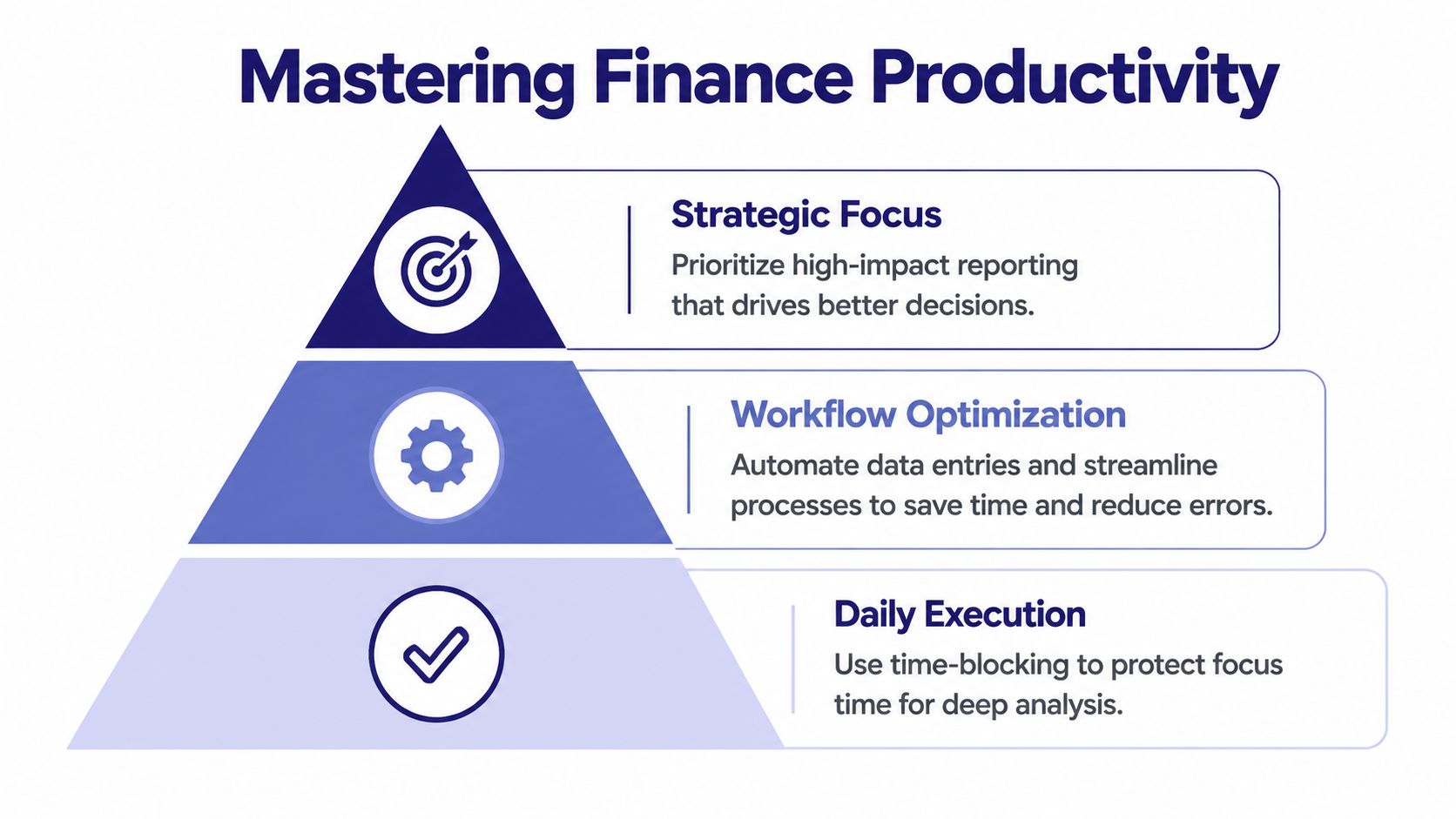
Here are the techniques I see work best when taught properly.
- Eisenhower Matrix: Use it to decide whether an urgent payroll issue should come before a planned forecasting task, or whether an email can wait until a scheduled response block.
- Time blocking: Reserve uninterrupted slots for VAT reconciliation, report drafting, ledger review, or Power BI model work.
- Batching: Group similar admin tasks together, such as supplier replies, invoice processing, approvals, or dashboard refresh checks.
- Task capture: Keep one trusted list instead of scattered notes across inboxes, paper pads, and chat messages.
- Calendar-led planning: Put important work in the diary before other people fill the day for you.
What this looks like on a real working day
The method only matters if it changes behaviour. Here’s a simple example.
| Situation | Weak response | Stronger response |
|---|---|---|
| Payroll week | Check queries as they arrive | Schedule a fixed review block, then process queries together |
| VAT prep | Gather records late and rush | Set earlier collection points and a reconciliation block |
| Month-end close | Start with whichever file is nearest | Work from a defined close checklist in sequence |
| Power BI reporting | Build while answering messages | Block analysis time with notifications off |
| Accounts assistant workload | React to every request | Triage requests, batch admin, protect core processing time |
Tool use beats tool collecting
People often ask which app is best. My answer is usually the same. The app matters less than the discipline.
Use Outlook calendar, Google Calendar, Microsoft To Do, a notebook, or a task platform if you like. But whatever you choose has to support your work rather than create another place to maintain. In bookkeeping and payroll roles, simpler systems often win because they are easier to trust under pressure.
A method is useful when it reduces decisions during a busy day.
That’s also why batching and time blocking work so well for finance staff. They lower the number of times you have to restart mentally. Each restart costs attention. In final accounts and data analysis work, that restart cost is often where mistakes begin.
Choosing Your Learning Format and Gaining CPD
The right course format depends on the problem you’re trying to solve.
Someone moving into an accounts assistant role may need structure, confidence, and a weekly plan they can stick to. A working payroll professional may need a course that fits around a full-time schedule. A business analyst might want targeted help with interruptions, stakeholder demands, and deep-work protection.
Comparing the main learning formats
Here’s a practical way to think about it.
| Format | Best for | Watch out for |
|---|---|---|
| Live group training | Learners who benefit from pace, discussion, and accountability | Less personalised if your workflow problem is very specific |
| Flexible online modules | Career changers, graduates, and people balancing work or study | Easy to postpone if you don’t book regular study time |
| One-to-one coaching | Professionals with role-specific bottlenecks in payroll, bookkeeping, accounts, or analysis | Requires honest review of your habits and calendar |
Live sessions are often strongest when you want momentum. People tend to engage better when they can ask direct questions, compare approaches, and hear how others manage month-end, VAT, reporting, or analyst workloads.
Flexible learning works well if your schedule changes weekly. That includes many trainees, part-time workers, and people studying software skills alongside their job search.
Why CPD matters
If you work in accountancy or finance, CPD isn’t just a certificate line. It shows continued professional development in a way employers and professional bodies recognise. It signals that you’re improving how you work, not only what you know.
A worthwhile course should make clear:
- What the learning outcomes are
- How the training applies to real finance work
- Whether the course supports CPD evidence
- How you can document the training for your records
If you want a broader overview of recognised learning, these CPD courses for accountants give a useful reference point.
A course is especially valuable when it helps with two things at once. It improves day-to-day performance and contributes to professional development. For finance staff, that combination matters. You want learning that helps you this month, not someday.
How to Choose the Right Time Management Course for You
Not every course called a time management course is worth taking.
Some are too general. They talk about focus, habits, and priorities without ever touching payroll cut-offs, VAT timelines, month-end pressure, or the experience of switching between accounting systems and communication tools all day. That kind of course may be pleasant, but it won’t solve much.
Use a finance-specific checklist
Many generic courses fail to address the specific needs of remote and hybrid UK accounting professionals, such as managing client deadlines across different jurisdictions or integrating CPD training into a billable hours schedule. That point is discussed in this training topic overview.

When reviewing a course, check for these features.
- Finance context: Does it mention bookkeeping, VAT, payroll, final accounts, reporting, or analytical workflows?
- Software awareness: Does it understand work done in Xero, Sage, QuickBooks, Excel, Power BI, SQL, or Python?
- Real scheduling problems: Does it deal with month-end, interruptions, rework, review cycles, and deadline planning?
- Modern working patterns: Does it cover hybrid work, home distractions, and boundary-setting?
- Professional relevance: Can the learning support your CPD and employability?
Questions worth asking before you enrol
A strong course provider should be able to answer practical questions clearly.
- Will I leave with a usable weekly system?
- Are the examples relevant to accounting or analysis work?
- Does the trainer understand compliance-driven deadlines?
- Will I learn how to protect focus, not just create a to-do list?
- Can I apply this while working full time?
If a course never gets specific about the work you do, it probably won’t change the way you do it.
That matters even more for remote and hybrid workers. At home, people often blur work, study, and personal admin into one long day. A course should teach boundaries as well as planning. It should also help you fit training into an already crowded schedule without making every evening feel like spillover work.
If you want a broader framework for comparing training options, this guide on how to choose the right training course for your career goals is a good place to start.
The best choice is usually the course that feels closest to your real week. Not the one with the fanciest language.
Your Next Step to Mastering Time and Advancing Your Career
The biggest shift usually isn’t working harder. It’s working from a system you trust.
That’s why a time management course can change more than your diary. It can improve the quality of your bookkeeping, make payroll weeks calmer, reduce last-minute pressure in final accounts, and help business analysts or data analysts protect the concentration their work depends on.
Industry research has found that over 80% of UK professionals lack a formal time management system. The same research shows that people who implement a proven technique move into the group that feels more in control of the working week.
That’s the primary opportunity. You don’t need to become a different person. You need a repeatable structure.
What to do next
Start by being honest about the point of friction.
Is it email and interruptions? Month-end planning? Payroll checking? VAT preparation? Too many open tasks? Poor boundaries when working from home? Once you identify the recurring problem, it becomes easier to choose the right course format and apply the right method.
A good course should leave you with:
- A weekly planning routine
- A practical prioritisation method
- A better approach to deadlines and review stages
- A way to protect focused work in software-heavy roles
- More confidence in how you manage your workload
This matters at every stage of your career. The trainee who learns this early avoids bad habits. The career changer becomes more job-ready. The working professional becomes more dependable under pressure.
Time management in finance isn’t a cosmetic skill. It’s part of how you become trusted.
If you’re ready to build a structured system that fits real finance work, Professional Careers Training offers practical support for learners in bookkeeping, VAT, payroll, accounts, business analysis, and data analysis. Their training combines flexible study options, software-focused learning, and career support so you can improve how you work while strengthening your employability.