

You're probably here because you've looked at UK accounting job adverts and kept seeing the same words again and again: Xero, Sage, QuickBooks, payroll systems,...
You might be working in bookkeeping, payroll, accounts support, business analysis, or data analysis and still feel that your day is shaped by systems you don't control. A supplier can't be set up because approval is stuck somewhere. A payroll run is delayed because one data feed is wrong. A dashboard looks polished, but the figures don't match the finance report. None of that feels like “IT work”, yet all of it sits at the point where business process, technology, people, and service meet.
That's why itil v4 foundation matters far beyond the IT department.
If your role depends on software, shared data, handoffs, approvals, reporting cycles, or internal support teams, you're already part of service management. Learning ITIL 4 gives you a clearer way to understand how work flows, where it breaks, and how to improve it without adding unnecessary bureaucracy. For UK professionals building careers in accounting, finance, and analytics, that can make you far more useful to employers. You stop being seen only as the person who processes figures, and start being seen as someone who improves how work gets done.
Beyond the IT Department An Introduction for Ambitious Professionals
A lot of learners first hear “ITIL” and switch off. They assume it's for service desk staff, infrastructure teams, or technical support roles.
That reaction makes sense. The name sounds technical. However, the value of itil v4 foundation is much broader. It helps people understand how organisations deliver reliable services, whether that service is a payroll run, a month-end report, a supplier onboarding process, or a management dashboard.

When finance problems are really service problems
Think about a familiar week at work.
A bookkeeper is waiting for access to the right ledger. An accounts assistant needs a new supplier record approved. A payroll officer is chasing corrections from multiple departments. A data analyst is trying to explain why one report says one thing and another says something else. Everyone is busy. Nobody owns the whole flow. Delays pile up.
These aren't just isolated admin issues. They're service issues.
ITIL 4 helps you ask better questions:
- What value is the work meant to deliver: Is the task helping a client, colleague, or manager make a decision or complete a process?
- Where does the workflow break: Is the issue caused by unclear ownership, poor communication, or a weak system setup?
- Who needs visibility: Does finance know what IT needs, and does IT understand the business impact?
Once you start thinking this way, your role changes. You're no longer just reacting to problems. You're spotting patterns.
Practical rule: If your work depends on people, systems, requests, approvals, or data quality, ITIL concepts already apply to your day.
Why this matters for your career
UK employers increasingly want people who can work across functions. Finance teams use Xero, Sage, QuickBooks, Excel, Power BI, payroll systems, expense tools, and approval platforms. Data teams depend on source systems, controls, permissions, and stakeholder communication. Business analysts sit between users and delivery teams.
That's where itil v4 foundation becomes a differentiator. It gives you a shared language for improvement. You can explain incidents clearly, support change sensibly, manage requests properly, and think in terms of value rather than isolated tasks.
For someone training in bookkeeping & VAT, advanced payroll, accounts assistant, final accounts, business analyst, or data analyst work, that's powerful. It shows you understand not only your own function but also how your work fits into the wider organisation.
What is ITIL 4 Foundation Really About
At its heart, itil v4 foundation is about helping organisations create value through services. That phrase can sound abstract, so let's make it concrete.
Think of a well-run restaurant. The customer doesn't only pay for food on a plate. They value the booking process, the welcome, the timing, the accuracy of the order, the cleanliness, and the way problems are handled if something goes wrong. The kitchen matters, but the full service experience matters more.
Workplaces are similar.
A payroll report isn't valuable just because numbers exist in a system. It becomes valuable when it's accurate, delivered on time, understandable, and trusted. A dashboard isn't useful because it has charts. It's useful because a manager can act on it. A bookkeeping process isn't impressive because it has lots of steps. It's impressive when it helps the business stay organised, compliant, and efficient.
The idea of value co-creation
ITIL 4 uses the idea of value co-creation. In plain English, that means value is created together. The provider and the user both play a part.
In accounting and data work, that's easy to see:
- Finance produces reports, but managers must use them properly.
- A data analyst builds a dashboard, but stakeholders must define what they need.
- Payroll sets up a process, but employees and managers must provide accurate inputs.
- An accounts assistant processes supplier records, but procurement and approvers must follow the right steps.
So ITIL 4 isn't a rigid instruction manual. It's a framework for making services work better across the whole chain.
Two ideas that make ITIL 4 easier to grasp
Two parts of ITIL 4 help people organise their thinking.
One is the Service Value System, often shortened to SVS. You can think of this as the overall operating model. It shows how different parts of an organisation work together to turn demand into value.
The other is the four dimensions model. Think of this as a reminder that good service doesn't depend on one thing alone. You need the right people, the right information and technology, the right suppliers or partners, and the right workflows.
A finance example makes this clearer.
| Situation | What usually goes wrong | What ITIL helps you notice |
|---|---|---|
| New payroll software setup | People focus only on the tool | Training, process, access, and supplier support matter too |
| Month-end reporting | Teams blame data quality alone | Handoffs, ownership, timing, and report design also affect outcomes |
| Supplier onboarding | Delays look like admin backlog | Request flow, approvals, and communication need structure |
Good service isn't just “the system works”. It's “the user gets the outcome they need with the right experience and the right level of control”.
Why non-technical professionals should care
If you work in final accounts, bookkeeping, payroll, analysis, or business support, you often sit near the business pain points. You see where requests get stuck. You hear complaints about systems. You understand reporting deadlines. You know what happens when one missing field causes downstream issues.
That gives you a strong base for ITIL 4. You already understand operational reality. The certification gives that experience a framework and vocabulary.
The Core Components of ITIL 4 Explained
ITIL 4 was introduced in 2019 and marked a major redesign. It moved away from the older 26-process structure used in ITIL v3 and shifted to 34 management practices. It also introduced the service value chain with 6 activities: Plan, Improve, Engage, Design and Transition, Obtain/Build, and Deliver and Support, reflecting a stronger focus on digital service delivery and end-to-end value creation, as outlined in this explanation of ITIL 4.
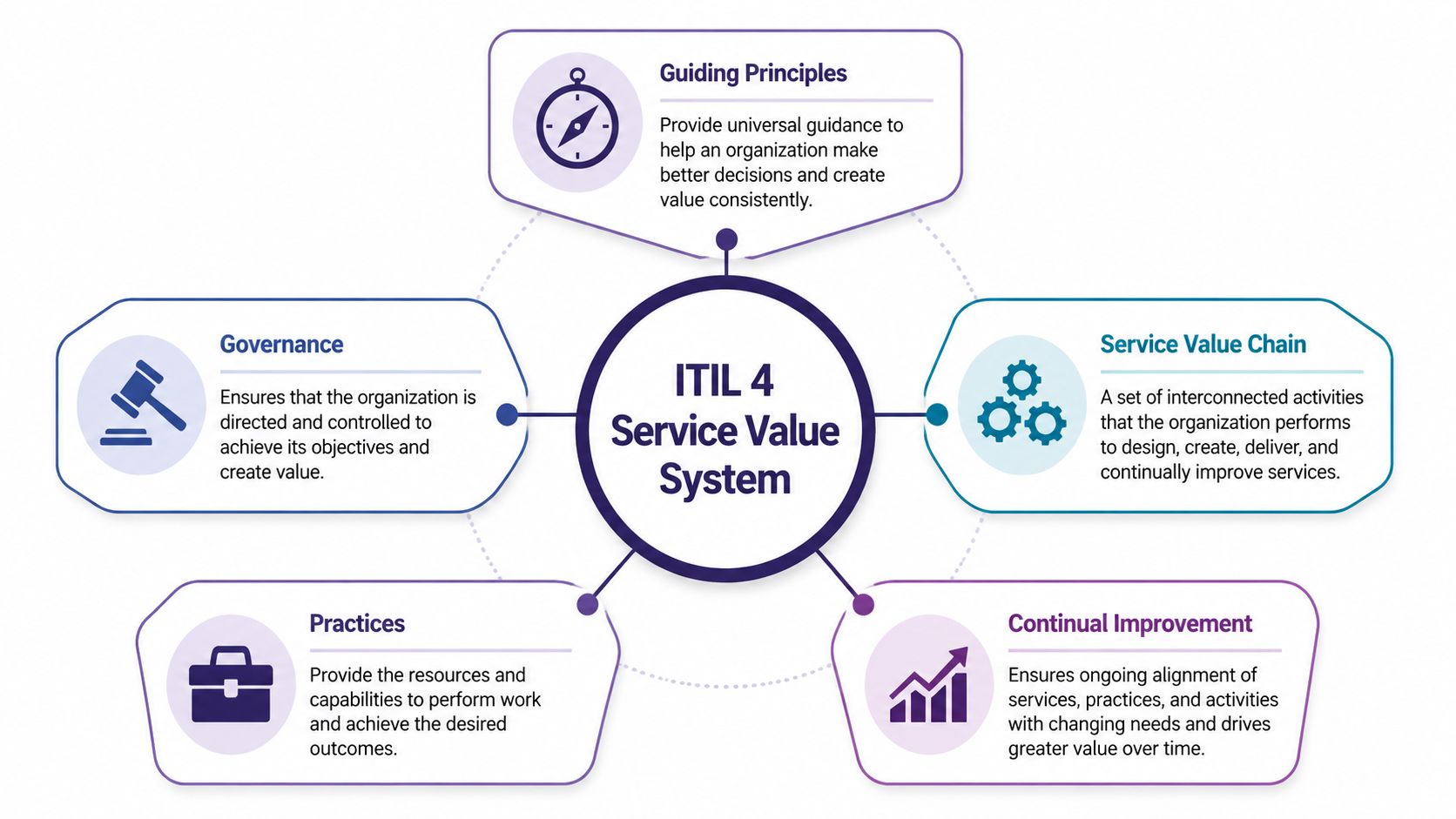
The Service Value System in plain English
The Service Value System brings together five core components. For those working in finance or data, this framework functions as the control environment surrounding a reliable reporting process.
Guiding principles These are broad recommendations for decision-making. One of the most useful is “focus on value”. For a data analyst, that means building a report that answers a business question, not one that only looks advanced.
Governance
This is the oversight layer. In finance terms, it's close to controls, accountability, and decision rights. GDPR, approval rules, audit expectations, and access permissions all sit comfortably in this kind of thinking.Service value chain
This is the flow of work that turns need into outcome. If an accountancy practice onboards a new client, it has to plan, engage with the client, design the setup, obtain the necessary information, deliver the service, and keep improving.Practices
ITIL 4 now uses practices rather than the older process-heavy model. That shift matters because real work rarely sits in neat boxes. Practices recognise that people, tools, knowledge, and routines all matter.Continual improvement
This is the discipline of making work better over time. In accounting, that might mean reducing recurring reconciliation issues by fixing root causes rather than repeatedly chasing corrections.
The four dimensions through a finance and data lens
The four dimensions model helps prevent narrow thinking. Many workplace problems happen because teams focus on one dimension and ignore the rest.
| Dimension | Finance or data example |
|---|---|
| Organisations and people | Payroll staff need clear roles, handovers, and training |
| Information and technology | Xero, Sage, QuickBooks, Excel, SQL, or Power BI must support the task properly |
| Partners and suppliers | Software providers, outsourced payroll support, and data vendors affect service quality |
| Value streams and processes | Supplier setup, VAT workflows, month-end close, and reporting cycles need sensible flow |
This is why a tool upgrade on its own doesn't solve much. A new platform can still fail if staff don't know how to use it, approval routes are unclear, or data definitions remain messy.
For teams dealing with subscriptions, software spend, and platform oversight, it also helps to understand wider IT governance for SaaS cost control. Finance and operations often need that governance mindset to keep systems useful and costs visible.
Why practices matter in real jobs
Among the 34 management practices, the service management group includes familiar areas such as incident management, problem management, service desk, change enablement, and service request management. Those ideas translate well into non-technical work.
A payroll issue, a broken data feed, a delayed supplier setup, and a failed report refresh all benefit from the same habits. Clear ownership, good communication, controlled change, and learning from repeat issues.
For an accounts assistant, that means handling requests in a consistent way. For a business analyst, it means understanding how change affects users. For a bookkeeper, it means seeing how a task links to the full service flow, not just the ledger entry in front of you.
How ITIL 4 Principles Improve Your Daily Work
The quickest way to understand itil v4 foundation is to watch it show up in ordinary work.

A data analyst handling a live reporting issue
It's Monday morning. A sales dashboard in Power BI is showing figures that don't match the finance extract. Senior managers are already using it.
Without structure, people start guessing. Someone blames the source file. Someone else edits a measure directly. A third person sends three separate messages to three different teams. Confusion grows.
An ITIL mindset changes the response.
First, the issue is treated like an incident. The analyst records what's affected, who's impacted, and what the business risk is. Then they communicate clearly. Finance knows the dashboard is under review. Users know whether to pause use. The technical team checks the data pipeline. The analyst documents the immediate workaround if one exists.
The point isn't to sound formal. The point is to stop chaos.
An accounts assistant managing requests properly
Now take a simpler example. An accounts assistant receives requests to create new suppliers. Some arrive by email. Some come on Teams. Some include bank details. Some don't. Some have approval. Some clearly haven't been checked.
That kind of work often becomes messy because no one treats it as a service. ITIL's service request management thinking helps you set a cleaner flow.
A strong routine might include:
- Defined entry point where all requests are logged in one place
- Required fields so missing information gets caught early
- Approval checks before records are created
- Status visibility so requesters know what's happening
- Basic categorisation to spot repeat delays or common errors
That's not just admin tidiness. It reduces risk. It protects data quality. It saves time for everyone involved.
When work is repeatable, don't rely on memory. Build a clear path that others can follow.
A payroll lead controlling change
Payroll teams know that change can be risky. A new pay element, a software update, or a revised approval process can all affect staff pay and trust.
That's where change enablement becomes valuable. Instead of making changes informally because “it should be fine”, the team asks sensible questions. What's changing? Who needs to know? What could go wrong? How will we test it? When should we make the change to reduce disruption?
This short explainer gives a useful visual overview of how ITIL 4 is commonly taught:
A bookkeeping example that shows continual improvement
A bookkeeper notices the same VAT coding error every month. They can fix each transaction one by one, or they can step back and ask why it keeps recurring.
That second move is very ITIL.
Maybe the expense category is unclear. Maybe the software rule is set badly. Maybe a team member never received proper training. Maybe the handoff from procurement is weak. The useful question isn't “Who made the mistake?” but “What in the service design allows this mistake to repeat?”
That's how ITIL improves your daily work. It helps you move from firefighting to improvement.
For business analysts, this approach is especially valuable because the role already sits between user need and process design. For data analysts, it strengthens communication and stakeholder handling. For accounts staff, it adds process awareness that employers often associate with more senior operational roles.
Your Guide to the ITIL 4 Foundation Exam and Training
For many learners, the exam feels more intimidating than the subject itself. In practice, the foundation level is designed as an entry point.
According to UK-facing exam guidance, the ITIL 4 Foundation exam has 40 multiple-choice questions, and you need 26 correct answers, which is 65%, to pass. There's no penalty for wrong answers, and typical UK exam pricing is reported at around £200 to £370. The same guidance notes that ITIL 4 launched in February 2019 and replaced the older ITIL v3/2011 model with the four dimensions approach and the Service Value System. Those details are set out in this ITIL 4 Foundation exam guide.
Why the exam is accessible for non-technical learners
This isn't an exam that expects you to be a network engineer or software developer. It tests your understanding of core ideas, language, and practical service management thinking.
That makes it suitable for people in:
- Bookkeeping and VAT who want stronger process and systems knowledge
- Advanced payroll roles where controlled change and incident handling matter
- Accounts assistant positions that involve requests, approvals, and software workflows
- Final accounts work where accuracy, handoffs, and service quality affect deadlines
- Business analyst pathways that require stakeholder and process understanding
- Data analyst roles where reporting services and data quality need structure
Choosing the right training format
Different learners need different study formats. The best choice depends on your schedule, confidence level, and how much support you want when applying ITIL ideas outside a traditional IT role.
| Training route | Suits who | What to consider |
|---|---|---|
| Self-paced online study | Independent learners | Good if you're disciplined and comfortable learning solo |
| Structured classroom learning | Learners who like pace and discussion | Helpful if you benefit from guided explanation |
| 1-to-1 training | Busy professionals and career changers | Useful when you want examples tailored to finance, payroll, or analytics work |
If you're already building skills in business analysis alongside service management, it's worth pairing your study with a grounding in BCS Foundation in Business Analysis. The two areas complement each other well because both help you think clearly about stakeholder needs, process design, and business value.
One sensible way to prepare
A practical study plan often works better than cramming. Try this approach:
Learn the terms first
Get comfortable with concepts like service, value, incident, change, practice, and continual improvement.Link each idea to your own job
If you work in payroll, map concepts to payroll. If you work in reporting, map them to dashboards and data issues.Use examples, not just definitions
The exam becomes easier when you can picture a real workplace situation.Review little and often
Short, repeated study sessions usually stick better than one long session.
Professional Careers Training offers ITIL 4 Foundation training as one option, including support that can suit learners who want concepts linked back to practical career paths in finance and data work.
Positioning Your CV for the UK Job Market with ITIL 4
A qualification only helps if employers can see its relevance. That's especially true when your background isn't in a traditional IT role.

What ITIL 4 signals to employers
For a UK employer, itil v4 foundation can signal several useful things at once.
It suggests you understand structured ways of working. It shows you can think about services from the user's point of view. It hints that you can work across teams, handle requests and incidents more clearly, and support controlled change.
That matters in roles such as:
- Accounts assistant moving towards systems-focused finance work
- Bookkeeper stepping into broader operations support
- Payroll professional working with process improvement or software change
- Data analyst aiming for a business analyst path
- Finance professional who regularly works with IT, software vendors, or reporting teams
How to present it on your CV
Don't just list the certification and leave it there. Connect it to work you've done.
A stronger CV might refer to:
- Improved request handling for supplier setup or access issues
- Supported controlled changes in payroll or finance systems
- Worked across teams to resolve reporting or data problems
- Mapped processes to reduce delays or repeat errors
- Focused on service quality in internal support tasks
This helps employers see the qualification as practical, not decorative.
A useful CV doesn't only say what you studied. It shows how your learning changed the way you work.
Why it helps hybrid roles
Many good career moves now sit in the middle of disciplines. Systems accountant. Finance analyst. Reporting analyst. Business analyst. Operations support. Service improvement roles inside finance or data-heavy teams.
In those jobs, technical depth matters less than the ability to connect people, systems, and process. ITIL 4 helps with that. It gives finance professionals a better way to talk to technical teams and gives analysts a stronger grasp of service impact.
If you're updating your application materials, these UK CV writing tips for finance and data roles can help you present qualifications like ITIL 4 in a way that feels relevant to hiring managers.
Next Steps on Your Professional Development Pathway
Itil v4 foundation isn't the end of your learning. It's a strong starting point. It gives you a practical framework for understanding how work flows through modern organisations and how your role contributes to better service, better control, and better outcomes.
If you're planning your wider development, combine service management knowledge with role-specific skills in finance, analysis, and software. That mix is often what makes a candidate stand out. For accountants and finance learners, it also fits naturally into a broader approach to continuing professional development for accountants.
If you want structured support with job-ready training in finance, accounting, business analysis, data analysis, and itil v4 foundation, Professional Careers Training offers flexible learning, practical software skills, and career-focused guidance for UK learners.