If you're training to become a business analyst, or you already work as one, you've probably noticed AI tools turning up in more of your...
You might be in a familiar position. You're good with numbers, careful with detail, and trusted with sensitive information, but you're no longer sure you want a career built only around ledgers, reconciliations, reports, or dashboards. You like the business side of work, yet you're increasingly drawn to the people side.
That doesn't put you off-course for HR. In the UK, it often puts you in a stronger position than you think.
A lot of people searching how to get a job in human resources assume they need a pure HR degree and a perfectly linear background. In practice, employers often hire for evidence. They want proof that you can handle confidential records, follow policy, support managers, work accurately, and deal with systems and process. If you've worked in finance, payroll, accounts support, bookkeeping, business analysis, or data analysis, you already hold part of that toolkit.
The key is to package those skills in a way that fits modern HR hiring. That's where most candidates go wrong. They undersell what they already know, then apply too broadly with generic CVs and no UK-recognised HR signal. A better route is to combine your existing strengths with targeted training and a clear story about where you fit.
Your Roadmap to a UK Human Resources Career
HR isn't an informal career path that people drift into. UK labour-market data places human resources officers within the professional workforce, and employer demand remains strong for people-management capability linked to recruitment, retention, and employee engagement, according to the human resources career outlook summary.
That matters if you're moving across from finance or data. It means you don't need to apologise for your background. You need to translate it.
Why finance and data backgrounds often fit HR well
Modern HR teams don't only need strong communicators. They need people who can work with process, compliance, records, systems, and reporting. Since team dynamics are central to HR work, our separate guide to what makes a successful team is worth reading alongside this one. That's why people from payroll, accounts support, and data-heavy roles often make solid hires for entry-level and operational HR jobs.
A finance professional usually brings habits that are valuable in HR:
- Accuracy under pressure when dealing with records, dates, pay data, and audit trails
- Confidentiality from handling payroll, personal data, or financial files
- Policy awareness from following procedures and working within controls
- Stakeholder support from answering queries clearly and keeping things organised
- Data handling from using Excel, reporting tools, or business systems
Those aren't side notes. They're central to many HR roles.
Practical rule: Employers rarely reject a good career changer because they came from finance. They reject them because the application doesn't make the HR connection obvious.
What works and what doesn't
The strongest candidates usually do three things well. They choose a realistic first HR role, they add a recognised UK HR signal such as CIPD-aligned study, and they build applications around evidence rather than enthusiasm.
What tends to work:
- A targeted move into HR admin, HR assistant, payroll and HR support, recruitment coordination, or people operations
- Relevant training that shows commitment to UK HR practice
- A CV built around tasks like onboarding support, compliance checks, payroll liaison, reporting, scheduling, and records management
What usually doesn't work:
- Applying for broad HR adviser roles too early
- Sending a finance CV unchanged
- Relying on soft statements such as “people person” or “great communicator” with no proof
If you're analytical and people-focused, HR can be a very sensible move. The route in is rarely about starting from zero. It's about using what you already have, then adding the right UK markers to become credible fast.
Mapping Your Financial Skills to Modern HR Roles
The most useful way to think about HR is not “Which HR job should I get?” but “Which part of HR already matches the work I know how to do?”
That's important because the field is shifting towards stronger demand for analytics, payroll expertise, employee relations, HRIS, and compliance skills, and these areas are often more accessible to newcomers, especially those coming from payroll, recruitment coordination, or HR administration, as outlined in this overview of entering HR without an HR degree.
Where your current training fits
If you've studied bookkeeping and VAT, your instinct for records, deadlines, and accuracy maps well to HR administration and compliance-heavy support work. If you've trained in advanced payroll, that's one of the clearest bridges into HR because payroll sits close to contracts, benefits, onboarding changes, leave records, and employee queries.
Business analyst and data analyst training can also be powerful. HR teams increasingly rely on reporting around hiring, absence, turnover, headcount, workforce planning, and employee data quality. You don't need to become an HR analyst on day one, but if you can clean data, spot patterns, and present findings clearly, you're already useful.
Leveraging Your Finance and Data Skills for HR
| Your Current Skill or Training | Relevant HR Role | Why It's a Strong Match |
|---|---|---|
| Bookkeeping and VAT | HR Administrator | Strong fit for records, process accuracy, document control, and compliance-minded work |
| Advanced Payroll | Payroll and HR Officer | Direct overlap with pay processing, employee changes, benefits coordination, and confidential data handling |
| Accounts Assistant | HR Assistant | Good foundation for admin support, query handling, spreadsheet work, and organised case support |
| Final Accounts | HR Operations Coordinator | Shows attention to detail, deadline discipline, and comfort working with formal documentation |
| Business Analyst | HRIS Coordinator or People Analyst | Useful for process mapping, reporting, system improvement, and stakeholder communication |
| Data Analyst | HR Analyst or Recruitment Reporting Support | Strong match for workforce data, hiring reports, dashboards, and trend analysis |
Best entry points for career changers
Not every HR role is equally open to someone switching careers. The easier first moves are usually operational.
The most realistic options include:
- HR Administrator for document handling, offer packs, onboarding, and systems updates
- HR Assistant for general team support, employee records, meeting coordination, and policy admin
- Payroll and HR support for people with payroll training or payroll office experience
- Recruitment Coordinator for interview scheduling, candidate communication, and hiring process support
- People Operations support in firms that combine systems, reporting, and employee administration
If your background is numerical, don't hide it. HR teams need people who can trust the data as much as they trust the conversation.
A common mistake is aiming straight for employee relations or strategic advisory work without first building enough HR-specific exposure. A better move is to enter through payroll, admin, reporting, or coordination, then widen your scope once you're inside the function.
Gaining the Right UK Qualifications and Certifications
If you want to be taken seriously in the UK HR market, you need a qualification path employers recognise. The clearest one is CIPD.
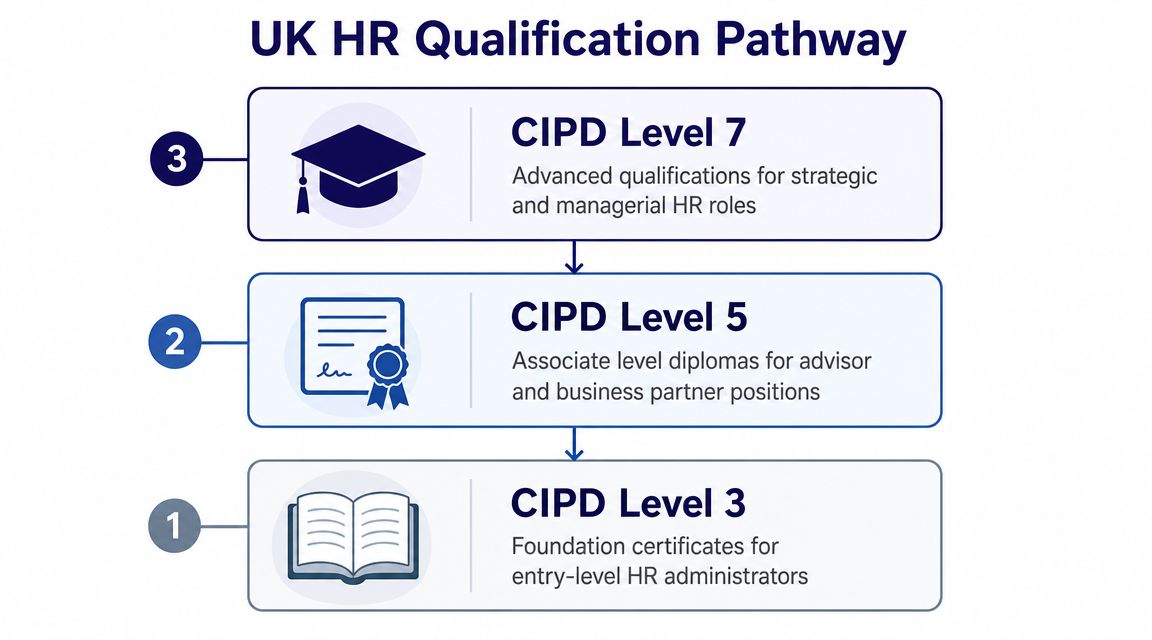
In the UK, CIPD is the main professional body for HR and people development. Its framework includes Foundation, Associate, and Advanced levels that map to different career stages, and employers often see CIPD study as a credible signal that a candidate understands core topics such as employment law and recruitment. The same source notes that CIPD has had around 160,000 members worldwide in recent years, which shows how widely used its standards are, as explained in this overview of HR career outlook and CIPD pathways.
Which CIPD level usually makes sense
For individuals moving into HR from finance, payroll, or data, the starting question is simple. Are you entering HR for the first time, or are you already working close to people processes?
A practical guide looks like this:
- Foundation level often suits people starting out, returning to study, or changing career
- Associate level tends to fit those with more workplace exposure and a clearer path into adviser-level work
- Advanced level is usually for experienced practitioners moving towards strategic roles
If you're comparing options, this guide to the CIPD Level 5 route is useful for understanding whether Associate-level study fits your stage.
Pair HR study with practical tools
CIPD gives you the professional benchmark. It doesn't replace job-ready software skills.
If your aim is employability, pair HR study with practical tools that support operational work:
- Advanced Excel for HR reporting, trackers, absence logs, onboarding lists, and audit checks
- Sage, Xero, or QuickBooks exposure if your target roles sit near payroll or shared services
- Payroll training if you want a route into compensation support, payroll liaison, or HR operations
- Business analysis or data analysis training if you're aiming for HR systems, reporting, or workforce analytics
This combination stands out. A candidate with CIPD-aligned learning plus usable Excel, payroll knowledge, and strong systems confidence often looks more practical than someone with theory alone.
Trade-offs to think through
There isn't one perfect combination. There is only the best fit for the role you're targeting.
If you want a quick route into employment, payroll and HR admin can be more accessible than broad HR generalist jobs. If you want a longer-term path into advisory or business partner work, CIPD usually carries more weight. If you're strongest in reporting and systems, an HRIS or people data angle may be your entry point.
Choose the qualification mix that matches the jobs you can realistically win now, not the title you'd like in three years.
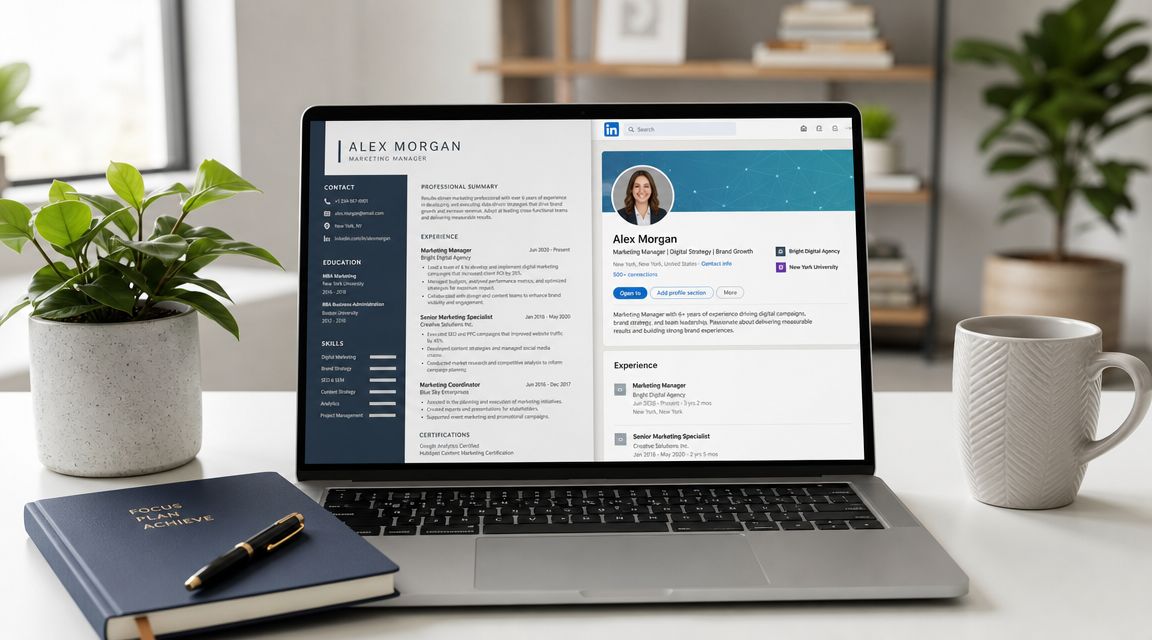
Building a Job-Winning CV and LinkedIn Profile
Most HR applications fail because the candidate describes their old job, not the new one they want. Recruiters don't need proof that you were busy. They need proof that your past work lines up with HR tasks.
A successful UK pathway into HR is best treated as a competency-and-evidence problem. A common pitfall is applying with generic admin experience and no clear people-process exposure. The highest-yield method is to map each part of the job description to evidence from payroll, onboarding, compliance, or related work, as discussed in this guide to entry-level HR hiring.
Rewrite your CV in HR language
Here is where career changers either gain traction or disappear.
Instead of writing finance bullets that stay finance-heavy, reframe them around HR-relevant capability.
| Before | Better HR-focused version |
|---|---|
| Reconciled monthly accounts | Managed sensitive data accurately and worked to strict deadlines, showing the level of control needed for employee records and payroll support |
| Processed supplier invoices | Maintained high-volume documentation and followed approval processes, relevant to HR administration and compliance workflows |
| Produced weekly reports | Built and maintained reporting for stakeholders, useful for HR metrics, recruitment tracking, and people data accuracy |
| Responded to payment queries | Resolved time-sensitive queries professionally, a strong match for employee support and payroll-related communication |
| Updated finance systems | Kept core systems accurate and current, relevant to HRIS updates and maintaining employee records |
Build a LinkedIn profile that signals your move clearly
Your LinkedIn profile should do three jobs. It should show your target direction, include searchable keywords, and make your background look relevant rather than accidental.
A simple approach works well:
- Headline such as “Payroll and Data Professional transitioning into HR Operations” or “Finance Administrator pursuing HR and People Operations roles”
- About section focused on confidentiality, process, stakeholder support, systems, and HR-aligned training
- Skills section including payroll, HR administration, onboarding, compliance, Excel, reporting, HRIS, recruitment coordination where relevant
- Featured section with a polished CV or short post about your professional development
If you want a stronger online presence, this resource on LinkedIn personal branding gives useful ideas for making your profile more discoverable and more coherent.
You can also sharpen the practical side of your profile and outreach with this guide on using LinkedIn for job search.
CV test: If someone removed the job titles from your CV, would the bullet points still suggest HR capability? If not, rewrite them.
Don't waste your cover letter
A cover letter doesn't need to tell your life story. It needs to make one argument.
Use this structure:
-
State the move clearly
Explain that you're moving from finance, payroll, or data into HR operations or HR support. -
Show the overlap
Point to confidential data handling, policy-led work, reporting, systems, stakeholder support, or process accuracy. -
Add the UK credibility piece
Mention CIPD study, payroll training, or other relevant learning. -
Close on value
Explain how your background helps the team handle people processes reliably and professionally.
That is usually enough.
Smart Job Hunting and Interview Preparation
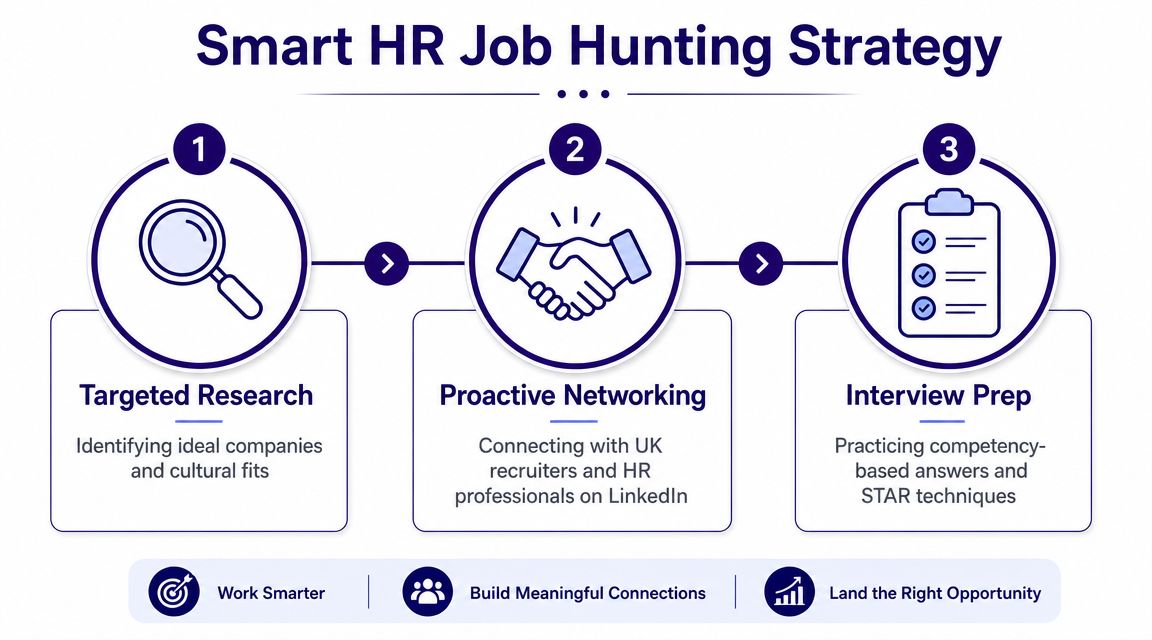
Job hunting for HR works best when you stop thinking like a mass applicant and start thinking like a targeted candidate. Broad advice such as “network more” or “apply everywhere” isn't enough, especially in the UK where many employers still lean on recognisable entry routes like CIPD, apprenticeships, and internal moves, as noted in this practical guide to getting into HR.
Target the right employers
A finance or data background tends to carry more weight in businesses that value process and regulated operations.
Look closely at:
- Financial services and FinTech where payroll, compliance, and systems discipline matter
- Professional services firms with structured HR operations
- Larger employers that have separate HR admin, payroll, recruitment, and HRIS teams
- Shared service environments where people data and process quality are central
- Remote-first firms if you're comfortable with systems and self-management
If remote work is part of your search, this round-up of a job search platform for remote HR professionals can help you spot people operations and HR roles that aren't always visible on standard boards.
Use networking in a practical way
Many job seekers overcomplicate networking. You don't need polished “coffee chat” scripts. You need relevant conversations with a clear reason behind them.
A practical weekly routine:
- Connect with HR recruiters who handle assistant, coordinator, payroll, and people operations roles
- Follow HR leaders in sectors where your background fits
- Comment usefully on posts about onboarding, payroll changes, HR systems, or employee operations
- Message with context by explaining your transition and the specific HR support roles you're targeting
Video guidance can also help if you're preparing for interviews and outreach:
Prepare STAR answers from your existing experience
Many career changers think they have no HR examples. Usually, they do. They just haven't framed them properly.
Suppose you're asked, “Tell me about a time you handled a sensitive issue with accuracy and professionalism.”
A finance-to-HR STAR answer might sound like this:
In a payroll-related support task, I noticed a discrepancy affecting employee pay records before the processing deadline. I checked the source data, confirmed the issue against the approved documentation, and raised it quickly with the relevant colleague. I then updated the records carefully and kept communication clear so the correction could be made without confusion. The result was an accurate outcome, a controlled process, and a better understanding on my part of how important confidentiality and precision are when work affects employees directly.
That answer works because it shows judgement, accuracy, communication, and discretion. Those are HR behaviours.
For more help with structuring strong answers, this guide on how to prepare for job interviews is a practical place to start.
Your HR Career Timeline and Action Checklist
A move into HR becomes much easier when you treat it like a short project with clear stages. You don't need to do everything at once. You do need momentum.
A realistic short-term timeline
A simple timeline can keep the process focused.
First phase
Audit your current experience. Pull out anything related to payroll, compliance, employee records, onboarding support, scheduling, reporting, systems, or stakeholder communication. Choose the HR job titles that best match that evidence.
Second phase
Start or shortlist CIPD-aligned study. At the same time, strengthen one practical area that supports employability, such as advanced payroll, Excel, bookkeeping and VAT knowledge, or data reporting.
Third phase
Rewrite your CV and LinkedIn profile around HR language. Apply for realistic entry points such as HR Administrator, HR Assistant, Payroll and HR Officer, Recruitment Coordinator, or People Operations support.
Fourth phase
Prepare interview stories from your existing work. Focus on confidentiality, process improvement, accuracy, dealing with queries, meeting deadlines, and using systems well.
Your action checklist
Use this as a working list rather than a one-off exercise.
- Pick a target route such as payroll into HR, HR admin, recruitment coordination, or people analytics support
- Match your current skills to HR tasks instead of describing yourself in broad terms
- Choose the right qualification level based on whether you're entering, progressing, or repositioning
- Add practical software or reporting skills that support real HR work
- Rewrite your CV bullets so they show people-process evidence
- Update LinkedIn with an HR-facing headline and clear keyword signals
- Apply selectively rather than sending the same application everywhere
- Build STAR examples from finance, data, or payroll work
- Speak to recruiters who understand operational HR hiring
- Stay consistent for long enough to let the repositioning work
The best HR career changers don't pretend they were already in HR. They prove they were already doing parts of HR work well.
If you're coming from finance, bookkeeping, payroll, accounts support, business analysis, or data analysis, your background can be an advantage. HR teams need people who are organised, accurate, discreet, and comfortable with systems. That's already familiar ground for you. Your task now is to connect those strengths to the right entry role and support them with recognised UK training.
If you want structured help turning finance, payroll, or data skills into job-ready HR applications, Professional Careers Training offers practical training, software certifications, CV support, LinkedIn optimisation, and job-hunting guidance designed for UK career changers and trainees.