If you're training to become a business analyst, or you already work as one, you've probably noticed AI tools turning up in more of your...
If you’ve been searching what does an accountant manager do, you’re probably not looking for a vague job description. You want the practical version. What do they do each day? What skills do employers want? And how do courses in bookkeeping, payroll, final accounts, business analysis, or data analysis help you get there?
The short answer is this. An accounting manager doesn’t just process finance work. They run the finance operation behind the scenes, keep controls tight, support reporting, and make sure the numbers are reliable enough for managers, auditors, and directors to use.
Moving Beyond the Ledger
A lot of people think promotion in finance means doing the same work at a higher level. That isn’t really how the accounting manager role works.
When you move into this job, your focus shifts. You’re no longer judged only on whether you posted the journal correctly or reconciled the bank on time. You’re judged on whether the whole process works. That includes the team, the systems, the deadlines, the controls, and the quality of the information going upward to decision-makers.

In the UK, that wider responsibility didn’t appear by accident. The role evolved from simple supervision into a control-focused management function tied to governance and decision support, influenced by regulation such as the FCA’s Senior Managers Regime, which formalised oversight responsibilities.
That matters because it explains why UK employers often expect far more than bookkeeping knowledge.
What that shift feels like in real life
Think of two people in the same finance team.
- The bookkeeper records sales, purchases, receipts, and payments.
- The accounting manager checks whether the process around those records is sound, whether deadlines are met, whether reconciliations are complete, and whether the final reports can be trusted.
One role is essential to recording the past.
The other is responsible for controlling the process and helping the business act on the numbers.
Career coach view: If you enjoy spotting gaps, improving workflows, checking accuracy, and helping others work better, you’re already thinking like an accounting manager.
For many learners, the relevance of training becomes clearer. A bookkeeping course helps you understand the entries. A VAT course helps you understand compliance. But management-level progression comes when you can connect those tasks into a complete finance process.
What an Accounting Manager Really Is
An accounting manager keeps the finance function orderly, accurate, and useful. If the bookkeeper records the transactions and the finance director focuses on bigger commercial decisions, the accounting manager sits in the middle and makes sure the numbers can be trusted before anyone acts on them.
In a UK business, that usually means more than checking a ledger. It means overseeing the flow of information from sales, purchases, payroll, expenses, and bank activity into reports that managers can use. The role combines technical accounting, team supervision, deadline control, and systems know-how.
The core purpose of the job
At its heart, the job has three linked aims.
-
Keep the numbers reliable
An accounting manager checks that postings are correct, reconciliations are completed, and errors are spotted before they end up in management reports, VAT work, or year-end accounts. -
Run the accounting cycle properly
They keep daily processing, month-end close, and audit preparation on track, so nothing important is missed and reporting does not become a last-minute scramble. -
Manage people, processes, and software
They review work, answer technical questions, improve routines, and make sure finance tools such as Xero or Sage are being used well rather than superficially.
The role is more than senior bookkeeping. It is finance operations management.
What employers usually mean by the title
UK employers often use the title “accounting manager” for someone who owns the quality of the finance process from start to finish. That can include management accounts, balance sheet reconciliations, budget support, audit preparation, payroll oversight, and deadline management.
A useful way to understand the difference is this. A junior team member may post an invoice. The accounting manager checks whether the invoice has been coded correctly, whether the control account still reconciles, whether the VAT treatment is right, and whether the result will distort the month-end figures. They are looking at the full chain, not just one task.
That distinction explains why job adverts often ask for a mix of reporting, analysis, supervision, and systems experience. Employers want someone who can turn busy finance activity into clear, dependable information. If you have practised how to prepare management accounts, you are already building part of that bigger-picture skill set.
A strong accounting manager keeps asking two practical questions. Are the numbers right, and can the business rely on them?
What the role is not
An accounting manager’s role is more than being the most experienced person doing transactional work. They are responsible for the standard of the whole process.
They are also not usually the person setting company-wide strategy. That tends to sit with a finance manager, financial controller, or finance director, depending on the size of the organisation. The accounting manager is closer to the engine room. They make sure the monthly numbers are accurate, the team follows proper procedures, and financial information reaches decision-makers in a form they can use.
That practical focus is one reason software skills matter so much in the UK jobs market. A course in bookkeeping teaches the logic of double entry. Payroll training helps you understand one of the most sensitive areas in finance. Data analysis training helps you spot patterns, exceptions, and reporting issues faster. Experience with Xero or Sage shows employers that you can manage workflows inside the systems they already use.
There is another part of the role that often gets overlooked. Accounting managers may also need to help protect client data in accounting, especially when teams handle payroll records, supplier details, bank information, and cloud-based finance software.
If you are moving up from accounts assistant, payroll, or bookkeeping work, the mindset shift is clear. Your value no longer comes only from completing your own tasks correctly. It comes from making sure the whole finance process works correctly, every month, under pressure.
A Day in the Life Your Key Responsibilities
The rhythm of this job makes more sense when you break it into daily, monthly, and annual work.

In UK accounting operations, an accounting manager is often the control-owner for the general ledger and sub-ledgers, overseeing reconciliations across accounts payable, accounts receivable, payroll, cash, and fixed assets so errors don’t flow into VAT returns or financial reports, as described in this accounting manager responsibilities summary.
Daily responsibilities
Some days are about people. Some are about exceptions.
A typical day might include:
- Reviewing team output so purchase invoices, sales postings, expenses, and journals are coded correctly
- Answering complex queries when a junior team member isn’t sure how to treat a transaction
- Checking reconciliations for bank accounts, supplier balances, customer accounts, or control accounts
- Monitoring payroll and VAT issues where a mistake could become a compliance problem
- Keeping systems tidy in software such as Xero, Sage, or QuickBooks
The role is still hands-on, but not in the same way as an accounts assistant role. You’re often reviewing, approving, and solving rather than processing everything yourself.
Because finance teams handle sensitive information every day, it’s also wise to understand how firms protect client data in accounting when documents, payroll records, and cloud systems are shared across teams.
Monthly responsibilities
At this point, the pressure usually rises.
Month-end is one of the clearest tests of whether someone can perform at accounting manager level. You’re expected to keep the close on track, review accruals and prepayments, clear suspense items, ensure balance sheet reconciliations are complete, and prepare management accounts that make sense.
If you’re still building confidence in that area, this practical guide on how to prepare management accounts helps show what employers expect to see.
Monthly work often includes:
- Leading the month-end close
- Reviewing journals, including accruals, prepayments, depreciation, and payroll postings
- Checking ledger integrity before reports go to management
- Producing management accounts with commentary on variances
- Following up unusual movements that need explanation
Practical rule: If the balance sheet hasn’t been reviewed properly, the profit figure may look tidy while the underlying records are still wrong.
Annual responsibilities
The annual cycle adds another layer.
An accounting manager often helps prepare for audit, gathers support for key balances, works with external accountants or auditors, supports budget preparation, and helps maintain year-end reporting quality. In some organisations, they also oversee parts of grants, treasury, debt, or external reporting.
That means final accounts knowledge isn’t optional. You need to understand how the monthly story becomes the year-end story.
The Skills That Get You Hired and Promoted
A strong accounting manager has a mix of technical control and human judgement. If either side is weak, the role gets harder.
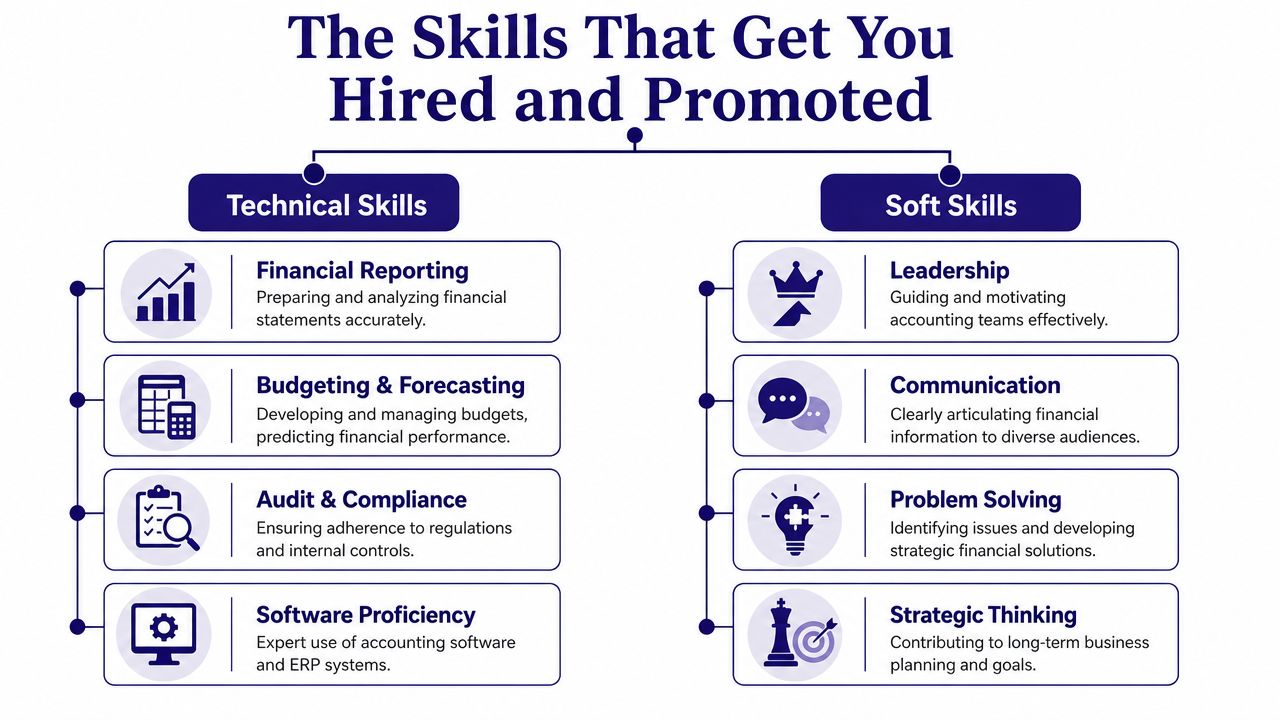
Technology is changing what employers expect. The modern UK accounting manager needs skills beyond manual bookkeeping, with growing demand for proficiency in Xero, Sage, QuickBooks, Power BI, and SQL, as noted in this discussion of the technology-heavy accounting manager role.
Technical skills that employers look for
The best way to understand technical skills is to connect them directly to training.
Bookkeeping and VAT
This is your base.
If you can’t read a ledger, spot mispostings, understand VAT treatment, or follow a transaction from source document to trial balance, you won’t manage the process well. Bookkeeping and VAT training helps you supervise purchase ledger, sales ledger, bank postings, control accounts, and indirect tax routines with confidence.
Managers review work done by others, making it necessary to have enough depth to catch errors quickly.
Advanced payroll
Payroll is one of the most sensitive areas in finance.
An accounting manager may not run every payroll file personally, but they often oversee payroll controls, posting accuracy, deadlines, and the connection between payroll outputs and the nominal ledger. Advanced payroll training gives you the practical language to understand payslips, deductions, pension-related entries, payroll journals, and compliance risks.
If you’ve only seen payroll from a distance, this is a very sensible upskilling area.
Accounts assistant experience
This might sound basic, but it isn’t.
Many good accounting managers started in accounts assistant work because it teaches the practical mechanics of finance. You learn invoice flow, supplier issues, customer receipts, account coding, credit control pressure, and document handling. That practical grounding helps you manage a team later because you understand where errors happen.
Final accounts
This is one of the clearest progression points.
Final accounts training helps you understand how trial balance adjustments, accruals, prepayments, depreciation, and corrections feed into financial statements. When month-end problems appear, this knowledge helps you diagnose the issue instead of just chasing figures around a spreadsheet.
Business analyst and data analyst skills
Many candidates can stand out in this area.
Modern accounting managers don’t just report numbers. They interpret them. That means using Excel well, building clear reports, spotting trends, and turning raw data into management insight. Training in business analysis or data analysis can help you work with exports from Sage, Xero, or QuickBooks, then turn them into useful dashboards or variance commentary.
You don’t need to become a data scientist. You do need to be comfortable asking good questions of the data.
Soft skills that move you into management
Technical strength gets you noticed. Soft skills often get you promoted.
A useful starting point is this guide to leadership skills, especially if you’re moving from individual contributor to team lead. You can also build the management side of your profile through focused learning on leadership skills for managers.
The soft skills that matter most include:
-
Leadership
You need to review work fairly, give feedback, and keep standards high without demoralising the team. -
Communication
A good manager explains accounting issues in plain English to directors, auditors, and non-finance staff. -
Problem-solving
Finance rarely goes exactly to plan. Systems break, postings fail, deadlines clash, and someone always finds an old issue at the wrong moment. -
Judgement
Not every issue needs escalation. Part of the role is knowing what you can resolve yourself and what needs wider input.
Strong accounting managers don’t hide behind jargon. They make messy financial information understandable and usable.
Accounting Manager vs Other Finance Roles
Job titles can be messy in the UK. One company calls someone an accounting manager. Another calls the same person a finance manager. Another uses controller.
That overlap is real. But there is still a useful distinction. In the UK job market, the accounting manager title often overlaps with finance manager or controller roles, yet the key differentiator is that the accounting manager is usually a compliance-and-control role focused on enforcing policies and coordinating audits, not just supervising people, as explained in this career summary of the accounting manager role.
Finance role comparison
| Attribute | Senior Accountant | Accounting Manager | Finance Manager |
|---|---|---|---|
| Primary focus | Completing complex accounting work | Overseeing controls, processes, and team output | Supporting financial planning and wider business decisions |
| Day-to-day emphasis | Technical delivery | Review, control, reporting, staff supervision | Strategy, budgeting, business partnering |
| Ownership | Individual tasks and technical areas | Month-end process, ledger integrity, audit readiness | Department direction and commercial support |
| Team responsibility | May mentor juniors informally | Usually manages or coordinates finance staff | Often leads broader finance function |
| Best fit for | Strong technical accountant | Process leader who likes control and coaching | Commercially minded finance professional |
The simplest way to tell the difference
A senior accountant is usually the experienced doer. They handle more difficult accounting work and often support junior staff.
An accounting manager owns the process. They make sure the team output is correct, the ledgers are controlled, the close is on time, and the audit trail is solid.
A finance manager usually has a broader brief. They may be more involved in planning, stakeholder management, and business performance.
If you’re unsure where management accounting fits into this picture, this guide on what a management accountant does can help you separate reporting, analysis, and control-focused roles.
Some job adverts use the title loosely. Read the duties, not just the heading.
Your Path to Becoming an Accounting Manager
It usually starts with a familiar scene. You are posting journals, checking bank reconciliations, answering payroll queries, or helping with month-end. Then one day you realise the next step is no longer about doing your part well. It is about making sure the whole finance process runs properly, on time, and without loose ends.
That is the shift into accounting management.
A common UK route begins in roles such as accounts assistant, bookkeeper, payroll administrator, or junior accountant. From there, people build wider responsibility through reconciliations, accruals and prepayments, month-end support, reporting packs, and audit preparation. The step after that is often senior accountant, finance team lead, or a similar post where you review work, solve problems, and keep deadlines on track.
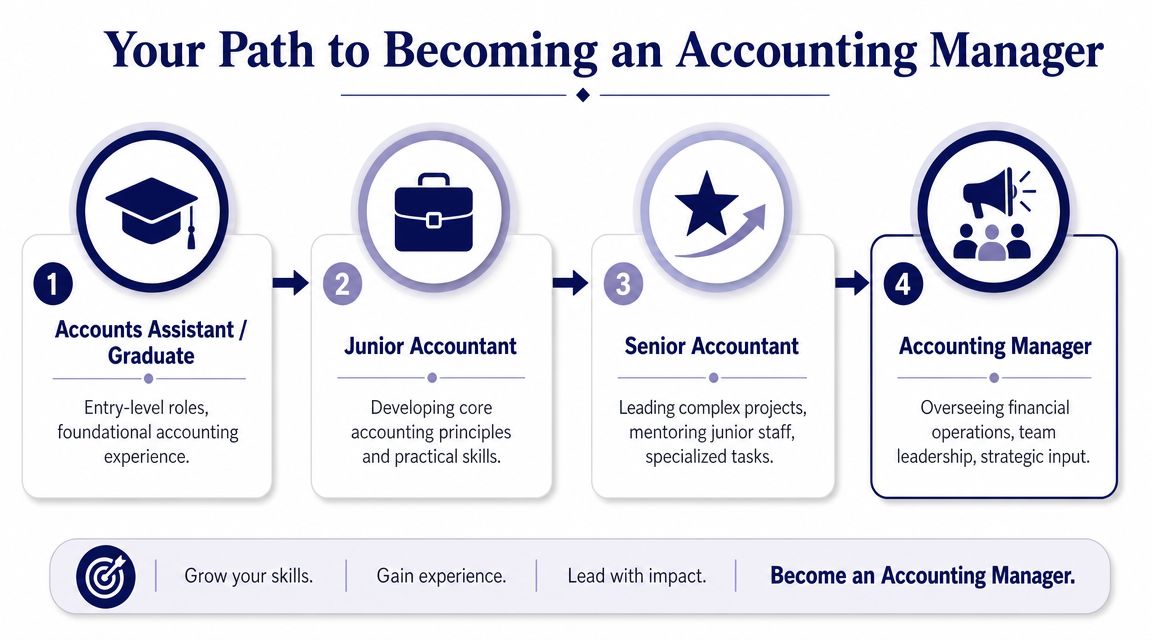
In UK employers’ terms, the move happens when you can do more than process transactions. You can check the numbers, explain them, spot issues early, and keep the team organised. Many accounting manager jobs also expect you to support budgets, forecasts, variance analysis, and management information. In plain English, that means turning raw figures into useful answers for the business.
What to build before you apply
Employers usually look for evidence that you can own a process from start to finish. A good way to picture it is this. An accounts assistant handles parts of the machine. An accounting manager keeps the whole machine running.
Useful stepping stones include:
- Month-end exposure through journals, reconciliations, accruals, prepayments, and management accounts support
- Ledger control experience across purchase ledger, sales ledger, bank, payroll, VAT, and fixed assets
- Audit support such as preparing schedules, explaining balance movements, and keeping backup clear
- Reporting practice using Excel and software outputs to produce information someone else can act on
- Process improvement examples where you reduced errors, shortened a routine, or made a report easier to review
These are the experiences that show readiness for responsibility.
How training strengthens your CV
Training matters most when it closes a specific gap between your current job and the one you want.
If your background is mainly transactional, study final accounts and management reporting so you can understand the bigger picture behind the entries. If payroll sits outside your current role, advanced payroll gives you practical knowledge that employers value because payroll affects controls, deadlines, and staff trust. If you are confident with the accounting but less confident explaining trends, business analyst or data analyst training can help you use Excel, Power BI, or SQL to turn figures into insights.
Software matters too. UK employers often ask for working knowledge of Xero, Sage, or QuickBooks because managers are expected to review reports, check ledger accuracy, and investigate issues inside the system, not just export data from it. Knowing the software shortens your learning curve and makes your CV easier to shortlist.
How to show management potential before you have the title
You do not need “manager” on your payslip to prove you can do the job.
In interviews, talk about examples where you:
- trained or supported a junior colleague
- improved a reconciliation or reporting process
- spotted an error before month-end closed
- resolved a difficult supplier, payroll, or customer query
- worked with auditors or other departments to get information quickly
- explained financial results clearly to a senior non-finance colleague
Those are all signs of management potential because they show judgement, ownership, and communication.
The accounting manager role suits people who like structure and who get satisfaction from making the numbers reliable. If that sounds like you, the path is usually closer than it looks.
If you’re ready to turn accounting knowledge into job-ready management skills, Professional Careers Training offers practical training across bookkeeping and VAT, advanced payroll, accounts assistant skills, final accounts, business analysis, and data analysis. Their flexible approach, software training in Sage, Xero, and QuickBooks, and career support can help you build the kind of experience UK employers look for when hiring accounting managers.