
You're probably reading this because your life doesn't have room for a traditional college timetable. Maybe you're working full time. Maybe you're coming back after...
You're probably reading this because your life doesn't have room for a traditional college timetable.
Maybe you're working full time. Maybe you're coming back after a career break. Maybe you've finished a degree but still don't feel job-ready. That's common in accounting and finance. Plenty of people know the theory but haven't yet built the practical confidence employers expect.
That's why AAT at home makes sense for a lot of UK learners. It gives you a structured route into accounting without forcing you to stop earning, stop parenting, or stop dealing with real life. When done properly, it can move you towards roles like Bookkeeper, Accounts Assistant, Payroll Administrator, Business Analyst support, and even more data-focused finance work.
Home study only works if you treat it like career training, not casual learning. You need a clear level choice, a realistic study plan, software practice, and a plan for turning the qualification into interviews. If you get those parts right, studying from home can be a smart and practical way into the UK finance job market.
Is Studying AAT at Home Right For You
It's 8:30pm. Work is done, the house is quieter, and you're wondering whether an accounting qualification can fit around the rest of your life without turning into another half-finished plan. That is the main challenge of AAT at home.
For the right person, home study is a smart route into finance work. It gives you a clear path into roles such as Bookkeeper, Accounts Assistant, and Payroll Administrator without forcing you into a fixed college timetable. But only if you treat it as job preparation from day one. Your goal is not to “study accounting.” Your goal is to become useful to an employer.

When home study is a strong choice
AAT at home suits you if your routine is busy but predictable enough to protect regular study time. It works well for adults who need flexibility and want a structured qualification that leads to practical finance work, not vague “business skills”.
It is a good fit if you:
- Need flexible study hours around work, childcare, or shift patterns
- Prefer learning in steady blocks instead of travelling to weekly classes
- Want a recognised route into UK accounting support roles
- Need practical training linked to bookkeeping, reconciliations, VAT, payroll, and finance admin
- Can work to a routine without waiting for someone else to push you
The key question is simple. Can you stick to a timetable when nobody is chasing you?
If the answer is yes, home study can work very well. If the answer is no, fix that first. AAT from home rewards consistency, not last-minute panic.
What employers care about
Many learners worry that studying from home will look weaker on a CV. That is not what usually decides the outcome.
UK employers care about whether you can step into the work. Can you process invoices correctly? Can you handle bank reconciliations? Do you understand VAT basics, purchase ledger, sales ledger, payroll inputs, and month-end support? Can you use accounting software with confidence? Those are the points that move you closer to interview shortlists.
That is why home study needs to connect to real office tasks. If your course provider gives tutor support, exam prep, and practical exercises, good. If you also build software confidence in tools employers ask for, even better. That combination makes your AAT study look far more credible than passive learning with no evidence of application.
Strong study habits matter here. Vivora for online student success is a useful resource if you need help building consistency in a remote learning routine.
If you are unsure whether home learning matches the way you work best, review this comparison of online training vs classroom learning. Choose the format that fits your week and helps you finish.
The honest way to decide
Do not ask whether AAT at home is possible. It is.
Ask whether you can turn home study into evidence of job-readiness. That means regular study hours, a provider with support, practice that reflects finance tasks, and a plan to talk about those skills in applications and interviews.
If you want flexibility and you are prepared to study with discipline, AAT at home is a strong choice. If you want someone else to create the routine for you, a classroom option may suit you better.
Choosing Your AAT Level and Training Provider
Choosing the right starting point matters more than people think. If you start too high, you'll struggle. If you start too low, you may waste time. The best choice is the level that matches your current knowledge and your target role.
What each AAT level leads towards
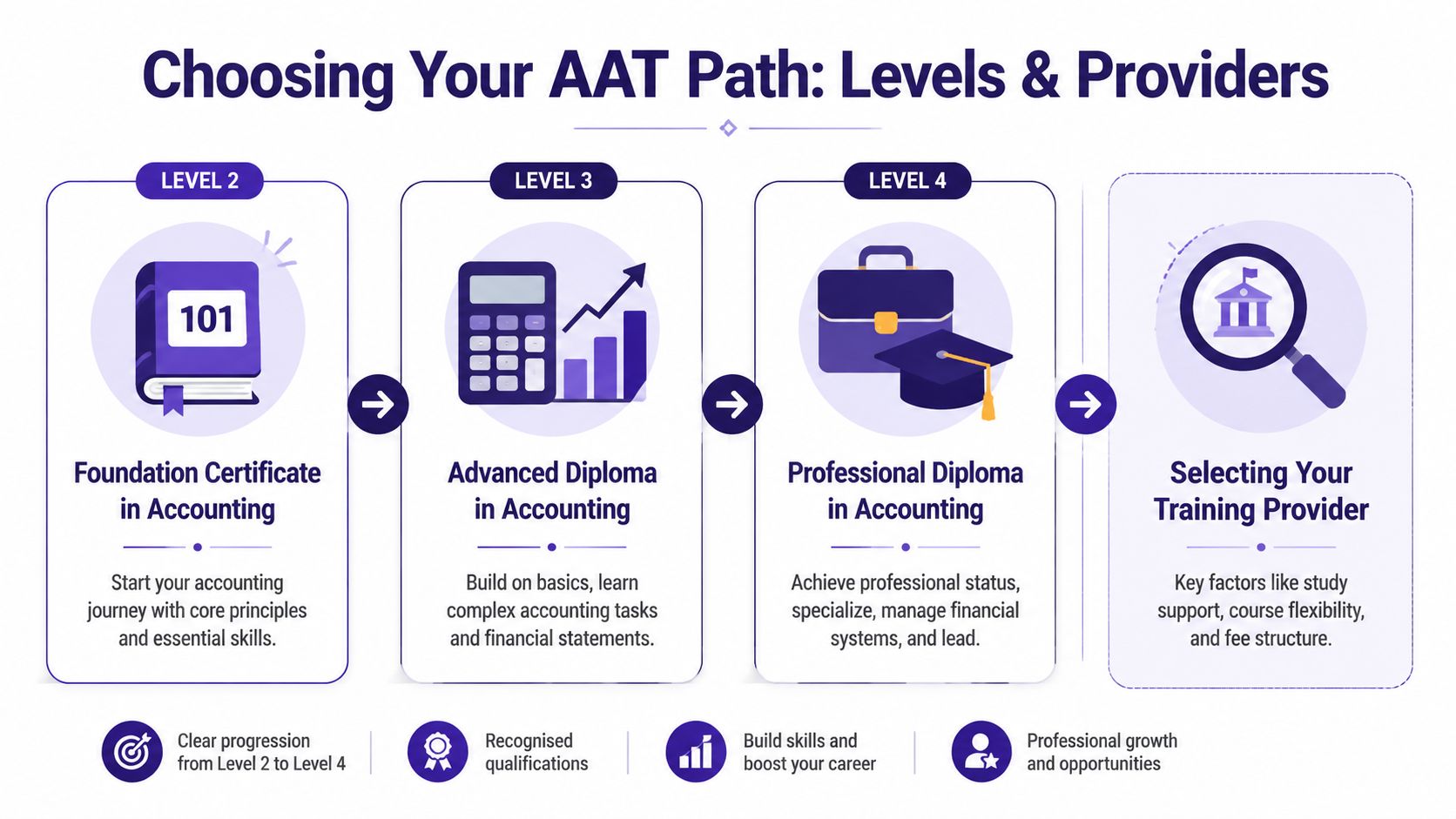
Here's the practical way to think about the main levels.
| AAT level | Best for | Job-readiness focus |
|---|---|---|
| Level 2 | Beginners | Core bookkeeping, finance admin, entry-level accounts support |
| Level 3 | Learners with basics in place | More advanced bookkeeping, VAT, final accounts support, payroll understanding |
| Level 4 | Learners aiming higher | Professional accounting tasks, stronger reporting, more responsibility in finance teams |
According to an AAT webinar transcript on remote study and assessments, Level 2 Accounting has 4 units and 4 assessments, Level 3 has 4 units and typically takes around 9 to 12 months, and Level 4 has 5 units with around 12 months expected completion time. The same source reports pass rates of 93.2% at Level 2 and 92.3% at Level 3.
Those figures matter. They show that remote learning can still produce strong outcomes when the course is structured properly.
My advice on where to start
Start with Level 2 if you're changing career, returning to work, or don't yet feel confident with double-entry basics. This level is where future Accounts Assistants and Junior Bookkeepers build their base.
Move into Level 3 when you want stronger responsibility. This is the level where home study starts translating more clearly into practical tasks employers recognise, such as bookkeeping and VAT work, support with final accounts, and broader finance team duties.
Aim for Level 4 if you want to look more credible for higher-level finance roles or build towards broader accounting responsibility. It also helps if you want a stronger platform for future progression.
If you're unsure, read through a practical overview of AAT Level 2 distance learning and compare the content with the work you can already do.
How to judge a training provider properly
Price is often the primary factor when choosing a provider. I think that's a mistake. Cheap training is expensive if it leaves you unprepared.
Check for these points:
- Human support. You need access to tutors who can explain why an answer is wrong, not just mark it wrong.
- Flexible scheduling. Evening and weekend options matter if you're working.
- Software access. If training ignores Sage, Xero, or QuickBooks, it's incomplete.
- Practical exercises. You need tasks that resemble real finance work.
- Clear exam guidance. Remote exams have procedures. Your provider should prepare you for them.
- Career relevance. The course should help you connect units to roles such as bookkeeper, payroll administrator, accounts assistant, or finance analyst support.
A provider isn't just selling lessons. They're shaping how quickly you become useful to an employer.
Match the course to the role
If your goal is bookkeeping and VAT, make sure the course and support build confidence in day-to-day transaction work.
If your goal is advanced payroll, look for training that doesn't treat payroll as an afterthought.
If your target is business analyst or data analyst support, don't rely on AAT alone. Use AAT for finance logic, then add Excel-heavy reporting, data handling, and system confidence around it.
That combination is far more powerful than qualification-only thinking.
Creating Your Personalised Study Plan
AAT at home works best when your week already has a place for it. If you “fit study in when possible”, you probably won't keep going.
Your plan needs to be boring, realistic, and repeatable. That's good. The learners who finish aren't usually the most naturally gifted. They're the ones who keep showing up.
Build a weekly routine you can keep
Start with your actual life, not your ideal life. If you work full time, don't pretend you'll study every night for hours. Students burn out when they build a fantasy timetable.
A practical weekly plan usually includes:
- Two focused weekday sessions for reading, question practice, or tutor support
- One longer weekend block for deeper work such as mock tasks or software practice
- One short review slot for checking weak areas and planning the next week
Put those sessions in your calendar now. Treat them like fixed appointments.
Set up a workspace that reduces friction
You don't need a perfect home office. You do need a space where you can start quickly.
Keep these basics ready:
- Laptop or desktop that can handle course platforms and exam software
- Reliable internet
- Notebook or digital notes system
- Calculator if required for your learning style
- Quiet corner where you can work without constant interruption
The main goal is to remove excuses. If every study session starts with finding cables, updating software, and clearing the table, you'll lose momentum.
Software practice is not optional
Many learners fall behind because they revise the theory but avoid the software.
That's a mistake because employers hire for work, not just exam success. If you want roles in bookkeeping, payroll, or accounts support, you need hands-on familiarity with tools such as Sage, Xero, and QuickBooks. If you're moving towards business analyst or data analyst support, you also need confidence with Excel, especially sorting, filtering, formulas, and basic reporting logic.
Use your study plan to include software time every week. Don't wait until the course ends.
Here's what that can look like:
| Study task | Career value |
|---|---|
| Entering sales and purchase invoices | Bookkeeping accuracy |
| Bank reconciliation practice | Accounts assistant readiness |
| VAT-related exercises | Bookkeeping and finance compliance support |
| Payroll workflow exposure | Payroll administrator confidence |
| Exporting data into Excel | Reporting and analyst support skills |
Passive study builds familiarity. Practical repetition builds employability.
Plan around the job you want
Tailor your home study to your target role.
If you want to be a Bookkeeper, spend more time on transactions, ledgers, reconciliations, and VAT logic.
If you want to be an Accounts Assistant, add month-end style tasks and reporting discipline.
If you want to move into advanced payroll, make payroll processes part of your regular weekly practice.
And if you're aiming at business analyst or data analyst pathways within finance, start thinking beyond pure accounting. Learn how finance data is captured, checked, exported, and explained.
Mastering Remote AAT Exams and Assessments
Remote AAT exams are manageable if you respect the process. They become stressful when students ignore the technical steps and assume they'll sort it out on the day.
That's the wrong approach. The exam process has rules, checks, and a sequence. Learn it early and you'll remove a lot of anxiety.
What happens before the exam
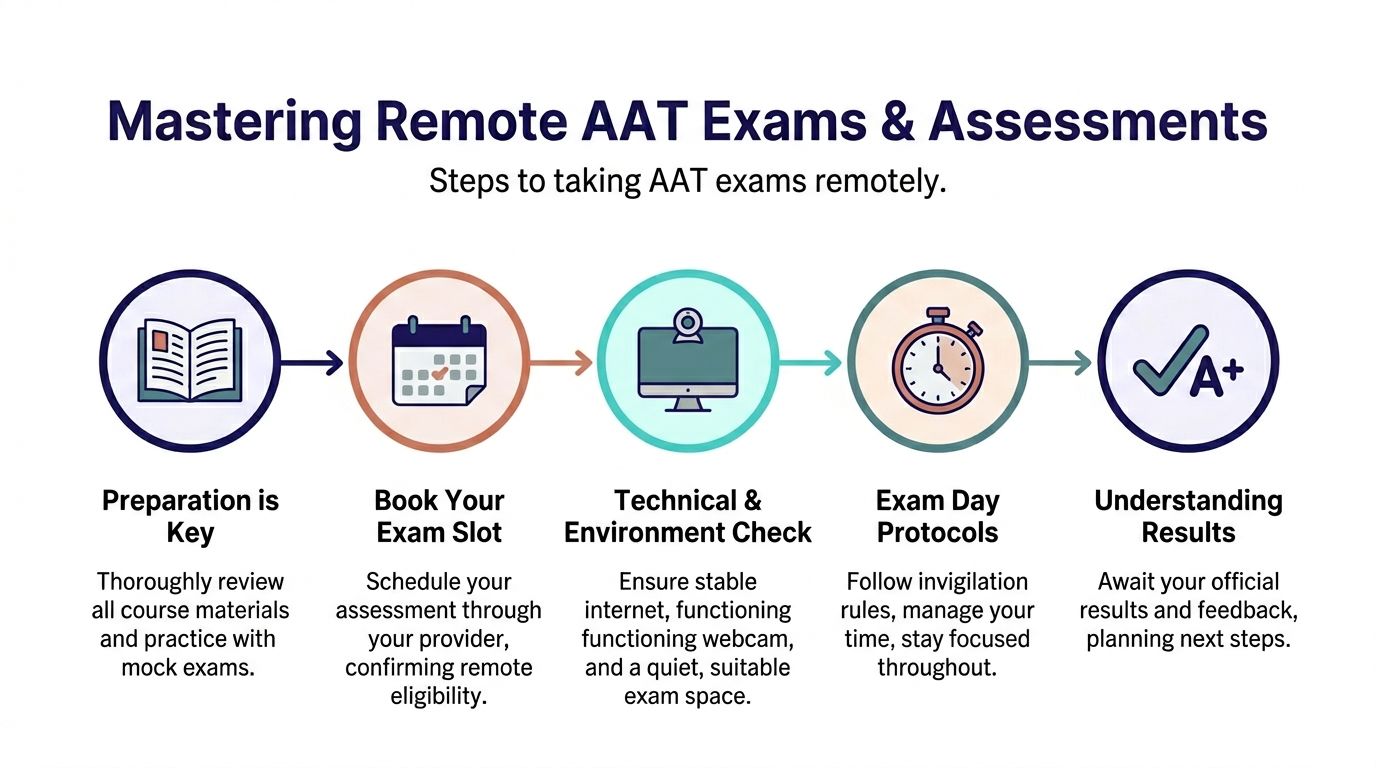
The guide to AAT remote exams and booking online makes the process clear. Candidates must confirm their device meets the technical requirements, install the PSI secure browser, and complete a practice assessment before the live exam. There are also system and security checks before access is granted, including ID photos and a room scan.
That tells you something important. Remote exams aren't casual home tests. They're controlled assessments.
Use this checklist before exam week:
- Test your device early so you're not debugging under pressure
- Install the PSI secure browser ahead of time
- Complete the practice assessment exactly as instructed
- Choose a quiet room that you can keep interruption-free
- Prepare identification and expect visual checks
Why the security steps are actually helpful
Some students find the room scan and ID process intimidating. I think they should see it differently. These checks protect the value of the qualification.
If you're studying AAT at home, you want employers to trust that remote assessment still reflects real ability. Controlled invigilation helps preserve that trust.
The more seriously you treat the exam setup, the calmer you'll feel when the assessment starts.
What to do if something goes wrong
Technical issues can happen. Panic makes them worse.
The same remote exam guidance says that if any incident disrupts the assessment, it must be reported by email by the end of the next working day. That's a process requirement, not a suggestion.
Keep a simple response plan:
- Stay calm and note the issue
- Capture relevant details while they're fresh
- Follow the official reporting process
- Don't assume the system will log everything for you
If you need broader context on assessment locations and options, including how remote routes compare with physical centres, review AAT exam centres and assessment guidance.
Exam readiness is more than revision
Students often think exam preparation means doing questions. It also means reducing practical risk.
That includes checking your room, internet stability, login access, webcam setup, and documents in advance. You want exam day to feel familiar.
Remote assessment rewards calm preparation. Treat the process as part of the qualification, because it is.
Effective Revision for Practical Accounting Skills
Reading notes isn't revision. It's exposure.
If you want to pass exams and do the job afterwards, you need active revision. Accounting is practical. Payroll is practical. VAT is practical. Final accounts are practical. You get better by doing the work, making mistakes, and correcting them.
Revise by task, not by chapter
Most students revise in the wrong order. They go chapter by chapter because it feels tidy. Employers don't think in chapters. They think in tasks.
A better approach is to revise around real work:
- Bookkeeping and VAT by processing entries, spotting errors, and checking VAT treatment
- Advanced payroll by working through payroll scenarios and checking each stage
- Final accounts by building them from underlying records instead of memorising layouts
- Accounts assistant work by mixing reconciliations, ledger checks, and month-end style tasks
- Business and data-focused finance tasks by interpreting outputs, not just producing them
This method trains your brain to recognise what the work is asking.
Use mock exams as diagnostics
Mock exams aren't just for timing. They tell you where your understanding breaks down.
After each mock, don't just mark it and move on. Split your errors into categories:
| Error type | What it usually means |
|---|---|
| You forgot a rule | Weak recall |
| You knew the rule but applied it badly | Weak application |
| You ran out of time | Weak exam control |
| You misread the task | Weak question discipline |
That diagnosis matters. If your issue is application, more reading won't fix it. You need more practice.
One hard truth: the student who reworks mistakes carefully usually overtakes the student who keeps rereading neat notes.
Train for confidence in messy scenarios
Real finance work is rarely clean. Information is missing. Entries don't match. Someone posts something to the wrong code. Payroll inputs arrive late. VAT questions aren't always obvious at first glance.
Your revision should reflect that.
Try this pattern each week:
- One clean practice task to build speed
- One messy task where you have to spot and fix issues
- One timed question set to improve control
- One software-linked activity so the theory connects to systems
This is especially important if you want jobs in bookkeeping, payroll, or accounts support. Recruiters and hiring managers often notice quickly whether a candidate has only studied the topic or can work through it.
Don't separate theory from software
If you learn payroll rules but can't follow payroll workflow in software, your confidence will collapse in interviews.
If you understand bank reconciliation on paper but freeze when looking at accounting software, that gap will show.
That's why strong revision blends both sides:
- The rule
- The transaction
- The software screen
- The final output
For learners aiming at more analytical roles, this also applies to data handling. If you can explain a finance figure but can't organise the data behind it in Excel, you're only halfway prepared.
The best revision is slightly uncomfortable because it forces you to apply what you know.
Translating Your AAT Qualification into a Career
You pass an AAT unit at home on Tuesday. By Friday, you spot an Accounts Assistant vacancy, open your CV, and realise it says almost nothing about what you can do.
Fix that early.
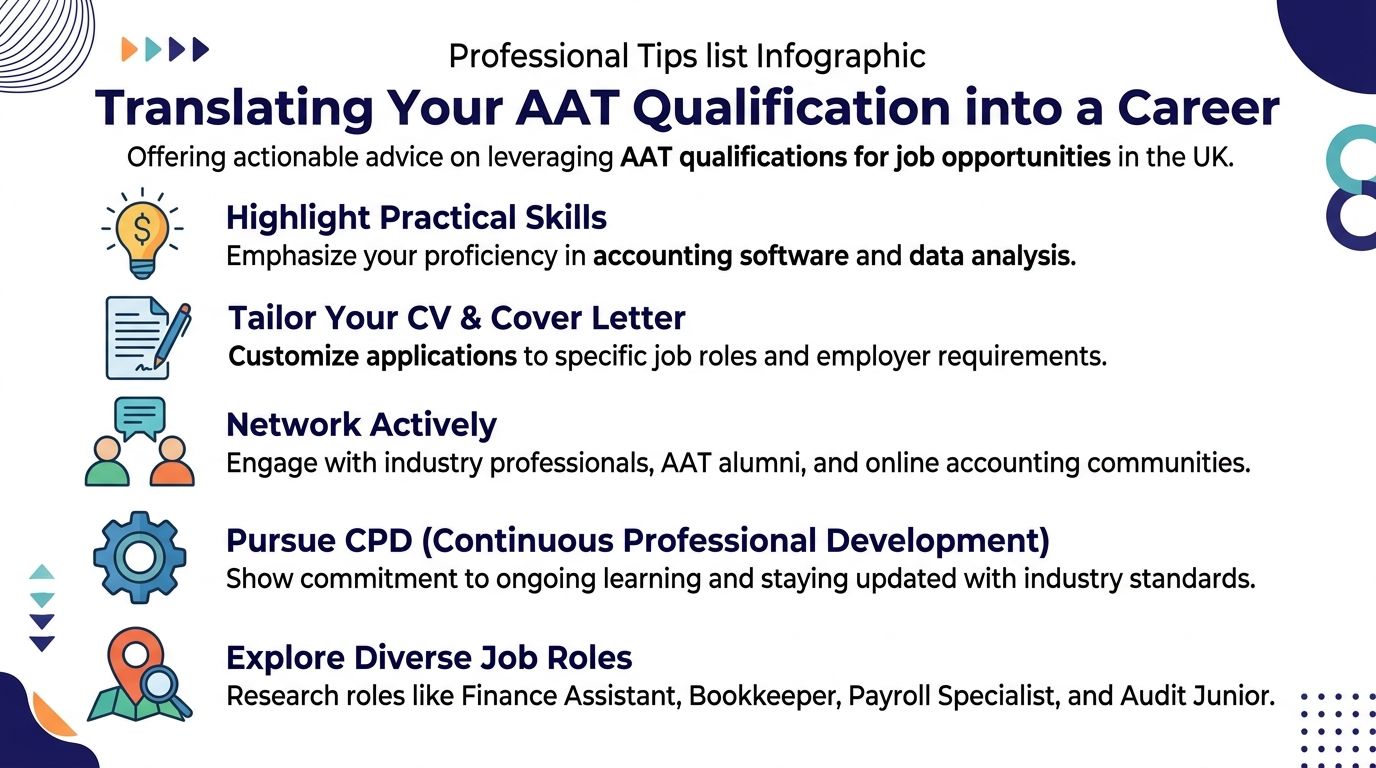
Studying AAT at home only pays off if you turn each topic into evidence for a real job. Employers are not buying flexible study. They are hiring someone who can process transactions, support month-end, handle payroll steps, use accounting software, and communicate clearly with the rest of the business.
Rewrite your CV around job-ready tasks
“AAT student” is not a strong selling point on its own. A recruiter wants to see what sits underneath it.
Write your CV in the language of entry-level finance work:
- Processing purchase and sales ledger entries
- Assisting with bank reconciliations and cash posting
- Applying VAT rules to routine transactions
- Supporting payroll administration and data accuracy
- Using Excel for checking figures, organising data, and producing simple reports
- Building working confidence in Sage, Xero, or QuickBooks
That wording gives employers something concrete. It also helps your application line up with the jobs AAT learners usually target first: Bookkeeper, Accounts Assistant, Finance Administrator, Credit Control Assistant, and Payroll Administrator.
Match your application to the vacancy
Stop sending the same CV everywhere. It weakens your chances.
For an Accounts Assistant role, bring forward reconciliations, ledger work, invoice processing, and month-end support.
For a Bookkeeper role, lead with day-to-day transaction posting, VAT, software use, and keeping records accurate.
For a Payroll Administrator role, focus on accuracy, confidentiality, deadlines, and your understanding of payroll workflow.
For finance-related analyst routes, put Excel, reporting logic, data checking, and commercial awareness near the top. Those roles sit closer to finance operations than many learners expect, so your ability to organise and interpret figures matters.
A strong application also balances technical ability with the way you work. StoryCV's guide to soft and hard skills is a useful reference here because finance candidates often describe one side and neglect the other.
Build a LinkedIn profile recruiters can actually find
A half-finished LinkedIn profile makes you look half-prepared.
Keep it simple and searchable:
- Use a headline with terms such as AAT, Accounts Assistant, Bookkeeper, Payroll Administrator, Sage, Xero, QuickBooks, and Excel
- Write an About section that names the roles you want
- Add your AAT level, software practice, and any relevant admin or finance tasks
- Include your UK location
- Make the profile complete and professional
Recruiters search by role title, software, and qualification keywords. Give them all three.
Here's a useful video if you're thinking about your next career move after study:
Treat software practice as part of your employability
Many home learners often encounter a specific challenge. They pass assessments, yet struggle to talk about systems in interviews.
If you want a bookkeeping job, practise posting transactions in software. If you want payroll work, understand the sequence of payroll inputs, checks, and outputs. If you want accounts support roles, get comfortable with reconciliations, invoice handling, and Excel-based checking.
Your qualification gets attention. Software confidence gets interviews. Clear examples of how you have used both get offers.
Employers hire people who look ready to contribute in week one, not people who only sound good on paper.
That should shape how you study and how you present yourself.
If you want a training route that links AAT study to practical accounting software, flexible support, and real recruitment help, take a look at Professional Careers Training. They offer accountancy training, 1-to-1 support from qualified trainers, software training in Sage, Xero, and QuickBooks, plus help with CV preparation, LinkedIn optimisation, job hunting strategy, and employer references.