If you're training to become a business analyst, or you already work as one, you've probably noticed AI tools turning up in more of your...
For anyone targeting remote accounting jobs in the UK, the winners are rarely the people who send the most applications. They’re the people who understand what employers are buying. They want someone who can work without hand-holding, use cloud systems properly, handle core finance tasks accurately, and communicate well through a screen. Academic knowledge helps, but on its own it won’t carry you very far in a remote-first shortlist.
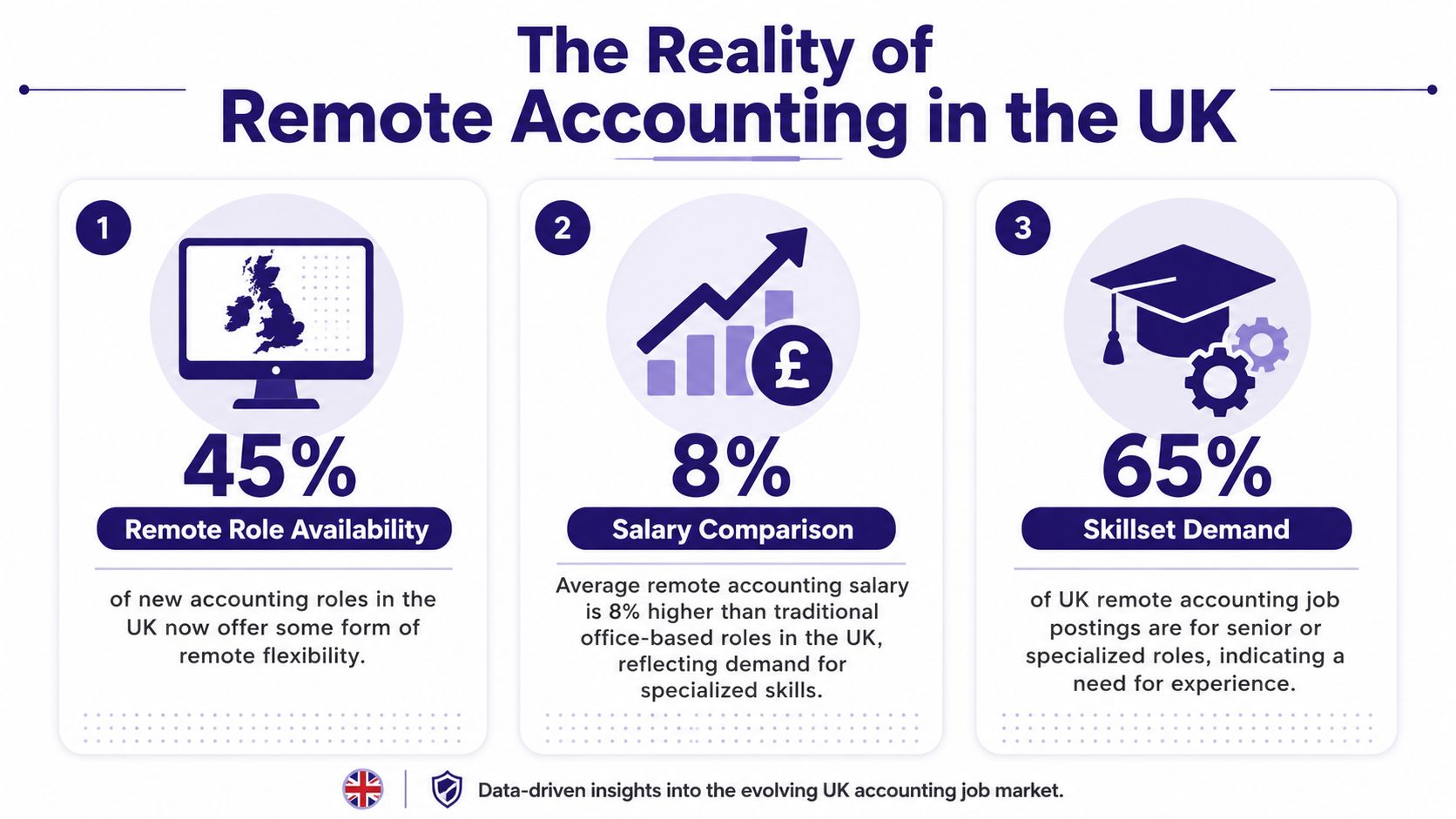
The Reality of Remote Accounting in the UK
Remote work still appeals to accounting candidates for good reason. It cuts commuting time, opens access to employers outside your local area, and often suits focused finance work. But if you’re targeting remote accounting jobs in the UK, you need to work from the actual market, not the version people talk about online.
A recent analysis of UK accounting job adverts found that fully remote accounting jobs made up less than 2% of postings, while remote-work demand averaged 6.34%. That gap matters because it tells you two things at once. Employers aren’t offering many fully remote roles, and candidates still want them in meaningful numbers, according to Distinct Recruitment’s accounting remote-work analysis.
What the market actually looks like
The easiest mistake is to treat “remote” as one category. In practice, the UK market breaks into three different buckets:
- Fully remote roles that allow home-based work without regular office attendance
- Hybrid roles that appear in remote searches but still require travel
- Location-tied remote roles where you work from home but must live near a specific office or region
That distinction changes how you search and how you present yourself. A candidate who can manage a hybrid accounts assistant job may not be right for a fully remote bookkeeping role supporting clients across the UK.
UK-specific vacancy pages still show a live market. Indeed UK lists 137 entry-level remote accounting jobs, and Glassdoor UK shows 86 remote accountant vacancies, which signals that demand hasn’t disappeared. At the same time, broader labour-market research cited in the same verified dataset shows a tougher backdrop in comparable markets, including a 24.4% drop in U.S. public-accounting job postings from July 2023 to July 2024, with remote roles down a further 6.8% and candidate interest only 0.3% lower than the prior year, as noted on Indeed UK’s remote accounting listings page.
Practical rule: Treat fully remote accounting jobs as a specialist segment, not the default market.
Why employers stay hybrid-first
Most accounting employers still prefer some office contact because finance work depends on trust, process control, and timely communication. It’s easier for them to train junior staff, supervise month-end pressure, and manage client queries in a hybrid model.
That doesn’t mean remote candidates are locked out. It means you need to remove risk. Employers choose remote hires when they believe that person can deliver clean work, use digital systems confidently, and stay organised without constant supervision.
That’s why candidates should pay attention to remote-working habits as well as technical skills. If you want a clear view of how strong distributed teams operate day to day, these actionable remote team strategies are useful because they mirror the behaviours finance employers look for: clarity, responsiveness, documentation, and reliable follow-through.
Building Your Remote-Ready Skillset
The strongest remote candidates usually don’t win because they know a little bit of everything. They win because they can show practical competence in the tasks employers need covered right now.
Industry guidance confirms that cloud-accounting stack fluency is now essential for remote finance work, and job ads commonly ask for accounting software experience alongside qualifications such as ACCA or AAT. Employers also want evidence of outcomes, not just a list of software names, according to this guidance on cloud-accounting and remote finance work.
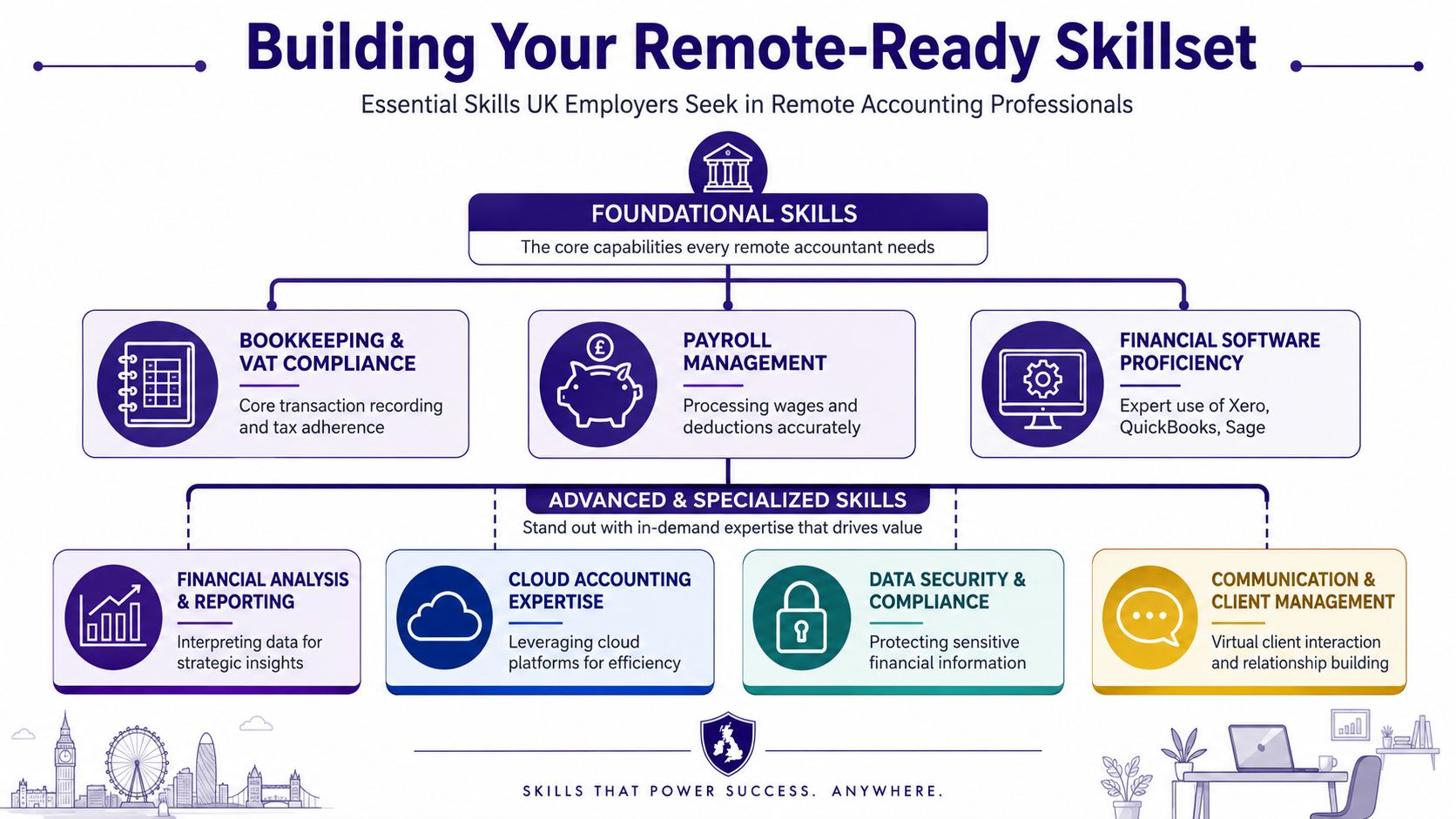
A good way to think about training is this. Can you step into a small business finance function, or support an accountancy practice, and handle real work from day one?
Bookkeeping and VAT
This is still the foundation.
If you can’t post transactions correctly, reconcile ledgers, handle supplier and customer accounts, and understand VAT treatment, remote work becomes harder very quickly. In an office, someone may spot your error early. In a remote setup, mistakes can sit in the system until month end.
Employers value candidates who can do the following with confidence:
- Process day-to-day entries accurately across sales, purchases, bank, and journals
- Handle VAT rules with care, especially where returns, coding, and supporting records matter
- Use software properly rather than relying on manual workarounds in Excel
- Explain what they’ve done so a manager or client can follow the audit trail
For bookkeeping and VAT, practical training should include live work in Xero, Sage, or QuickBooks, plus realistic exercises in reconciliations and VAT return preparation. Theory alone won’t persuade a hiring manager.
Advanced payroll
Payroll is one of the clearest ways to stand out because employers know how sensitive it is. A payroll mistake doesn’t just create admin. It creates employee complaints, trust problems, and compliance risk.
Remote payroll work rewards people who are methodical. You need to be comfortable with pay runs, deductions, pension processing, statutory elements, and reporting. You also need to communicate clearly when information is missing or deadlines are tight.
A candidate with advanced payroll training often looks stronger than someone with a broad but shallow finance profile because payroll shows discipline. It tells employers you can work accurately with confidential data and fixed deadlines.
If a role mentions payroll, don’t treat it as a side task. Many remote employers see payroll as proof that you can be trusted with high-risk admin.
Accounts assistant capability
Many job seekers undersell themselves. “Accounts assistant” sounds junior, but in remote settings the role often blends bookkeeping, credit control, supplier liaison, reconciliations, expense checking, and reporting support.
That means training should cover more than one narrow task. Employers want someone who can move across the finance workflow without waiting for constant instruction.
A remote-ready accounts assistant should be able to show competence in:
| Skill area | What employers want to see |
|---|---|
| Purchase ledger | Accurate invoice entry, query handling, payment prep |
| Sales ledger | Raising invoices, allocating receipts, chasing aged debt |
| Bank reconciliation | Clean matching and investigation of discrepancies |
| Month-end support | Journals, accruals awareness, reporting packs |
| Communication | Clear email updates to managers, suppliers, and clients |
Final accounts
Final accounts training separates candidates who can process transactions from candidates who understand the bigger picture.
That matters in remote roles because employers often need someone who can spot issues early, not just key in data. If you understand trial balances, year-end adjustments, and how accounts are prepared for review or submission, you’re more useful and easier to trust.
This is especially important for candidates moving up from bookkeeping into broader accounting roles. Final accounts knowledge shows progression.
Business analyst and data analyst skills
Not every remote accounting role is a pure accounting job. Some employers want finance staff who can also analyse information, build reports, and support decisions. That’s why Advanced Excel, Power BI, and data-handling skills can make a real difference.
You don’t need to pretend you’re a full data analyst. But you should be able to organise data, check trends, build usable reports, and explain what the numbers mean.
For candidates who want to strengthen this side of their profile, it helps to understand how modern finance teams use cloud systems and connected reporting tools. This practical guide to cloud accounting software and how it supports finance workflows is a useful starting point.
Optimising Your CV for Remote Opportunities
A remote accounting CV has one job. It must make the recruiter believe you can produce accurate work without needing constant follow-up.
Most CVs don’t do that. They list duties. They mention software. They stay vague. In a competitive market, vague gets ignored.
Show output, not task lists
Compare these two examples.
Weak version
- Managed accounts payable and bookkeeping duties
- Used Xero and Excel
- Assisted with month-end
Stronger version
- Processed supplier invoices, reconciled bank transactions, and supported month-end using Xero and Excel in a deadline-driven finance environment
- Maintained accurate ledger records and resolved discrepancies by checking source documents and account history
- Prepared clear update notes for managers so outstanding queries could be actioned quickly
The second version works because it sounds like real work done by a reliable person. It also suggests independence and communication without using empty phrases like “hard-working” or “self-starter”.
Build evidence from training as well as employment
If you’re a graduate, career changer, or returner, you may not have long finance employment history. That doesn’t mean your CV has to look thin.
Use practical training projects properly. If your course included bookkeeping exercises, VAT return practice, payroll processing, final accounts preparation, Excel reporting, or software-based case work, present that as applied learning.
A good project bullet might look like this:
- Completed practical bookkeeping and VAT tasks using cloud software, including transaction posting, bank reconciliation, invoice handling, and draft reporting
- Built payroll processing exercises covering pay calculations, deductions, and record accuracy
- Produced structured Excel reports from finance data and explained key findings in plain language
Make your LinkedIn profile work harder
Recruiters searching for remote accounting jobs in the UK often scan LinkedIn before they contact candidates. If your profile headline only says “Accounting Graduate” or “Looking for opportunities”, you’re missing a chance to be found.
Use searchable terms that reflect actual work, such as bookkeeping, VAT, payroll, accounts assistant, Xero, Sage, QuickBooks, final accounts, Excel, Power BI, business analysis, or data analysis, where relevant to your training and experience.
For practical UK-specific structure, this guide to UK CV writing tips for finance candidates is worth reviewing. If you want help turning rough career history into sharper wording, an AI CV builder can also help you refine phrasing before you do the final human edit.
Don’t let software write your whole CV. Use it to improve clarity, then make sure every line still sounds like your real experience.
How to Find Genuine UK Remote Accounting Jobs
Most frustration in this market comes from one issue. Job boards often label roles as remote when they’re in fact hybrid.
That’s not a small detail. It changes whether the role fits your life, your travel limits, and your expectations. Job listings often mix both models. For example, an ad presented as remote may still say “Hybrid remote in Wembley”, which is exactly why candidates need to check the wording carefully on Indeed’s remote accounting listings.
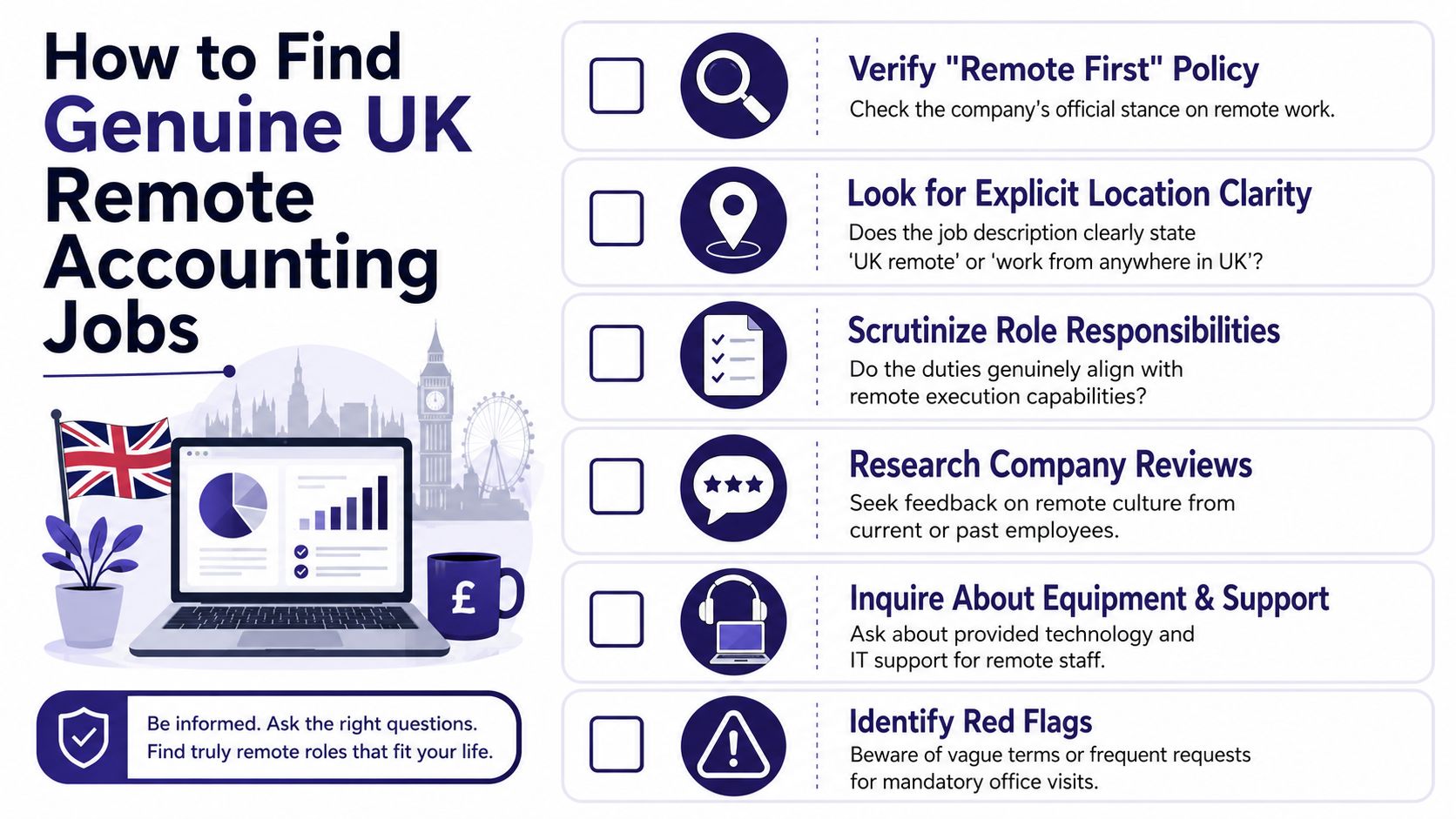
Read the advert like a contract
Don’t stop at the job title. Read for hidden attendance requirements.
Here are common signs that a role isn’t fully remote:
- Location wording such as “remote in Birmingham” or “home-based with monthly office visits”
- Travel language such as “team days”, “training in office”, or “occasional client visits”
- Geographic limits that require you to live within commuting distance
- Vague flexibility terms like “remote option available” with no clear pattern stated
Green flags are much clearer. The advert should say the role is fully remote, specify whether it is UK-wide, and explain how equipment, onboarding, and communication are handled.
Use a filtering checklist
A simple screening process saves time. Before you apply, check these points:
- Remote status. Does the advert clearly say fully remote, not just remote-friendly?
- Location rule. Can you work from anywhere in the UK, or only near one office?
- Duties. Are the tasks realistic for remote delivery, such as bookkeeping, payroll, reporting, reconciliations, or client support?
- Software stack. Does the employer name tools like Xero, Sage, QuickBooks, or Excel?
- Communication expectations. Is there evidence of structured remote management rather than informal office dependence?
This short video is useful if you want a visual walk-through of how to assess remote job listings and remote fit during your search.
Go beyond the big job boards
A lot of candidates stay trapped in Indeed, Reed, and Glassdoor refresh mode. Those sites matter, but they’re noisy. You also need direct recruiter contact and a stronger LinkedIn search method.
LinkedIn works particularly well when you combine targeted keywords with direct outreach and profile optimisation. If you want a practical method, RedactAI’s LinkedIn job guide gives useful ideas on how to search, engage, and follow up more effectively. For a UK-focused job search approach, this guide on using LinkedIn for job search in practice is also worth applying.
A good recruiter can tell you in one conversation whether a “remote” role is genuine, how flexible the employer really is, and what skills the shortlist needs.
Acing the Virtual Interview and Technical Tests
By the time you reach interview stage, the employer already believes you might be able to do the job. Now they’re checking whether you can do it remotely without becoming hard work to manage.
The first test starts before you answer a single question. Your setup matters. A clear camera, stable internet, good sound, and a tidy background all signal professionalism. In finance hiring, that kind of detail still counts.
Strong answers sound calm and specific
A hiring manager might ask, “How do you manage your time when working from home?”
A weak answer is broad.
“I’m very organised and motivated.”
A stronger answer is grounded.
“I work from a task list linked to deadlines. I review urgent items first, keep notes on outstanding queries, and give updates early if I’m blocked on client information or approvals.”
That answer works because it reflects actual working habits. It shows planning, communication, and accountability.
Another common question is about distractions at home. The strongest candidates don’t over-defend themselves. They answer directly and practically.
“I work in a dedicated space, keep my day structured, and protect focused time for detailed work such as reconciliations, payroll checks, or reporting.”
Expect a technical task
For remote accounting jobs in the UK, technical tests often focus on the sort of work you’d be doing. You may be asked to review a reconciliation, spot an error in a spreadsheet, explain a journal, or describe how you’d process a task in Xero, Sage, or QuickBooks.
What helps most is not speed talking. It’s showing your method.
A good candidate says what they would check first, what evidence they would compare, and when they would escalate an issue. For example, in a bank reconciliation task, talk through matching entries, identifying timing differences, checking supporting records, and documenting unresolved items.
If the role includes business analysis or data analysis elements, expect questions around Excel logic, report structure, data cleaning, or dashboard interpretation. Keep your answers commercial. Explain what the numbers mean, not just what the formula does.
Your Offer Salary and Long-Term Career Growth
When an offer arrives, many candidates focus only on the headline salary. That’s understandable, but remote accounting roles need a wider review.
Salary data from UK remote-accounting listings shows an average pay of £33,024 per year across 86 job openings, with junior roles averaging £28,638, mid-level roles £32,744, senior roles £37,525, and lead accountants £43,924, according to Glassdoor’s UK remote accountant listings. Another UK remote-accounting source also states that the average remote accountant salary is around £33,024, while many roles ask for broad skills including VAT, payroll, and management accounts, as shown on RemoteRocketShip’s UK accounting jobs page.
Read the offer beyond the pay figure
A remote role can look attractive until you spot hidden expectations. Check:
- Working pattern. Is it fully remote in practice, or does it include office attendance later?
- Equipment and support. Who provides the laptop, software access, and technical help?
- Hours and availability. Are you expected to be online at fixed times?
- Scope creep. Does the role combine bookkeeping, payroll, VAT, reporting, and admin for one salary?
Many remote roles encompass responsibilities beyond their titles. A “remote accountant” may be covering several finance operations duties.
Think ahead about progression
Your first remote job doesn’t need to be perfect. It does need to move you forward.
If you start in bookkeeping or accounts assistant work, the next progression step may come from adding payroll, final accounts, or reporting responsibility. If you already have that base, stronger Excel, Power BI, business analysis, or data analysis skills can help you move into more commercial finance work.
For anyone considering contract or freelance routes later, you’ll also need to understand how your working arrangement affects tax status and compliance. IR35 can become relevant when you move into contractor structures, so it’s worth getting proper advice before accepting that kind of engagement.
The bigger point is simple. Remote access is not the career plan. Skill growth is.
If you want practical help closing the gap between study and employment, Professional Careers Training offers accountancy training built around real UK employer expectations. That includes bookkeeping and VAT, advanced payroll, accounts assistant training, final accounts, business analyst and data analyst skills, plus software training in Sage, Xero, QuickBooks, Excel, Power BI, SQL and more. Their support also covers CV preparation, LinkedIn optimisation, job-hunting strategy, and recruitment guidance, which is exactly the combination many candidates need to compete for genuine remote accounting roles in the UK.