
You might be hearing the phrase Employee Life Cycle CIPD in a class, an interview, or a workplace conversation and wondering what it means for...
You might be hearing the phrase Employee Life Cycle CIPD in a class, an interview, or a workplace conversation and wondering what it means for you. If you're trying to build a career in HR, accounting, payroll, bookkeeping, business analysis, or data analysis, the phrase can sound abstract at first. In practice, it isn't abstract at all. It's a way of understanding how people join an organisation, grow in it, stay with it, and eventually leave it.
That matters because employers don't experience hiring, training, performance, and retention as separate problems. They experience them as one connected journey. If that journey is managed well, people settle in faster, perform better, and feel clearer about their next step. If it's managed badly, confusion starts early and often ends in turnover.
For learners and career changers, this model is useful for another reason. It helps you see where practical training fits into real working life. A bookkeeping and VAT course supports one stage. Advanced payroll supports another. Final accounts, accounts assistant training, business analyst skills, and data analyst tools all connect to different points in that journey.
Understanding the Employee Life Cycle in Modern HR
When students first meet the employee life cycle, they often think it's just another HR diagram to memorise. It isn't. It's a practical framework that helps you understand the full relationship between an employee and an organisation, from first contact to final exit.
In UK HR practice, the model matters because it pushes people professionals to think in a joined-up way. Recruitment affects onboarding. Onboarding affects confidence. Development affects performance. Performance affects retention. Exit feedback often reveals what went wrong much earlier.
Why the model matters in real workplaces
A simple way to think about it is this. The employee life cycle asks one question at every stage: what does this person need now to do good work and build a sustainable relationship with the employer? That question is central to modern people practice.
If you're new to HR, it helps to pair this model with a wider understanding of digital change. A useful introduction to that area is this guide to AI and automation in HR, which shows how technology increasingly supports recruitment, administration, and employee decision-making.
For readers who want a grounding in day-to-day HR work, it also helps to review the duties of human resources. Once you understand those duties, the life cycle stops looking like theory and starts looking like the thread that connects them.
The employee life cycle isn't about isolated HR tasks. It's about how each decision shapes the next employee experience.
Where learners often get confused
Many people mix up the life cycle with a checklist. That creates problems. The model isn't saying every employee follows the same neat path. It says employers should manage each stage deliberately.
A few common misunderstandings come up again and again:
- Thinking attraction is just advertising: It also includes reputation, credibility, and whether the role looks realistic.
- Assuming onboarding is one day of induction: In practice, onboarding often stretches across the early period of employment.
- Treating development as optional: In most skilled roles, development is part of staying employable.
- Seeing exit as failure: Sometimes a well-managed exit strengthens employer reputation and future hiring.
That last point is especially important in professional fields. People move roles, gain qualifications, and progress. Good employers expect movement and plan for it.
Defining the CIPD Employee Life Cycle Model
The CIPD model gives structure to something every employee already experiences. In UK HR, the formal conceptualisation of the employee lifecycle gained prominence in the 2000s, driven by the CIPD. A 2016 CIPD survey found over 70% of UK organisations used a lifecycle model to design HR policies, up from under 40% a decade earlier, showing how firmly established it became in practice (CIPD lifecycle reference).
A useful analogy is a professional relationship. First, the organisation gets your attention. Then it chooses whether you're the right fit. Once you're in, it helps you settle, grow, contribute, stay, and finally leave professionally.
The five-stage view made simple
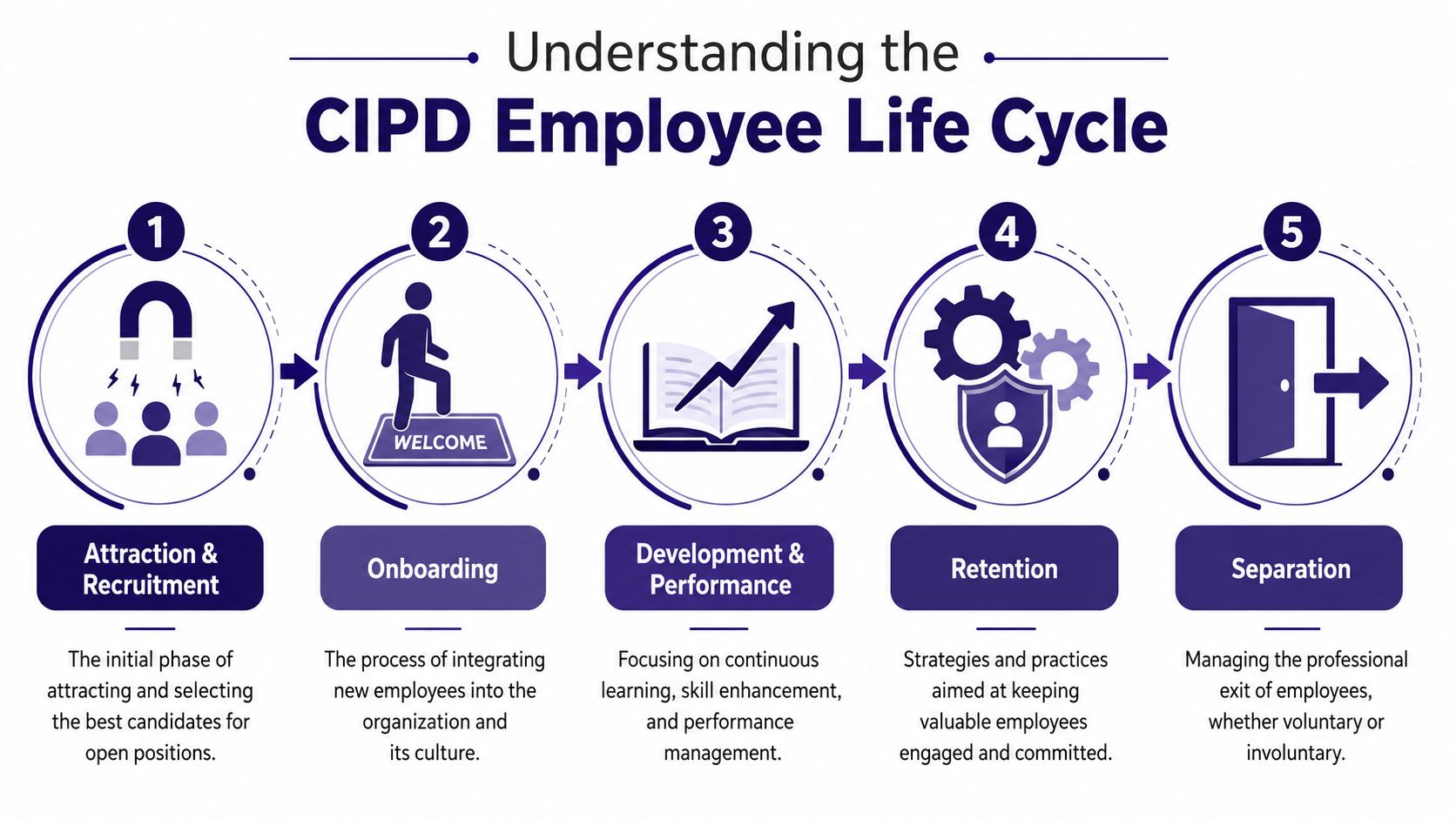
Different employers use slightly different labels, but the most common CIPD-style structure can be remembered in five broad stages.
Attraction and Recruitment
The organisation draws in potential candidates, defines the role, assesses suitability, and appoints the best person.
Onboarding
The new employee learns the role, systems, standards, and culture, and starts becoming productive.
Development and Performance
The employee builds skills, receives feedback, and improves contribution over time.
Retention
The employer works to keep good people through support, progression, fair treatment, and engagement.
Separation
The employment relationship ends, ideally through a respectful process that protects knowledge, reputation, and future goodwill.
Why these stages are linked
The model is powerful because no stage stands alone. A poor hiring decision often leads to weak onboarding. Weak onboarding can lead to early frustration. Little development can reduce motivation. Poor retention practices can increase avoidable exits.
That chain matters in practical careers too. Think about an accounts assistant role. If a candidate joins without confidence in Sage, Xero, reconciliations, or transaction handling, the employer's onboarding burden increases. If the employer then doesn't support further development, progress stalls.
Here's a quick view of the logic:
| Stage | Main question | What success looks like |
|---|---|---|
| Attraction and Recruitment | Can we find and select the right person? | Good fit, clear expectations, strong start |
| Onboarding | Can this person settle in quickly? | Confidence, clarity, early productivity |
| Development and Performance | Can they grow and contribute more? | Better skills, better output, career progress |
| Retention | Do they want to stay and build here? | Commitment, stability, stronger capability |
| Separation | Can they leave professionally? | Respectful exit, useful feedback, positive reputation |
The employee life cycle CIPD model is worth learning well because employers use it to organise real decisions, not just HR paperwork.
Aligning the Life Cycle with the CIPD Profession Map
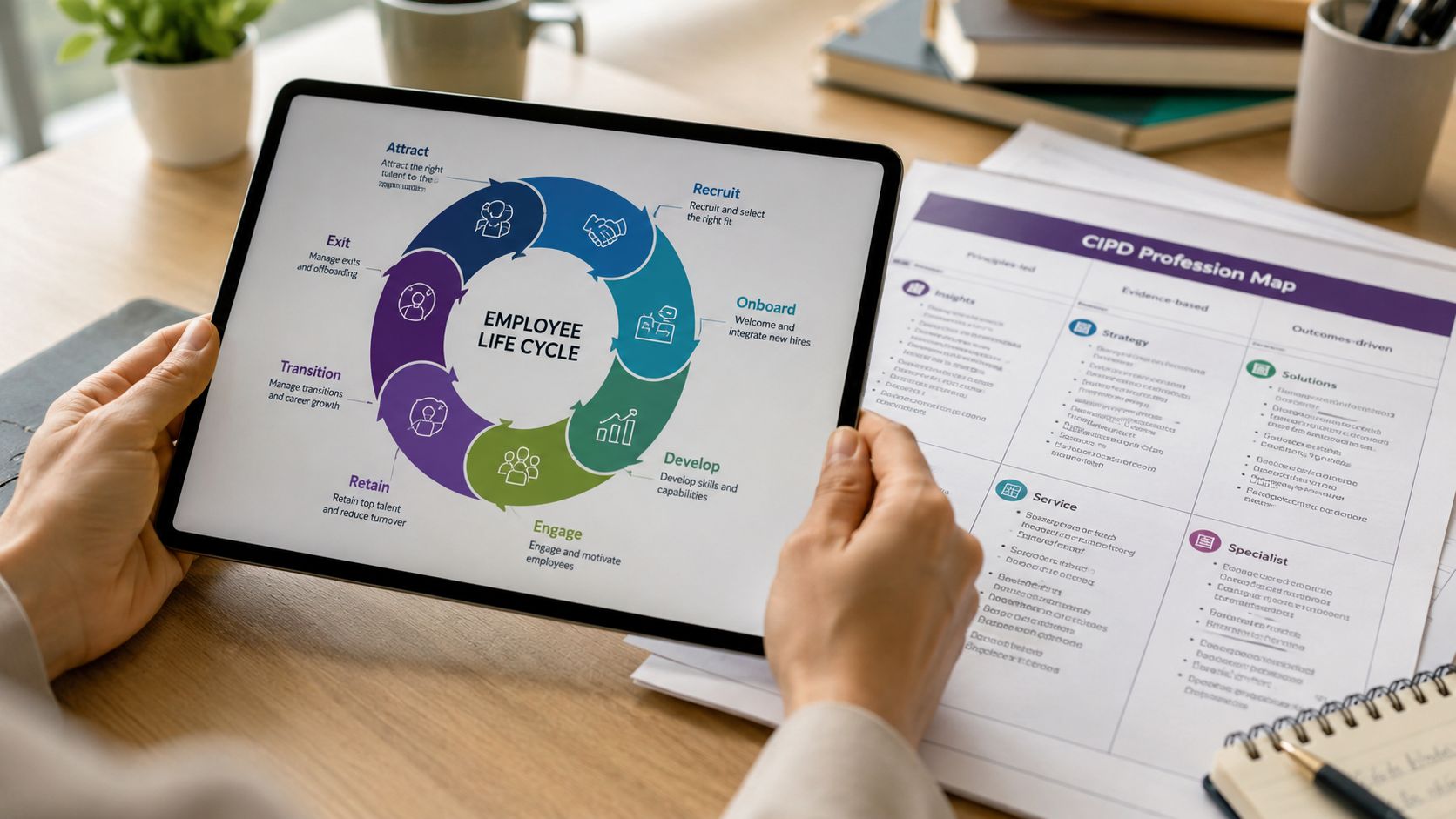
The life cycle becomes more useful when you connect it to the standards expected of HR professionals. That's where the CIPD Profession Map comes in. It helps you move from knowing the stages to showing how a practitioner should act within them.
Matching stages to professional practice
If you look at the model through the Profession Map, clear links appear.
- Attraction and recruitment connect strongly to resourcing. HR practitioners need to understand role requirements, fair selection, and candidate experience.
- Onboarding links closely with learning and development because new starters need structured support, role clarity, and early capability-building.
- Development and performance connect to areas such as people development, performance conversations, and organisational capability.
- Retention draws in employee voice, reward, wellbeing, inclusion, and manager effectiveness.
- Separation calls for professionalism, sound process, and ethical handling of people decisions.
If you're studying at an intermediate level, reviewing a guide to the CIPD course level 5 can help you see how these ideas are assessed in a more applied way.
The behaviours underneath the model
The Profession Map also reminds you that good HR isn't only about process. It depends on behaviour.
A recruiter can follow a process and still create a poor experience. A line manager can hold an induction and still leave a new starter confused. A people professional can run exit interviews and still miss the underlying issue.
Professional judgement matters most when the process looks complete but the employee experience still feels weak.
That is why behaviours such as ethical practice, commercial awareness, valuing people, and evidence-based thinking matter at every point. A fair recruitment process needs ethical judgement. A development plan needs business understanding. A retention strategy needs listening, honesty, and consistency.
Why this matters for employability
Interviewers often ask questions that sit at this junction between model and standards. They don't just want you to list life cycle stages. They want to hear that you understand the professional responsibility inside each one.
For example, if asked about onboarding, a stronger answer wouldn't stop at paperwork and induction. It would include role clarity, support, early learning, manager involvement, and a fair introduction to expectations. That sounds much closer to real CIPD practice.
Building Skills for the Attraction and Recruitment Stages
Attraction and recruitment are the first points where employability becomes visible. Employers inquire, "Can this person do the work?" and, critically, "Can this person start contributing without a long struggle?"
A hiring manager reading applications for an accounts assistant role usually isn't searching for vague enthusiasm. They want signs of practical readiness. That often means familiarity with Sage, Xero, QuickBooks, reconciliations, purchase ledger, sales ledger, and VAT handling.
What employers are really scanning for
Take two common vacancies. One is for a junior finance role. The other is for a junior analyst role.
In the finance role, the manager may need someone who can record transactions accurately, understand VAT codes, and support month-end routines. In the analyst role, the manager may need someone who can work with SQL, Power BI, and Python, clean data properly, and explain findings in business language.
That requirement isn't just a preference. In the UK, around 30% of financial and business-services vacancies requesting "data analysis" or "SQL" skills require formal training or certification, which makes practical tool-based learning especially important at the attraction stage.
How vocational training changes a candidate profile
A candidate with bookkeeping and VAT training sends a different signal from someone who only says they are "good with numbers". The same applies to analytics.
- Bookkeeping and VAT training shows that you can record transactions properly, use accounting software, and understand routine compliance tasks.
- Accounts assistant training suggests you're ready for ledgers, reconciliations, journals, and support work around financial reporting.
- Business analyst and data analyst training signals that you can move beyond spreadsheets and work with structured tools such as Power BI, SQL Server, or Python notebooks.
- Interview preparation matters too, because technical ability still needs to be explained clearly. This guide on how to prepare for job interviews is useful if you need to turn practical skills into strong interview answers.
A recruiter usually notices concrete evidence fast. "Trained in Sage and Xero" is clearer than "fast learner". "Built dashboards in Power BI" is stronger than "interested in data".
Employers don't hire potential alone. They hire signs that potential can be used quickly.
That is why the attraction stage isn't only about the employer's brand. It's also about your own career positioning.
Driving Performance Through Onboarding and Development
Once a person is hired, the true test begins. A good selection decision can still fail if the employee lands in a role without the right support, systems training, or clear standards. That's why onboarding and development deserve serious attention.
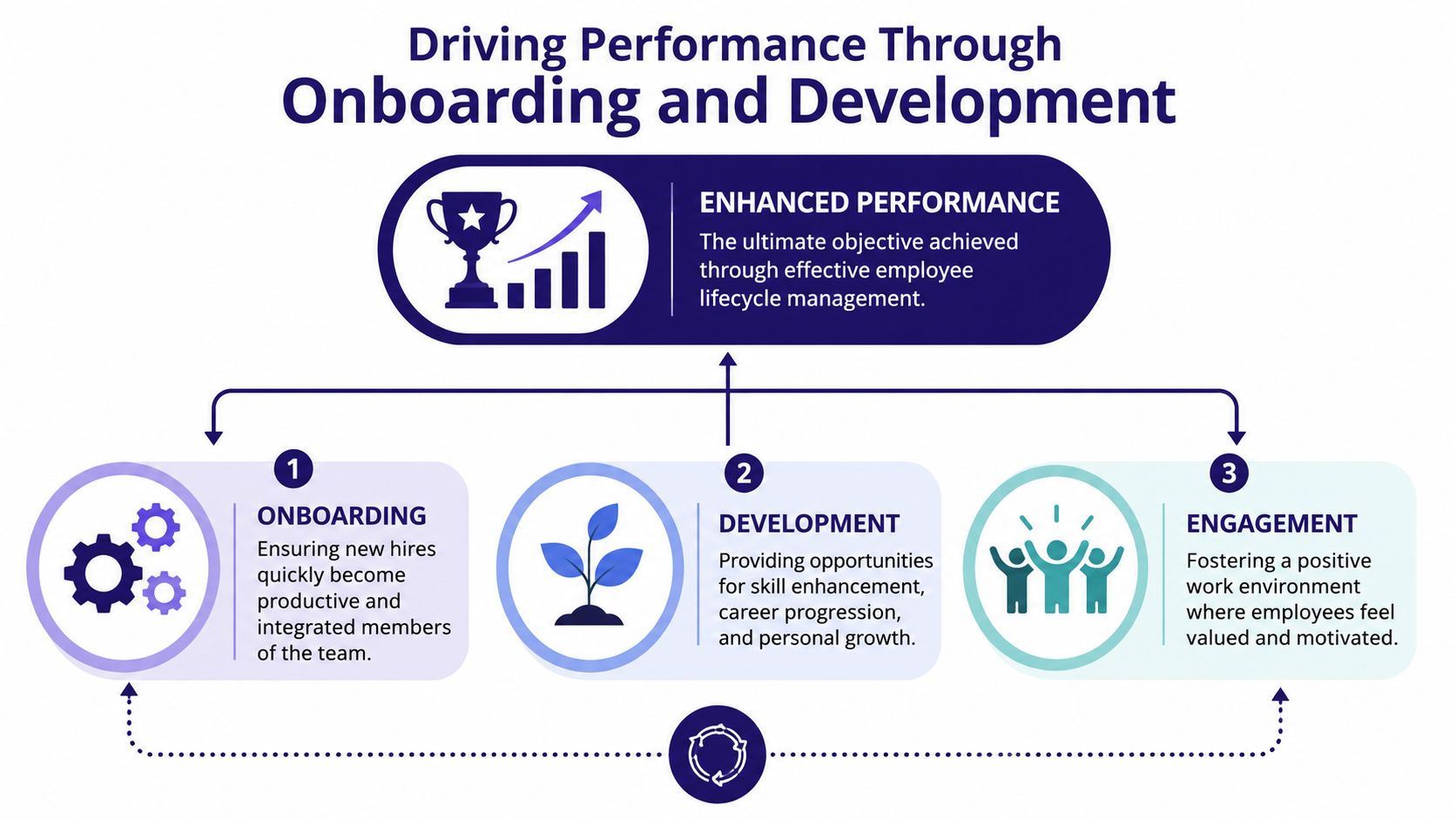
Many people use the word onboarding when they really mean induction. The wider meaning is more helpful. If you'd like a plain-language explanation, this glossary of onboarding definitions gives a helpful starting point.
Why skill-building sits at the centre of onboarding
A new starter becomes productive faster when the employer combines welcome, guidance, and technical training. In finance roles, that might mean learning how the organisation records invoices, processes VAT, runs payroll, or reconciles ledgers. In analyst roles, it might mean understanding data sources, reporting expectations, and how insights are presented to decision-makers.
That link between support and performance is backed by evidence. CIPD research shows that UK organisations which systematically manage onboarding, development, and engagement report up to a 20% higher level of overall performance compared to those with ad hoc people practices (CIPD recruitment guidance).
What this looks like in practical careers
Consider how different training paths map into this stage:
- Bookkeeping and VAT helps a new finance employee handle precise transaction recording, software coding, and VAT routines with less supervision.
- Advanced payroll helps a payroll clerk move from basic processing to more confident work with PAYE, National Insurance, student loan deductions, and statutory payments.
- Accounts assistant training helps early-career staff understand journals, control accounts, reconciliations, and software-based daily routines.
- Final accounts training supports progression into year-end preparation, classifications, and reporting formats.
- Business analyst and data analyst training helps employees move from raw data handling to structured reporting and decision support.
The practical side matters because UK compliance work isn't theoretical. For example:
- VAT work requires accurate records because VAT-registered businesses must submit VAT returns to HMRC within one calendar month and seven days after the end of each tax period, and payment is due by the same deadline.
- Payroll work requires discipline because HMRC's Real Time Information system requires employers to report payroll information on or before each employee's payday.
- Final accounts work needs technical awareness because small companies that meet at least two thresholds, including turnover of £10.2 million or less, asset total of £5.1 million or less, and 50 or fewer employees, can qualify for small-company exemptions under the applicable UK framework.
These aren't side details. They show why structured development makes someone more reliable and more valuable.
A short explainer can help reinforce how these stages connect in practice:
A strong onboarding process answers three things early. What good work looks like, how the systems work, and where the employee can grow next.
Improving Retention and Managing Professional Exits
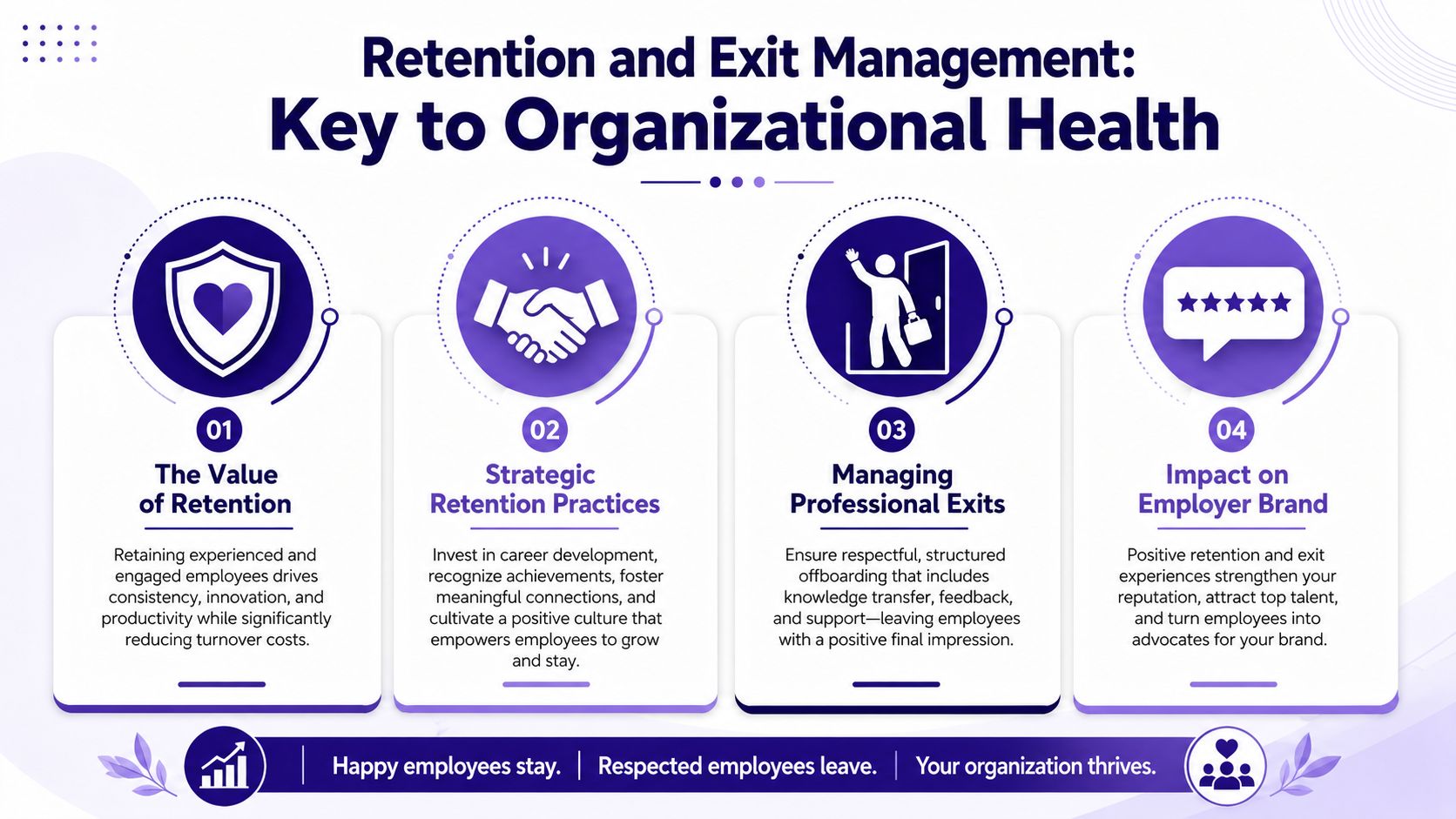
Retention is often discussed as though it's only about stopping people from leaving. That is too narrow. Good retention means giving capable employees reasons to continue building their careers with an employer. Those reasons often include growth, fairness, confidence in management, and visible progression.
Why retention is tied to development
When employees can see the next step, they're more likely to stay engaged. In finance teams, that next step may be moving from bookkeeping into accounts assistant work, then into final accounts preparation. In payroll, it may be progression from routine input to higher-responsibility payroll administration. In analytics, it may be the shift from reporting tasks to broader business analysis.
This isn't just intuition. According to CIPD benchmarks, UK organisations with formal retention strategies, including career development support, can experience 15–25% lower staff turnover (retention benchmarks).
That link matters because training does more than build capability. It signals that the employer sees a future for the employee.
What a retention-focused employer tends to do
A retention-minded organisation usually combines several actions rather than relying on one.
- Clear progression routes: Employees know what skills lead to broader responsibility.
- Useful training: Learning relates directly to the job, not just generic courses.
- Regular career conversations: Managers talk about growth before frustration builds.
- Respect for specialist work: Payroll, bookkeeping, final accounts, and analytics all require precision and should be treated as skilled disciplines.
Reframing the exit stage
Not every departure is negative. Sometimes an employee leaves because they are ready for a bigger role, a different specialism, or more responsibility. If the employer managed the relationship well, that person may still speak positively about the organisation.
A professional exit can protect knowledge, preserve relationships, and strengthen employer reputation long after the last working day.
In HR terms, separation is not just administration. It includes offboarding, final documentation, respectful treatment, and learning from the reasons people leave. That feedback often loops back into the earlier stages of the life cycle and improves future hiring and development.
Putting the Employee Life Cycle into Practice
The employee life cycle CIPD model becomes much more useful when you stop seeing it as HR vocabulary and start using it as a career roadmap. Attraction is about how employable you look. Recruitment is about how clearly you prove your fit. Onboarding is about how quickly you become useful. Development is how you grow. Retention is how you stay valuable. Exit is how you leave professionally.
That matters in the current labour market because organisations are dealing with frequent movement. The UK average employee turnover rate was approximately 18.8 per 100 employees, meaning nearly 1 in 5 workers left their jobs each year according to the Labour Force Survey summary discussed here in the employee lifecycle overview. In that environment, practical skills that improve performance and support retention stand out.
A practical way to use the model for your own career
Try reading the life cycle from your own point of view rather than the employer's.
| Life cycle stage | Your career question |
|---|---|
| Attraction | Do my CV, skills, and certifications make me credible? |
| Recruitment | Can I explain how I would handle real tasks in the role? |
| Onboarding | Could I settle quickly into UK systems, software, and standards? |
| Development | What skill should I add next to increase my value? |
| Retention | Would an employer see me as someone worth investing in? |
| Exit | Am I building a professional reputation that will follow me positively? |
This way of thinking is especially useful for career changers and newcomers to the UK market. It helps you focus on what employers need. In many workplaces, digital systems now shape every stage too, so understanding key HR automation benefits can help you see how modern employers manage people data, processes, and employee support.
The strongest takeaway
The model doesn't only belong to HR professionals. It belongs to anyone who wants to build a stable career. If you're training in bookkeeping and VAT, advanced payroll, accounts assistant work, final accounts, business analysis, or data analysis, you're not just collecting skills. You're strengthening your position at multiple points in the employment journey.
That is what turns theory into employability.
If you're ready to turn this understanding into job-ready skills, explore Professional Careers Training. Their programmes cover bookkeeping and VAT, advanced payroll, accounts assistant, final accounts, business analyst, and data analyst training, with flexible study, software support in Sage, Xero, and QuickBooks, and practical career coaching to help you move from learning into work.