You're staring at a blank CV and a job advert full of familiar words, requirements gathering, SQL, stakeholder management, Power BI, Agile, and you know...
That’s where a practical approach to CPD Continuing Professional Development makes a real difference. Done well, it isn’t just an annual admin task. It becomes a way to build job-ready skills in bookkeeping and VAT, advanced payroll, accounts assistant work, final accounts, business analysis, and data analysis, while also keeping a clean record of what you learned and how you used it.
Your Guide to Continuing Professional Development
A junior accounts assistant often starts with a simple goal. They want to feel more confident with reconciliations, understand VAT properly, and stop relying on someone else every time a payroll query lands on their desk. Then CPD enters the picture, and it can feel vague.
One week they attend a webinar. Another week they read about Making Tax Digital. Later they complete a bookkeeping exercise in Sage or Xero. All of that may be useful, but the bigger question remains. How do you turn useful learning into a structured development path?
CPD is more than collecting certificates
The best way to think about CPD is as a running record of how you stay effective in your role and prepare for the next one. In finance, rules change, software changes, and employer expectations change. If your learning stays static, your confidence often drops before your performance does.
For accounting and finance professionals, that matters in practical ways:
- Bookkeeping and VAT: You need to handle records cleanly, process transactions accurately, and prepare VAT work with care.
- Advanced payroll: You need to understand payroll workflows, deadlines, and the knock-on effect of errors.
- Accounts assistant and final accounts work: You need to link day-to-day postings with month-end and year-end outcomes.
- Business analyst and data analyst skills: You need to turn raw data into useful reporting with tools such as Excel, SQL, Python, and Power BI.
Practical rule: Choose CPD that helps you do this week’s job better and next year’s job more confidently.
Where people usually get stuck
Most professionals don’t struggle because they lack motivation. They struggle because they lack a simple framework, and know they should reflect, but they don’t know what good reflection looks like. They take training, but they don’t link it to a goal.
That gap matters most when you don’t have a manager or peer group formally checking your CPD plan. In that situation, self-direction isn’t optional. It’s the skill that holds the whole process together.
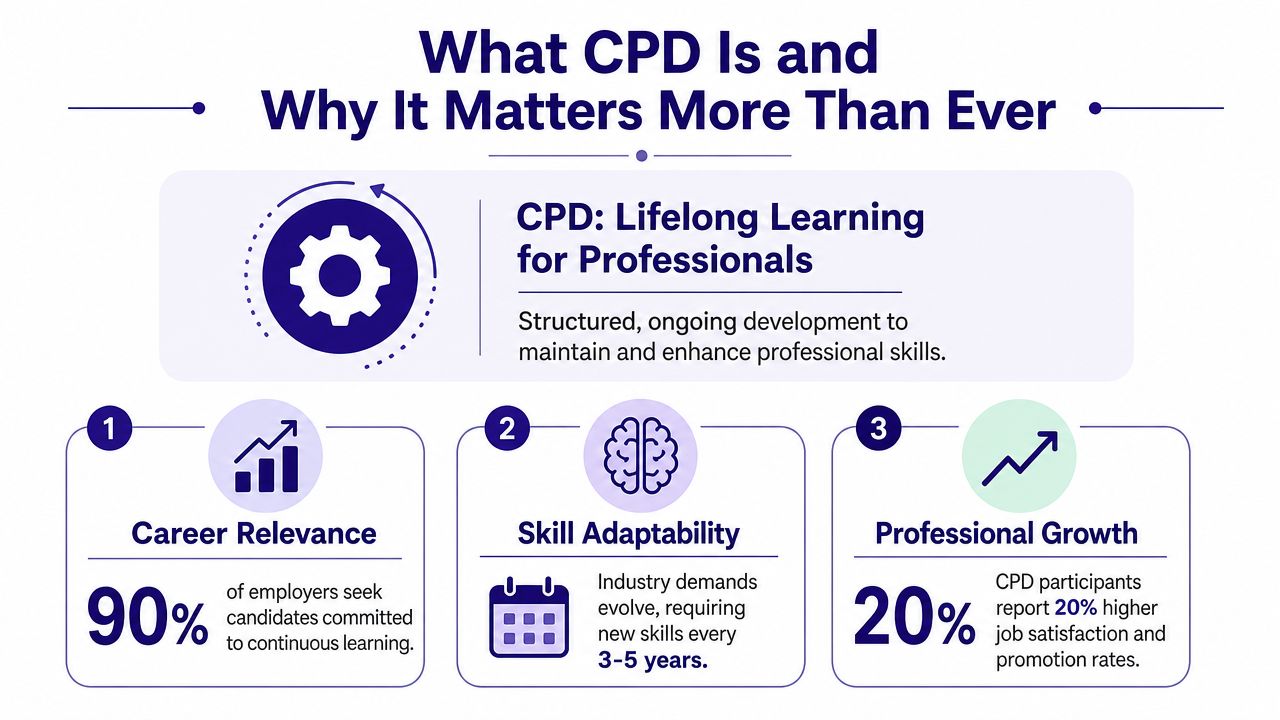
What CPD Is and Why It Matters More Than Ever
Think of CPD as a professional MOT. Your car may still run, but that doesn’t mean every part is performing well. The same applies at work. You may be coping with your role, yet still have gaps in VAT knowledge, payroll processing, journal entries, reporting tools, or data analysis methods.
CPD gives you a structured way to check those gaps and deal with them before they become problems.
Why employers care
Good CPD isn’t only about staying compliant. It has a clear business case. Organisations that invest in CPD initiatives achieve 24% higher profit margins and a 218% increase in average income per employee, while 94% of employees in the UK say they’d stay longer if better learning and development opportunities were available, according to this UK CPD analysis.
That tells you something important. Employers don’t see development as a nice extra. They see it as part of performance, retention, and capability.
If you want a broader primer on the idea behind CPD, this guide to understanding professional development is a useful companion read. For an accounting-focused view, you can also review CPD guidance for accountants and finance professionals.
Why it matters for your own career
In finance and analysis roles, small skill upgrades often have a large practical effect. A better grasp of VAT rules can stop repeated posting errors. Stronger payroll knowledge can reduce rework. Better Excel or Power BI skills can turn a manual report into one that’s clearer and faster to produce.
That’s why CPD works best when it serves both of these aims:
| Focus | What it looks like in practice |
|---|---|
| Current performance | Learning how to process VAT returns, complete payroll tasks, or prepare final accounts more accurately |
| Future progression | Building analyst skills, software confidence, and reporting capability for broader roles |
Good CPD should answer two questions. What can I do better now, and what will this help me do next?
What this means in real working life
A bookkeeping course isn’t just a course if it helps you understand ledgers, VAT return preparation, and financial record-keeping in a way you can use at work. A payroll class matters because payroll errors affect trust. A data analysis course matters because more finance teams expect staff to interpret trends, not only process transactions.
The strongest CPD choices are rarely random. They sit close to your actual tasks and your likely next step.
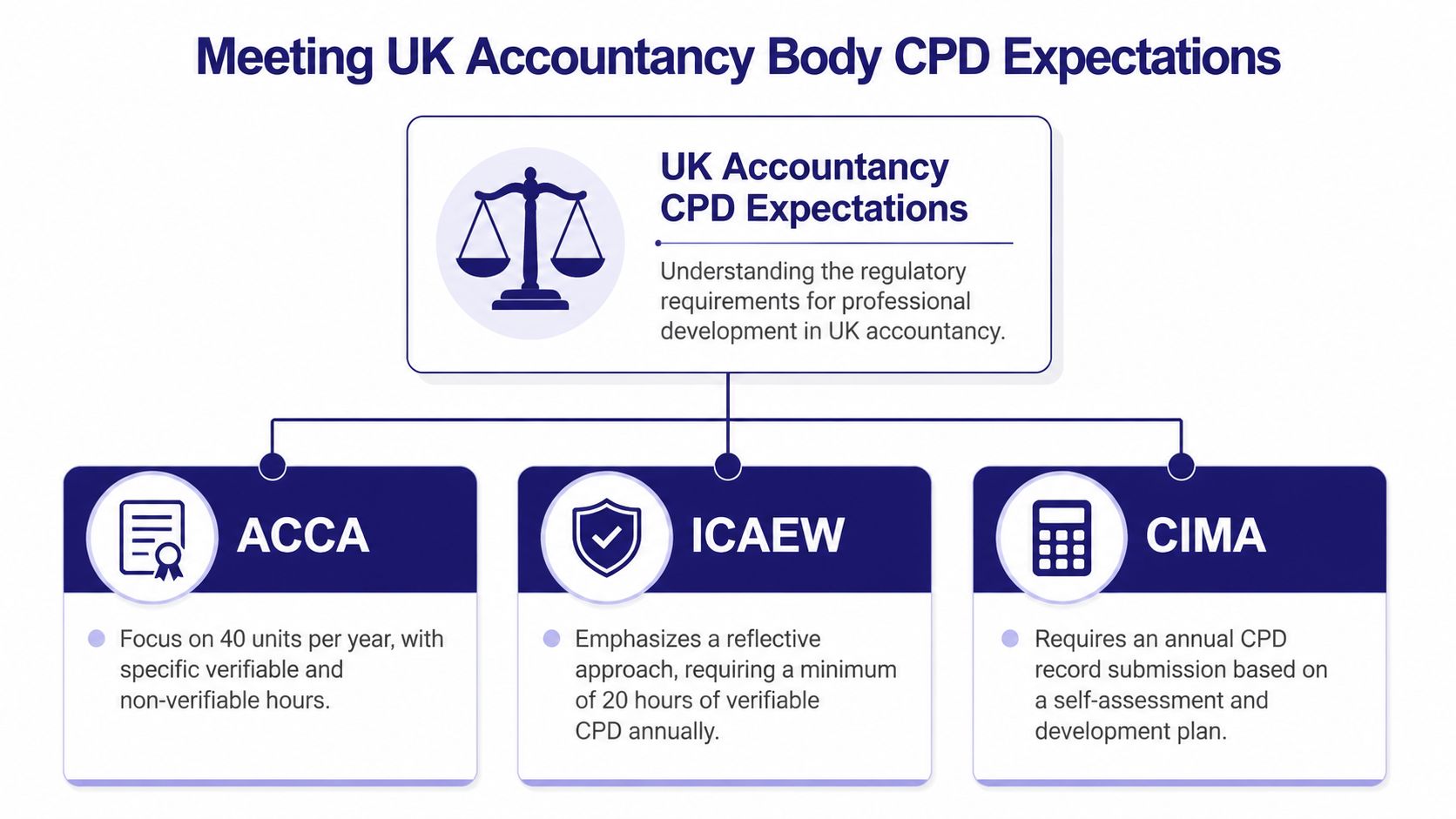
Meeting UK Accountancy Body CPD Expectations
Many professionals first ask the same question: What do the regulators want from me?
The short answer is simpler than many expect. They want learning that is relevant, they want you to reflect on it, and they want you to keep a record that can stand up to review. The exact rules vary by body, but the shared logic is consistent.
The big picture in the UK
In the UK, CPD is mandatory for approximately 1.5 million individuals registered under 32 regulated professional titles, and 81% of those registered individuals are required to reflect on their learning experiences as part of the process, according to research published in BMJ Open.
That matters because it shifts the focus away from “Did you attend something?” to “What changed because you learned it?”
What to pay attention to
If you work towards or within bodies such as ACCA, ICAEW, AAT, or CIMA, keep these principles in mind:
- Relevance matters: Your CPD should connect to your current role or a realistic progression route. A VAT course makes sense for a bookkeeper. A Power BI module makes sense for a reporting or analyst path.
- Reflection matters: You need to show what you learned and how it affected your work, judgement, or confidence.
- Evidence matters: Keep certificates, notes, attendance records, screenshots of completed modules, or summaries of practical learning.
A common mistake is assuming regulators care most about the format. In practice, many regulators are more interested in whether the learning is useful and evidenced than whether it came from a classroom, webinar, software workshop, or guided self-study.
What this means for accounting and finance roles
An accounts assistant might log learning on journals, reconciliations, and final accounts support. A payroll administrator might focus on payroll process knowledge and software confidence. A business analyst might record work on requirements gathering, Excel modelling, SQL, or dashboard reporting.
Reflection doesn’t need fancy language. It needs clear language. State what you learned, where you applied it, and what improved.
A useful CPD note can be as simple as this:
| Activity | Weak reflection | Strong reflection |
|---|---|---|
| VAT training | Attended VAT session | Improved my understanding of taxable supplies and VAT return preparation. I used this in month-end review to check coding more confidently. |
| Payroll workshop | Completed payroll course | Clarified payroll workflow and common input errors. I now review source data more carefully before processing. |
That’s the level of practical thinking most professionals need.
Exploring Different Types of CPD Activities
You finish a busy week and wonder whether any of it counts as CPD. You joined a VAT webinar, fixed a reconciliation issue that had appeared for three months, and spent an hour learning a better Excel formula from a colleague. Many accounting and finance professionals leave activities like these out of their record, even though they often produce the clearest improvement in day-to-day work.
A useful way to sort CPD is to place it into two buckets. One bucket is formal and planned. The other is informal and work-based. That simple split helps when your professional body expects reflection, but does not require formal peer review. In that situation, your judgement matters more. You need a sensible way to choose learning, explain why it mattered, and show what changed.
Structured CPD
Structured CPD usually starts with a defined objective. It has a title, a timetable, and some form of evidence such as registration, attendance, or a certificate. It works like studying from a map rather than exploring side streets. You know where the session is meant to take you.
Examples include:
- Bookkeeping or VAT courses: useful for building confidence in transaction posting, ledger control, invoice treatment, and VAT return preparation
- Advanced payroll training: suitable for professionals who handle payroll processing, statutory payments, or payroll software checks
- Accounts assistant programmes: helpful if you need stronger skill in journals, reconciliations, control accounts, and finance systems
- Final accounts training: relevant when your role is shifting from routine processing to month-end or year-end support
- Business analyst or data analyst courses: practical if your work now includes reporting, Excel modelling, SQL, Power BI, or process improvement
- Time management training: helpful if your technical learning is being held back by missed deadlines, poor prioritisation, or inconsistent study habits. A short time management course for professional development can support the practical side of keeping CPD on track
Some professionals also choose specialist technical study. For example, the LSFL VAT course covers taxable persons, taxable supplies, tax points, and the value added mechanism.
Unstructured CPD
Unstructured CPD is less formal, but it often reflects how people grow at work. It includes the learning that happens while solving problems, testing ideas, and improving routines. In firms where no one checks your development plan line by line, this category becomes especially important.
Common examples include:
- Reading and research: reviewing VAT updates, payroll guidance, software help articles, or technical commentary
- Problem-solving at work: resolving a suspense account issue, correcting repeat posting errors, or improving a reconciliation method
- Mentoring and shadowing: observing how a senior colleague reviews exceptions, or helping a junior teammate understand a process
- Software practice: testing Excel functions, building a Power BI visual, or practising tasks in Sage, Xero, or QuickBooks
- Self-directed planning: using examples from other fields to shape your own objectives, such as these resources to download development plan templates
This type of learning needs stronger notes because there is often no certificate to do the talking for you. A short record is enough if it answers three questions. What did I do and what did I learn? What changed in my work after that?
Choose the right activity for the right gap
A short article and a full training course can both count. They do different jobs.
If your knowledge gap is narrow, such as checking one VAT rule or learning one payroll report, a focused reading session may be enough. If your gap affects performance across a whole area, such as bookkeeping accuracy or month-end confidence, formal training is usually the better choice.
That is the practical framework many professionals need. Match the size of the learning activity to the size of the problem. Then write a short reflection that links the activity to your work. This turns CPD from a compliance task into a plan you can direct yourself.
How to Plan and Log Your CPD for Success
Many professionals require significant assistance in structuring their continuing professional development. In UK professional development, 81% of registrants are required to reflect on learning, but only 35% use a formal Personal Development Plan and 26% have no requirement for peer-to-peer learning, which creates a real need for self-directed planning, as discussed in this PubMed-indexed analysis of CPD frameworks.
That gap explains why smart people still end up with weak CPD records. They’re learning, but they aren’t organising that learning well.
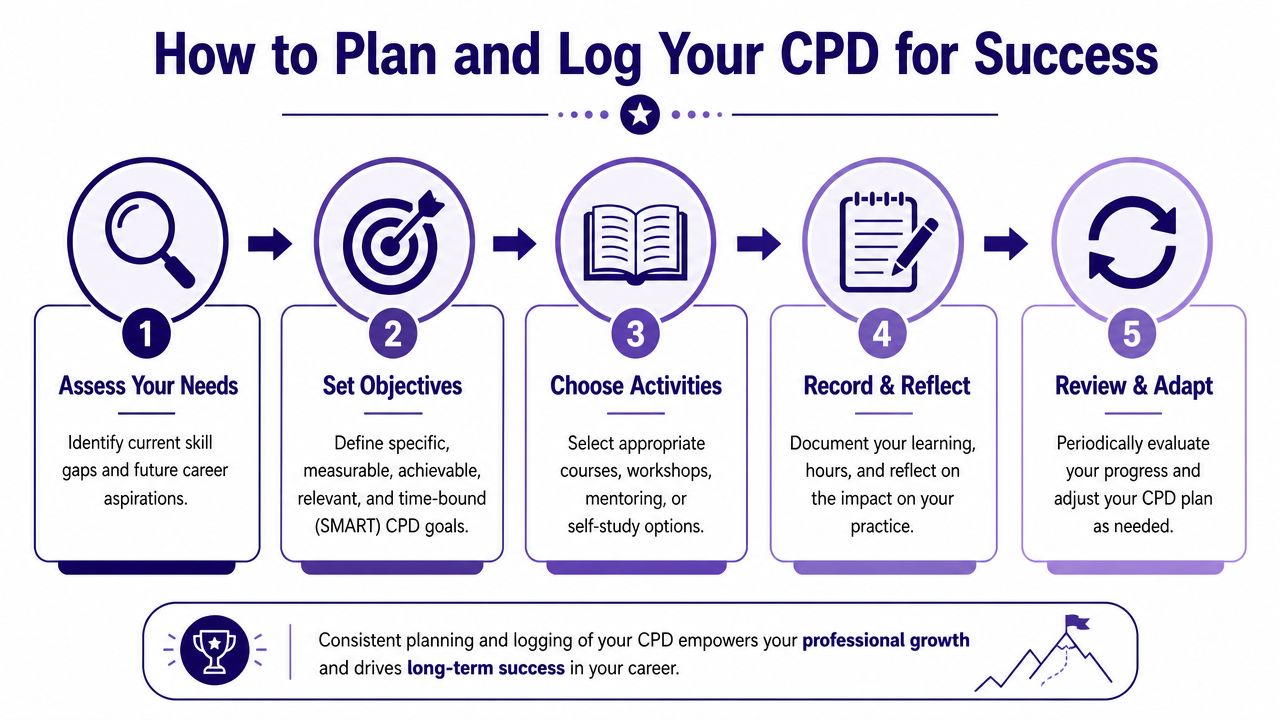
Use the Assess Plan Act Reflect cycle
I recommend a simple four-part cycle.
Assess
Start with your current role and your next likely role. Be honest. Where do you hesitate? Where do you rely heavily on others? Which tasks do you avoid because you don’t feel fully capable?
For a finance professional, your gaps might include:
- Bookkeeping: transaction posting, ledgers, bank reconciliation
- VAT: rates, invoices, coding, return preparation
- Payroll: process flow, checks, software use
- Accounts assistant tasks: journals, accruals, prepayments, control accounts
- Final accounts: adjustments, review logic, supporting schedules
- Analysis: Excel, SQL, Power BI, dashboard thinking
Plan
Once you know your gaps, choose learning that fits them. Don’t pick courses because they sound impressive. Pick them because they solve a work problem or prepare you for a realistic step up.
If you need a starting point for structure, it can help to download development plan templates and adapt one for your own CPD record. Many professionals also benefit from improving how they schedule study time, especially if they’re balancing work and evening learning, so a short guide on time management for study and professional training can make the plan easier to keep.
Act
Now do the learning. This part sounds obvious, but the trick is to connect each activity to a purpose.
Here’s one example:
| Goal | CPD activity | Why it helps |
|---|---|---|
| Handle VAT work more confidently | Complete a bookkeeping and VAT course, then practise invoice coding | Builds both rule knowledge and day-to-day application |
| Move into payroll support | Take advanced payroll training and shadow month-end processing | Combines formal learning with workflow understanding |
| Progress into analysis | Study Advanced Excel, SQL, or Power BI and build sample reports | Turns theory into a portfolio of practical work |
Before you watch the video below, think about your own pattern. Are you learning in a deliberate way, or only reacting to what lands in your inbox?
Reflect
Reflection is where weak CPD becomes strong CPD. Keep it plain. You don’t need a long essay.
A simple log works well:
| Date | Activity | Type | Notes on impact |
|---|---|---|---|
| 12 Jan | VAT webinar | Structured | Clarified VAT invoice requirements. I used this to review supplier invoice coding more accurately. |
| 18 Jan | Researched Excel lookup functions and tested them in a workbook | Unstructured | Improved how I match transaction data during reconciliations. |
| 27 Jan | Payroll training session | Structured | Helped me understand the sequence of payroll checks before processing. |
Write the reflection as if you’re explaining it to a line manager. What did you learn, where did you apply it, and what difference did it make?
That one habit closes the gap between compliance and real growth.
Achieve Your CPD Goals with Professional Careers Training
You finish a busy week, open your CPD log, and realise the hard part is not finding a course. It is choosing learning that solves a real problem in your work and also supports the role you want next. That is the point where many finance professionals drift into random training.
A better approach is to treat CPD planning like building a set of working papers. Each course should have a purpose, evidence, and a clear link to practice. If your professional body expects reflection but does not require formal peer review, that discipline matters even more. You need a record that shows your judgement, not just your attendance.

Training that supports both compliance and career progress
Good training should help you answer two questions. What problem does this solve in my current role? What capability does it build for the next stage of my career?
For a junior bookkeeper, that may mean improving accuracy in transaction processing, VAT handling, and reconciliations, and for an accounts assistant, it may mean building confidence in month-end tasks, journals, or payroll support. For someone moving towards reporting or analysis, it may mean learning Advanced Excel, SQL, Python, or Power BI in a way that leads to better outputs at work, not just better notes in a folder.
That is why practical course choice matters. CPD is strongest when the training maps to real job responsibilities and gives you something you can apply quickly.
Match the course to the gap
Use a simple rule. Pick the course that closes the next gap in your work.
- Bookkeeping and VAT training suits professionals who need stronger control over day-to-day processing and indirect tax basics.
- Advanced payroll training helps if payroll queries, checks, and processing steps are becoming part of your workload.
- Accounts assistant training fits people moving beyond basic admin into broader finance support.
- Final accounts training helps if you want a clearer understanding of adjustments, accruals, prepayments, and year-end routines.
- Business analyst or data analyst training suits finance professionals who want to move closer to reporting, systems, and decision support.
Software matters too. Sage, Xero, and QuickBooks are often the difference between understanding a process in theory and carrying it out properly in a live finance environment.
If you want a practical starting point, these CPD courses for accountants and finance professionals show how role-based training can fit into an ongoing development plan.
A framework you can actually use
Try this sequence.
Start with the task that currently slows you down or creates risk. Choose training that explains the underlying rule or process. Apply it in your work within the next two weeks. Then record the result in plain language.
For example, if invoice coding errors keep appearing, bookkeeping and VAT training is easier to justify than a general finance webinar. If month-end reporting feels manual and repetitive, Excel or Power BI training may be a better CPD choice because you can link it directly to efficiency, accuracy, and reporting quality.
This method bridges the gap between mandatory reflection and self-directed planning. You are not waiting for someone else to validate every step. You are building a reasoned CPD trail that shows why the learning mattered.
Turn training into visible progression
A strong CPD record should read like a career story.
A junior finance professional might begin with bookkeeping and VAT to improve transactional accuracy. Next, they add payroll because payroll queries are becoming part of the role. After that, they study final accounts and reporting tools to support month-end and produce better analysis. Each step has a clear reason, a clear application, and a clear result.
Career support can strengthen that process as well. CV writing, interview preparation, LinkedIn updates, and job search strategy help you present your new skills properly. If your CPD plan is tied to progression, guidance on mastering job interviews can help you convert training into a stronger performance when opportunities come up.
Choose CPD that fixes a real work issue first, then supports the next role second. That order keeps your record credible and your progress practical.
Professional Careers Training is useful for this kind of CPD because the learning is tied to finance and analyst job paths, software use, and career support. For professionals who need to plan their own development carefully, that makes the next step easier to choose and easier to justify in a CPD log.
Take Control of Your Professional Growth
CPD works best when you stop treating it as a pile of hours and start treating it as a professional habit. For UK accounting, finance, payroll, business analysis, and data analysis roles, that habit keeps you current, makes your record stronger, and helps you move into better work with more confidence.
The shift is simple. Don’t wait for someone else to design your development for you. Assess your gaps, choose training that fits your role, log it properly, and reflect on how it changed your work. That’s the bridge between mandatory reflection and meaningful progress.
If you’re also preparing for the next role, not just your current one, interview practice matters too. A practical guide to mastering job interviews can help you turn your new skills into a stronger performance when opportunities come up.
Good CPD doesn’t just prove you learned something. It shows that you’re becoming more capable, more reliable, and more ready for what comes next.
If you want practical support with your next CPD step, Professional Careers Training offers flexible accountancy and analyst-focused training with 1-to-1 support, software training in Sage, Xero, and QuickBooks, plus career coaching to help you turn learning into real job progress.