
If you're training to become a business analyst, or you already work as one, you've probably noticed AI tools turning up in more of your...
That mismatch is normal.
What matters now isn’t whether you followed the perfect route. It’s whether you can build a practical route. If you want accounting jobs for graduates in the UK, stop thinking only in terms of graduate schemes and prestige labels. Start thinking like an employer. They want someone who can process invoices properly, handle bookkeeping & VAT accurately, support payroll without drama, help produce final accounts, analyse data sensibly, and learn fast.
That gives you a far clearer path than most careers advice does.
From Degree to First Day a Graduate’s Roadmap
A typical graduate sits in an awkward middle ground. You know the theory, but the market hires for tasks. One employer wants an accounts assistant who can help with bank reconciliations. Another wants a payroll trainee who understands deadlines and detail. A small practice wants someone who can support final accounts work and pick up client communication without freezing.
That doesn’t mean your degree has failed you. It means a degree is the base, not the finished product.
The gap most graduates feel
If you’ve applied for trainee accountant jobs and heard nothing back, don’t assume you’re the problem. Many good graduates get stuck because they aim too narrowly. They search only for “graduate accountant”, “audit trainee”, or “Big 4 graduate scheme”, then ignore the roles that build employability fast.
Practical rule: Your first finance job does not need to be your dream title. It needs to give you useful tasks, software exposure, and proof that you can work in a finance team.
That’s why a smart graduate roadmap starts with three questions:
-
What kind of work do you want to do?
Transactional accounting, payroll, reporting, business analysis, or data-led roles all ask for different strengths. -
What practical skill are employers missing from your CV?
Usually that’s software use, live-process understanding, or proof you can handle routine work accurately. -
What job title gets you in fastest?
Sometimes that’s trainee accountant. Often it’s accounts assistant, finance assistant, payroll administrator, or junior analyst.
A better way to move forward
You need a playbook, not motivation quotes. Start with a grounded view of the market, then fill the practical gaps, then apply with intent. If you need a plain-English overview of routes into the profession, this guide on getting into accounting is a useful starting point.
The key point is simple. Your first payslip usually goes to the graduate who looks job-ready, not just academically strong.
Mapping Your Graduate Accounting Career Path
Most graduates make job searching harder than it needs to be because they treat every finance role as the same. It isn’t. You need a clear map.
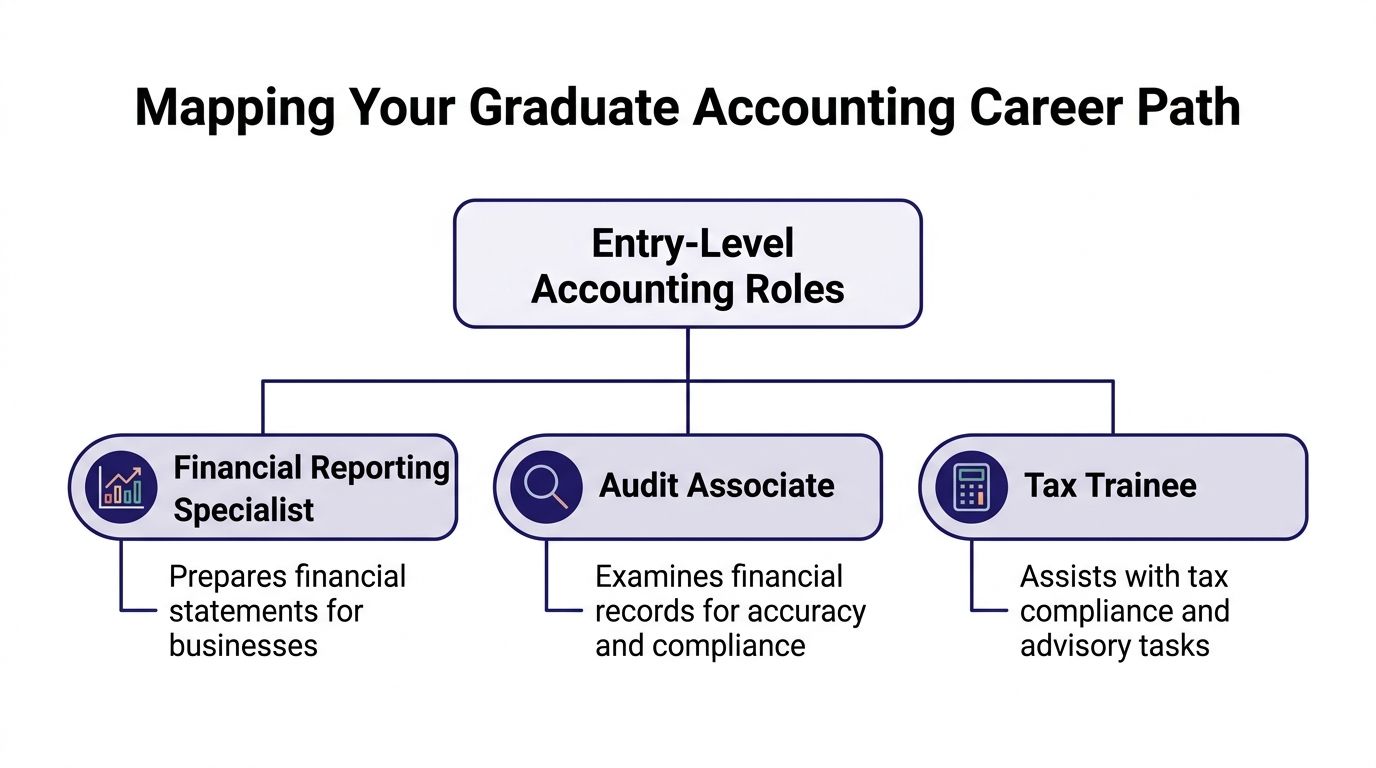
In the 2016/17 academic year, 12,210 UK domiciled first-degree graduates were recorded in finance occupations six months after graduating, representing 6.6% of the employed cohort. The most popular occupations were business professionals at 33.2% and finance and investment analysts and advisers at 23.7%. Employment of accountants is projected to grow by 5% from 2023 to 2028 according to Prospects Luminate’s analysis of graduates working in finance.
That tells you two things. Graduates do get into finance roles, and the route isn’t limited to one narrow accountant label.
The core accounting path
This is the most practical route for graduates who want a solid finance career and steady progression.
Common starting points include:
- Bookkeeping & VAT work where you record transactions, reconcile accounts, and support compliance.
- Accounts assistant roles where you handle purchase ledger, sales ledger, credit control support, expenses, and month-end basics.
- Final accounts support in practice or small business finance teams, where you help prepare year-end information and working papers.
This path suits graduates who like structure, accuracy, and a visible link between daily work and financial statements.
The specialist path
If you prefer process, deadlines, and technical rules, payroll can be an excellent route.
Advanced payroll work is often overlooked by graduates who think it’s too narrow. That’s a mistake. Payroll teaches precision, confidentiality, systems discipline, and the ability to work under pressure. Employers value that.
A graduate who becomes reliable in payroll often builds a reputation quickly because errors matter and consistency stands out.
The analytical path
Not every graduate wants journals and ledgers as the long-term plan. Some want to work closer to insight and decision-making.
That’s where business analyst and data analyst routes come in. These roles suit graduates who enjoy Excel, reporting, trend analysis, process improvement, and translating numbers into action.
A simple way to consider:
| Path | Best first roles | Best fit |
|---|---|---|
| Core accounting | Bookkeeper, Accounts Assistant, Finance Assistant | You like records, controls, month-end, and reporting |
| Specialist | Payroll Administrator, Payroll Assistant | You like rules, deadlines, and process accuracy |
| Analytical | Junior Analyst, Reporting Assistant, Data Analyst support roles | You like trends, systems, dashboards, and business decisions |
Pick a lane for your first move. You can change later. What hurts graduates is not choosing.
If you’re open to newer sectors, it’s also worth scanning Web3 finance and accounting vacancies to see how finance roles are evolving in digital businesses. Even if you don’t apply there immediately, the job descriptions help you spot skill trends.
Building Your Job-Ready Skillset and Qualifications
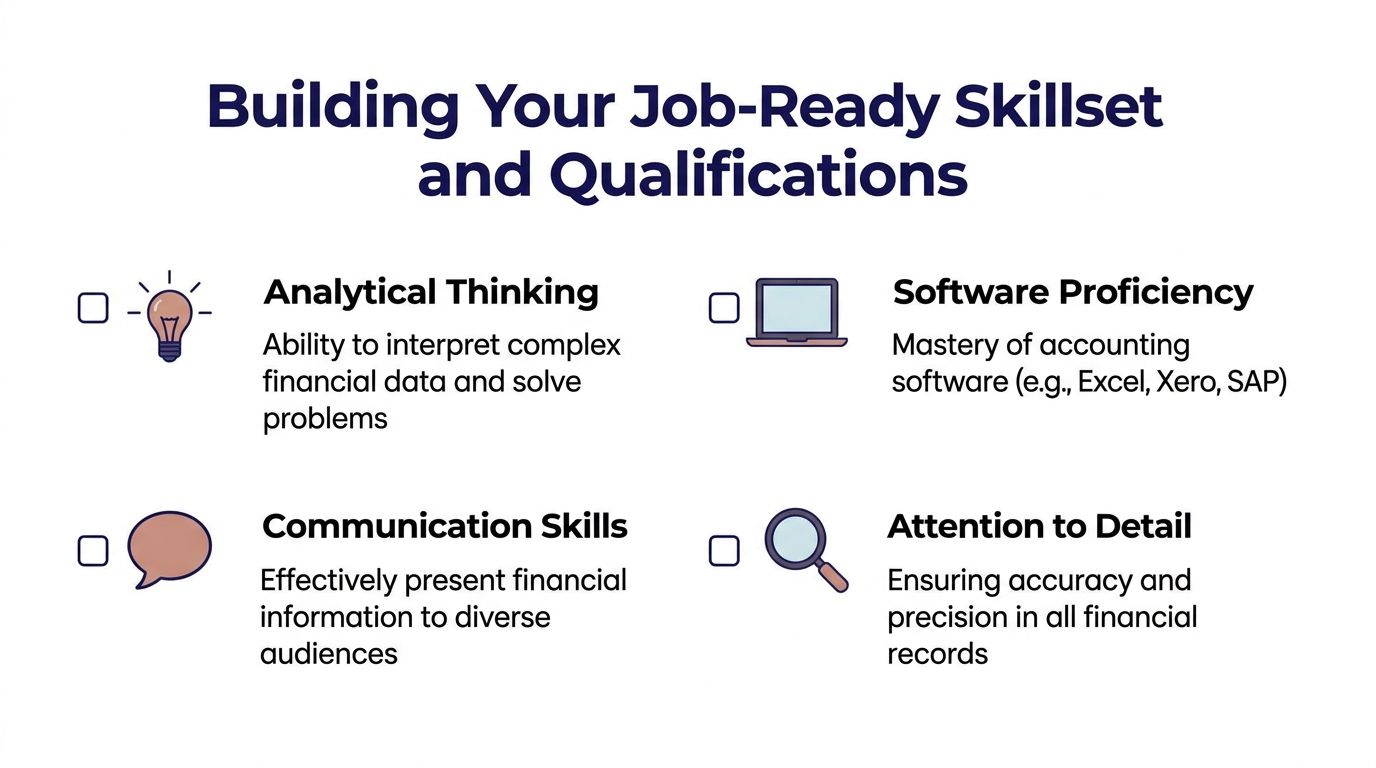
Employers don’t hire degrees. They hire capability. Your degree helps, but it won’t carry the whole application.
Formal routes that still matter
There’s been a real shift in entry requirements. Major firms like EY, Deloitte, and PwC have removed the 2:1 grade requirement in the last 12 months, which means candidates with a 2:2 or below can apply more broadly. Some accountancy firms now also offer fully funded Level 7 apprenticeship routes for candidates with a 2:2 or above.
That matters because too many graduates write themselves off too early.
If you’ve got a 2:2, stop acting as if the door is closed. It isn’t. Apply properly. Frame your application around work ethic, commercial maturity, software learning, and evidence that you can handle real finance tasks.
For graduates who need a more practical base, AAT is worth taking seriously. The AAT Level 2 accounting route is especially useful if you want to strengthen your grounding in day-to-day bookkeeping, transactions, and finance operations.
The software gap you must close
In this scenario, many graduates lose out. Employers expect practical confidence with systems, not just textbook knowledge.
Your priority list should include:
- Excel first: You should be comfortable cleaning data, building working schedules, checking formulas, and presenting results clearly.
- Accounting software next: Sage, Xero, and QuickBooks show employers you can operate in live finance environments.
- Role-specific tools after that: Payroll systems, reporting tools, and dashboards matter once you’ve chosen a path.
If you’re moving towards finance operations, process knowledge also matters. Reading practical breakdowns such as Toya AI’s payment automation insights can help you understand how modern finance teams handle accounts payable workflows and repetitive payment tasks.
Skills by route
Here’s the practical version of what to build.
- For bookkeeping & VAT: Learn transaction posting, reconciliation, VAT handling, ledger discipline, and software workflows.
- For accounts assistant jobs: Focus on purchase ledger, sales ledger, credit control awareness, expenses, and month-end support.
- For final accounts work: Strengthen double-entry confidence, trial balance understanding, adjustments, and year-end preparation.
- For advanced payroll: Prioritise confidentiality, deadline management, process accuracy, and system use.
- For business analyst and data analyst roles: Build Excel reporting, data cleaning, trend interpretation, and communication.
Employers forgive limited experience. They don’t forgive vagueness. If you say you know Excel or Xero, be ready to explain what you’ve done with it.
The professional habits that make the difference
A graduate becomes employable fast when they combine technical learning with the habits finance teams rely on.
Those habits are simple:
- Accuracy under routine pressure
- Clear communication with non-finance colleagues
- Good note-taking and process discipline
- Asking sensible questions early instead of hiding mistakes
Those don’t sound glamorous. They get people hired.
Understanding UK Salary and Career Progression
Salary matters. It should. You’re not being shallow for caring about pay. You’re being practical.
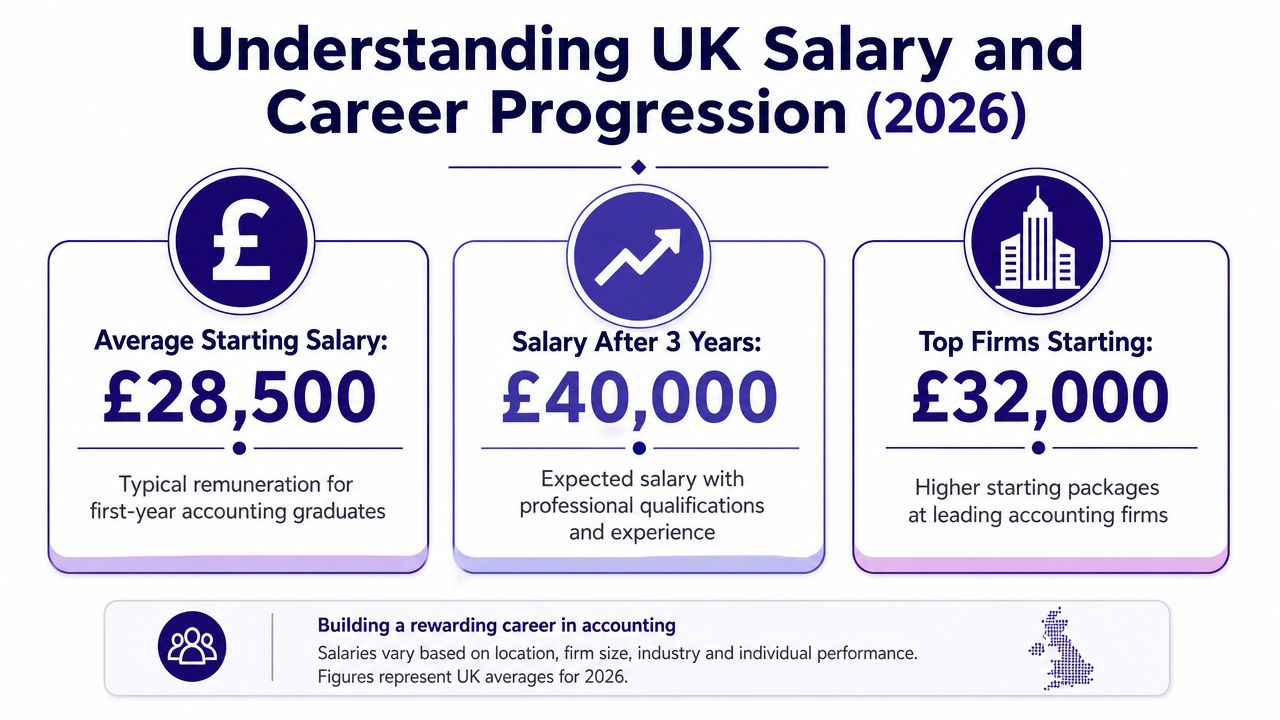
As of June 2026, the average starting salary for Accounting graduates in the UK is £32,042, compared with the national average graduate starting salary of £29,771, according to Graduate Jobs’ accounting vacancies data. That’s a strong signal. Accounting remains one of the better-paid graduate routes.
What trainee pay really looks like
Early pay depends heavily on route, location, and employer type.
According to targetjobs on accountancy salaries and benefits for graduates:
- Graduate trainee ACCA accountants start between £19,000 and £25,000
- Trainee ACA accountants range from £18,500 to £28,000
- Big 4 firms offer graduate-level pay around £32,000
That explains why graduates get fixated on famous firms. The premium is real.
Don’t misread the salary ladder
A lower first salary isn’t always a bad decision. If an accounts assistant role gives you software experience, month-end exposure, and a route into study support, it may beat a higher-paid role with narrow admin work and no progression.
Here’s the better way to judge an offer:
| What to assess | Why it matters |
|---|---|
| Study support | It affects long-term career value |
| Software exposure | It improves your next move |
| Range of tasks | Broad experience builds employability |
| Manager quality | Good supervision accelerates learning |
| Title versus substance | Useful work beats a flashy title |
Entry-level alternatives that still pay sensibly
Not every graduate starts on a traditional trainee accountant track. In the UK, bookkeepers and payroll administrators coming through AAT Level 2 or Level 3 training can start from £20,670 annually, rising to £23,670 in the second year, with a standard 37.5-hour working week, based on Indeed listings for accounting training linked roles.
That’s important because it shows there are viable paid routes into finance work outside the classic graduate scheme model.
Salary matters, but trajectory matters more. Your first role should increase your value in the market, not just cover this month’s rent.
Crafting Your Winning Job Search Strategy
Most graduates search badly. They apply widely, tailor very little, and put too much faith in degree classification carrying them through.
That’s why talented people stay stuck.
A more honest job search starts with this fact: many graduates with 1st-class degrees are still jobless after 3 years, and UK accounting community advice often points them towards accounts assistant or accounts payable/receivable roles as valid strategic entry points rather than failures, as seen in this Reddit discussion from the UK accounting community.
Stop worshipping graduate schemes
Graduate schemes are fine. They are not the whole market.
If you only apply to branded trainee programmes, you’ll miss the roles that teach the mechanics employers care about. An Accounts Assistant job can give you invoice processing, reconciliations, payment runs, email handling, supplier contact, ledger work, and month-end support. That’s not second best. That’s employability. If you would still rather target a structured programme, our separate guide to accounting graduate schemes covers how those application processes actually work.
Build a smarter target list
Don’t search one job title. Search a cluster.
Use titles such as:
- Accounts Assistant
- Finance Assistant
- Accounts Payable Assistant
- Accounts Receivable Assistant
- Bookkeeper
- Payroll Assistant
- Junior Finance Analyst
- Reporting Assistant
- Trainee Accountant
That wider search gives you more chances to get inside a finance team.
Tailor your CV for tasks, not modules
Employers don’t care that you studied Management Accounting 2 unless you translate it into job language.
Instead of writing academic descriptions, write bullets that sound operational:
- Reconciled data sets using Excel and checked for inconsistencies
- Prepared financial information accurately under deadline pressure
- Analysed trends and presented findings in a clear format
- Worked with numerical data requiring strong attention to detail
If you need help tightening your profile and outreach, this guide on how to use LinkedIn for job search is worth using properly, not skimming once and forgetting.
A practical application formula
Use this simple order when applying:
- Apply to roles where you match at least the core tasks
- Customise your top third of applications
- Mention software early if you have it
- Show reliability, not just ambition
- Follow up professionally
You do not need the perfect first role. You need the first role that gives you evidence.
That’s how graduates stop being “promising” and start being employable.
How Professional Careers Training Gives You an Edge
The biggest problem for graduates isn’t lack of intelligence. It’s lack of applied proof. Employers want to see signs that you can step into a finance team and contribute without months of hand-holding.

That’s exactly why practical training matters more than another round of vague online reading. If you want accounting jobs for graduates, your training should match real vacancies. That means job-focused learning in bookkeeping & VAT, advanced payroll, accounts assistant, final accounts, business analyst, and data analyst skills.
Why foundational training still matters
The AAT offers foundational qualifications such as the Level 1 Award and Level 2 Certificate in Bookkeeping, and these serve as stepping stones into roles like Bookkeeper, Payroll Admin, and Accounts Assistant, according to Prospects’ guide to accounting courses.
That point is often underestimated by graduates. They think foundational means basic. In hiring terms, foundational often means usable. A graduate who understands bookkeeping processes, VAT handling, and ledger work looks more useful than one who can discuss theory but can’t process routine finance tasks confidently.
What practical training should include
Good training should do more than explain concepts. It should mirror the work itself.
For these routes, that means:
- Bookkeeping & VAT: recording transactions, reconciling entries, understanding VAT treatment, and using software properly
- Accounts Assistant: handling ledgers, payments, invoices, and month-end support tasks
- Advanced payroll: processing payroll work with accuracy and confidentiality
- Final accounts: preparing year-end information and understanding how records flow into formal reporting
- Business analyst and data analyst training: building reporting, analysing trends, and turning numbers into decisions
A strong programme also needs software practice. Sage, Xero, QuickBooks, Advanced Excel, SQL, Python, and Power BI all improve your ability to move from study to paid work, especially in analyst-facing roles.
The support most graduates actually need
Technical learning is only part of the picture. Graduates also need structure, accountability, and proper career support.
The strongest training providers give you:
- 1-to-1 support from qualified accountants
- Flexible study options
- Recognised software certification
- CV preparation and interview guidance
- Job hunting strategy and employer-facing support
That combination is what closes the gap between education and employability.
Your Future in Accounting Starts Today
You don’t need a perfect CV, a perfect grade profile, or a perfect start. You need movement.
The graduates who get traction are the ones who stop waiting for the market to “recognise potential” and start building practical proof. They choose a path. They learn the tools. They target sensible job titles. They stop seeing accounts assistant or payroll roles as beneath them. They use them as launchpads.
That’s the core message behind accounting jobs for graduates in 2026. There isn’t one doorway. There are several. Some are more prestigious. Some are faster. Some are better for your confidence and cash flow. The smart move is the one that gets you into live finance work and keeps your progression open.
If you’re bright but anxious, take that anxiety and turn it into a plan:
- choose your route
- build practical skills
- apply beyond narrow graduate labels
- get comfortable with software
- back yourself with training that employers recognise
You’re closer than you think. Most graduates don’t need reinventing. They need translating from academic potential into workplace value.
That’s fixable. And it starts now.
If you want a faster route from graduate uncertainty to job-ready confidence, Professional Careers Training offers practical accountancy and analytics training built around real employability. With 1-to-1 support from ACCA qualified Chartered Accountants and CPD approved trainers, flexible evening and weekend study, official Sage, Xero and QuickBooks certification, plus CV, LinkedIn and job search support, it’s a strong option for graduates who want skills that lead to interviews and offers.