
If you have ever looked at a set of year-end accounts and felt slightly lost, you are not alone. "Final accounts" is one of those...
They often are closer than they think.
A strong route into home bookkeeping jobs starts with practical training, not guesswork. If you can learn the work that employers need, build a portfolio that proves it, and apply in a focused way, you can move from interested beginner to job-ready candidate with much more confidence.
The Growing Demand for Remote Bookkeepers in the UK
A lot of people look at bookkeeping because they want more than a payslip. They want work they can do from home, skills that stay useful, and a role that feels grounded in real business needs. Bookkeeping fits that brief well because every organisation needs accurate records, clean reconciliations, and reliable reporting.
This isn’t a tiny niche. As of 2025, there are 54,977 people employed in the bookkeeping sector across the United Kingdom, which shows a sizeable and stable profession rather than a passing work-from-home trend, according to IBISWorld’s UK bookkeeping employment data.

Why home bookkeeping jobs keep attracting applicants
Remote bookkeeping appeals to several groups at once. Recent graduates see it as a practical entry point into finance. Parents and carers see flexibility. Career changers often see a role with clear tasks and visible outcomes.
What keeps demand steady is the day-to-day reality of business life:
- Small firms need support: Owners still need sales recorded, supplier bills posted, and bank accounts reconciled.
- Compliance hasn’t gone away: HMRC rules still have to be followed properly.
- Cloud software has changed delivery: Work that once required office files can now be done securely from home with the right systems.
That last point matters. The move to digital accounting has made remote delivery far more practical, especially for small businesses that don’t need a full-time in-house finance team.
Why the opportunity is bigger than it first looks
Remote work in finance isn’t just about bookkeeping clerk roles. The same starting point can lead into accounts assistant, advanced payroll, final accounts, and even broader analytical work such as business analyst or data analyst support where finance data needs to be organised and interpreted.
Home bookkeeping jobs are often the first rung, not the final destination.
Once you understand ledgers, reconciliations, VAT, payroll flows, and reporting logic, you build habits that transfer into many office-based and remote finance positions.
If you’re exploring related remote finance paths as well, this guide to remote accounting jobs in the UK can help you see where bookkeeping sits in the wider market.
Building Your Job-Ready Bookkeeping Skillset
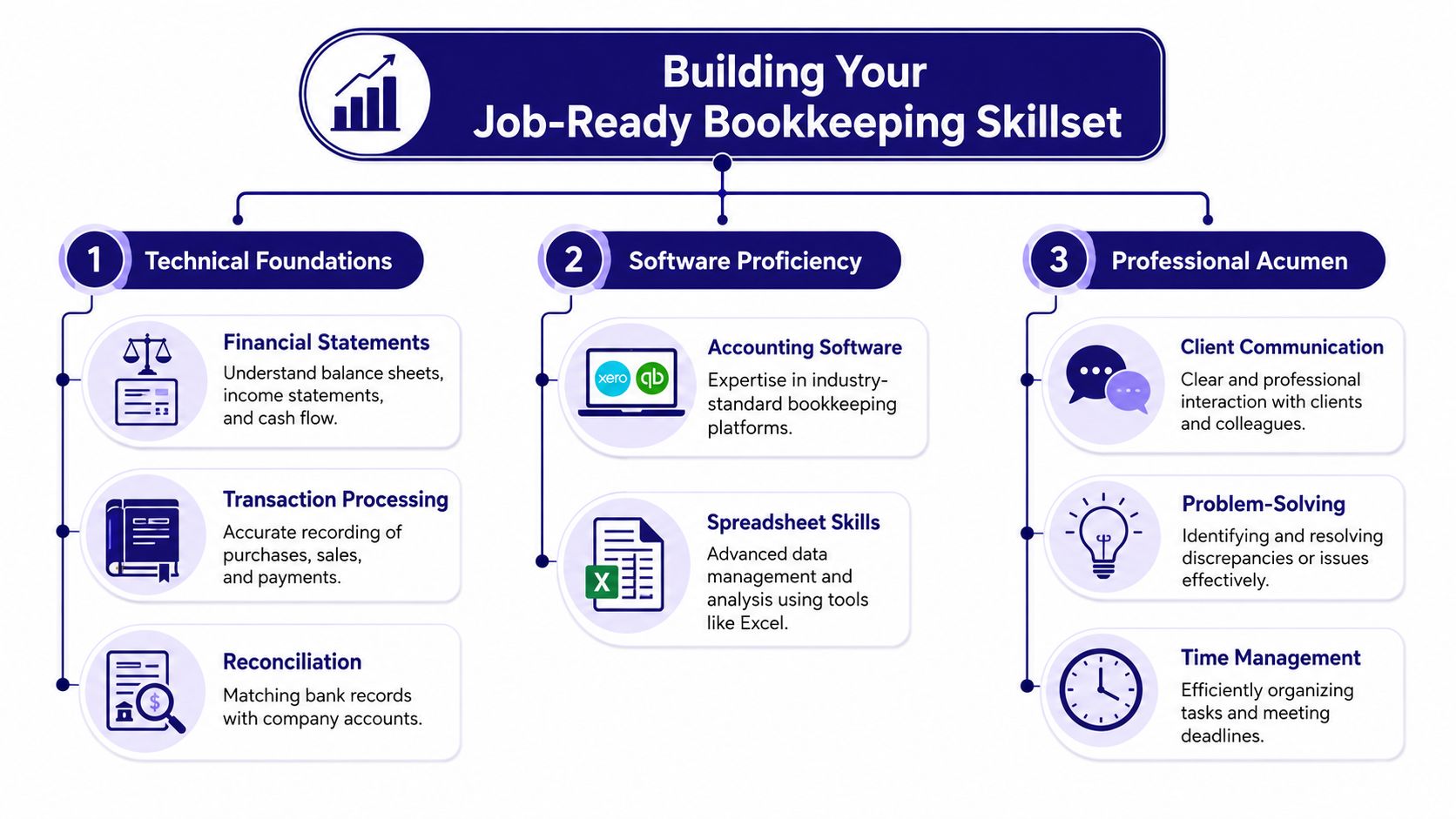
The biggest mistake beginners make is trying to “learn bookkeeping” as one vague subject. Employers don’t hire vague skills. They hire people who can process transactions, post journals correctly, reconcile accounts, handle VAT records, support payroll, and work confidently in software such as Xero, Sage, QuickBooks, and Excel.
That means your training needs to mirror real work.
Start with bookkeeping and VAT
The foundation is still the same. You need to understand how money moves through a business and how to record it accurately. That includes sales, purchases, receipts, payments, journals, and bank reconciliation.
For UK learners, bookkeeping and VAT training matters because VAT errors cause real problems. You need to know when VAT applies, how input and output VAT work, and how records support returns. In the UK, businesses must register for VAT if taxable turnover exceeds the £85,000 threshold within a 12-month period, as outlined in Institute of Financial Accountants endorsed bookkeeping and VAT training.
A good beginner question is, “Do I need to master tax law first?” No. You need practical competence first. Learn the bookkeeping flow, then layer VAT rules on top.
Learn software as part of the job, not after it
Software skill isn’t an optional extra anymore. The UK’s Making Tax Digital initiative mandates that all VAT-registered businesses submit VAT returns digitally via HMRC-compatible software, so bookkeepers need to work confidently in those systems, as covered by Lantra’s training on bookkeeping, VAT and Making Tax Digital.
That’s why software practice should sit inside your training plan, not at the end of it.
Here’s the practical order I’d suggest:
- Xero or Sage first: Learn how transactions are posted, coded, and checked in a cloud system.
- QuickBooks next: It widens your employability and helps you speak to more employers and clients.
- Excel throughout: Don’t treat spreadsheets as basic admin. They’re part of finance work every week.
If you want to strengthen the spreadsheet side, this resource on Excel for accounting is worth adding to your routine.
A short practical explainer can make the learning path easier to picture:
Add payroll, final accounts, and progression skills
Once the foundation is in place, your value rises when you can support more than day-to-day posting.
| Training area | Why it matters at home | Typical role links |
|---|---|---|
| Advanced payroll | Employers need accurate pay runs and timely reporting | Payroll assistant, accounts assistant, bookkeeper |
| Final accounts | You become more useful at month-end and year-end | Accounts assistant, junior accountant |
| Business analyst awareness | You can explain what the numbers mean | Finance admin, reporting support |
| Data analyst skills | You can clean and present finance data clearly | Reporting, operations support, analyst pathways |
For payroll, UK compliance is specific. Employers must report under the Real Time Information system each time they pay staff, which is why advanced payroll training that covers RTI reporting gives learners a stronger practical base.
For broader credibility, many learners also use recognised study routes. The AAT Level 2 Bookkeeping qualification covers practical areas such as double-entry bookkeeping, bank reconciliations, and final accounts preparation, as outlined by AAT qualifications and courses.
Practical rule: Learn enough bookkeeping to be accurate, enough software to be employable, and enough reporting to be useful beyond data entry.
That combination supports home bookkeeping jobs, but it also opens doors into accounts assistant, final accounts, business analyst, and data analyst pathways where finance knowledge gives you an edge.
Crafting a CV That Bypasses the Experience Trap
The qualification paradox catches a lot of good candidates. They see remote bookkeeping roles that sound beginner-friendly, then notice a request for AAT or part-qualified ACCA and assume the door is closed.
It isn’t always closed.
Many UK job ads for remote bookkeepers request AAT or part-qualified ACCA status despite saying “no experience required”, yet practical portfolios from CPD-approved software training in tools such as Xero and Sage can help candidates present themselves as QBE, or Qualified by Experience, according to Indeed’s UK remote bookkeeping listings context.
Turn training into evidence
Employers trust proof. If your course included tasks such as posting purchase invoices, reconciling a bank account, correcting nominal code errors, processing VAT, or producing reports, that work can become portfolio material.
Use simple evidence such as:
- Software screenshots: Show a clean dashboard, chart of accounts, or reconciliation screen with sensitive information removed.
- Short project notes: Explain what you did, which software you used, and what issue you solved.
- Before-and-after examples: A messy ledger corrected into balanced records is persuasive.
- Course assignments: These count when they reflect real business tasks.
A weak CV says, “Studied bookkeeping.”
A stronger CV says, “Completed practical bookkeeping training using Xero and Sage, including transaction posting, bank reconciliation, VAT processing, and basic reporting.”
Write for relevance, not for history
If you don’t have formal bookkeeping employment yet, pull relevant experience from other roles. Retail work may show cash handling and accuracy. Office support may show spreadsheet confidence and document management. Customer service may show communication, time management, and problem-solving.
That’s why new entrants often benefit from reading guidance on tips for your first resume. The useful lesson isn’t to pad your CV. It’s to translate what you’ve done into the language employers recognise.
For UK applicants, it also helps to study examples of how to write a CV with no experience so your document feels local and role-specific.
What to put near the top of your CV
Don’t bury the useful part.
Open with a short profile that includes:
- Your target role: home bookkeeper, accounts assistant, payroll support
- Your software: Xero, Sage, QuickBooks, Excel
- Your practical scope: reconciliations, VAT records, payroll support, final accounts support
- Your working style: organised, accurate, comfortable working independently
A practical portfolio can do what a missing job title can’t. It gives the employer a reason to keep reading.
LinkedIn should mirror this. Use the headline to state the role you want and the tools you can use. A vague headline wastes valuable space.
Where to Find and How to Win Remote Bookkeeping Roles
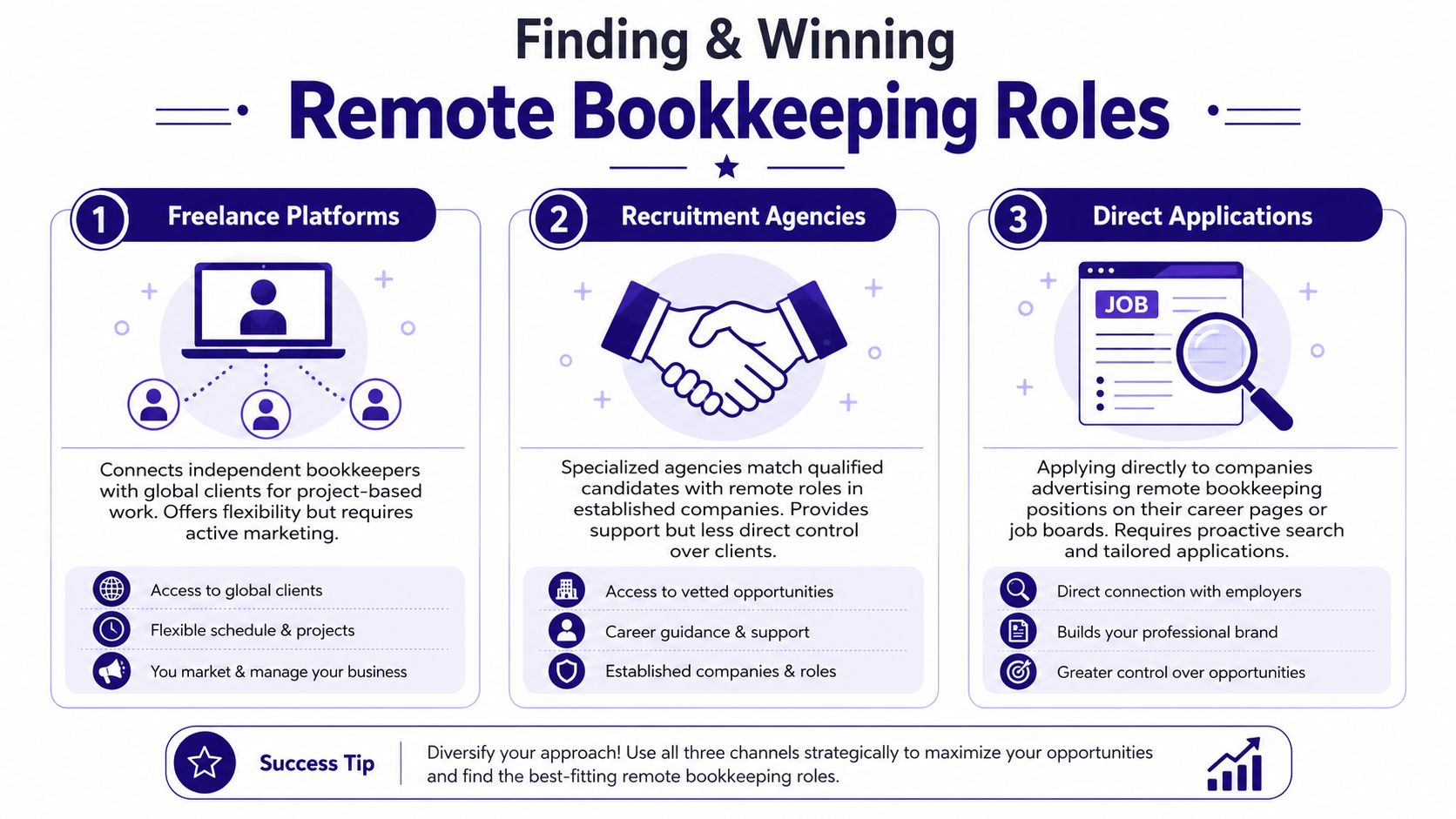
Many applicants search in one place, send generic applications, and then conclude there aren’t enough opportunities. The better approach is to use three channels at once and treat each one differently.
Benchmark data shows remote bookkeeping vacancies in the UK range from 175 to 466 active listings, with annual salaries typically around £26,000 to £32,000, based on LearnSignal’s bookkeeping jobs overview. That means there is visible demand, but competition is real. You need a plan.
Compare the main routes
Different channels suit different stages.
| Route | Best for | Watch out for |
|---|---|---|
| Job boards and company sites | Structured employed roles | High volume competition |
| Freelance platforms | Building experience and testimonials | You need to market yourself |
| Recruitment agencies | Access to hidden or specialist vacancies | You must present clearly and professionally |
Freelance platforms are especially useful when you need proof of client work. Small clean-up tasks, bank rec updates, and software migration support can help you build credibility fast. Recruitment agencies can help if your CV already shows software training and a clear target role.
Use a focused application message
A cover letter for home bookkeeping jobs doesn’t need to sound grand. It needs to reduce employer doubt.
Try this structure:
- Opening line: State the role and your fit.
- Practical evidence: Mention software and tasks you’ve completed.
- Business value: Show that you understand accuracy, deadlines, and communication.
- Close: Ask for an interview or short conversation.
Example:
I’m applying for your remote bookkeeping role. I’ve completed practical training in Xero, Sage, QuickBooks and Excel, with hands-on work in transaction posting, bank reconciliation, VAT records and reporting. I’m looking for a role where accuracy, organisation and clear communication matter, and I’d welcome the chance to discuss how I could support your finance team from day one.
That style works because it sounds capable without pretending to have years of experience.
Make your online profile do some of the work
When recruiters or clients search online, your profile needs to support your CV, not confuse it. A headline such as “Bookkeeping trainee seeking opportunity” is weaker than one that names software and services.
For that reason, it’s useful to learn how to turn your profile into a pipeline. The main takeaway is simple. Make it obvious what you do, who you help, and which tools you use.
A good profile summary can mention bookkeeping, VAT support, payroll awareness, Excel, and your interest in accounts assistant or reporting work. That can also help if you later move towards business analyst or data analyst roles with a finance focus.
Pricing Your Services and Managing Client Contracts
Employed roles aren’t the only route. Some people use home bookkeeping jobs as a bridge into freelance work. Others start freelance from the beginning because they want more control over schedule, workload, and client choice.
The challenge is pricing. Beginners often copy low rates because they’re nervous. That usually creates stress, not growth.
An effective billing structure for UK home bookkeepers involves starting at £40 per hour for client setup and cleanup tasks, then moving to flat monthly retainers that average £70 to £100 per hour once the workflow is established, according to Oxford Home Study’s guide to remote bookkeeping jobs.
Why hourly is useful at the start
Hourly pricing makes sense when the books are messy or the scope is unclear. Cleanup work, backlog entry, opening balance corrections, and software setup can all take longer than expected.
Hourly billing protects you when:
- Records are disorganised: You don’t yet know how much fixing is needed.
- The client is new to you: Their responsiveness may affect the job.
- The process isn’t standardised: You’re still learning their systems.
Once the work becomes routine, hourly pricing can start to punish efficiency. If you get faster, you earn less for the same value delivered.
Why retainers are usually stronger
Monthly retainers work better when the client needs the same work each month. For example, sales posting, purchase ledger maintenance, reconciliations, and a monthly reporting pack.
This gives you:
- More predictable income
- Clearer client expectations
- A workflow you can schedule around other clients
- A stronger business model for home-based work
If you save a client time and reduce errors every month, you’re selling reliability, not just hours.
A niche can help here too. If you ever want to specialise in community, charity, or faith-based organisations, reading Grain’s advice on church bookkeeping is useful because it shows how service scope, reporting needs, and stakeholder expectations can differ in practice.
What a simple client contract should cover
You don’t need a dense legal document to start. You do need clarity.
A basic bookkeeping service agreement should set out:
- Scope of work: What you will and won’t do
- Software used: Xero, Sage, QuickBooks, spreadsheets, payroll tools
- Deadlines: When records must be sent and when reports will be delivered
- Fees and payment terms: Hourly or monthly, invoice dates, due dates
- Confidentiality: How you handle financial information
- Ending the agreement: Notice period and handover arrangements
Keep the wording plain. Confusion usually starts when the scope is vague. If payroll, VAT returns, credit control, and reporting are all included, say so. If they’re not, say that too.
Your Next Steps with Professional Careers Training
What’s needed isn’t more random advice, but a route one can follow without second-guessing every step. For home bookkeeping jobs, that route is usually practical training, software confidence, portfolio evidence, CV support, and guided job search.
That’s where structured learning makes the difference. A course in bookkeeping and VAT helps you build the core habits of accurate transaction processing, reconciliation, and compliance awareness. Advanced payroll training adds another employable skill that many smaller employers value. Learning final accounts makes you more useful at month-end and year-end. Broader development in accounts assistant, business analyst, and data analyst skills helps you move beyond entry-level admin into more rounded finance support.
Why practical support matters
The qualification paradox becomes much easier to handle when your training produces visible evidence. Software certificates, practical assignments, guided projects, and CV coaching help you show employers what you can do now.
Professional Careers Training supports that kind of progression with 1-to-1 training from ACCA qualified Chartered Accountants and CPD-approved trainers, flexible scheduling that includes weekend and evening classes, official certification in Sage, Xero, and QuickBooks, software support, and recruitment help including CV preparation, career coaching, job hunting strategy, LinkedIn optimisation, and employer referrals.
A simple action plan
If you’re unsure where to begin, keep it straightforward:
- First, build the foundation: Learn bookkeeping, VAT, and digital record-keeping properly.
- Next, add software proof: Get hands-on with Xero, Sage, QuickBooks, and Excel.
- Then, widen your employability: Add advanced payroll, final accounts, or reporting skills.
- After that, package your evidence: Build a CV, LinkedIn profile, and small portfolio.
- Finally, apply with purpose: Target remote employed roles and selective freelance work.
You don’t have to arrive fully formed. You do need to become clearly useful.
That’s a significant shift. Once employers or clients can see your skills in action, you stop looking like someone who “wants to get into bookkeeping” and start looking like someone who can help keep the books accurate, compliant, and organised.
If you’re ready to take a concrete step, explore the flexible accountancy and software training options at Professional Careers Training. Their programmes combine practical bookkeeping, VAT, payroll, final accounts, software certification, and career support, which makes them a strong option for anyone aiming to turn home bookkeeping jobs into a real UK career path.