

LinkedIn allows 220 characters in the headline field. That small space does two jobs at once. It helps your profile appear in recruiter searches, and...
You've done the hard part already. You studied accounting, finance, business analysis, or data. You may even have hands-on skills in Xero, Sage, QuickBooks, Power BI, SQL, payroll, VAT, or final accounts. Yet when you start looking at UK jobs, the visa side can feel harder than the career side.
That's a common problem. Many strong candidates focus on course content, CV updates, and interviews, then get stuck on sponsorship, salary rules, English language evidence, or application timing. If you're aiming for roles such as accounts assistant, bookkeeper, payroll officer, business analyst, or data analyst, the rules matter just as much as your technical ability.
The good news is that the system is strict, but it isn't random. Once you understand how UK work visas fit with your chosen career path, the process becomes far easier to manage. For accounting and analyst roles, that means lining up three things at the same time: the right job title, the right employer, and the right evidence.
Navigating the 2026 UK Work Visa Landscape
You find a UK job posting for a junior data analyst or accounts assistant role. The duties match your skills. You can use Excel, Power BI, Xero, or payroll software with confidence. Then you reach the line that changes everything: candidate must have the right to work in the UK or sponsorship may be available for the right applicant.
That single sentence often decides whether your job search moves forward.
The rules for work visa requirements UK have become stricter in recent years, especially around sponsored work and salary levels. For accounting, finance, and data candidates, that does not mean the door is closed. It means your career plan and your visa plan need to fit together from the start, like matching two halves of the same key.
What this means for finance and data candidates
Employers do not sponsor people solely because they have a degree. They usually sponsor candidates who can do useful work quickly and justify the time, cost, and compliance involved in hiring from overseas.
In practice, that changes how you should position yourself.
If you are aiming for accounting roles, employers look for evidence that you can handle real tasks such as bank reconciliations, purchase and sales ledgers, VAT support, payroll processing, month-end routines, or assisting with final accounts. If you are aiming for data or business analysis roles, they want proof that you can work with spreadsheets, SQL, reporting tools, dashboards, data cleaning, and stakeholder requests, not just talk about theory from a classroom.
A general profile is harder to sponsor. A job-ready profile is easier to defend internally.
That is why practical training matters so much in this field. ACCA knowledge, bookkeeping practice, Xero familiarity, Excel reporting, Power BI dashboards, and similar skills do more than strengthen your CV. They help you move closer to the kind of role an approved sponsor may hire for.
Why career strategy matters early
Many international candidates apply first and check the visa rules later. That is a bit like preparing for an exam before checking which subject is on the paper. You may work hard and still miss the target.
A stronger method is to start with the role itself. Ask:
- Is this job likely to be sponsorable?
- Does the employer have a history of hiring international staff?
- Does the salary level have a realistic chance of meeting visa rules?
- Do my current skills match what the employer needs on day one?
Those questions are especially important in accounting and data because job titles can look similar while the visa prospects are very different. An entry-level accounts role with basic admin duties may be harder to align with sponsorship than a more technical finance assistant, payroll specialist, business analyst, or data analyst position where the employer can point to clear business value.
The UK system is stricter now, but it still rewards candidates who plan carefully. If you build skills that map directly to sponsorable roles, your visa options become far clearer and your job search becomes far more focused.
Understanding the UK's 70-Point Immigration System
A UK work visa application often feels confusing because two decisions are happening at the same time. An employer is deciding whether you fit the job. The Home Office is deciding whether that job fits the visa rules. The 70-point system is the framework that brings those two tests together.
You can read it like a scorecard with two layers. First, you need the core points that prove the role is sponsorable. Then you need the remaining points, which usually come from salary or another permitted factor under the Skilled Worker rules set out in the official UK government guidance for Skilled Worker visas.
The core points come first
Some parts of the score are fixed because they establish the basic right to apply. If one is missing, the rest of the application does not have much to stand on.
Those core points come from:
- A genuine job offer from an approved sponsor
- A role that meets the required skill level
- English language ability that meets the rules
For an accounting or data candidate, that matters more than many people expect. A job title on its own does not carry the application. The employer, the duties, and the occupation coding all have to line up properly. An accounts assistant role focused mostly on routine admin may be viewed very differently from a finance assistant position with month-end support, reconciliations, payroll input, or reporting duties. The same applies in analytics. A vague "data support" post may be harder to classify than a data analyst role with clear reporting, dashboard, SQL, or business insight responsibilities.
The remaining points are where career planning shows up
The final part of the score is often described as "tradeable" points. That phrase sounds technical, but the practical meaning is simple. Once the core conditions are met, the application still needs an approved route to the full score, and salary is often the factor people focus on first.
Salary is not the only consideration, but it is often the one that connects most directly to your career stage. Early-career applicants in finance and analytics should pay attention to this because training can influence the kind of role you qualify for, and the kind of role you qualify for affects salary. Better technical fit often leads to stronger job offers.
Here is the system in a simple format:
| Part of the system | What it covers | What it means for your job search |
|---|---|---|
| Core points | Sponsorship, skill level, English | The role must be suitable for the visa route |
| Remaining points | Salary or another permitted factor | Your job package must complete the eligibility test |
A useful way to read this is as a career filter. The visa does not only ask, "Are you talented?" It asks, "Have you been hired into a role that matches a recognised skilled position under the rules?"
Why this matters so much in accounting, finance, and data
Many international applicants lose time when they improve general employability without improving visa suitability.
In accounting, practical skills often make the difference between a loosely defined junior role and one with enough substance for sponsorship discussion. Knowledge of ACCA-style accounting principles, bookkeeping workflows, Xero, Excel, VAT, and payroll processes helps an employer see how you will contribute from your first weeks, not after months of basic training.
In data and business analysis, employers usually want evidence that you can turn information into decisions. That could mean Excel modelling, SQL queries, Power BI dashboards, KPI reporting, or process analysis. If you are targeting analyst roles, this guide to entry-level data analyst jobs in the UK can help you see how employers describe junior positions and what skills appear repeatedly.
The point system may look like an immigration checklist. In practice, it works more like a career map. The closer your skills are to a clearly sponsorable accounting, finance, or analyst role, the easier it becomes to satisfy the rules with a real job offer rather than hope that a vague role title will somehow fit.
Key Visa Routes for Accounting and Data Professionals
Not every visa route deserves equal attention. If you're aiming to build a long-term career in UK accounting, finance, business analysis, or data analysis, a small number of routes matter far more than the rest.
The Skilled Worker route
For most international professionals, this is the main route to focus on. It's the route built for sponsored employment with an approved UK employer.
If you want to work as an accounts assistant, progress into final accounts work, move into advanced payroll, or build a career as a business analyst or data analyst, this is usually the route that anchors your planning. It connects your career choice directly to sponsorship, salary, occupation coding, and employer readiness.
The Graduate Route as a bridge
If you completed an eligible UK degree, the Graduate Route can give you breathing space. It lets you work and gain UK experience while searching for a longer-term sponsored position.
That matters because many employers are more comfortable sponsoring someone after seeing UK work experience, practical software knowledge, and evidence that the candidate can operate well in a local workplace. For accounting and analyst roles, that can mean using your post-study period to build experience in:
- Bookkeeping and VAT processing
- Payroll administration
- Accounts assistant support
- Excel reporting
- Dashboard building
- Business process documentation
Candidates aiming for analyst roles often benefit from reading practical guides on entry-level data analyst jobs in the UK, because these roles often ask for project evidence, not just academic grades.
A quick route comparison
| Route | Best for | Main limitation |
|---|---|---|
| Skilled Worker | Long-term sponsored employment | You need an approved sponsor and a qualifying role |
| Graduate Route | UK graduates building work experience | It's temporary, so you still need a long-term plan |
| Health and Care related roles | Some finance or data roles within NHS-linked settings | It only fits certain employers and job structures |
Which path should you prioritise
If you're outside the UK and already experienced, the Skilled Worker route usually deserves most of your attention.
If you're already in the UK after study, the Graduate Route can act as a practical stepping stone. It gives you time to improve your CV, gain office-based experience, and target employers more strategically. For many candidates in accounting and data, that bridge period is where theoretical learning turns into sponsor-worthy employability.
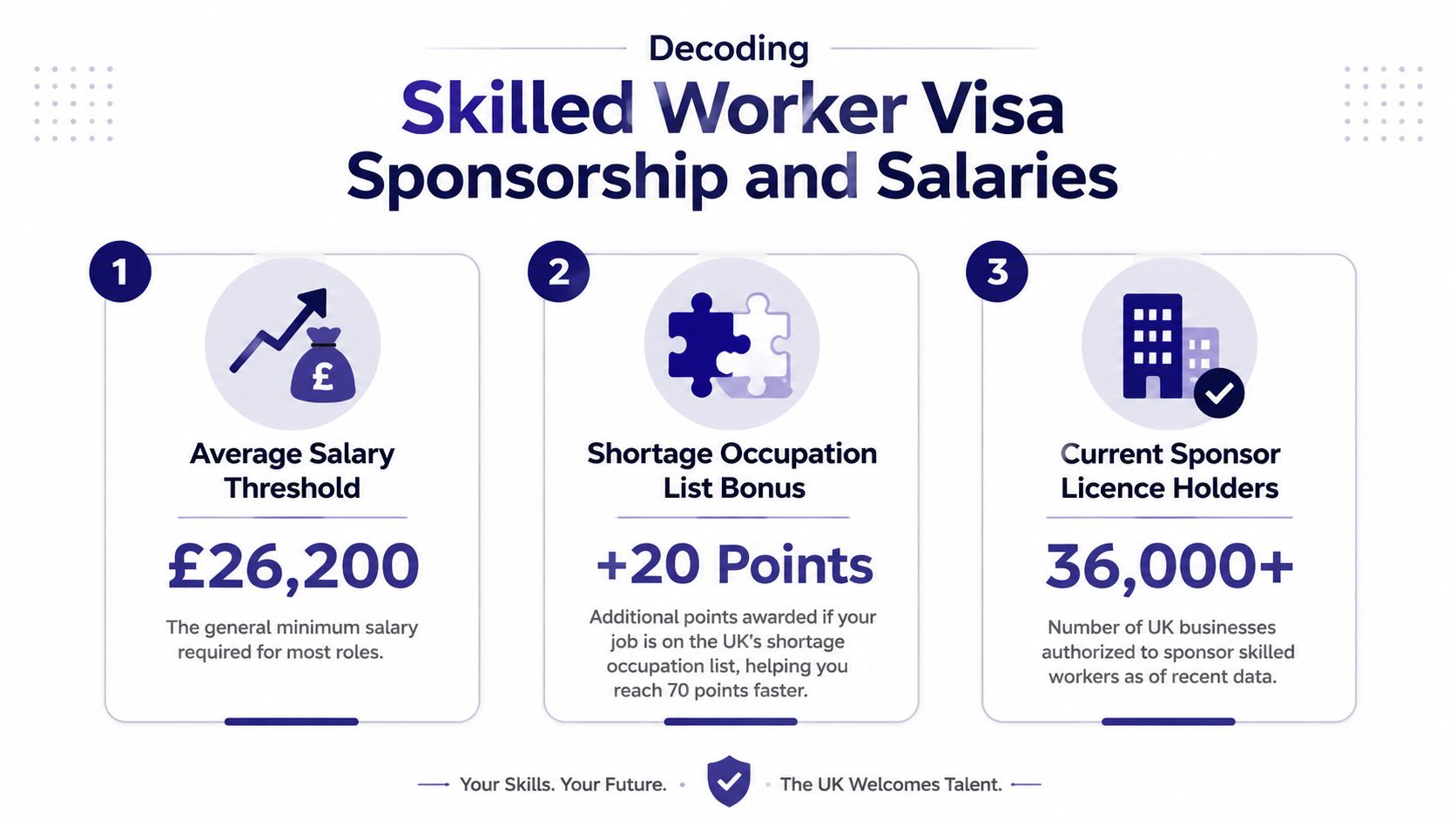
Decoding Skilled Worker Visa Sponsorship and Salaries
You receive encouraging feedback after an interview for a junior finance analyst role in Manchester. The hiring manager likes your Excel test, your Power BI project, and your understanding of month-end reporting. Then the conversation shifts to sponsorship and salary. That is the point where many strong candidates get stuck, not because they lack ability, but because the job, pay, and visa rules must all line up.
A Skilled Worker application only works when an employer is ready to issue a Certificate of Sponsorship, or CoS. Treat the CoS like the official reference number that connects your role to the immigration system. A contract or offer email shows intent. The CoS is the formal record that allows the visa application to proceed.
Why salary causes so much confusion
Candidates often hear several salary figures and assume the system is inconsistent. It is more accurate to say the system has layers.
Your pay usually needs to satisfy the immigration salary rules for the role you are being sponsored for. As noted earlier, the Skilled Worker route works on a points basis. Sponsorship and English cover part of the requirement. The remaining points are often tied to salary, though some applicants qualify through tradeable characteristics linked to the job or their qualifications.
For accounting and data professionals, that creates a practical career question. Are you applying for a role that is trained, titled, and paid at a level that supports sponsorship? An employer may want to hire you, but if the salary attached to the role does not fit the visa framework, the process can stop there.
Sponsorship is easier when your role is easy to classify
Employers are usually more confident about sponsorship when the job title, duties, and market salary make sense together. A finance analyst, management accountant, or data analyst role is often easier to explain than a vague title like office assistant with mixed responsibilities.
Immigration caseworkers do not assess your potential in the abstract. They assess the actual sponsored job. If your day-to-day work includes building dashboards in Power BI, reconciling financial data, supporting forecasting, or producing management reports, your profile is easier to position than someone whose duties are too broad or too junior.
That is why training choices matter. ACCA modules, Xero experience, advanced Excel, SQL, and Power BI do more than improve your CV. They help you qualify for roles that employers can justify at the right level.
Why some analyst candidates have an advantage
Data-focused roles can sometimes be more sponsorship-friendly than early-stage accounting support roles. The reason is simple. Analyst positions often have clearer technical duties and stronger salary logic from the start.
By contrast, roles such as accounts assistant or bookkeeper can still be valuable career steps, but sponsorship depends heavily on the employer's structure and expectations. If a business is considering visa sponsorship for an entry-level finance hire, they usually want evidence that you can contribute quickly in real systems such as Xero, Sage, QuickBooks, payroll software, and spreadsheet-based reporting.
A candidate who says, “I studied accounting,” sounds less convincing than one who can say, “I can process purchase ledger invoices, assist with bank reconciliations, support VAT records, and prepare month-end schedules in Excel and Xero.”
What employers often mean when they say sponsorship is difficult
That phrase usually points to one of three problems:
- The salary is too low for the role to support sponsorship
- The job title and duties are too unclear
- The employer is not yet convinced you can produce value quickly enough to justify the cost and admin
Read those concerns like a hiring manager would. Sponsorship is not only an immigration step. It is a business decision tied to risk, training time, and salary budget.
This is why salary conversations deserve preparation. If you are close to an offer, learn how to discuss pay in a way that reflects your technical value, not just your need for a visa. This guide on how to negotiate salary after a job offer can help you prepare for that conversation.
A sponsored offer makes the most sense when three pieces fit together. The role is eligible. The salary is credible. Your skills match what the employer needs now, especially in accounting, finance, or data work where practical output matters from week one.
Your Step-by-Step Visa Application Checklist
You have the job offer. The employer has agreed to sponsor you. Now the process shifts from persuasion to accuracy.
That change catches many applicants out, especially in accounting, finance, and data roles. You may be fully capable of producing a month-end report, reconciling accounts, or building a Power BI dashboard, but visa applications are decided on evidence, dates, and matching details. A strong candidate can still face delays if one document is missing or one salary figure does not match.
Start by building your document file
Before you open the online form, collect the documents you are most likely to need:
- Passport with valid personal details
- Certificate of Sponsorship reference number
- Proof of English language ability, if required for your case
- Academic documents, where relevant
- Financial evidence, if your route or circumstances require it
Treat this like preparing an audit file. If a caseworker checks one item, the supporting evidence around it should already be in place.
English language evidence is one area where applicants often get confused. The current Skilled Worker visa rules on the official UK government Skilled Worker visa page set out what forms of English proof are accepted. If you have seen articles predicting future rule changes, verify them against gov.uk before you rely on them. Immigration rules do change, but your application should be built on the version currently published by the government.
The seven practical stages
Follow these steps in order.
Secure the job offer
Your employer must be willing and licensed to sponsor you. For accounting and analyst roles, that usually means the business has decided your skills justify the cost and administration of sponsorship.Receive your Certificate of Sponsorship
Check the job title, salary, working hours, and personal details carefully. If you are applying for an accounts assistant, finance analyst, or data analyst role, the wording should match the job you were offered.Confirm your English evidence
Do this early. Do not assume an older test, a degree taught in English, or informal proof will automatically be accepted.Gather supporting documents
Put everything into one folder before you start the form. This is also a good point to organise any training records that strengthen your professional profile, such as practical accounting training courses linked to the role you will do in the UK.Complete the online application
Enter your details exactly as they appear on your passport and sponsorship records. Small mismatches can create unnecessary follow-up.Pay the required charges
The official government visa pages explain the current application fee and Immigration Health Surcharge. Check those pages at the time you apply, because fees can change and depend on your route and length of stay.Attend your biometric appointment
You will usually provide fingerprints and a photograph, then wait for a decision.
Timing matters more than many applicants expect
The government states a standard processing time for many out-of-country Skilled Worker applications, but a service standard is not a guarantee for every case. Delays often come from preventable issues such as waiting too long for an English test result, uploading the wrong financial document, or spotting a CoS error after submission.
For accounting and data professionals, the smart approach is simple. Prepare your visa file with the same care you would use for a payroll deadline or financial reporting pack. Accuracy first. Speed second.
Keep digital and printed copies of every key document. If the Home Office or your employer needs a detail confirmed later, you will save time and stress by having everything ready.
How Training in Accounting and Data Boosts Your Visa Chances
A UK employer is comparing two applicants for the same finance or analyst role. Both want sponsorship. One has general enthusiasm and a broad CV. The other can show job-ready skills, understands UK finance processes, and has trained on the tools the team already uses. The second candidate is much easier to hire.

That is why training matters so much for visa success. A work visa is tied to a real job, and a real job goes to the person who can add value quickly.
In accounting, employers usually look past theory alone. They want evidence that you can post purchase ledger entries, reconcile bank transactions, maintain VAT records, assist with payroll, support month-end work, and keep accurate records in the software their finance team uses. For international applicants, that practical ability does two things at once. It improves interview performance, and it makes sponsorship feel lower risk to the employer.
Training is strongest when it maps directly to the role you are targeting. For finance positions, that often includes bookkeeping and VAT, advanced payroll, accounts assistant duties, final accounts, and software skills in Xero, Sage, QuickBooks, and Advanced Excel. If you are building that foundation, these accounting training courses for practical finance roles can help you present yourself as someone ready to contribute from day one.
Why data skills can strengthen your position
Accounting and data analysis now overlap in many UK roles. A finance assistant may be asked to clean reporting data. A management accountant may need to build dashboards. A business analyst may need to explain numbers to non-technical stakeholders. Employers notice candidates who can cross that line confidently.
For data-focused paths, training often works best when it is tied to specific workplace tasks, such as:
- Excel for analysis and reporting
- SQL for querying structured data
- Power BI for dashboards and visualisation
- Business requirements gathering
- Process mapping
- Stakeholder reporting
As noted earlier, some analyst roles can also be easier to sponsor than applicants expect, especially when the role fits an eligible occupation code and the salary aligns with the rules. That means data training is not just about becoming more capable. It can also widen the range of roles that are realistic visa targets.
Employers sponsor clarity, not potential alone
A hiring manager in finance is listening for proof. So is a hiring manager in analytics.
“I want to work in finance” sounds sincere, but vague. “I can process journals, reconcile control accounts, support payroll, maintain VAT records, and produce reports in Excel and Xero” sounds like someone who can step into a live finance team.
The same pattern applies in analytics. “I am passionate about data” is a weak signal. “I can clean datasets, write SQL queries, build Power BI dashboards, and explain findings clearly to managers” is far more persuasive.
Here's a useful overview of the kind of practical role-readiness employers look for:
Training also supports long-term career planning
For many international professionals, the first sponsored role is not the final goal. It is the entry point.
That matters in accounting. Candidates who want to become chartered often begin in operational finance roles, build confidence in bookkeeping, payroll, reconciliations, and reporting, then progress into more advanced responsibilities and formal qualifications. According to RKY Careers' overview of UK skilled worker roles, becoming a Chartered Accountant commonly involves ACCA, relevant work experience, and a training contract that typically lasts three years.
A similar principle applies in data careers. An applicant may start as a reporting analyst or junior business analyst, then move into broader commercial analysis, systems work, or finance business partnering. Training gives you the first credible step. Once that step matches a sponsorable role, your visa options usually become much more practical.
Common Visa Application Mistakes to Avoid
Strong applicants still get refused. Usually, it isn't because they lack ambition. It's because they made a preventable mistake.
Missing the CoS deadline
A Certificate of Sponsorship doesn't stay valid forever. The Fortray guidance on UK visa sponsorship for analyst jobs states that once an employer assigns a CoS, the applicant must submit the visa application within three months. If that deadline passes, the CoS becomes invalid and the employer must issue a new one.
That can create delays and frustration, especially if the employer has already planned your start date.
Simple fix: apply as soon as your documents are ready. Don't sit on the CoS while you “wait and see”.
Using the wrong English evidence
This catches out many capable people. They assume a general English background, a non-approved test, or a qualification taught partly in English will be enough.
It may not be. The English requirement is a compliance point, not a flexible one. Check whether your proof matches the visa rules before you submit anything.
A refusal can happen even when the employer wants you and the job is real. Technical errors still matter.
Trusting the job title too much
Job titles can be misleading. One company's “Finance Assistant” may involve basic admin. Another's may include meaningful accounting work. One “Business Analyst” role may involve proper process analysis and reporting. Another may be little more than customer support with a fashionable title.
Simple fix: read the duties, not just the title. The occupation coding and actual responsibilities need to line up.
Underpreparing for document checks
Applicants often focus heavily on the offer letter and then rush the form. That's risky. A mismatch in names, dates, test details, or salary information can create avoidable problems.
A simple review process helps:
- Check personal details against your passport
- Check role details against the CoS
- Check English evidence against the exact visa requirement
- Check timelines for submission and appointments
Being organised doesn't make the process glamorous. It does make it safer.
Start Your UK Career Journey with Confidence
The UK system is tougher than many applicants expect. That's true. But tough doesn't mean impossible.
Success usually comes from treating immigration and career development as one plan, not two separate projects. If you want to build a future in bookkeeping and VAT, advanced payroll, accounts assistant work, final accounts, business analysis, or data analysis, your next move should improve both your employability and your visa position.
The strongest approach
The most reliable path usually combines four things:
| Priority | Why it matters |
|---|---|
| A clear target role | Employers sponsor defined value, not vague potential |
| Practical skills | Real software and office tasks make you easier to hire |
| Accurate visa preparation | Small technical mistakes can ruin a strong application |
| Career timing | Applying for the right jobs at the right stage improves your odds |
That's especially important if you're relocating from overseas. Once your job and visa plans are moving, practical support around housing and settling in can help too. If you need a useful starting point, you can find London relocation services that explain what to consider when planning a move.
What to remember
Keep the big picture simple.
- Know which visa route fits your stage
- Understand the sponsorship and salary logic
- Prepare your English evidence carefully
- Build job-ready skills, not just academic credentials
- Aim for roles where your training clearly matches business need
If you do that, the phrase work visa requirements UK stops sounding like a barrier and starts becoming a checklist. That shift matters. It turns anxiety into action.
If you want structured help building the skills employers sponsor for, Professional Careers Training offers practical accountancy and analytics-focused learning with 1-to-1 support, flexible timing, software training in Sage, Xero and QuickBooks, plus career coaching for CVs, LinkedIn, job hunting, and interview preparation.