In the UK, 62% of adults have experienced imposter syndrome at work within the past 12 months, according to a national study of 3,000 UK...
You're often in this position early in your finance career. A business looks profitable on paper, the sales ledger is active, invoices have gone out, but cash is tight and the bank account says something very different. Staff still need paying, VAT deadlines don't move, and suppliers won't wait because a customer is slow.
That's where invoice finance becomes more than a funding topic. It becomes a practical accounting skill. If you understand factoring vs Invoice Discounting, you're not just learning a finance product. You're learning how cash flow, credit control, bookkeeping, VAT records, payroll timing, final accounts, and business analysis all connect in real working life.
Improving Cash Flow with Invoice Finance
A common example is a growing UK SME that has done the hard part. It has won customers and raised invoices. The problem is timing. The customers pay later than the business needs cash, so the business starts stretching supplier terms, watching payroll dates closely, and checking the VAT position more often than usual.
Invoice finance frees up cash tied up in unpaid invoices. The two main routes are factoring and invoice discounting. Both let a business receive most of the invoice value before the customer pays, but they work differently in practice and they demand different skills from the finance team.

There's good reason to know this area well. There are approximately 55,000 UK firms using invoice finance or asset-based lending facilities, representing about 1% of all UK businesses, with the market financing hundreds of billions in turnover, according to UK invoice finance statistics.
Why trainees should care
If you work in bookkeeping and VAT, accounts assistant, final accounts, advanced payroll, business analyst, or data analyst roles, this topic shows up fast. Cash flow affects payroll scheduling, debtor reporting, month-end accuracy, and management decisions. It also links directly to working capital management fundamentals.
Teams are also using better systems to chase invoices, reduce delays, and improve collection discipline. If you want a practical view of that side, this guide on how AI improves finance operations is worth reading because it connects receivables work to real collection processes.
The key lesson is simple. Profit doesn't pay bills on time. Cash does.
How Each Finance Method Works Step by Step
A trainee often sees the same starting point in both cases: a sales invoice has been raised, but the cash has not arrived yet. The practical split comes later. One method hands more of the receivables process to the funder. The other keeps that work inside the finance team.
How factoring works
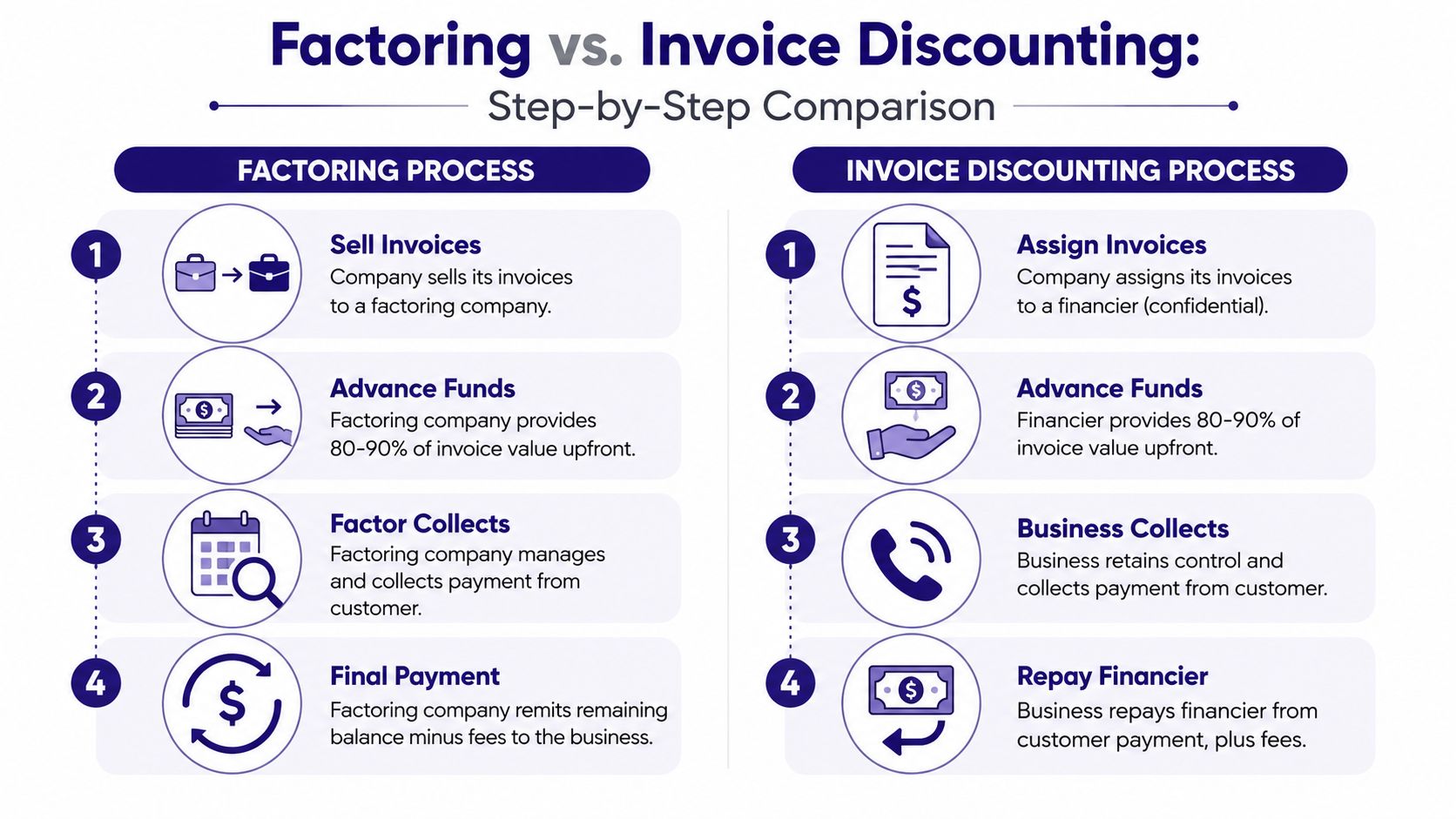
Factoring works like hiring a funding partner and a credit control team at the same time. If you need a quick primer on what is invoice factoring, that definition helps. True training value comes from following the entries, documents, and handoffs in order.
- The business raises an invoice after delivering goods or services to a customer.
- The invoice is sent to the factoring provider as part of the funding arrangement.
- The provider advances part of the invoice value upfront. The business gets cash before the customer pays.
- The provider handles collections and credit control under the agreed terms. The customer usually knows the factor is involved.
- The customer pays the factor.
- The factor passes over the balance, less fees and charges.
For a trainee, this is more than a funding process. It is a workflow question. You need to understand how the sales ledger ties to provider statements, how deductions are reconciled, and how disputes or credit notes affect the final amount released.
This method can suit a business that needs support with chasing debts. From a career point of view, it gives you exposure to outsourced receivables management, funding reconciliations, and client money movement. Those are useful skills if you want to move into credit control, assistant accountant, or commercial finance roles.
A short explainer can help if you want to hear the process described visually:
How invoice discounting works
Invoice discounting starts in a similar place, but the finance team keeps more control. The provider funds against the invoice book, while the business continues to manage the customer relationship and the collection process.
- The business raises the invoice in the usual way.
- The invoice ledger is used as security for funding from the provider.
- The provider advances part of the invoice value to support working cash flow.
- The business keeps chasing payment itself through its own credit control procedures.
- The customer pays the business, depending on how the facility is structured.
- The provider is repaid and deducts its charges under the facility terms.
These details can be particularly challenging for trainees. Discounting may look simpler because the customer often sees no visible change, but the internal discipline needed is higher. The ledger must be clean. Aged debt reporting must be reliable. Query management must be quick. Cash allocation errors can create real problems because the business is still steering the collections process itself.
That is why invoice discounting often builds stronger operational finance skills. If you want to progress into management accounts, finance business partnering, or credit management, this setup gives you direct practice in debtor analysis, collection performance, and control design. Training in credit control, accounts receivable, and working capital analysis fits naturally here.
Where trainees usually get mixed up
The easiest way to separate the two is to follow the customer payment journey.
- Factoring: the provider usually collects the debt.
- Invoice discounting: the business usually collects the debt.
- Factoring: customer contact is more visible.
- Invoice discounting: the arrangement is often kept in the background.
A simple memory aid helps. Factoring changes both funding and collections. Discounting changes funding, but usually leaves collections with the business.
That difference matters in day-to-day finance work. If collections stay in-house, your team needs stronger credit control habits, better debtor reporting, and tighter ledger maintenance. If collections sit with the factor, your attention shifts more toward statement reconciliation, fee checking, and monitoring how outsourced collections affect customer relationships.
A Side by Side Comparison of Key Differences
The clearest way to judge factoring vs invoice discounting is to compare them on confidentiality, customer contact, suitability, and internal capability.
Factoring vs Invoice Discounting at a Glance
| Criterion | Invoice Factoring | Invoice Discounting |
|---|---|---|
| Customer awareness | Disclosed to the customer | Usually confidential |
| Credit control | Managed by the provider | Kept in-house |
| Customer payments | Customer pays the finance provider | Customer usually pays as part of normal business collections |
| Administrative burden | Lower for the business | Higher for the business |
| Typical fit | Smaller or less established businesses needing support | Larger or more established businesses with stronger finance systems |
| Internal skill need | Less day-to-day collections capability needed | Strong internal credit control needed |
| Relationship control | Shared with provider involvement | Retained by the business |
Eligibility and business profile
There's a very clear threshold in the UK market. Invoice factoring is accessible to businesses with turnovers from £50,000, whereas invoice discounting generally requires a minimum turnover of £500,000+ and a dedicated internal credit control function, according to UK eligibility benchmarks.
That matters to trainees because the product choice often reflects the maturity of the finance function. A business using discounting usually needs reliable debtor reporting, disciplined chasing procedures, and people who can manage collections without damaging client relationships. A business using factoring may be buying administrative support as much as funding.
Practical rule: If the business can't run strong in-house credit control, invoice discounting usually isn't the first option to examine.
Control and confidentiality
This is often the deciding factor.
With factoring, the provider contacts customers and collects payment directly. That can relieve pressure on a stretched finance office, but it also changes the tone of customer communication. The sales team and finance team need to understand that the customer experience is no longer fully under their control.
With invoice discounting, the customer relationship remains with the business. This is why firms that highly value brand perception often prefer it. If you want a plain-language external explainer alongside this guide, what is invoice factoring gives a simple overview of the service side of factoring.
Scope of service
The service package differs just as much as the funding.
Factoring includes more hands-on collections and ledger support. Discounting is primarily a finance facility. That's why discounting is usually cheaper, but it also expects more from the internal team.
For an accounting trainee, this difference maps directly to skills:
- Bookkeeping and VAT skills support ledger accuracy and clean transaction records
- Accounts assistant skills support allocations, reconciliations, and debtor control
- Advanced payroll awareness matters because cash timing affects payroll planning
- Final accounts knowledge helps when reviewing year-end treatment and disclosures
- Business analyst and data analyst skills help assess debtor trends, payment patterns, and working capital risk
The finance product often reveals the true capability of the finance team behind it.
A Practical Guide to Costs and Pricing in 2026
A trainee reviewing two invoice finance quotes can make a costly mistake in ten seconds. The first quote shows a lower headline rate, so it looks cheaper. The second looks more expensive, but includes more support. If you do not separate funding cost from service cost, you are not comparing like with like.
How to read the price properly
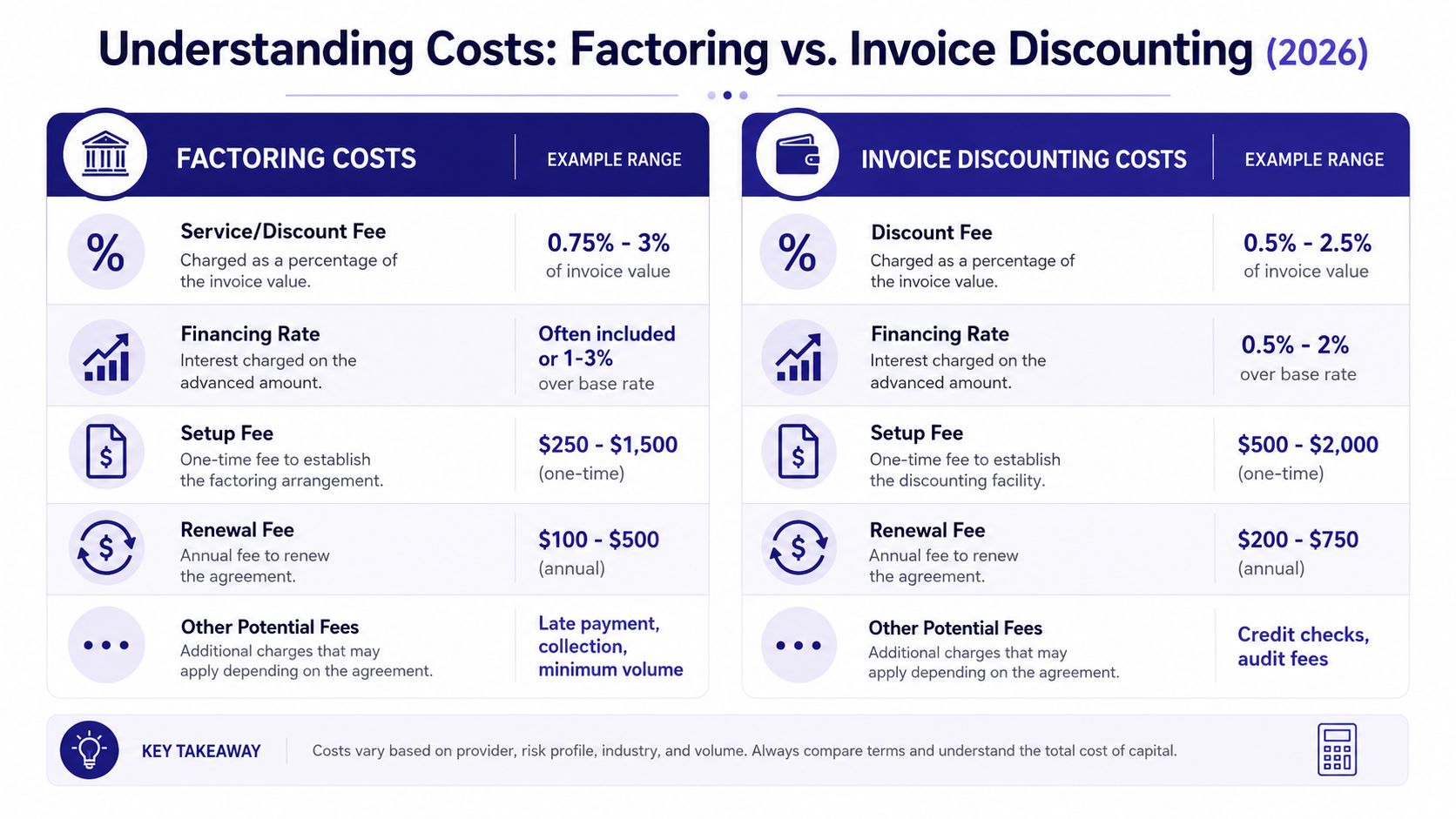
Invoice finance pricing usually has two moving parts.
First, there is the cost of getting cash early. That is the funding charge, and it works much like interest on the amount drawn. Second, there is the cost of administration and collections. That is the service charge. In factoring, that service element is usually higher because the provider takes on more of the sales ledger and credit control work. In discounting, the service element is often lower because the business keeps those jobs in house.
For an accounting trainee, this is more than product knowledge. It is training in how to question a quote, trace charges back to operations, and explain cash flow decisions to managers who only want the bottom-line number.
What affects the final cost
The final price depends on more than the advertised percentage. A stronger ledger, fewer disputes, better-paying customers, and reliable credit control usually support sharper pricing. A messy ledger does the opposite because the provider expects more administration, more chasing, and more risk.
That point matters in practice. Discounting can look cheaper on paper, but the saving disappears if the business has weak debtor management and slow collections. Factoring can look more expensive, yet still deliver better value if it removes pressure from a small finance team and improves cash timing.
A good trainee learns to ask four questions before judging price:
- What percentage of the invoice is advanced up front?
- What charge applies to the money used?
- What service work is included in the fee?
- What internal work still sits with the finance team?
Those questions help you compare facilities properly, and they build the same judgement used in management accounts, budgeting, and working capital reviews.
A simple worked example
Take a £10,000 invoice. If the provider advances part of the balance up front, the business gets immediate cash now and the remainder later, after the customer pays and charges are deducted. The important figure is not the advance on day one. The important figure is the net cash left after all fees.
In such scenarios, trainees often improve quickly. Management may focus on the initial receipt because it solves this week's pressure. Finance staff need to go further and calculate the full cost of that decision, then ask whether the business is paying for finance only or for finance plus outsourced credit control.
If you want to sharpen that skill, start with cost accounting principles in practice. It helps you analyse charges by function, not just by headline rate.
What this means for pricing decisions in 2026
Rate changes still matter because funding charges are linked to the wider borrowing market. But the operational question is often bigger than the rate itself. Who will chase debts? Who will resolve short payments? Who will keep the ledger clean enough to avoid extra friction and delay?
That is where the career angle becomes useful. A business using invoice discounting needs stronger in-house credit control, cleaner reconciliations, and tighter debtor reporting. A trainee in that environment builds practical skills in collections, query handling, ledger discipline, and cash forecasting. A business using factoring relies more on the provider for collections, so the trainee often gains experience in provider statement reviews, dispute tracking, fee analysis, and control over outsourced processes.
Cheaper funding is only cheaper if the business has the skills to support it.
Real World Use Cases for UK Businesses
The right answer depends on the business behind the numbers.
A smaller manufacturing firm with a thin back office
Consider a manufacturing business growing quickly through new trade customers. Orders are coming in, stock has to be purchased, and the office team is small. The ledger is getting busy, but there isn't a strong internal credit control process yet. In that situation, factoring often makes operational sense because the provider handles collections and reduces pressure on the internal team.
This aligns with current market guidance. Factoring is the only realistic option for UK businesses with turnover under £500k that lack internal credit control resources, while discounting is preferred for firms prioritising brand perception and smooth client relationships, according to Lendus benchmarking on factoring and discounting.
For a trainee in an accounts assistant role, that environment teaches practical skills fast. You'll learn how to post receipts, reconcile factor statements, review customer disputes, and understand why cash flow can tighten even during growth.
An established consultancy protecting client relationships
Now take a B2B consultancy with long-standing clients. The finance team is organised, debtor reports are reviewed regularly, and the directors care about maintaining a smooth client experience. They don't want customers dealing with a third party for collections because the commercial relationship is part of the brand.
Invoice discounting often fits this type of business better. The funding stays behind the scenes, the business keeps control, and the finance team manages collections in line with its usual tone and standards.
Why this matters for career growth
These two examples build different capabilities:
- Factoring exposure develops operational finance awareness, provider reconciliation skills, and cash management discipline
- Discounting exposure builds stronger credit control, reporting, and stakeholder communication skills
- Business analysis work grows when you compare funding options against operational risk and customer expectations
- Data analysis work grows when you study ageing trends, debtor concentration, and payment behaviour
A trainee who can explain why one business should factor and another should discount is already thinking beyond transaction processing. That's where stronger finance careers usually begin.
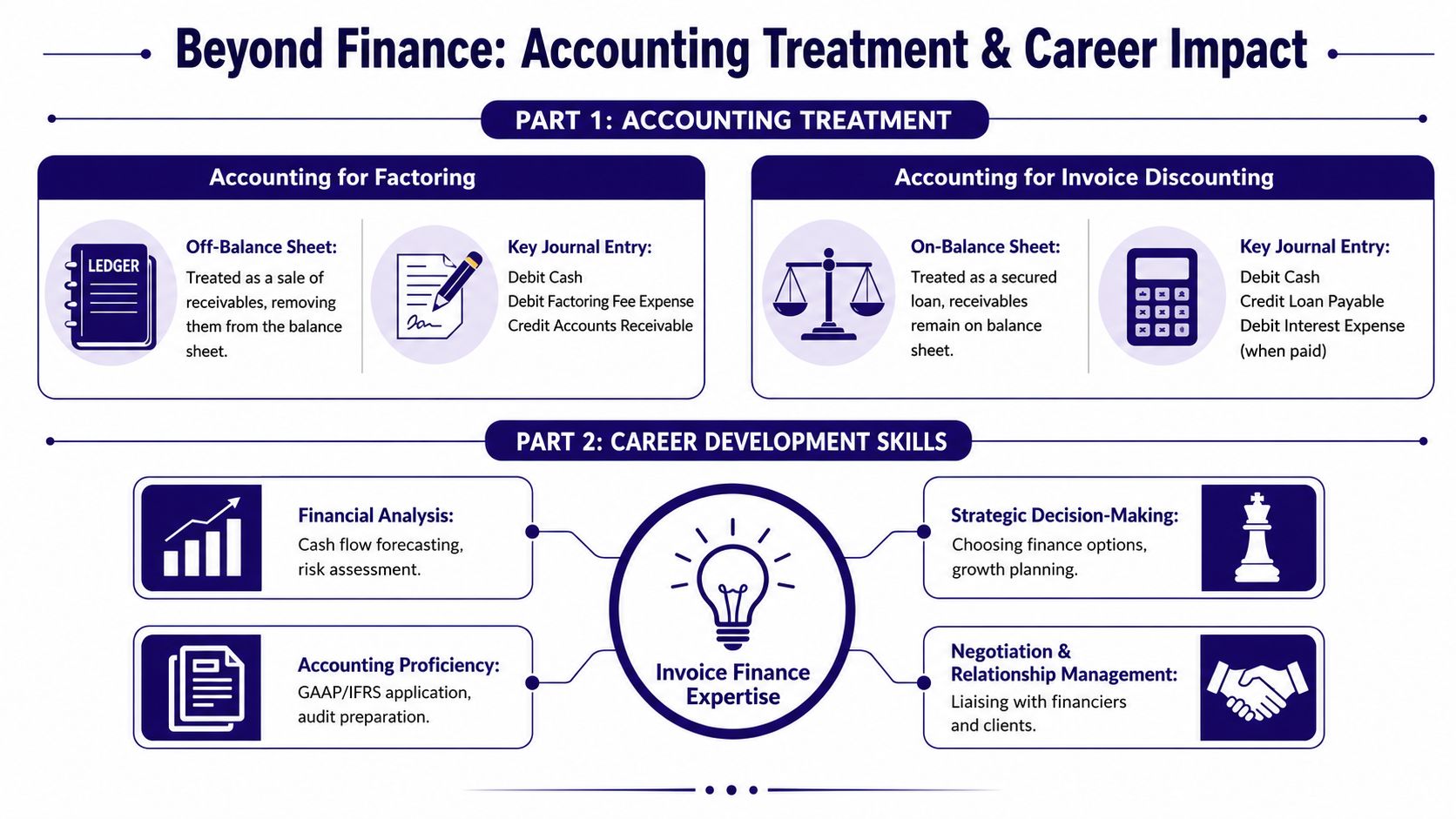
Accounting Treatment and Career Development Skills
Understanding the accounting treatment is where technical confidence starts to show. If you're using Sage, Xero, or QuickBooks, you need to know whether the transaction behaves more like a sale of receivables or more like borrowing secured on receivables.
Recording the transactions properly
In practice, factoring is commonly treated differently from invoice discounting because the commercial substance differs.
- Factoring entries: You'll usually focus on cash received, fees charged, and the reduction or transfer effect on receivables, depending on the arrangement and reporting framework.
- Invoice discounting entries: You'll usually keep receivables visible while recognising funding and related finance costs because the business still controls the debtor relationship.
The important point for trainees is to follow the substance of the agreement, keep supporting schedules, and reconcile provider statements carefully. This becomes especially relevant at month-end and year-end when preparing management accounts and final accounts.
Record retention matters too. HMRC legally requires businesses to keep VAT records for at least six years from the date of the VAT return submission, as noted in HMRC record-keeping guidance referenced here. If invoice finance affects sales ledger records, remittances, and VAT evidence, those documents need to be accessible and organised.
Skills that transfer directly into jobs
This topic connects strongly to training routes:
- Bookkeeping and VAT develops ledger control, VAT record discipline, and reconciliation accuracy
- Accounts assistant training builds confidence with postings, journals, allocations, and debtor reporting
- Final accounts training helps you understand year-end classification, disclosures, and review work
- Advanced payroll strengthens your feel for timing, cash pressure, and compliance deadlines
- Business analyst training helps you compare funding options strategically
- Data analyst training helps you interpret debtor data, trends, and risk signals in Excel, SQL, Python, or Power BI
Modern teams also combine technical accounting with systems thinking. If you want a broader view of process improvement, this resource on accounting workflow automation is useful because it links finance accuracy to better operating workflows.
Turning technical knowledge into career progress
A trainee who can post invoice finance entries is useful. A trainee who can explain the cash flow effect, reconcile the ledger, prepare financial statement support, and analyse debtor behaviour is far more valuable.
That's why it helps to practise not only bookkeeping entries but also how to prepare financial statements. The strongest candidates can move from transaction work into review work, analysis, and decision support.
Strong finance careers grow when you can connect bookkeeping detail to management decisions.
Your Decision Checklist and Final FAQs
A quick checklist helps when you need a practical answer.
Decision checklist
- Check turnover level: Is the business likely to meet the usual profile for discounting, or is factoring the more realistic route?
- Review credit control strength: Can the internal team chase debts consistently and professionally?
- Consider customer sensitivity: Would third-party collections affect relationships or brand perception?
- Assess admin capacity: Does the business want to outsource ledger chasing or keep it in-house?
- Analyse cash pressure points: Are payroll, supplier payments, or VAT timings creating strain?
- Look at reporting quality: Is the sales ledger clean enough to support a confidential facility?
Final FAQs
Can a business get bad debt protection with these facilities?
Sometimes it can, depending on the structure and provider. The exact position depends on the agreement, so the trainee should always read the terms rather than assume the provider carries the risk.
What's the difference between recourse and non-recourse?
Recourse means the business may still carry the risk if the customer doesn't pay. Non-recourse means the provider may accept more of that credit risk in defined circumstances. The wording matters, so this is an area where careful review is essential.
Can a business move from factoring to invoice discounting later?
Yes, that can happen as the finance function matures. A business may start with factoring when it needs outside support, then move to discounting once its internal credit control is stronger and it wants more confidentiality.
If you want practical, job-focused training that helps you handle topics like factoring, invoice discounting, VAT records, payroll timing, final accounts, and financial analysis with confidence, Professional Careers Training offers flexible accountancy training with 1-to-1 support from ACCA qualified Chartered Accountants and CPD approved trainers. You can build hands-on skills in Sage, Xero, QuickBooks, Excel, SQL, Python, and Power BI, while also getting career coaching, CV support, and help preparing for real UK finance roles.