If you're training to become a business analyst, or you already work as one, you've probably noticed AI tools turning up in more of your...
You can spend a long time staring at job ads before you notice the same words keep turning up, IFRS, consolidation, reporting, disclosures. That's the moment many junior accountants, career changers, and international arrivals start wondering whether a formal course is worth the effort, or whether they should just learn on the job and hope for the best.
The honest answer is that IFRS training courses can be useful, but only if you pick the right level, the right delivery style, and the right outcome. A short awareness course helps you speak the language. A certificate can give you structure. A diploma-style route can be better if you want employer-facing competence. And if you're working in bookkeeping, VAT, payroll, accounts assistant, final accounts, or data roles, the best course is the one that maps cleanly to the tasks you'll do on day one.
For a wider view on how training choices affect employability across digital careers, a useful comparison point is the web design bootcamps London guide, which shows how different learners weigh speed, structure, and job relevance when choosing a course.
If you're trying to decide whether to invest now or wait, the rest of this guide will help you judge what matters, what doesn't, and where a course is exam prep rather than workplace readiness.
Why IFRS Training Matters Right Now
A junior accountant reads a job advert for a reporting role in London and sees IFRS listed three times, then spots it again in a consolidation vacancy, then again in an analyst role. That's a common moment of pause. It's not because the learner is behind, it's because the market has made IFRS part of the expected vocabulary for anyone moving into reporting, control, or analysis.
The demand signal is visible in the scale of official capacity-building activity run from London. The IFRS Foundation's Capacity Building Programme reports more than 60,000 total attendees across all capacity-building activities in its 2025 activity report, and the Foundation is headquartered in Canary Wharf, London E14 4HD (IFRS Foundation capacity-building activity report 2025). That matters because it shows IFRS learning isn't a niche classroom topic. It sits inside a large continuing professional development ecosystem anchored in the UK's financial centre.
A practical course choice becomes much easier when you know what you're aiming for. Recent graduates usually need terminology, statement structure, and confidence. Career changers often need a bridge from bookkeeping or admin into reporting tasks. Working professionals may need evidence of current CPD, especially when standards, disclosures, or sustainability reporting move on.
Practical rule: if a course can't show how IFRS shows up in real UK reporting tasks, it's probably giving you theory without enough workplace value.
For a career-focused comparison of how accountancy learning links to progression, the Cloudvara accounting career guide is a useful companion read. The next step is to understand what IFRS is, and why UK finance jobs keep asking for it.
What IFRS Is and Why UK Finance Roles Rely On It
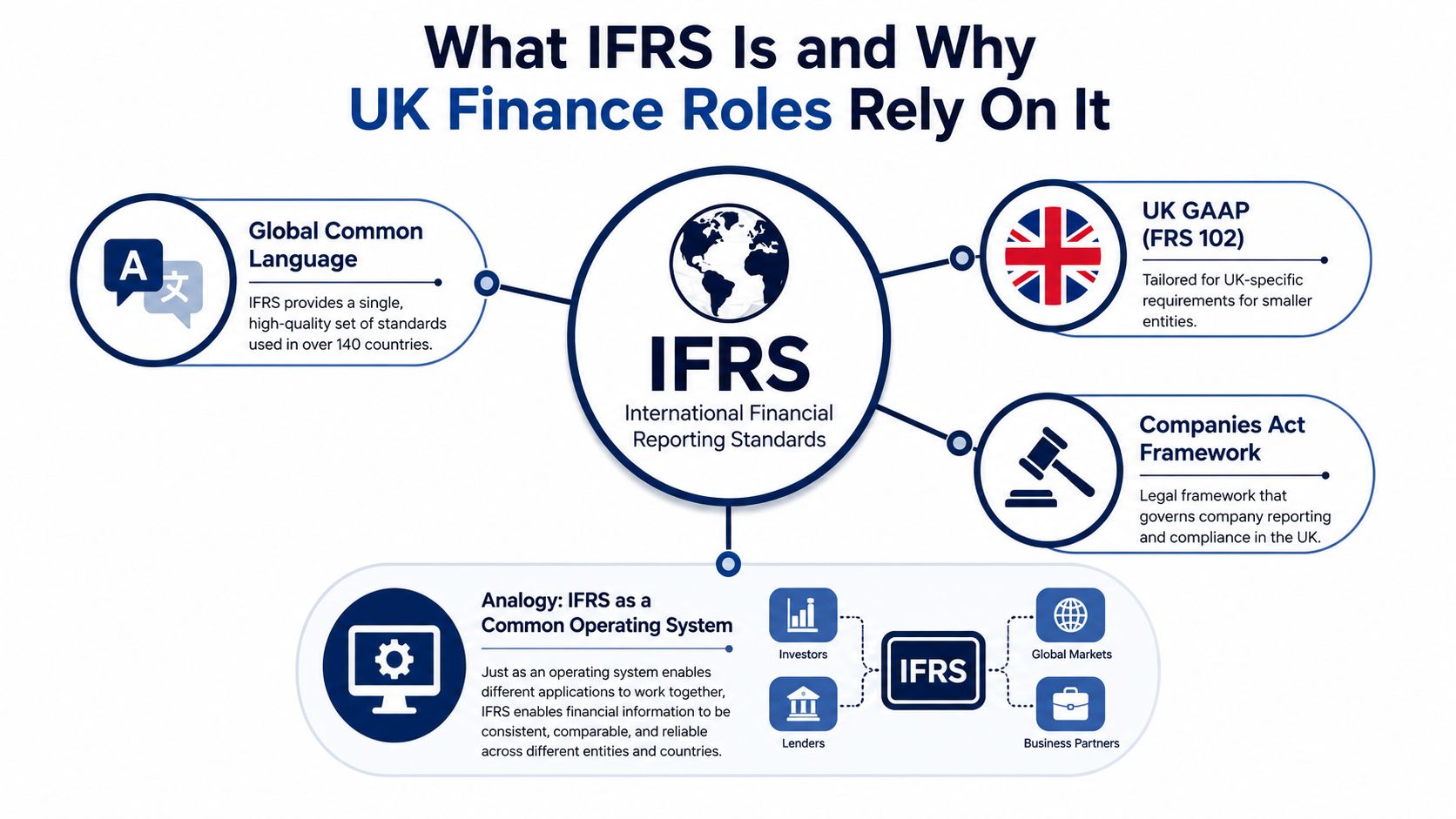
IFRS stands for International Financial Reporting Standards. In plain English, it is the reporting rulebook that helps organisations present financial information in a way investors, lenders, regulators, and employers can compare across borders and across sectors. IFRS functions like a shared operating system for financial reporting across borders, because the same reporting logic is followed even when businesses operate in different places.
In the UK, that shared system sits alongside other reporting frameworks rather than replacing everything else. Many smaller or domestic entities still work within UK GAAP, including FRS 102, and company reporting also sits within the Companies Act framework. A learner therefore needs more than a single definition. The main task is to know when IFRS applies, when UK GAAP applies, and how the legal form of the business changes the statements and disclosures that must be prepared.
The standards behind the language
The IFRS Foundation issues the standards and also teaches sustainability-linked reporting through IFRS S1 and IFRS S2. Its sustainability courses are delivered through self-paced modules and live expert training (IFRS sustainability courses). That matters in the UK because finance teams now treat sustainability as part of the same reporting workflow rather than as a separate side topic.
A learner who understands this can read a syllabus with more confidence. If a course covers statement structure, recognition, measurement, and disclosure, it is teaching the core grammar of reporting. If it adds sustainability reporting, that gives useful preparation for later work. If it does not connect any of that to UK reporting duties, the course may still be valid, but it is less likely to feel immediately useful in the workplace.
For a practical sense of how accountancy careers are framed, Cloudvara's accounting career guide is a useful companion read, especially where employers judge presentation, credibility, and fit for professional services roles (Cloudvara's accounting career guide). professional headshots for advisors also reflects that same employer mindset around professional presentation. IFRS training works in a similar way. It is not only about passing a module, it is also about showing that you can work inside a reporting environment with discipline and precision.
Main Types of IFRS Training Courses Available in the UK
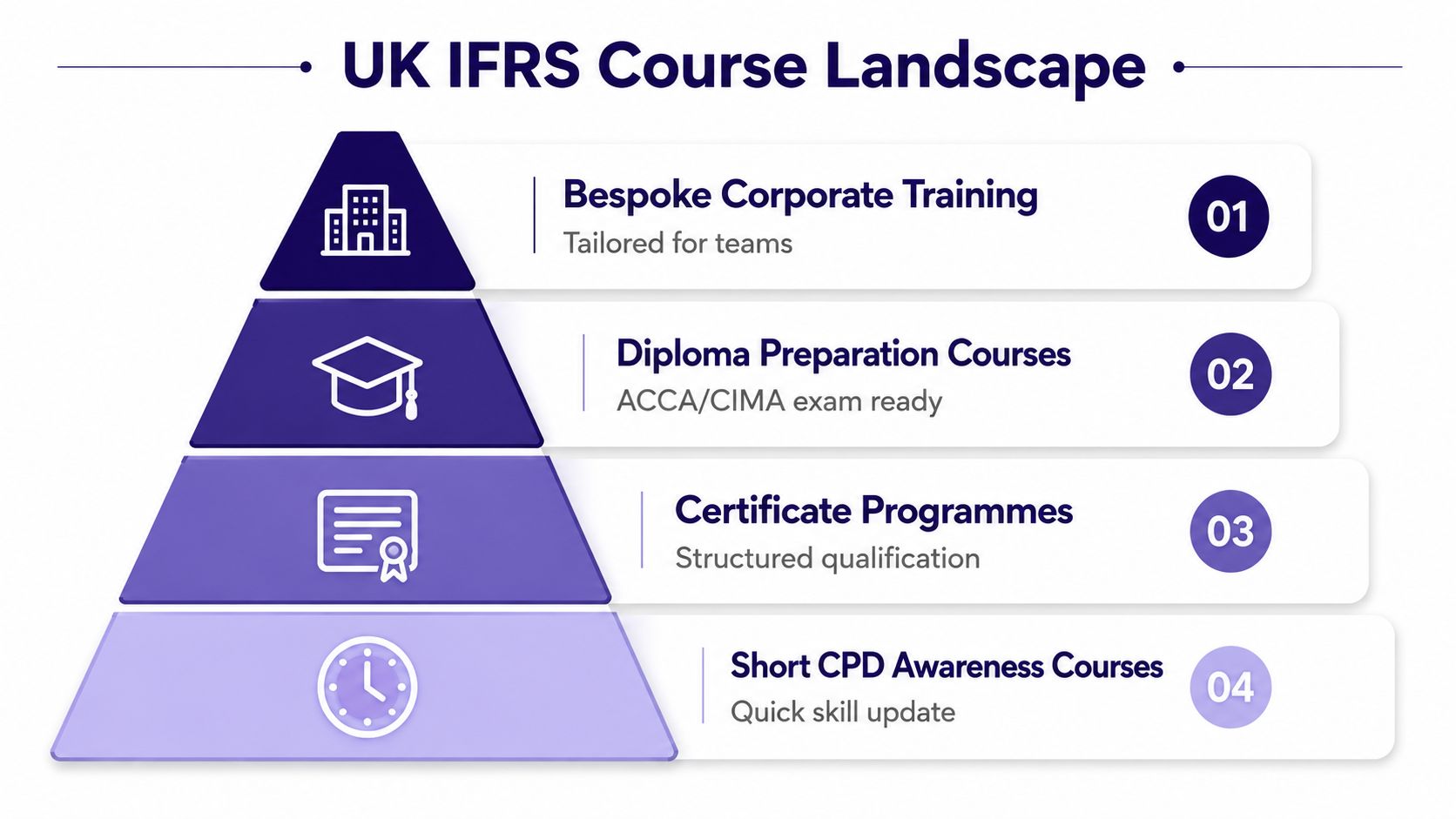
A new learner often meets IFRS training courses as a set of choices rather than one fixed route. In the UK market, those choices usually fall into four tiers, and each tier answers a different workplace need. Some courses are there to help you understand a change quickly, some are built to show formal study, some are aimed at exam preparation, and some are designed around a firm's own reporting process.
Short CPD awareness courses
These are the fastest option. They suit people who already work in finance and need a focused update on a standard change, a disclosure theme, or a practical reporting area. For day-to-day UK employer tasks, they are most useful when you need to read a new rule, recognise where it affects a working paper, or understand why a disclosure has changed. They are usually better for CPD evidence than for deep technical mastery. If you work in payroll, bookkeeping, or accounts support and mainly need to understand how a standard affects your working year, this can be enough.
Certificate programmes
Certificate-style training sits in the middle. A concrete example is the AICPA-CIMA IFRS Certificate Program, which is delivered online and priced at $755 for CIMA members and $955 for nonmembers (AICPA-CIMA IFRS Certificate Program). That pricing shows certificate learning is treated as a structured professional product, not a casual seminar. For an employer, this kind of course often signals that the learner can handle core reporting concepts, follow a syllabus, and present work with more consistency. It suits people who want a recognisable milestone and some formal structure without moving into a full qualification pathway.
Diploma preparation courses
Diploma-style preparation is for people who want stronger exam orientation and broader coverage. These courses often suit ACCA or CIMA learners, and they can also help career changers who want a more serious signalling device on the CV. In practical terms, the syllabus usually maps more closely to what a reporting or financial control employer expects on day one, because it tends to cover recognition, measurement, and disclosure in a way that is closer to actual reporting work. The trade-off is time. They usually ask more of you than a short course, but they can give more confidence when you are interviewing for reporting or financial control roles.
Bespoke corporate training
This is the most customised option. Teams use it when they need IFRS aligned to specific sectors, internal policies, or reporting workflows. It is useful for employers who want a common baseline across finance, audit support, and reporting staff. It is also the best fit when a firm wants course content tied to a live implementation issue rather than a generic syllabus. That makes it closer to the way a finance team works, because the teaching can be shaped around the journals, disclosures, controls, and review points that staff will handle in their own system.
The IFRS Foundation now also offers a sustainability layer through IFRS S1 and IFRS S2, so learners should check whether a course includes that content or leaves it out. For a provider-facing example of how course topics are framed in practice, see this IFRS 15 training resource, which shows how one standard is often taught as a practical reporting problem rather than a purely theoretical topic. That distinction matters for UK learners, because some courses are mainly exam prep, while others are closer to what an employer needs someone to do on the first week in post.
Choosing the right tier: if you need current awareness, start with CPD. If you want structure and proof, look at certificate programmes. If you need career momentum and stronger exam weight, a diploma route makes more sense. If you are buying for a team, corporate training is usually the cleanest fit.
Delivery Modes and How to Choose Between Them
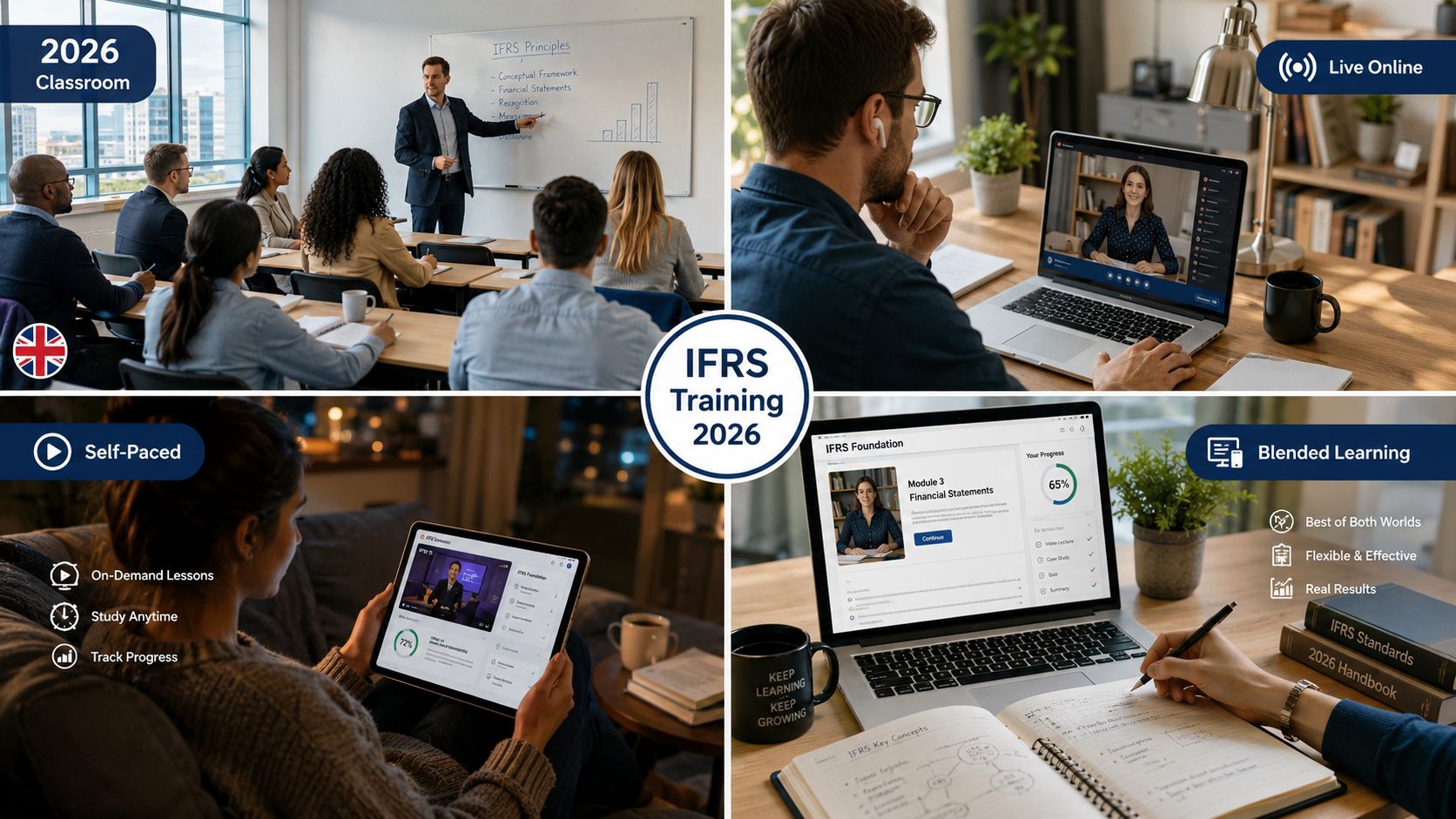
The same IFRS syllabus can feel very different depending on how it's taught. A classroom course suits some learners well, while others need flexibility because they're working full-time, caring for family, or studying from abroad and trying to fit UK job hunting around their day.
Classroom, live virtual, self-paced, and blended
In-person classroom learning gives you direct tutor contact and immediate peer discussion. It suits people who learn best by asking questions in the room and who want a fixed routine.
Live virtual classroom training keeps the tutor interaction but removes the commute. That makes it attractive if you live outside a major city or need to fit study around work shifts.
On-demand self-paced study gives the most flexibility. It's useful if you're balancing childcare, shift work, or an unpredictable schedule, but it does demand more self-discipline.
Blended learning combines formats. It often works well for learners who want structure without losing flexibility, especially if a provider combines recorded theory with live support.
A sensible decision rule is simple.
- Choose classroom learning if you need external discipline and you learn best by asking questions face to face.
- Choose live virtual study if you want real-time tutor support without travel.
- Choose self-paced learning if your schedule changes often and you can manage your own momentum.
- Choose blended learning if you want a middle ground between support and convenience.
For learners comparing formats in a more practical way, the key question is not “Which is best?” It's “Which format will I finish?” A good course is the one that fits your working pattern, not the one with the longest brochure.
A Realistic Sample Learning Path and Timeline
A learner starting from zero IFRS knowledge does not need to absorb everything at once. A sensible route is to start with the reporting framework, then move into the basic structure of financial statements, then the working mechanics of disclosures and consolidation, and finish with assessment and review. For someone new to reporting, that is more like learning to read a set of management accounts step by step than trying to memorise every standard in one go. A realistic pace is 14 to 20 weeks, depending on prior experience and the time available for study.
Weeks 0 to 4, build the frame
The first stage is orientation, then the reporting framework, then the basic vocabulary of financial statements. Learners stop mixing up profit, position, and cash flow. The aim is simple, to understand what each statement is for and how the pieces fit together.
Weeks 5 to 12, learn the core statements
Next come the statement of profit or loss, other income, the statement of financial position, and cash flows. IFRS starts to feel less abstract at this point, because the learner can see how transactions move through the accounts and affect the final numbers. A good course will make you practise with examples, not just read summaries.
For anyone coming from accounts assistant or final accounts work, this stage links directly to the mechanics of UK accounts preparation. Under the Companies Act filing framework, and depending on whether the entity reports under UK GAAP or IFRS, you need to be comfortable with the balance sheet, profit and loss account, notes, and directors' report where required. The filing deadline for private companies is 9 months after the accounting reference date. For day-one work, that means knowing which figures sit in the statements, which items belong in the notes, and where a junior accountant is expected to check for consistency before anything is filed.
Weeks 13 to 20, consolidate and evidence competence
The later phase moves into consolidated financial statements, then disclosure practice, then a final review. That is the stage employers care about when they need someone who can support a month-end or year-end close, help draft notes, or assist with group reporting. In practical terms, the learner should be able to read a consolidation adjustment, explain why it exists, and see how it changes the reported picture for the group as a whole.
If you are bridging from payroll, the same learning journey should include the operational mechanics that make pay processing real, PAYE, National Insurance, Real Time Information, Full Payment Submissions, and statutory rules for sick pay, maternity pay, paternity pay, and shared parental pay. HMRC requires employers to run payroll using RTI, sending FPS on or before each payday. That is not IFRS itself, but it matters to learners moving into finance roles because reporting teams often need people who understand both payroll data and accounting outputs. It also helps a learner see how month-end reporting depends on clean source data, the same idea that sits behind training and CPD for accountants in practice (continuing professional development for accountants).
Checkpoint moments make the course feel real. A mock consolidation exercise shows whether you can apply the rules. A CPD-style mini assessment tells you whether the content is sticking. A final portfolio summary gives you something concrete to discuss in interviews. For learners who also want a public-facing professional image, the professional headshots for advisors resource shows how presentation feeds into credibility in professional services.
Useful rule: if you can explain one statement, one adjustment, and one disclosure clearly to another person, you are moving from memorising to understanding.
Career Benefits and Who IFRS Courses Suit
A recent graduate usually wants the same thing, even if they say it differently. They want to sound credible in interviews and they want their first finance role to feel reachable. An IFRS course helps most when it turns textbook language into task language, especially for accounts assistant and junior financial accountant roles.
One graduate might have strong Excel skills but little confidence with reporting terminology. If they learn how disclosures sit beside the statements, how consolidation works at a basic level, and why year-end adjustments matter, they can walk into interview conversations with much more clarity. That helps in roles that touch bookkeeping, VAT, final accounts, and later on reporting support.
A career changer often needs a different bridge. Someone moving from admin or customer service into finance may not need the deepest technical route first, but they do need to understand how ledger work, reconciliations, and statutory deadlines connect to reporting. That learner often benefits when IFRS is taught alongside practical accounting workflows, because the accounting language starts to feel like part of the job rather than an academic exercise.
For learners who also want a public-facing professional image, the professional headshots for advisors resource shows how presentation feeds into credibility in professional services. That matters more than people admit when they're moving from support roles into client-facing finance work.
What the course helps you do at work
- Disclosures: prepare or review notes that support the main statements.
- Consolidations: understand the logic of group accounts and elimination entries.
- Audit support: explain adjustments clearly and back them with evidence.
- Analysis tasks: in business analyst and data analyst roles, use SQL, Excel, and Power BI to query, clean, model, and present data for stakeholders.
The strongest fit for IFRS learning is often where it overlaps with those day-to-day tasks. UK employers want people who can link accounting rules to outputs, not just recite standards. If you are comparing CPD with broader career development, this continuing professional development for accountants resource is a useful marker for how professionals think about ongoing learning.
How to Choose the Right Provider and Course
A strong provider should make the choice clearer, because the task is to match learning with the work you expect to do. Start with accreditation, then check whether the syllabus fits the role you are aiming for, then look at the tutor, the software, and the support you receive after the course. If you compare providers side by side against the same questions, the brochure language matters less and the differences become easier to see.
What to check before you pay
- Accreditation and recognition: Is the course CPD aligned, linked to ACCA or CIMA pathways, or delivered by a recognised awarding body?
- Syllabus depth: Does it cover practical reporting work, or is it mainly exam drilling?
- Tutor background: Are the tutors qualified accountants who can explain where learners usually get stuck?
- Software exposure: Do you get experience with Sage, Xero, QuickBooks, Excel, Power BI, or SQL where relevant?
- Post-course support: Is there help with CVs, interviews, recruiter introductions, or career coaching?
That checklist matters because each course type supports a different kind of UK employer task. A beginner who needs day-one confidence in reporting checks may need a course that explains how figures move through the accounts, while someone preparing for a qualification route may need more exam structure and less workplace practice. The wrong course can still sound credible, but it leaves a gap between study and the job.
Professional Careers Training is one UK-based example that fits this broader picture by offering 1-2-1 ACCA qualified tutor support, flexible timetables, official certification in Sage, Xero and QuickBooks, software support and installation, plus recruitment support covering CV preparation, career coaching, job hunting strategy, LinkedIn optimisation, and employer introductions. That mix is useful because it speaks to both sides of the learner journey, the classroom side and the hiring side. If you are still working out how ACCA qualification fits into your longer-term route, that background helps you judge whether a provider is teaching for exam success, job readiness, or both.
Practical rule: the cheapest course is rarely the best fit if it leaves you without tutor access, software practice, or employer-facing support.
A good way to test a provider is to ask what support looks like after enrolment. Some learners only need recorded lessons and a syllabus, but others need feedback on exercises, help with software setup, and someone who can explain why a reporting adjustment matters in practice. The clearest providers describe that support model in plain language, so you can see whether they are teaching knowledge, workplace application, or both.
Key Takeaways for Choosing IFRS Training in 2026
The right choice comes down to five decisions. First, match the course tier to your starting point. Second, pick a delivery mode you can realistically finish. Third, check whether the syllabus covers the standards and reporting tasks your target role uses. Fourth, decide whether you need software certifications bundled in, especially if you're moving into accounts support, analysis, or payroll-adjacent work. Fifth, think about how much post-course recruitment support you need to turn study into interviews.
If you're a graduate, your best route may be structure and confidence. If you're a career changer, you may need practical application and hiring support. If you're already in finance, CPD and updates may matter more than a full qualification route. In every case, the best course is the one that builds UK reporting competence in a way your employer can recognise.
Take the time to ask for a syllabus, check the support model, and compare outcomes rather than just fees. IFRS training is an investment in the ability to handle reporting properly, explain it clearly, and grow into more responsible finance work.
Professional Careers Training offers practical accountancy learning that fits this decision. If you're weighing IFRS against bookkeeping, payroll, accounts assistant, or analyst development, visit Professional Careers Training to review the support, software training, and career coaching available, then choose the route that matches your next role.