
If you're training to become a business analyst, or you already work as one, you've probably noticed AI tools turning up in more of your...
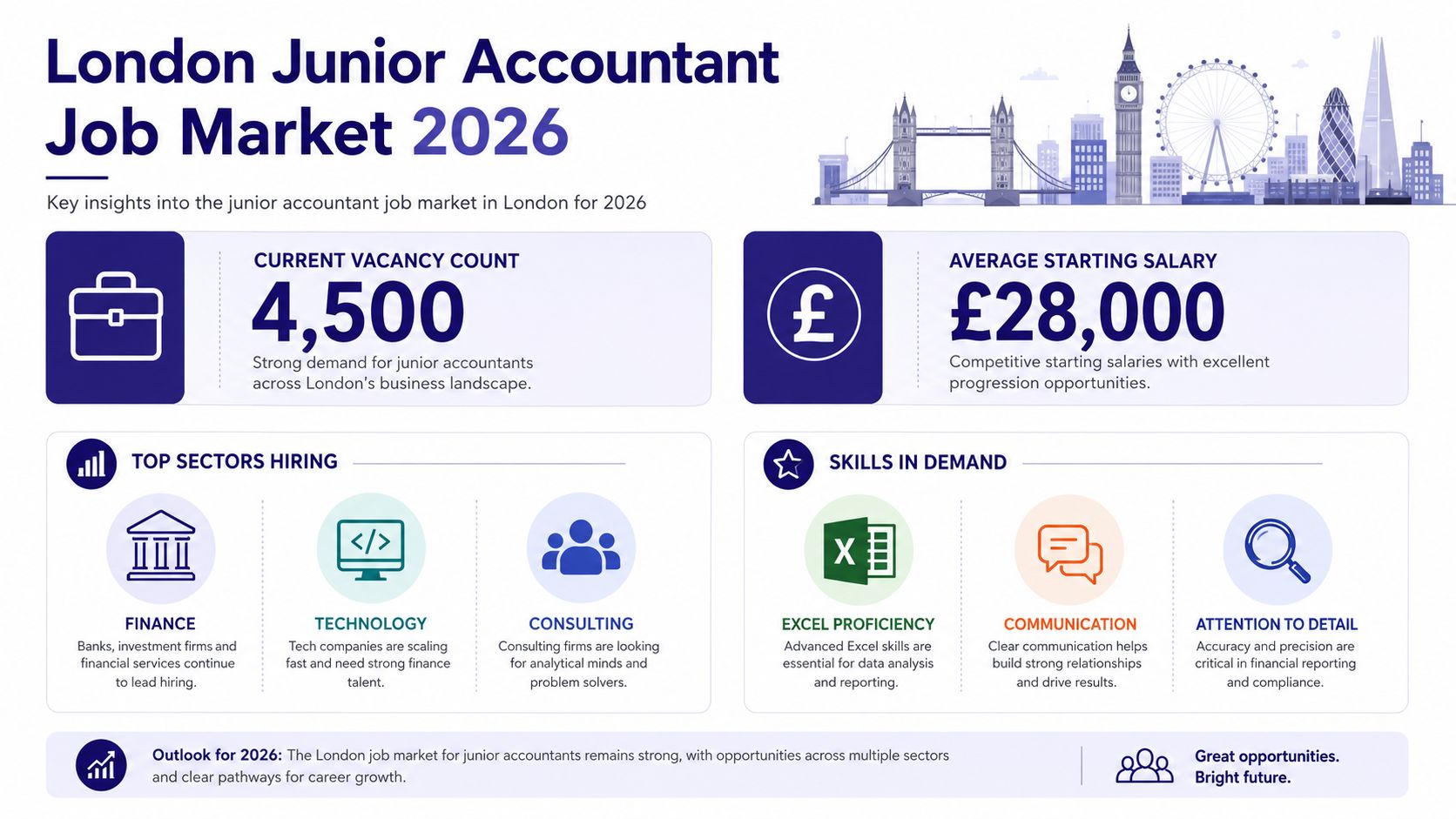
London junior accounting pay is not one number, it's a range. The current London data runs from £23,571 for entry-level workers under one year of experience to £37,499 on CityJobs, with Indeed showing an average of £31,148 based on 47 reported salaries and Totaljobs sitting at £37,500 for London overall. That spread matters, because junior accountant jobs London is really a cluster of roles, not a single ladder rung.
Understanding the London Junior Accountant Job Market
London still has depth in accounting hiring, but the market is fragmented. ITJobsWatch records 10,661 permanent vacancies for the broader London Accountant title in the 6 months to 6 October 2025, down from 17,612 in 2024 and 20,088 in 2023, yet the title's rank improved to 298 from 458 year-on-year, which tells you demand has shifted rather than disappeared (ITJobsWatch). That is the backdrop for junior hiring, where many openings sit under accounts assistant, finance assistant, and trainee accountant labels rather than one neat job family.
What the salary spread really means
The same London junior role can be priced very differently depending on scope. CityJobs shows an average of £37,499, with a range of £28,249 to £51,249 and 48 junior accountant jobs within 20 miles of London (Indeed London salary page). Indeed's London average is lower at £31,148, while PayScale's London estimate is £27,318 for 2025, with less than one year of experience at £23,571 and 1 to 4 years at £25,862 (PayScale London salary page).
That variation is not noise. It reflects whether the posting is a true entry role, a hybrid finance assistant post, or something closer to a junior accountant with month-end exposure. A role that touches reconciliations, management accounts support, and ledger work will usually sit higher than a job that only processes invoices.
Practical rule: if the ad mentions month-end, reconciliations, or management accounts, treat it as a stronger progression route even if the title sounds modest.
For search purposes, the market is large enough to support selective applications, but not broad enough to reward guesswork. A useful starting point is the live accountancy demand overview on this accounting jobs demand guide, then compare the title, salary band, and responsibilities before you apply.
Junior does not always mean bare minimum
The best London junior roles often ask for more than a degree and hope. Some postings sit much closer to mid-level expectations, while others are designed for graduates and career changers who can already handle software, reconciliations, and basic reporting. The most important habit is to read the task list, not just the title.
If you're early in your search, aim to understand where the role sits on the experience gradient. That will stop you overreaching for posts that need more practice and help you spot opportunities that can move you into the wider accounting ladder faster than a generic entry role.
Essential Skills and Software Competencies for London Roles
London recruiters screen junior candidates for practical readiness long before they care about polished theory. Current London listings repeatedly point to Excel, Xero, Sage, QuickBooks, double-entry basics, and familiarity with finance systems, with Microsoft Office, especially Excel, often treated as required (Indeed Greater London junior accountant listings). That matters because a junior hire is usually expected to contribute inside an existing close process, not learn the software from zero.
The order of skills that actually wins interviews
Start with Excel. A candidate who can use lookup functions, pivot tables, filters, and tidy formatting will usually look more job-ready than someone who only lists generic accounting knowledge. Recruiters ask for Excel because it affects reconciliations, reporting packs, and error-checking from day one.
Next comes accounting software. Xero stands out because it appears openly in London recruiter listings as a positive signal, and targetjobs notes that recruiter listings in London value accounting principles, active study toward a qualification, and Xero knowledge (targetjobs graduate salary guidance). Sage and QuickBooks matter for the same reason, they show you can move from classroom accounting to live bookkeeping. If you want structured practice, Excel for Accounting training is a sensible place to start because it builds the spreadsheet habits most junior postings expect.
Practical rule: if you can explain one reconciliation, one month-end task, and one software workflow without hesitation, you're already more interview-ready than many applicants.
Qualifications help, but software fluency gets you in the room
The qualification question is often overstated. You do not need full ACCA status for every London junior role, but you do need to show progression, or evidence that you can already do the work. ACCA trainee roles typically sit at £19,000 to £25,000 nationally, and London is the highest-paying region for trainee accountants, according to targetjobs and wider trainee salary benchmarking data.
Office Angels advertises a Central London junior accountant role at £30,000 to £35,000, asking for a graduate or final-year student in accounting or finance, strong Excel ability, and noting that Xero is a bonus rather than essential (Office Angels role). That is a useful signal. Some employers will hire on potential, but they still want proof that you can handle systems and process detail.
The clearest CV strategy is simple. List study progress, software exposure, and practical tasks. Do not just say you know bookkeeping, show that you've done bank recs, posted journals, assisted with VAT, or supported payroll runs.
Optimising Your CV and LinkedIn for London Recruiters
A London recruiter scanning junior accountant applications wants fast proof, not a biography. The strongest CVs are tight, role-specific, and honest about what the candidate can already do. That means your first page should show accounting software, study status, and practical tasks before it shows hobbies or generic profile language.

What belongs at the top of the CV
Lead with a short profile that names your target, such as junior accountant, accounts assistant, or trainee accountant. Then put software, study, and core tasks in the first visible section. If you've done bookkeeping, VAT, payroll support, or month-end assistance, say so clearly rather than burying it in a long paragraph.
Use the same logic on LinkedIn. Recruiters search for keywords, so your headline should include your target role and the systems you know. A profile that says “Accounting graduate with Xero and Excel experience” is easier to find than one that says “Aspiring finance professional”.
The internal link on CV structure is worth using alongside your own review: UK CV writing tips. It helps if your document is concise, but the win is alignment between the CV and the job ad.
How to signal readiness without overclaiming
Recruiters notice when a candidate overstates experience. They also notice when someone underplays it. The balance is to be specific about exposure and careful about ownership. For example, write “supported bank reconciliations and month-end journals” if that's true, not “managed month-end close” unless you did.
LinkedIn should also show your location preference and availability in a straightforward way. London recruiters often work quickly, so profiles that show an open-to-work signal, current study status, and software competence tend to be easier to place. That doesn't mean you need to look polished in a corporate, overproduced way. It means you need to look searchable and credible.
“Clear beats clever in junior accounting recruitment.”
A final point: make your application materials match the title you want, not the title you've had. If you're aiming at accounts assistant roles because they build practical experience faster, say that. If you're aiming at junior accountant jobs London because you already have software confidence and some reporting exposure, say that too.
Targeted Job Search Channels for London Accounting Roles
The London search process works better when it's segmented. LinkedIn may surface the biggest volume of junior titles, but specialist recruiters often hold the cleaner matches, and job boards still vary widely in quality. The most efficient approach is to treat each channel differently rather than sending the same CV everywhere.
Where the roles actually show up
LinkedIn and BeBee show broad volume, with 1,000+ junior accountant jobs in London on LinkedIn and 7,485 jobs in London on BeBee, while Robert Half has 186 junior-accountant results in London and Reed shows 145 junior accounts assistant jobs within 10 miles of London (Robert Half London junior accountant results). That fragmentation is useful because it tells you the market is spread across titles and platforms.
The practical move is to search by task, not just job title. Use combinations like “accounts assistant”, “junior accountant”, “month-end”, “Xero”, “VAT”, and “assistant management accountant”. That catches roles hidden behind slightly different wording.
Agencies and schemes deserve more attention than most candidates give them
Agency recruiters are often the fastest route into live London openings because they see roles before they fully settle on public boards. That matters in a market where the same employer may advertise under several title variants, or where a recruiter needs a candidate who can start quickly and handle immediate workload. Graduate schemes and trainee accountancy programmes still matter too, but they suit a different profile, usually candidates who can commit to study and progression over a longer arc.
Practical rule: if you're a career changer or international student, don't rely on job boards alone. Combine direct applications with recruiter conversations and targeted scheme searches.
The biggest mistake is random volume. A focused approach, where you build relationships with a small number of finance recruiters and keep your search terms specific, usually produces better interviews than applying to every junior finance role you see.
Interview Preparation and Technical Assessment Strategies
A London junior accounting interview usually tests two things at once, whether you can do the work and whether you can be trusted to learn quickly. The process is often straightforward. A screening call comes first, then a technical assessment or task, then a final interview with finance or hiring managers.
What the technical test usually checks
The most common exercise is Excel. You may be asked to tidy a spreadsheet, spot an error, or work through a simple reconciliation. You might also get a basic accounting scenario, such as matching receipts to ledger entries or explaining how you'd handle a month-end query.
A realistic example is this. A hiring manager asks a candidate to explain how they would investigate why the bank balance does not match the nominal ledger. The strongest answer is not jargon. It is a clear sequence, check timing differences, look for duplicate postings, review receipts, confirm journals, and escalate anything unresolved. For more worked examples like this, our guide to 8 key technical interview questions for UK finance roles is worth practising against before you go in.
How to answer behavioural questions without sounding rehearsed
London recruiters often ask why you want accounting, how you handle detail, and how you deal with pressure. They are not only testing confidence. They want to know whether you can stay accurate when the workload speeds up.
Use short, structured answers. State the situation, describe your action, and end with the result. If you have only classroom or training examples, use them. A training project, a bookkeeping exercise, or a payroll assignment can still demonstrate discipline and attention to detail if you explain it properly.
Practical rule: never bluff software or process experience in an interview. A recruiter will usually detect the gap once the conversation turns technical.
Preparation works best when it is hands-on. Rehearse reconciliations in Excel, review double-entry basics, and practise explaining what you'd do in a month-end close. That preparation carries more weight than memorising textbook definitions.
Actionable Next Steps and Training Pathways
The best route into junior accountant jobs London depends on where you are starting from. A recent graduate needs employability proof. A career changer needs translated experience and software confidence. An international student usually needs a clearer narrative around study, work permission, and readiness for UK processes.

Choose training based on the role you want
If your target is accounts assistant or junior accountant, start with bookkeeping and VAT. That gives you the process foundation most employers recognise immediately. If you want to support finance teams more broadly, advanced payroll and accounts assistant training can make your CV more useful for London SMEs and practices.
If your long-term aim is progression into month-end and reporting, final accounts training matters because it bridges the gap between transaction work and management information. If you're thinking beyond pure accounting into adjacent roles, business analyst and data analyst training can help you move towards reporting, dashboards, and data-led finance support.
Use training to close the exact gap on your CV
Professional Careers Training offers accounting training, software support for SAGE, XERO, and QuickBooks, plus recruitment support that includes CV preparation, career coaching, job hunting strategy, LinkedIn optimisation, and reference to employers. That mix suits candidates who need both technical practice and a clearer route into the market.
The best sequencing is straightforward. First, pick the course that matches the job family you're applying for. Then update your CV with the tools and tasks you can now evidence. Finally, begin applying with a small, disciplined list rather than flooding the market.
A simple progress check helps here. If you can explain your software exposure, show a realistic salary target, and pass a basic reconciliation task, you're moving in the right direction. If not, add one more layer of training before you push harder on applications.
If you want practical accounting training, software confidence, and recruitment support that maps directly to junior accountant roles in London, visit Professional Careers Training and review the courses that fit your current level. The right pathway can turn classroom knowledge into interview-ready proof, especially if you're aiming for bookkeeping, VAT, payroll, accounts assistant, or first-role accounting work in London.