If you work in payroll, or you're training to, "statutory payments" is one of those phrases that sounds dry until you realise how much rests...
Business Analyst Employment is projected to grow by 11% over the next decade according to the labour market data referenced in UK career guidance, yet many learners still treat business analyst and business analytics as if they mean the same thing. They don't, and that confusion can send someone into the wrong course, the wrong interview, and the wrong kind of work. I've seen capable learners waste months because they trained for a title rather than the work behind it.
| Factor | Business Analyst | Business Analytics |
|---|---|---|
| Core focus | Needs, process, stakeholders, and solutions | Data, reporting, forecasting, and insight |
| Main question | What does the business need, and how should change happen? | What does the data show, and what might happen next? |
| Typical tools | Workshops, process maps, requirements documents, presentation decks | SQL, Excel, Power BI, Python, dashboards |
| Labour-market framing in the UK | Often grouped with Business and Financial Project Management Professionals | Often grouped with data and statistical occupations |
| Best fit for | People who like coordination, negotiation, and structured change | People who like datasets, reporting, and analytical problem-solving |
A learner in Manchester once told me she wanted “the analytical one”, but her real strength was running workshops, calming friction between teams, and turning messy notes into clear decisions. That profile usually fits business analysis more naturally than analytics. Another learner, a former operations coordinator, thought he wanted business analysis until he started enjoying SQL queries and dashboard building far more than meetings, which pulled him towards business analytics.
The UK labour market makes this distinction more important than it looks on paper. The ONS tracks occupations at the occupation level, not just by job title, so a role's classification affects how demand, wages, and vacancies are compared across regions such as London, the South East, and the North West, as set out in UK occupational guidance on the distinction between these paths (ONS-based UK occupational guidance). That means this isn't just a naming issue. It's a training decision, a job-search decision, and a long-term career decision.
Introduction, Why This Comparison Matters in the UK
A clear job title does not always mean a clear career path. In the UK, employers often group work by occupational category, so two roles that sound similar can still lead to different interviews, different daily responsibilities, and different pay expectations. That is why business analyst and business analytics should be treated as distinct choices, even though the labour market increasingly blends them in practice.
The confusion matters most for learners choosing between business, accounting, and data routes. Someone with a background in bookkeeping & VAT, advanced payroll, accounts assistant work, or final accounts often already has the discipline and process awareness that support business analysis. Someone who enjoys Excel models, dashboards, reporting, SQL, Power BI, or Python may fit business analytics more naturally, especially where employers want people who can work with data as part of decision-making.
Real job ads make the overlap obvious. A vacancy may carry the business analyst title but focus heavily on reporting and data interpretation. Another may use business analytics language, then spend the first screening call asking about stakeholder handling and process change. That is why this comparison works better as a hiring guide than as a glossary definition.
A learner in Bristol told me she applied for “the analytical one”, then discovered her strongest contribution was running workshops, calming friction between teams, and turning scattered notes into clear decisions. Another learner, from an operations background, expected to prefer business analysis but found he spent more time enjoying SQL queries and dashboard work than meetings. Those are not edge cases. They are the kind of trade-offs UK employers see every week.
Practical rule: choose the path that matches the work you want to repeat every week, not the title that sounds most impressive.
The policy side matters too. The UK Government's National Data Strategy pushed more employers to value people who can turn raw data into decisions, and that has made analytics skills more visible in hiring. The IIBA discusses that shift in relation to the UK data skills gap in its overview of business analysis and analytics careers (IIBA on the National Data Strategy and UK data skills gap). That change did not replace business analysis. It made hybrid roles more common, and it raised the value of training that connects process thinking with data skills. For learners looking for a practical route into the profession, the business analyst training guide gives a useful starting point.
What Is a Business Analyst Role
A business analyst works between business users, process owners, and technical teams. The role is to identify what is not working, define what the organisation needs, and recommend a practical solution that people can put in place. In UK career guidance, business analysis is treated as a structured profession with clear responsibilities, which is why the job title usually means more than a loose office support role (business analyst training guide).
The role is about change, not modelling
The strongest business analysts spend much of their time on stakeholder management, requirements gathering, and process mapping. They ask users what is happening now, what is broken, what success looks like, and what the organisation can realistically support. Then they turn that into clear documentation that delivery teams can work from.
That work suits people who are comfortable with ambiguity and still like bringing order to it. It is not a deep statistics job. It is a coordination and problem-framing job. If you enjoy taking messy conversations and turning them into a usable brief, the role can be a strong fit.
A good business analyst makes hidden work visible, then helps teams agree on the next move.
For learners coming from finance or bookkeeping courses, the role often feels familiar because both areas value precision, traceability, and clean handoffs. The difference is that business analysis sits closer to change management and systems improvement. For a UK starting point, this business analyst training guide shows how employers usually frame the role in practice.
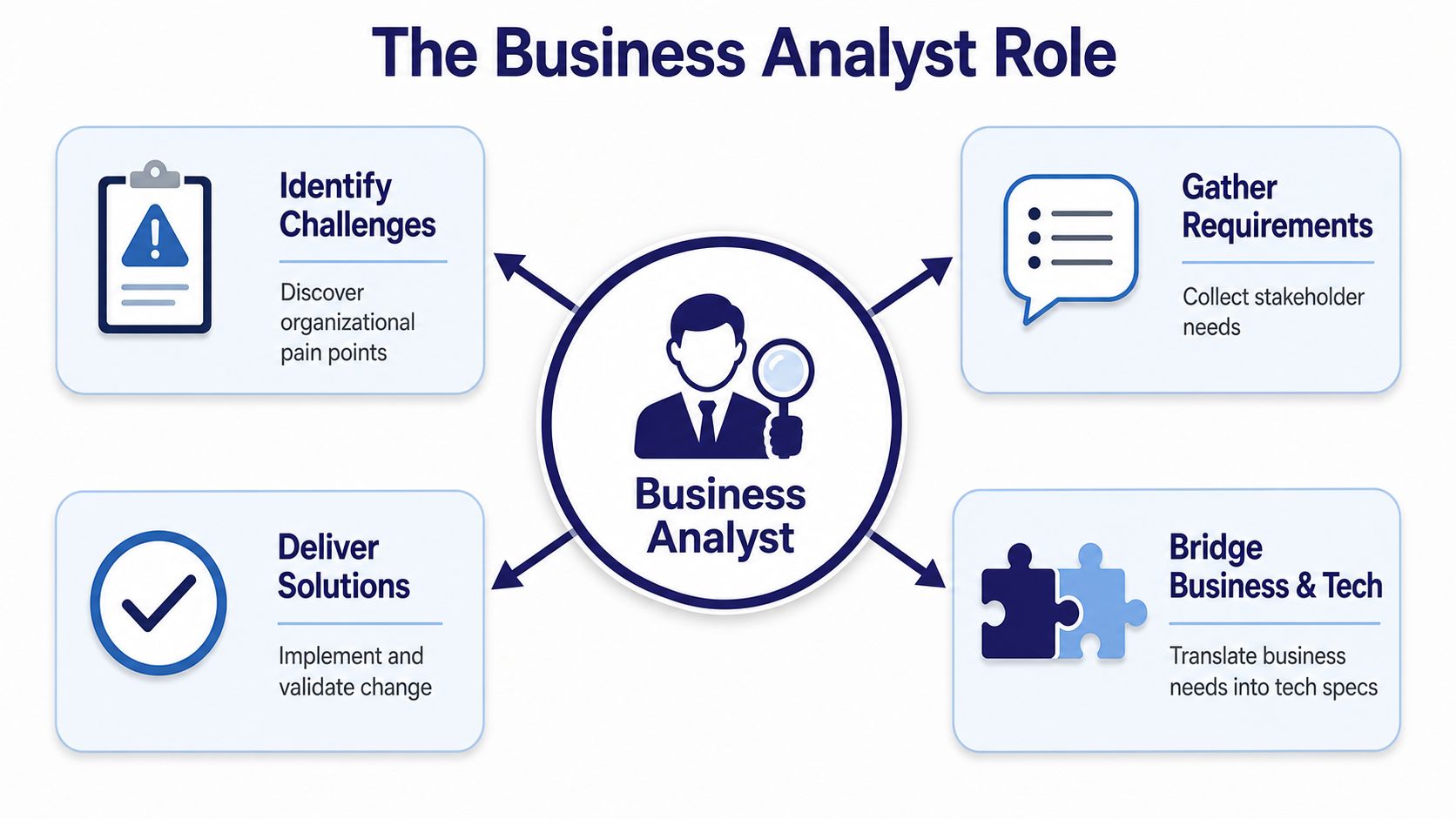
The job also has a real trade-off that many learners overlook. A business analyst can spend a lot of time clarifying needs without ever owning the final technical build, so success depends on influence, not just analysis. In many UK teams, that means patience, clear writing, and the ability to keep different departments aligned when priorities compete.
What Is Business Analytics as a Field and Function
Business analytics is the data-led side of the comparison. It focuses on collecting, cleaning, analysing, and presenting data so organisations can make better decisions. Where business analysis asks what the business needs, business analytics asks what the data is showing and what that means for future action.
The work has become more visible in the UK because employers now expect more evidence-based decision-making across commercial, operations, and customer teams. That shift has also pushed more demand for people who can handle reporting, visualisation, and analysis tools in day-to-day business settings. In practice, that is why so many UK job descriptions now expect comfort with SQL, Excel, Power BI, and data interpretation.
The field differs most from the business analyst role in where the effort sits. The work centres on the analytical pipeline, not the workshop room. You are usually pulling information from databases, cleaning it, building dashboards, and turning results into something managers can use. If you want a practical bridge into the topic, the analytics topics for cold email pros page is a useful example of how analytics thinking shows up in real business functions, even outside classic data teams.
A learner who wants a route into UK employment without waiting for a perfect technical identity should look at entry-level roles that blend reporting and support. This entry-level data analyst jobs UK guide helps show how analytics-style skills appear in live job searches.
The other reason this matters is classification. Analytics-heavy roles are often treated separately from business project management in labour statistics, which affects how demand and salary patterns are discussed across regions. If you are comparing opportunities in London, the South East, or the North West, that distinction can shape how you read the market.
Core Skills for Business Analysts and Business Analytics Professionals
The best way to decide between the two paths is to compare the actual skills, not the job title. A business analyst needs strong human and process skills first. A business analytics professional needs stronger technical and numerical skills first. The overlap is bigger than many think, and that overlap is where the UK market now lives.
| Skill Area | Business Analyst | Business Analytics |
|---|---|---|
| Stakeholder management | Core skill | Helpful, but usually secondary |
| Requirements elicitation | Core skill | Limited use |
| Process mapping | Core skill | Useful for context |
| Communication | Critical | Critical |
| SQL | Useful in many roles | Core skill |
| Excel | Strong advantage | Core skill |
| Power BI | Increasingly common | Core skill |
| Python | Nice to have in some roles | Increasingly expected |
| Statistical thinking | Helpful for interpretation | Core skill |
| Documentation | Core skill | Core skill |
A lot of UK job ads now blur the boundary. That's why it makes sense to prepare for a hybrid curriculum rather than a rigid either/or choice. If an employer wants someone who can run discovery sessions and also pull data, the candidate with both toolsets has the better shot. The same pattern shows up in practical hiring guidance that points to SQL, Excel, Power BI, and increasingly Python as shared expectations across many roles (Phoenix on business analyst vs business analyst-related skill overlap).
For a useful decision-making lens, the PEO Metrics decision guide is a reminder that job-search decisions improve when you compare real hiring structures rather than labels alone. The same logic applies here. Your training should reflect the stack employers ask for, not the clean distinction that career articles wish existed.
Career adviser rule: if a job title and a job description point in different directions, trust the description.
That's especially true for career changers. A strong starting programme should cover stakeholder conversation, requirements writing, spreadsheet confidence, and basic dashboard literacy. If your course only gives you one half of that mix, you may struggle in interviews where employers expect practical range.
Day-to-Day Tasks and Workflows
A business analyst's week usually revolves around people, process, and paperwork. Monday might start with a requirements workshop in finance. Tuesday could be spent mapping a current process in Visio or Lucidchart. By Thursday, the work may have shifted into drafting a business case or presenting options to senior stakeholders.
A business analytics professional spends more time in the data stack. Their week might begin by writing SQL queries, continue with Excel modelling, and move into dashboard work in Power BI or Tableau. By the end of the week, they may be explaining what the data says about sales, operations, or customer behaviour.
A realistic workflow comparison
| Activity | Business Analyst | Business Analytics |
|---|---|---|
| Morning focus | Meetings and interviews | Data extraction and checking |
| Midweek work | Process mapping and requirements writing | Modelling and visualisation |
| End-of-week output | Recommendations and change briefs | Dashboards and insight summaries |
| Main tools | Visio, Confluence, JIRA, slides | SQL, Excel, Power BI, Python |
| Time split | More stakeholder-facing | More data-facing |
This is why many people misjudge fit. They think they want analysis, but they really want structure and coordination. Others think they want business-facing work, then realise they'd rather work with datasets than run workshops all day. Both are valid, but the daily rhythm is different enough to matter.
The most reliable way to sense fit is to review job descriptions and notice what dominates the language. If the ad talks about meetings, dependencies, and change requests, you're looking at a business analyst workflow. If it talks about queries, dashboards, and reporting accuracy, you're looking at business analytics. That single reading habit saves a lot of poor training decisions.
UK Career Paths and Salary Expectations
Pay in this area is easier to read by progression than by a single headline figure. Early-career business analyst roles in the UK often start at £25,000 to £35,000 a year, move into senior territory at £45,000 to £65,000, and can reach £70,000 or above for lead or principal positions. Business analytics roles often begin in a similar entry range, but the mid-level and senior bands can run stronger where employers want advanced reporting, SQL, Python, or Power BI capability. For a broader market reference, the Underdog.io salary breakdown is a useful comparator for analytics-aligned pay patterns in the wider intelligence space (Underdog.io salary breakdown).
Region still matters
London and the South East tend to pay more because corporate, financial services, and centralised data teams are concentrated there. The North West and other regions can be more modest, but they still offer credible opportunities, especially where organisations need people who can support change, reporting, and process improvement without a heavy specialism. UK labour-market guidance also reminds jobseekers that employers hire against local conditions as much as national averages, so salary expectations should be set with the region in mind, not only the job title (ONS-based UK occupational guidance).
| Career stage | Business Analyst | Business Analytics |
|---|---|---|
| Entry | £25,000 to £35,000 | Similar starting range |
| Mid-level | £35,000 to £50,000 | Often stronger where technical skills are deeper |
| Senior | £50,000 to £70,000+ | Can reach higher when technical depth is strong |
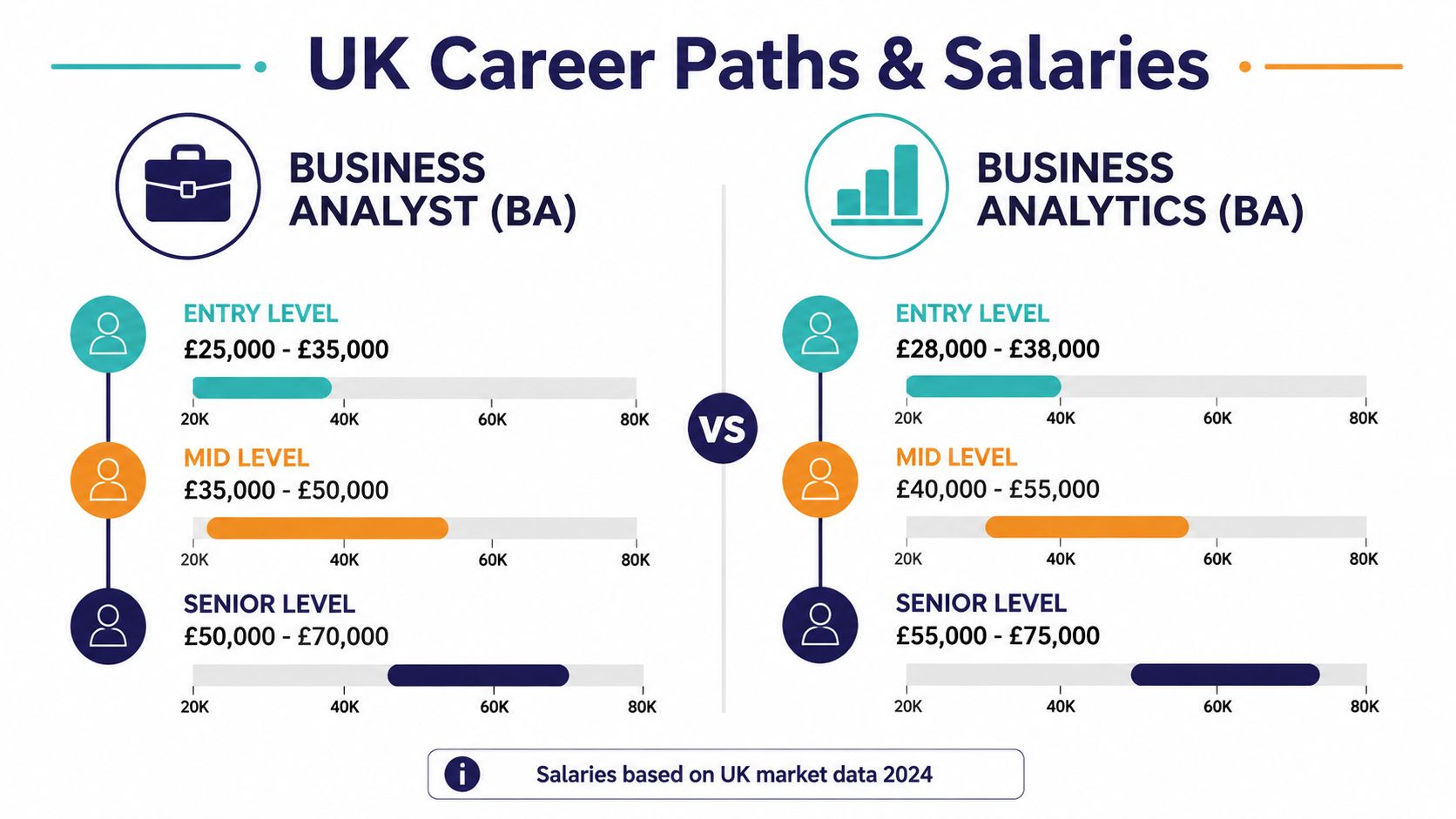
Progression paths split after the first few jobs. Business analysts often move into product management, programme leadership, or consultancy. Business analytics professionals often progress towards data science, advanced analytics leadership, or specialist reporting roles. If you want a career that can later move into accounting systems, payroll process improvement, or finance operations, the business analyst route often gives a broader platform. If you want to move deeper into data interpretation and modelling, analytics is usually the better long-term lane.
Navigating Career Path Ambiguity and Hybrid Roles
The clean split between business analyst and business analytics looks neat on a page, but UK employers don't always hire that way. Job ads increasingly want the same stack of tools from both sides, especially SQL, Excel, Power BI, and, in many cases, Python. That's why so many learners get stuck. They're told to choose one lane, yet the market keeps asking for both.
Why hybrid training is often the stronger bet
A hybrid candidate can gather requirements, speak to stakeholders, and still understand the data underneath the request. That matters because employers don't just want reports. They want someone who can work out what to report on, where the data sits, and how the finding turns into a decision. The practical value is obvious when a manager asks for “the numbers” but the issue is a broken process.
This is also why the old divide between “business-focused” and “technical” isn't enough. In many UK teams, people who can combine discovery with analysis are more useful than specialists who only do one half. Recent employer skills discussions have leaned towards productivity, automation, and AI-ready data use, not narrow labels. That doesn't erase specialism, but it does reward range.
Reading job descriptions properly
Business analyst postings usually emphasise stakeholder management, requirements elicitation, process improvement, and tools such as JIRA, Confluence, and Visio. Interviewers often test how you resolve conflict, prioritise requirements, and keep multiple teams aligned. If you've done accounting, payroll, or final accounts work, that attention to detail can be a strong advantage.
Business analytics postings usually ask for SQL, Excel, Power BI or Tableau, and sometimes Python or statistical modelling. Interviewers often use case studies, technical tests, or dataset exercises to see whether you can turn raw information into a sensible recommendation. If you've built reports in finance or supported data-heavy tasks before, that experience can transfer well.
Useful test: if you can explain the problem, the process, and the data in one interview answer, you're probably ready for hybrid roles.
What employers actually value
For both tracks, practical proof beats theory. A portfolio that shows a problem, the data or process behind it, and the recommendation you made is far stronger than a certificate list alone. That's especially true for career changers who don't yet have direct title experience.
The safest path in 2026 is often not a pure identity. It's a blended profile that can do discovery, documentation, and analysis without sounding fragmented in interviews.
Recommended Training and Certification Pathways
Training choice is where this becomes real. If you want business analysis, look for a programme that teaches stakeholder requirements, process mapping, and the documentation habits UK employers expect. If you want business analytics or data analyst work, you need SQL, Excel, Power BI, and enough analytical practice to discuss the numbers with confidence.
Professional Careers Training offers structured options that map well to this split. The Business Analyst Training route focuses on business analysis fundamentals, stakeholder requirements, process mapping, and practical workplace tools. The Data Analyst Training route is better suited to learners who want hands-on work with SQL, Excel, Power BI, and analytical methods used in reporting roles. If you want to understand how employers recognise the business analyst side, this business analyst certification UK guide is a useful starting point.
For people building a broader employability base, the accounting and finance courses matter too. Bookkeeping & VAT, advanced payroll, accounts assistant, and final accounts training can sharpen the accuracy, compliance mindset, and systems discipline that employers also value in business-facing and data-facing roles. That's especially useful if you want to move between finance operations, reporting support, and business analysis work.
What to look for in a good programme
- Practical software exposure: SAGE, Xero, QuickBooks, Excel, SQL, and Power BI should appear in the training mix where relevant.
- Flexible delivery: evening and weekend classes matter if you're changing careers while working.
- Support beyond the classroom: CV help, LinkedIn improvement, and interview prep are often what turns learning into interviews.
- Evidence of job alignment: the course should reflect how UK employers phrase responsibilities, not just abstract definitions.
If you're torn between business analyst and business analytics, don't pick based on which sounds smarter. Pick the route that gives you the strongest blend of credibility, tools, and practical confidence. That's what gets interviews in the UK market.
Professional Careers Training helps learners build job-ready capability across business, finance, and data. If you're deciding between business analyst and business analytics, or you want a hybrid route that covers both, visit Professional Careers Training to explore training that supports your next step with practical, UK-focused learning.