If you're VAT registered, you don't just charge VAT and get on with your day. Every accounting period, you have to work out exactly how...
If you already understand what final accounts are but keep putting off actually preparing yours, this guide is for you. It is a practical, step-by-step checklist for sole traders and small business owners who need to get from a shoebox of receipts and a bank statement to a finished trading account, profit and loss account and balance sheet, without missing anything HMRC expects to see.
If you want the definitions first, our plain-English guide to what final accounts actually are covers that ground. This article picks up from there and walks through the actual process.
Before you start: what you need to gather
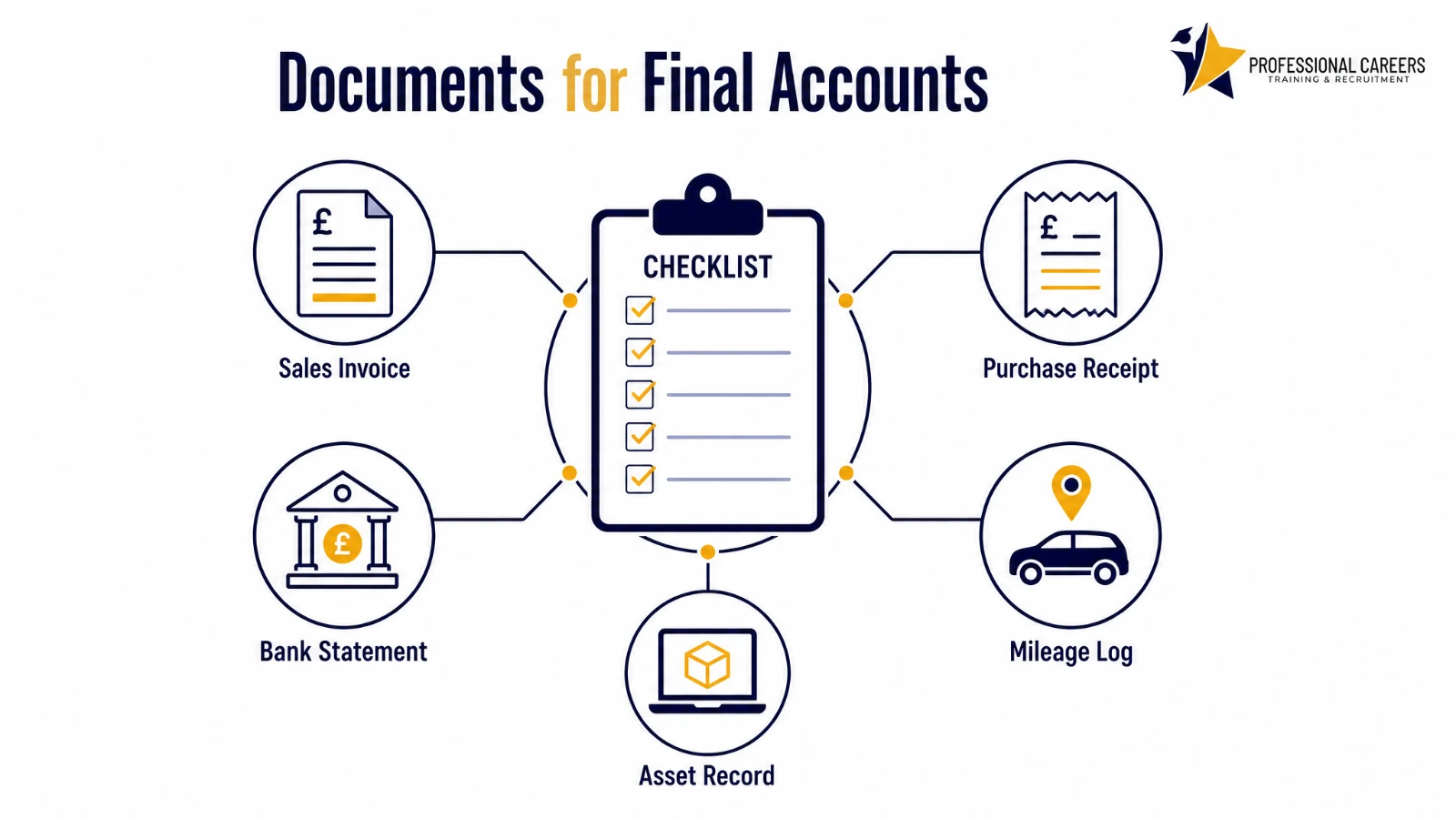
Final accounts are only as accurate as the records behind them. Before you open a spreadsheet or accounting package, pull together everything from the accounting year you are closing off. Missing even one category here is the single biggest cause of final accounts that need reworking later.
- Every sales invoice raised during the year, whether paid or still outstanding
- Every purchase invoice and receipt for stock, materials, tools and subscriptions
- Bank statements covering the full year, for every business account and card
- A mileage log if you use simplified expenses for a vehicle
- Records supporting any working-from-home or home-office costs
- Details of any equipment, vehicles or other assets bought or sold in the year
- Last year’s final accounts, so opening balances and comparatives are correct
- Any HMRC or Companies House correspondence relevant to the business
Final accounts are only as good as the records behind them. Gather everything from the year before you start, not part way through.
Step 1: reconcile your bank and cash records
Reconciliation means matching every transaction in your accounting records against what your bank statements actually show. This is where most errors in a set of final accounts start, so it is worth doing properly before anything else.
Matching transactions to the bank statement
Work through each bank statement line by line and confirm it appears in your bookkeeping records, whether that is a spreadsheet or software like Xero, QuickBooks or FreeAgent. Anything on the statement that is not in your records needs investigating and adding. Anything in your records that is not on the statement needs checking too, since it may be a duplicate or a payment that has not yet cleared.
Common reconciliation mistakes
The most frequent issues are personal transactions mixed into a business account, payments recorded twice, and transfers between your own accounts mistakenly treated as income or expenses. Cash sales and expenses paid in cash are also easy to miss if they were never logged at the time.
- List every bank and card account used for the business during the year
- Match each statement line to a bookkeeping entry, adding anything missing
- Flag and remove personal transactions or internal transfers
- Check the closing bank balance in your records matches the statement exactly
Step 2: confirm your accounting basis
Before you calculate a profit figure, you need to know which accounting basis you are using, because it changes when income and expenses count. Since the 2024/25 tax year, cash basis has been the default method for most sole traders and partnerships, and HMRC removed the previous £150,000 turnover limit on using it.
Under cash basis, you record income when you actually receive the money and expenses when you actually pay them. Under the traditional accruals basis, you record income when you invoice it and expenses when you incur them, regardless of when cash moves. You can still elect to use accruals instead of the cash basis default, and it usually suits businesses that carry significant stock, work extensively on credit, or have complex year-end adjustments.
Cash basis is now the default for most sole traders, but you can still choose accruals if it fits your business better.
Step 3: apply year-end adjustments
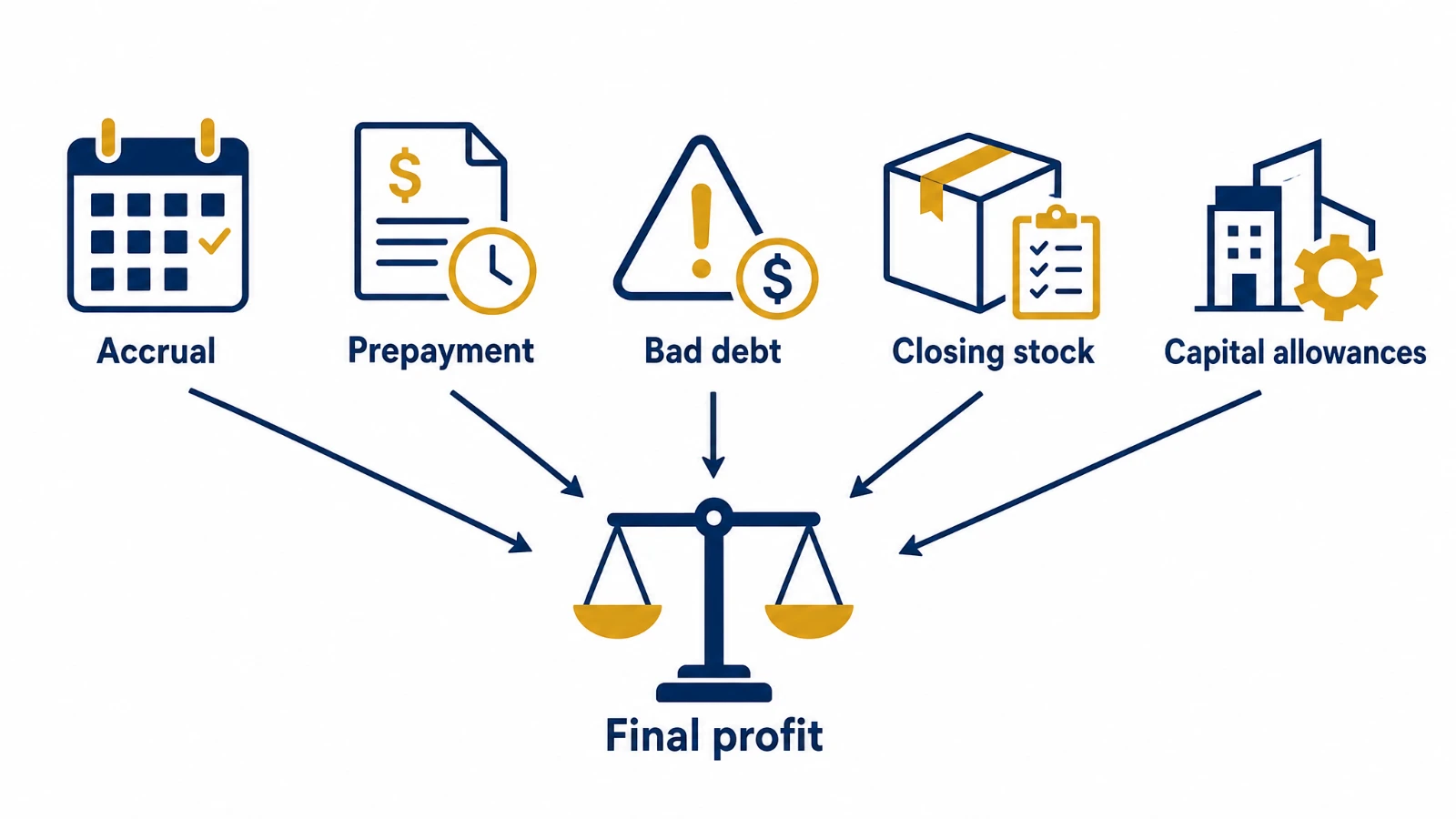
Even under cash basis, a few adjustments are usually needed to turn a raw set of bookkeeping totals into accurate final accounts. Under accruals, this step is more involved.
Accruals and prepayments
An accrual is a cost you have benefited from but not yet paid for, such as an accountant’s fee for work already done but not yet invoiced. A prepayment is the opposite: something you have already paid for that covers a period extending beyond your year end, such as annual insurance paid in month nine of your accounting year.
Bad debts and closing stock
If a customer is genuinely not going to pay an outstanding invoice, that debt needs writing off rather than left sitting in your sales figure. If you hold stock or work in progress at the year end, it needs valuing and including on the balance sheet, normally at the lower of cost or what you could actually sell it for.
Capital allowances instead of depreciation
For tax purposes, HMRC does not let you deduct depreciation on equipment, vehicles or other assets. Instead, you claim capital allowances, most commonly the Annual Investment Allowance, which lets many small businesses deduct the full cost of qualifying equipment against profit in the year of purchase.
| Adjustment | What it does | Typical example |
|---|---|---|
| Accrual | Adds a cost incurred but not yet billed | Accountant’s fee not yet invoiced |
| Prepayment | Removes a cost paid in advance for a future period | Annual insurance premium |
| Bad debt write-off | Removes income that will never be collected | An invoice a customer will not pay |
| Closing stock | Values unsold stock or work in progress | Materials bought but not yet used or sold |
| Capital allowances | Replaces accounting depreciation for tax | Annual Investment Allowance on new equipment |
Step 4: claim allowable expenses correctly
Getting expenses right affects your profit figure directly, so it is worth a dedicated step rather than rushing it at the end.
The £1,000 trading allowance
If your total income from self-employment is £1,000 or less in the tax year before expenses, you generally do not need to report it to HMRC at all. Above that, you can either deduct your actual allowable business expenses as normal, or deduct a flat £1,000 trading allowance instead, whichever gives you the better result. You cannot use both methods on the same income.
Simplified expenses: mileage and working from home
Rather than tracking the actual cost of running a vehicle or working from home, HMRC lets sole traders use simplified expenses flat rates instead. These are optional, but they save a lot of record-keeping if your circumstances are straightforward.
Mileage
If you use a vehicle for business journeys, you can claim a flat rate per mile instead of working out actual running costs like fuel, insurance and servicing. The rate drops after your first 10,000 business miles in the tax year.
Working from home
If you work from home for part of the business, HMRC offers a flat monthly rate based on hours worked, covering variable costs like heating and electricity. It does not cover fixed costs such as rent, mortgage interest or council tax.
| Expense | Flat rate |
|---|---|
| Car or van, first 10,000 business miles | 45p per mile |
| Car or van, business miles after 10,000 | 25p per mile |
| Motorcycle, any business mileage | 24p per mile |
| Working from home, 25 to 50 hours a month | £10 a month |
| Working from home, 51 to 100 hours a month | £18 a month |
| Working from home, 101 or more hours a month | £26 a month |
Simplified expenses flat rates trade a little accuracy for a lot less admin, and they are worth using if your circumstances are straightforward.
Step 5: build the trading account, profit and loss account, and balance sheet
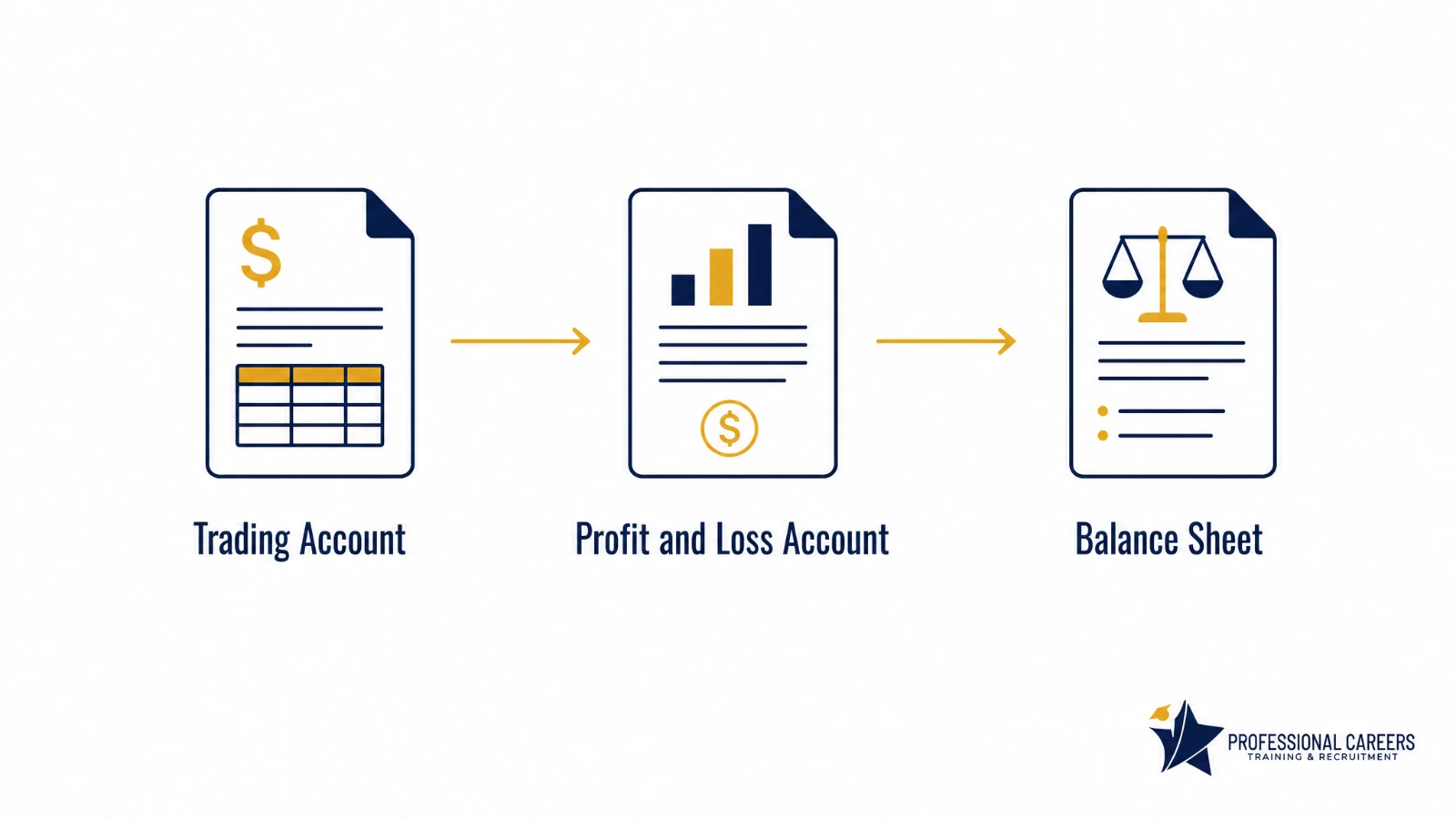
With reconciled records, a confirmed accounting basis, adjustments applied and expenses claimed correctly, you can now assemble the three documents that make up a complete set of final accounts.
Trading account
The trading account shows your turnover, the direct cost of the goods or services you sold, and the gross profit left over. Not every sole trader needs a separate trading account, particularly service-based businesses with no cost of sales, but it is standard for anyone buying and selling stock.
Profit and loss account
The profit and loss account takes gross profit and deducts every other business expense, from software subscriptions to professional fees, to arrive at net profit. This net profit figure is what actually gets taxed, so it needs to be right before you file anything with HMRC.
Balance sheet
Sole traders are not legally required to produce a balance sheet the way limited companies are, but it is genuinely worth doing anyway. A balance sheet lists what the business owns, such as equipment and money owed by customers, against what it owes, such as loans and money owed to suppliers, giving you a clear picture of the business’s financial position at the year end.
Step 6: check, review and sign off
Before you use these figures for anything, run a final review. This step catches the mistakes that slip through everything above.
- Check the balance sheet actually balances, with assets equal to liabilities plus capital
- Compare this year’s figures against last year’s and query anything that has moved unexpectedly
- Confirm every adjustment from Step 3 has actually been applied, not just noted
- Check the net profit figure matches what you plan to declare on your tax return
- Keep a dated, saved copy, since HMRC can ask to see your records for several years
A final accounts figure that has not been checked against last year’s numbers is not actually finished yet.
Key deadlines and what happens if you miss them
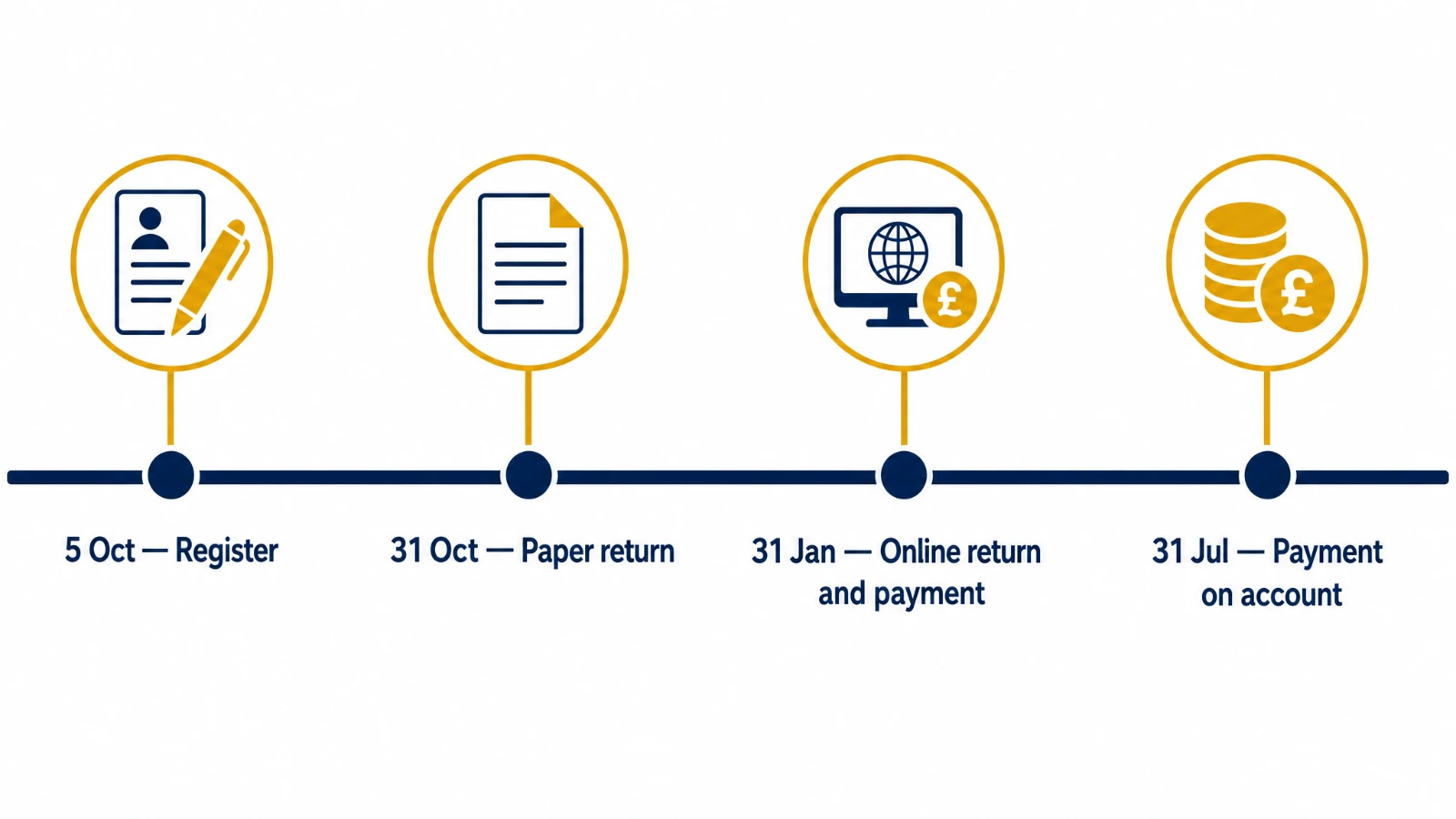
Final accounts themselves have no fixed filing deadline for a sole trader, since you are not submitting them to Companies House. What does have hard deadlines is the Self Assessment tax return built from them, and missing these carries automatic penalties.
| Deadline | Date |
|---|---|
| Register for Self Assessment (if not already registered) | 5 October |
| Paper tax return | 31 October |
| Online tax return | 31 January |
| Balancing payment due | 31 January |
| Second payment on account (where applicable) | 31 July |
Miss the online filing deadline and HMRC applies an automatic £100 penalty, even if you owe no tax, with further daily penalties after three months. Full detail on registering, filing and paying is on HMRC’s Self Assessment deadlines page, which is worth bookmarking alongside your own final accounts timetable.
DIY, a bookkeeper, or formal training: which route makes sense
Plenty of sole traders prepare their own final accounts successfully, particularly with straightforward, service-based businesses and clean records kept throughout the year. Where it gets harder is stock valuation, capital allowances, or a business that has grown enough that mistakes now carry real cost.
If you are weighing up whether to outsource this or build the skill yourself, our Final Accounts Training course covers exactly this process in depth, from reconciliation through to a finished set of accounts, alongside the wider bookkeeping foundations from our Bookkeeping and VAT Training course. Both come with CPD certification and guaranteed recruitment support if you are building this into a career move rather than just handling your own business.
If you are instead trying to decide between routes like AAT, ACCA or CIMA to formalise your accounting knowledge long term, our AAT vs ACCA vs CIMA comparison lays out the practical differences. And if VAT registration is on the horizon alongside your final accounts, it is worth reading our guide to Making Tax Digital for VAT before it becomes urgent.
Frequently asked questions
Do sole traders have to file final accounts with Companies House?
No. Filing accounts with Companies House only applies to limited companies. As a sole trader, your final accounts feed into your Self Assessment tax return, which goes to HMRC instead.
Do I need an accountant to prepare final accounts as a sole trader?
Not necessarily. Many sole traders with straightforward, service-based businesses and clean records prepare their own. An accountant or dedicated training becomes more useful once stock, capital allowances or more complex adjustments are involved.
What is the deadline for preparing final accounts?
There is no separate filing deadline for a sole trader’s final accounts themselves. What matters is the Self Assessment tax return built from them, which is due online by 31 January following the end of the tax year.
Can I switch between cash basis and accruals basis each year?
You can elect which basis to use each tax year, but switching regularly adds complexity, since moving between the two requires adjustments to avoid double-counting or missing income and expenses. Most businesses are better off picking a basis and sticking with it unless circumstances genuinely change.
What records do I need to keep after final accounts are done?
HMRC generally expects sole traders to keep business records for at least five years after the 31 January submission deadline for the relevant tax year. Keep invoices, receipts, bank statements and the final accounts themselves together, not just the summary figures.