If you work in payroll, or you're training to, "statutory payments" is one of those phrases that sounds dry until you realise how much rests...
If you work in payroll, or you’re training to, “statutory payments” is one of those phrases that sounds dry until you realise how much rests on getting it right. Sick pay, maternity pay, paternity pay. Get the calculation wrong and someone’s rent doesn’t get paid on time.
The rules changed significantly on 6 April 2026. Statutory Sick Pay in particular now works quite differently to how it did even a year ago.
This guide sets out what every statutory payment covers, who qualifies, how much they’re worth, and what employers can and can’t claim back from HMRC.
What “statutory payments” actually cover
Statutory payments are minimum amounts the law requires employers to pay employees during certain types of absence: sickness, having a baby, adopting a child, or taking shared parental leave. They’re a floor, not a ceiling.
Employers can pay more generously through their own contractual sick pay or enhanced maternity schemes. They just can’t pay less than the statutory minimum to anyone who qualifies.
There are six statutory payments UK payroll teams deal with regularly: Statutory Sick Pay (SSP), Statutory Maternity Pay (SMP), Statutory Paternity Pay (SPP), Statutory Adoption Pay (SAP), Shared Parental Pay (ShPP) and Statutory Parental Bereavement Pay (SPBP).
Each has its own eligibility test, rate and maximum duration. Getting one confused with another is a common source of errors.
Statutory payments set a legal minimum for sickness, maternity, paternity, adoption and shared parental leave. Employers can top them up, but never pay less than the statutory rate to someone who qualifies.
Statutory Sick Pay changed completely on 6 April 2026
SSP has been part of UK payroll for decades, but the Employment Rights Act 2025 rewrote its basic mechanics from 6 April 2026. Anyone trained on the old rules needs to unlearn a few habits.
How SSP used to work
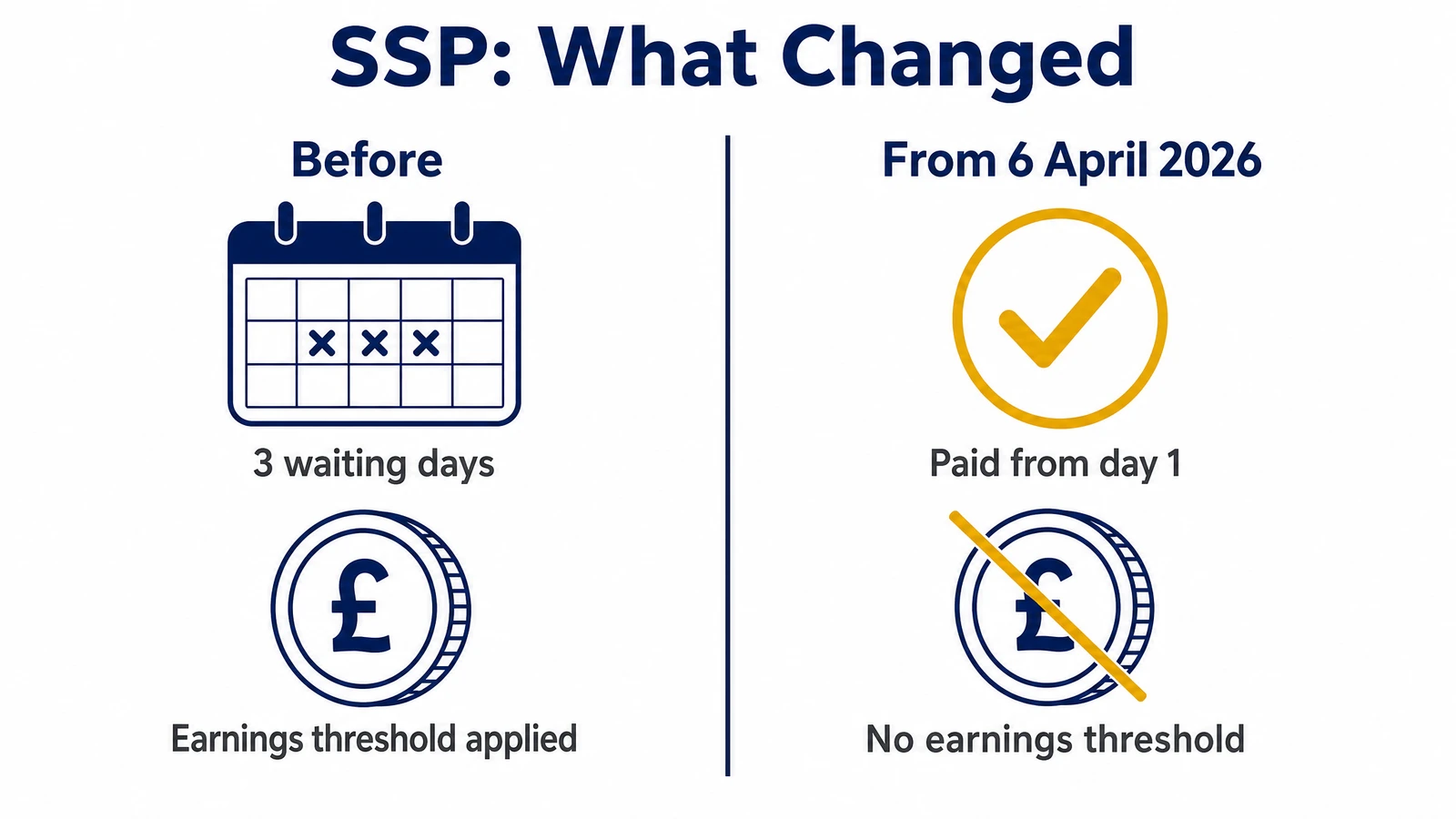
Before the reform, SSP only applied to employees earning above the Lower Earnings Limit for National Insurance. It also wasn’t payable for the first three “waiting days” of any sickness absence, so an employee who was off for two days got nothing at all.
Anyone earning below the threshold, often part-time or lower-paid staff, got no statutory sick pay whatsoever.
What changed from 6 April 2026
Two things changed at once. The earnings threshold was scrapped, so SSP eligibility no longer depends on how much someone earns. And the three waiting days were abolished, meaning SSP is now payable from the very first day of sickness absence.
The government’s own estimate, set out in Acas’ guidance on the 2026 changes, is that the reform brings around 1.3 million lower-paid workers into SSP eligibility for the first time, many of them part-time and disproportionately women.
For payroll teams, it also means far more short absences now trigger a payment that previously didn’t exist at all.
It’s worth being clear about what didn’t change too. SSP is still only available to people classed as employed for tax purposes, and it still runs alongside an employee’s normal sick leave policy rather than replacing it.
Employers can also still choose to pay more generously through a contractual sick pay scheme of their own.
How to work out SSP now
The rate itself also changed shape. SSP is now the lower of a flat weekly rate or 80% of the employee’s average weekly earnings, rather than always paying the same flat amount regardless of income.
Take an employee earning £300 a week who’s off sick for a full week. 80% of £300 is £240, which is higher than the £123.25 flat rate, so they’d receive £123.25.
A part-time employee earning £140 a week would get £112 instead, since 80% of their earnings falls below the flat rate. The lower of the two figures always applies.
- Check the employee has told you they’re sick within your deadline, or within 7 days if you don’t set one.
- Confirm they’re classed as employed for tax purposes; SSP doesn’t apply to the genuinely self-employed.
- Work out their average weekly earnings over the relevant reference period.
- Pay the lower of the flat weekly rate or 80% of those average earnings, from day one of the absence.
- Continue paying for as long as the sickness lasts, up to the 28-week maximum.
SSP is worth £123.25 a week or 80% of average weekly earnings, whichever is lower, and it can run for up to 28 weeks. After that, an employee who’s still unable to work may need to claim Employment and Support Allowance instead.
From 6 April 2026, SSP is paid from day one of sickness with no earnings threshold at all. Anyone still working out entitlement using the old waiting-days rule is calculating it wrong.
Statutory Maternity Pay: what it is and who qualifies
Statutory Maternity Pay supports employees taking maternity leave. It’s separate from Maternity Allowance, which is a benefit for people who don’t qualify for SMP through an employer, most often the self-employed.
Eligibility for SMP
To qualify, an employee needs to have worked continuously for the same employer for at least 26 weeks by the “qualifying week”, 15 weeks before the baby is due.
Their average weekly earnings over the relevant 8-week reference period must also be at least £129, the lower earnings limit for 2026/27.
How much SMP pays and for how long
SMP runs for up to 39 weeks. The first 6 weeks are paid at 90% of average weekly earnings, with no cap. The remaining 33 weeks are paid at £194.32 a week or 90% of average earnings, whichever is lower.
SMP is taxable and subject to National Insurance in the normal way, and it doesn’t depend on the employee planning to return to work afterwards. There’s no requirement to pay any of it back if they decide not to.
Statutory Paternity Pay, Adoption Pay and Other Parental Payments
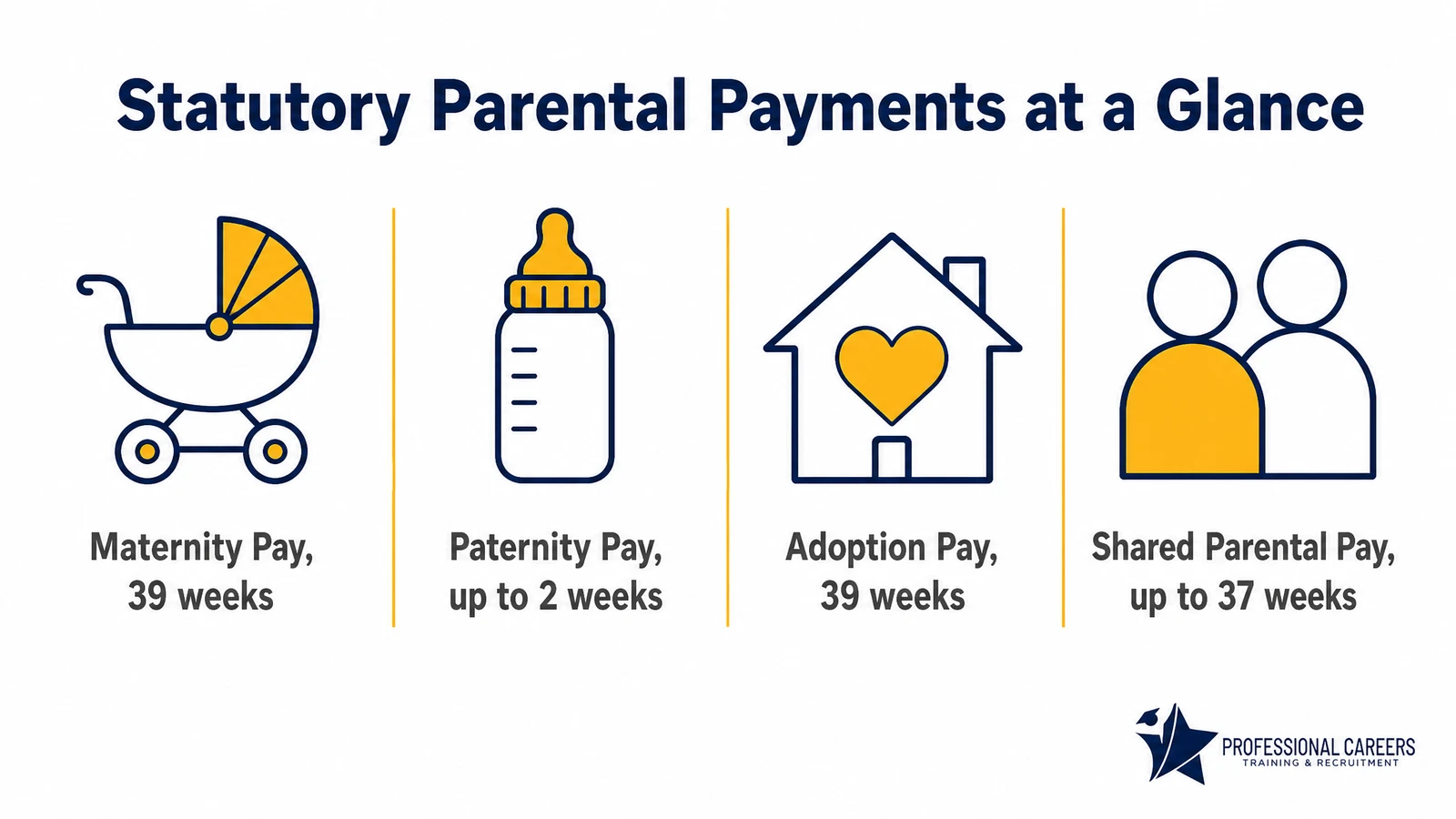
The same broad structure, an earnings and length-of-service test, then a fixed weekly rate or a percentage of pay, applies to the other statutory parental payments, with some differences worth knowing.
Statutory Paternity Pay
SPP gives eligible employees one or two weeks of leave, paid at £194.32 a week or 90% of average weekly earnings, whichever is lower. The same 26-week service test and £129 earnings threshold apply as for SMP.
Statutory Adoption Pay
SAP mirrors SMP closely: 39 weeks total, 90% of average earnings for the first 6 weeks, then £194.32 a week or 90% of earnings for the remaining 33.
It applies to one adopting parent, or to parents using a surrogacy arrangement who meet the relevant conditions.
Shared Parental Pay
ShPP lets eligible parents split up to 37 weeks of pay between them, once the mother or primary adopter has ended their own maternity or adoption leave and pay early to free up the remaining entitlement.
It’s paid at the same £194.32 a week or 90% of earnings rate. Both parents separately need to satisfy an employment and earnings test before either can claim it.
Statutory Parental Bereavement Pay
SPBP is the least common of the group, and the one payroll teams are least likely to have handled before. It supports an employee who loses a child under 18, or suffers a stillbirth after 24 weeks of pregnancy.
It gives up to 2 weeks of leave, paid at the same £194.32 a week or 90% of earnings rate as paternity pay.
Unlike the other statutory payments, there’s no length-of-service requirement for SPBP. Any employee is entitled to the leave itself from their first day in a job, though the earnings threshold for the pay element still applies.
Paternity, adoption, shared parental and parental bereavement pay all use the same £194.32 weekly rate as the second stage of maternity pay. The eligibility tests are what actually differ between them.
How much employers can claim back from HMRC
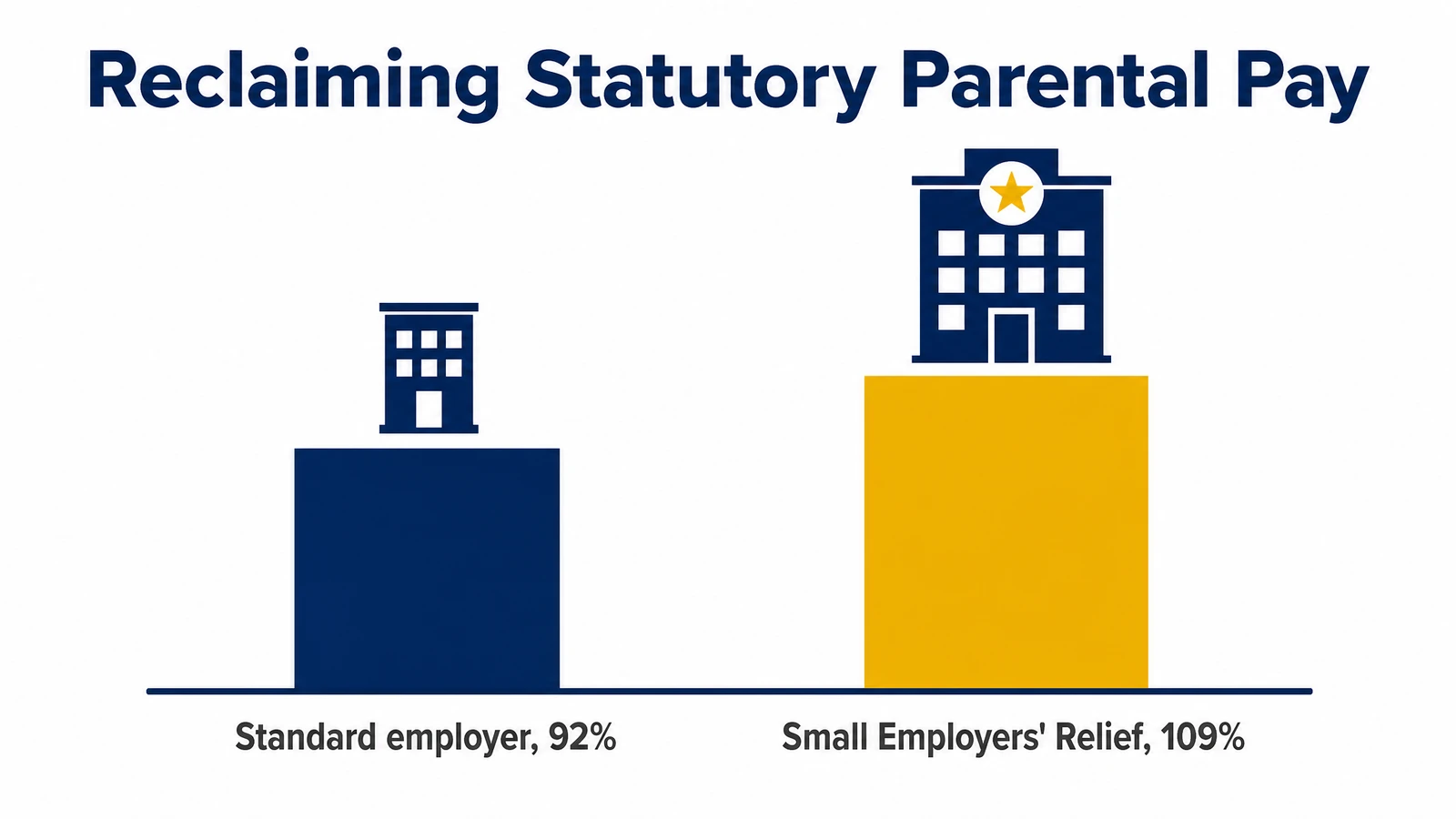
This is where SSP and the parental payments genuinely part ways. Employers currently have no way to recover the cost of SSP from HMRC at all, aside from a coronavirus-era rebate scheme that no longer applies. The full cost sits with the employer.
Maternity, paternity, adoption, shared parental and parental bereavement pay work differently. Employers paying Class 1 National Insurance can reclaim 92% of what they’ve paid out. Smaller employers can reclaim more, under a scheme called Small Employers’ Relief.
| Payment | Standard reclaim | Small Employers’ Relief |
|---|---|---|
| Statutory Sick Pay | Not reclaimable | Not reclaimable |
| Maternity, paternity, adoption, shared parental and bereavement pay | 92% | 109% (100% + 9% compensation) |
An employer qualifies for Small Employers’ Relief if their total Class 1 National Insurance contributions came to less than £45,000 in the previous tax year, as confirmed in CIPP’s own guidance on the current rates.
That threshold catches a large share of small and mid-sized UK businesses. Smaller employers are more exposed to the cost of a single member of staff taking a long period of parental leave, so the extra 9% is there to soften that.
Reclaiming is done through the normal payroll process, by adjusting the amount of PAYE and National Insurance paid over to HMRC each period rather than submitting a separate claim form.
It’s one more reason accurate, up-to-date payroll software matters. Getting it wrong either understates what the business owes HMRC or leaves money unclaimed that the employer was entitled to.
Common mistakes payroll teams make with statutory payments
A few errors come up again and again, in real payroll teams and in training exercises alike.
- Still applying the old SSP earnings threshold or waiting-days rule for absences from 6 April 2026 onwards.
- Confusing the SSP earnings rule, now scrapped, with the separate £129 lower earnings limit that still applies to SMP, SPP, SAP and ShPP.
- Assuming SSP can be reclaimed the way maternity and paternity pay can.
- Missing the 26-week continuous employment test for parental payments, especially where someone has recently changed employer.
- Forgetting that Small Employers’ Relief is based on the previous tax year’s NI bill, not the current one, so eligibility needs checking annually.
Most statutory payment errors come from applying an old rule after it’s changed, not from complicated maths. Keeping the SSP reform and the £129 parental pay threshold straight avoids the two most common ones.
Where this fits into a payroll career
Statutory payments come up in almost every UK payroll role, from a first junior position through to running payroll for a whole organisation. They’re also a reliable feature of payroll qualifications and interviews, since they combine legal knowledge with a genuine calculation rather than pure theory.
Reforms like the SSP changes are also a normal part of the job, not a one-off. UK payroll legislation is updated most tax years, sometimes significantly.
Part of what separates a competent payroll professional from a struggling one is keeping pace with changes like this, rather than working from rules that were true two or three years ago.
How our Advanced Payroll Training course covers this
Getting comfortable with SSP, SMP, SPP, SAP and ShPP, including when each applies and what an employer can and can’t reclaim, is core material on our Advanced Payroll Training course.
It sits alongside PAYE, National Insurance and the auto-enrolment pension duties covered in our guide to workplace pension auto-enrolment. If you’re newer to the subject, our PAYE and National Insurance explainer is a good place to start before coming back here.
Who the course suits
The course is built for people who want a genuinely practical grounding rather than just the theory, with CPD certification and guaranteed recruitment support once you finish.
It suits both complete beginners, as covered in our guide to payroll training for beginners, and people already working in a related role, such as an accounts assistant, who want to move specifically into payroll.
Do all employees qualify for Statutory Sick Pay?
Since 6 April 2026, yes, as long as they’re classed as employed for tax purposes and have told their employer they’re sick within the required deadline. The old earnings threshold that excluded lower-paid staff has been removed.
How is Statutory Sick Pay calculated in 2026/27?
SSP is paid at the lower of £123.25 a week or 80% of the employee’s average weekly earnings, from the first day of sickness absence, for up to 28 weeks.
Can employers reclaim the cost of Statutory Sick Pay?
No. Unlike maternity, paternity, adoption and shared parental pay, SSP currently cannot be reclaimed from HMRC, aside from the coronavirus-era rebate scheme that no longer applies.
What earnings threshold applies to Statutory Maternity Pay?
An employee needs average weekly earnings of at least £129 over the relevant 8-week reference period, plus at least 26 weeks of continuous employment by the qualifying week, 15 weeks before the baby is due.
What is Small Employers’ Relief?
It lets employers with total Class 1 National Insurance contributions under £45,000 in the previous tax year reclaim 109% of what they’ve paid in maternity, paternity, adoption, shared parental or parental bereavement pay, instead of the standard 92%.