
If you've looked up "financial analyst salary UK" and found three different numbers on three different sites, you're not alone. Pay for this role varies...
Business analyst and data analyst job adverts often sit side by side, use some of the same software, and pay surprisingly similar salaries. It is no surprise people researching a career change get the two mixed up.
The roles are genuinely different jobs. They have different daily routines and different skills at their core. Different kinds of people thrive in each one.
This guide compares both paths honestly, using current UK salary and demand data, so you can work out which one actually fits you.
What Does a Business Analyst Actually Do?
A business analyst sits between a business and the people building a solution to one of its problems. Their job is to work out what a business actually needs.
They then describe that need clearly enough for developers, project teams or senior managers to act on it. That makes a business analyst more of a translator and problem-definer than a number-cruncher.
Most of the work happens in conversation, in workshops, and in documents, not in spreadsheets or code.
A typical week
A business analyst’s week is built around people rather than data. Expect stakeholder interviews, requirements workshops and process mapping sessions.
Writing up what was agreed matters just as much, so nothing gets lost between meetings.
The BCS, the professional body for IT, frames this as a structured process: stakeholder engagement, requirements elicitation, requirements prioritisation, and requirements documentation.
Elicitation covers observation, workshops, interviews, document analysis, brainstorming, surveys and prototyping. Prioritisation usually follows a framework such as MoSCoW, which sorts requirements into Must have, Should have, Could have and Would like.
That matters most on a project with limited time and budget, since it still has to deliver the things that count first.
Who they work with
A business analyst reports to and liaises with a wide mix of people. Senior stakeholders set direction, project managers track delivery, developers build the solution, and end users will actually use it day to day.
The BCS puts it plainly: a business analyst acts as translator between business stakeholders and technical teams. Lack of communication is one of the most common causes of a project failing outright.
A business analyst’s real output isn’t a spreadsheet. It’s a clear, agreed, written-down answer to “what does the business actually need here?”, one that a technical team can build from without guessing.
What Does a Data Analyst Actually Do?
A data analyst’s job starts where a business analyst’s often ends: once there is data to work with. Their role is to pull it together and make sense of it.
They then present findings that help someone else make a decision. Where a business analyst spends most of a day talking and writing, a data analyst spends most of a day inside software.
A typical week
A data analyst’s week revolves around a recurring cycle. They pull data from a database or system, clean and check it, then build or update a dashboard.
Explaining what the numbers actually mean to a non-technical audience comes next. This still involves plenty of communication, particularly explaining results clearly.
The starting point is always the data itself though, rather than a stakeholder conversation.
The tools they live in
PC Training’s own Data Analyst Training course breakdown covers the toolkit a UK data analyst role typically expects: Excel, Power BI, SQL, Tableau and increasingly Python.
SQL remains the single most in-demand skill in UK data analyst job adverts, appearing in 44.3% of postings. That is why most training routes treat it as a non-negotiable foundation rather than an optional extra.
AI tools are increasingly part of this toolkit too. They are not a separate skill but features built into Excel, Power BI and similar software that speed up routine data cleaning and first-draft analysis.
Our guide to AI and data analysis covers this in more depth.
Skills and Qualifications Compared
The clearest way to see how different these roles are is to compare what they actually ask of you day to day. One leans on people skills and structured thinking, the other on technical fluency with data tools.
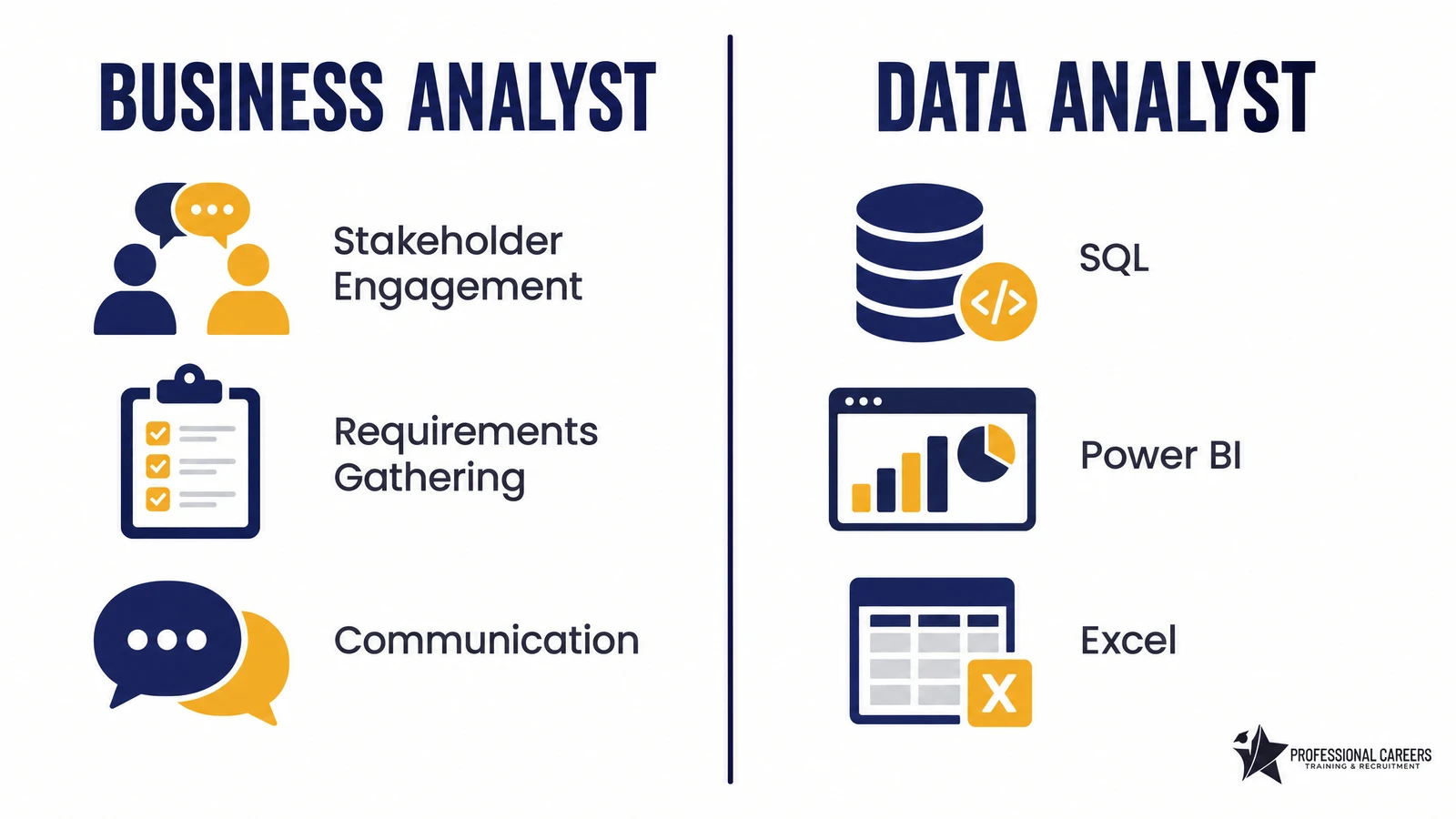
| Area | Business Analyst | Data Analyst |
|---|---|---|
| Core skill set | Stakeholder engagement, requirements gathering, communication, negotiation | SQL, Excel, Power BI, Tableau, Python, statistical reasoning |
| Documentation style | Requirements catalogues, use cases, user stories, process maps (BPMN/UML) | Dashboards, reports, data visualisations, written findings |
| Common frameworks | MoSCoW prioritisation, Agile ceremonies, stakeholder matrices | Data cleaning and validation processes, exploratory analysis |
| Recognised UK qualification route | BCS Foundation Certificate in Business Analysis | No single dominant certifying body; tool-specific skills and a project portfolio carry more weight |
| Where the work happens | Mostly in meetings, workshops and written documents | Mostly inside data and dashboarding software |
Neither skill set is harder than the other. They are simply different.
A business analyst who struggles with ambiguity and people management will find the role draining. A data analyst who dislikes spending most of a day in software will find that role equally wrong for them.
UK Salary and Demand Right Now
Salary data for both roles moves around from month to month, so it is worth looking at the current picture rather than an old average that may no longer hold.
The figures below are drawn from IT Jobs Watch’s business analyst data and its data analyst data, both live UK job market trackers.
| Measure | Business Analyst | Data Analyst |
|---|---|---|
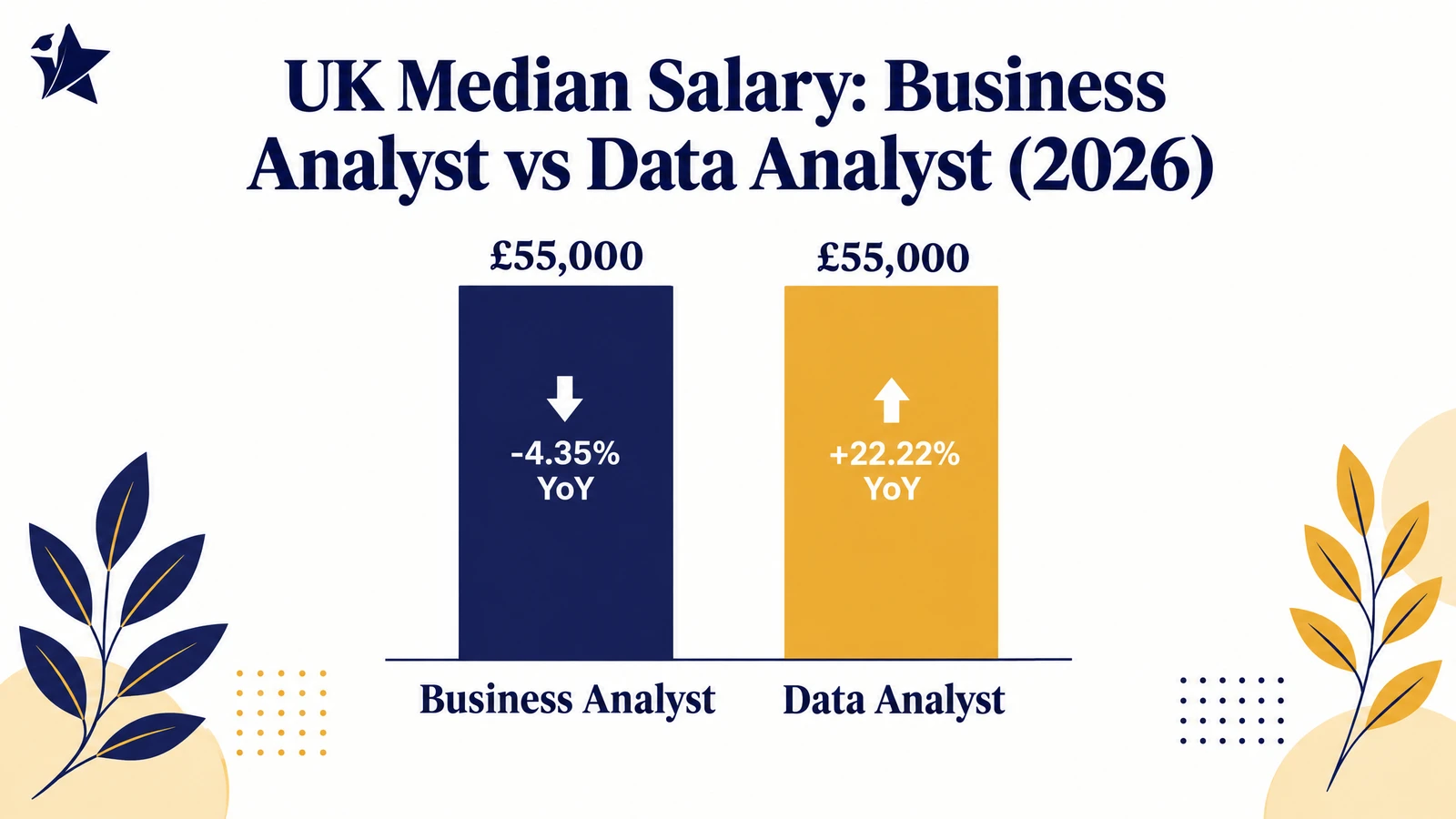
| UK median salary | £55,000 | £55,000 |
| Year-on-year change | Down 4.35% (from £57,500) | Up 22.22% (from £45,000) |
| London median | £65,000 (down 18.75% YoY) | £60,000 (down 4.00% YoY) |
| UK excluding London | £52,500 (up 5.00% YoY) | £50,000 (up 17.65% YoY) |
| Permanent UK vacancies | 1,516 (up from 698 a year earlier) | 1,071 |
The headline figure most people do not expect: the two roles have converged on exactly the same UK median salary this year, £55,000.
Business analyst pay has eased back slightly while data analyst pay has climbed sharply, as demand for data skills grows across UK employers.
Business analyst vacancies have also grown faster, more than doubling year-on-year. That suggests UK employers are investing heavily in change and transformation work right now, not just in data capability.
Neither role currently pays meaningfully more than the other in the UK. The honest answer to “which pays better” is: pick based on the work itself, not the payslip, because right now they land in roughly the same place.
Which Path Suits Which Kind of Person
Salary and demand being close means the real decision comes down to fit. Be honest with yourself about which of these two lists sounds more like a week you would enjoy.
You might lean towards Business Analysis if:
- You enjoy untangling what people actually mean, not just what they first say they want.
- You would rather run a workshop than build a spreadsheet model.
- You are comfortable managing disagreement between stakeholders with competing priorities.
- You like writing clearly and documenting decisions so nothing gets lost.
You might lean towards Data Analysis if:
- You get genuine satisfaction from finding a pattern buried in a messy dataset.
- You would rather learn a new tool (SQL, Power BI, Python) than sit through another stakeholder meeting.
- You think in numbers first and prefer evidence over opinion when settling a disagreement.
- You want a skill set that is easy to demonstrate with a portfolio of real projects.
Most people recognise themselves more strongly in one list than the other within a few lines. If you still feel torn, that is a genuine signal too, and it points towards roles that blend both, covered next.
Career Progression: Where Each Path Can Lead
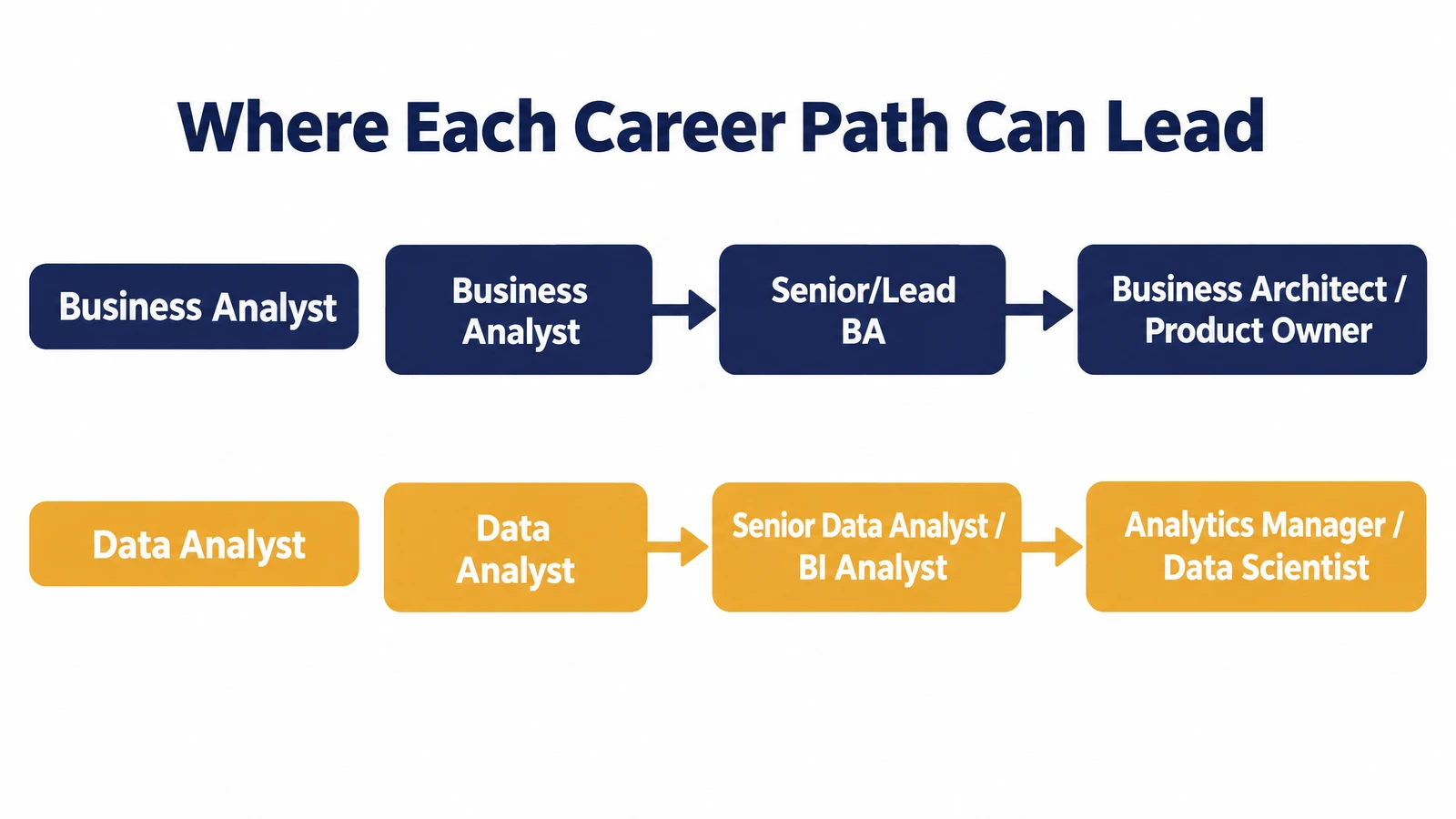
Neither role is a dead end, and the typical next steps look quite different a few years in.
From business analyst
A business analyst’s experience in requirements, stakeholder management and process improvement tends to open doors upward and sideways. Common next steps include senior or lead business analyst, product owner, business architect, or a move into project or programme management.
Each of these builds directly on skills a business analyst already uses daily, rather than requiring a fresh set of technical qualifications.
From data analyst
A data analyst’s path tends to follow the depth of their technical skills. Common next steps include senior data analyst, business intelligence (BI) analyst or analytics manager.
Some move towards data science over time, once they build stronger statistical and programming skills.
The strongest progression usually comes from specialising further in one or two tools, Power BI and SQL together is a common combination, rather than staying generalist indefinitely.
Progression in either role rewards depth over breadth. A business analyst who masters stakeholder management, or a data analyst who masters one or two tools properly, tends to move up faster than someone who stays a generalist in either camp.
Can You Move Between the Two, or Do They Overlap?
The two roles overlap more than their job titles suggest. UK employers increasingly expect business analysts to be comfortable with data tools, not just documents.
Our SQL for Business Analysts guide covers exactly this shift. Business analysts who can query data directly, rather than always waiting on a data analyst, are increasingly valued for bringing both skill sets to the table.
The reverse move happens too. Data analysts who build strong stakeholder communication and requirements-gathering skills often progress into senior analyst, product analyst or business analysis roles later in their career.
AI is accelerating this overlap on both sides. Our guide to AI and business analysis covers how AI tools are pushing business analysts to get more comfortable with data.
Meanwhile data analysts are leaning on AI to handle routine querying faster, which frees up time for the communication side of the role.
The two roles are drifting towards each other, not further apart. The safest long-term bet for either career path is picking up at least some fluency in the other side’s core skill.
How PC Training’s Courses Compare
Both of our training routes are built around the real skills UK employers ask for in each role, not a generic syllabus. The right starting point depends on which list above matched you more closely.
The Business Analyst Training programme focuses on requirements gathering, stakeholder management, process mapping and the recognised BCS Foundation route, with guaranteed recruitment support once you are ready for the job market.
The Data Analyst Training programme runs around 200 hours across Excel, Power BI, SQL, Tableau and Python, combining structured e-learning with 1-to-1 mentoring. It is also backed by guaranteed recruitment support.
Neither course assumes prior experience. Both are built for people changing career into finance and analytics roles from a standing start, which is the position most people researching this comparison are actually in.
There is no wrong choice between these two courses if the role genuinely fits you. The expensive mistake is picking the one that sounds more impressive rather than the one that matches how you actually like to work.
Frequently Asked Questions
Is a business analyst or data analyst job easier to get into with no experience?
Neither has a hard barrier to entry, but they ask for different starting points. Business analyst roles value clear communication and structured thinking more than a technical background.
Data analyst roles expect demonstrable tool skills such as SQL, Excel and Power BI even at entry level, often shown through a project portfolio rather than formal experience.
Which pays more, business analyst or data analyst, in the UK?
As of October 2026, UK median salaries for both roles have converged at £55,000, according to IT Jobs Watch.
Business analyst pay has eased slightly over the past year while data analyst pay has risen sharply, so neither role currently has a clear salary advantage.
Do business analysts need to know SQL or Power BI?
Not always, but it is increasingly an advantage. UK employers more often expect business analysts to query data directly rather than wait on a data analyst. Picking up basic SQL alongside core business analysis skills is a genuinely useful differentiator.
Can a data analyst become a business analyst later in their career?
Yes, this is a common progression route. Data analysts who build strong stakeholder communication and requirements-gathering skills, alongside their existing technical ability, often move into senior analyst, product analyst or business analyst roles.
What qualification should I get for a business analyst role in the UK?
The BCS Foundation Certificate in Business Analysis is the most widely recognised UK entry-level qualification. It covers the core techniques employers expect: stakeholder engagement, requirements elicitation, prioritisation and documentation.
Both paths lead to genuinely well-paid, in-demand UK careers right now, and neither one is the safer choice financially.
The better question is which week sounds like one you would actually want to have, over and over, for the next few years.