

If you've looked up "financial analyst salary UK" and found three different numbers on three different sites, you're not alone. Pay for this role varies...
If you’ve looked up “financial analyst salary UK” and found three different numbers on three different sites, you’re not alone. Pay for this role varies a lot by sector and region.
A lot of the figures floating around online are also out of date, or based on a small handful of job ads rather than real market data.
This guide uses current UK job market data to show what financial analysts actually earn in 2026. It also compares pay with two closely related roles.
Those roles are business analyst and data analyst. We’ll also set out what genuinely moves your own pay up.
What Does a Financial Analyst Actually Do?
A financial analyst looks at a company’s numbers, the wider market, and economic conditions. They turn that into something decision-makers can actually act on.
You’re building the case for or against a course of action, not just reporting what already happened. That’s the key difference from most accounting roles.
The role suits people who are comfortable with numbers and enjoy working out why a figure moved, not just what the figure is. It sits close to accounting, but the focus is forward-looking rather than historical.
A Typical Week
Day-to-day work varies by employer, but careers guidance on the role points to a consistent core of tasks:
- Building and maintaining financial models that forecast revenue, costs or cash flow
- Researching investment opportunities or assessing the value of a business or asset
- Collecting and checking financial data from internal systems and external sources
- Writing up findings into reports and presenting them to managers or stakeholders
- Tracking market conditions and competitor performance that affect the numbers
- Flagging variances between forecast and actual results, and explaining why they happened
Most financial analyst jobs are office-based, Monday to Friday, working inside a wider finance team. Expect longer hours around reporting deadlines and budget season, which is true of most roles at this level.
Financial Analyst Salary UK: The 2026 Numbers
UK job market data from IT Jobs Watch, covering the six months to October 2026, puts the median financial analyst salary nationally at £57,500.
That’s up 4.55% on the same period last year. Permanent vacancies for the role have risen sharply too, up around 41% year on year.
| Percentile | Annual salary |
|---|---|
| 10th percentile | £40,000 |
| 25th percentile | £45,000 |
| Median (50th) | £57,500 |
| 75th percentile | £72,500 |
| 90th percentile | £85,000 |
That spread tells its own story. A newly qualified analyst at a smaller firm will usually sit nearer the 10th to 25th percentile.
Someone several years in, with a specialism such as modelling, risk or M&A support, can realistically reach the 75th percentile and beyond.
Entry-Level vs Experienced Pay
Entry-level roles, often labelled “junior” or “graduate” analyst, tend to sit around £35,000 to £45,000. That broadly matches the 10th to 25th percentile figures above.
These roles usually sit inside a larger finance function, supporting a senior analyst or finance manager rather than owning a model end to end.
Once you’ve got two to four years of experience and a professional qualification behind you, £55,000 to £70,000 becomes realistic across most sectors. Analysts with eight or more years’ experience, particularly in financial services, regularly clear £80,000.
London vs the Rest of the UK
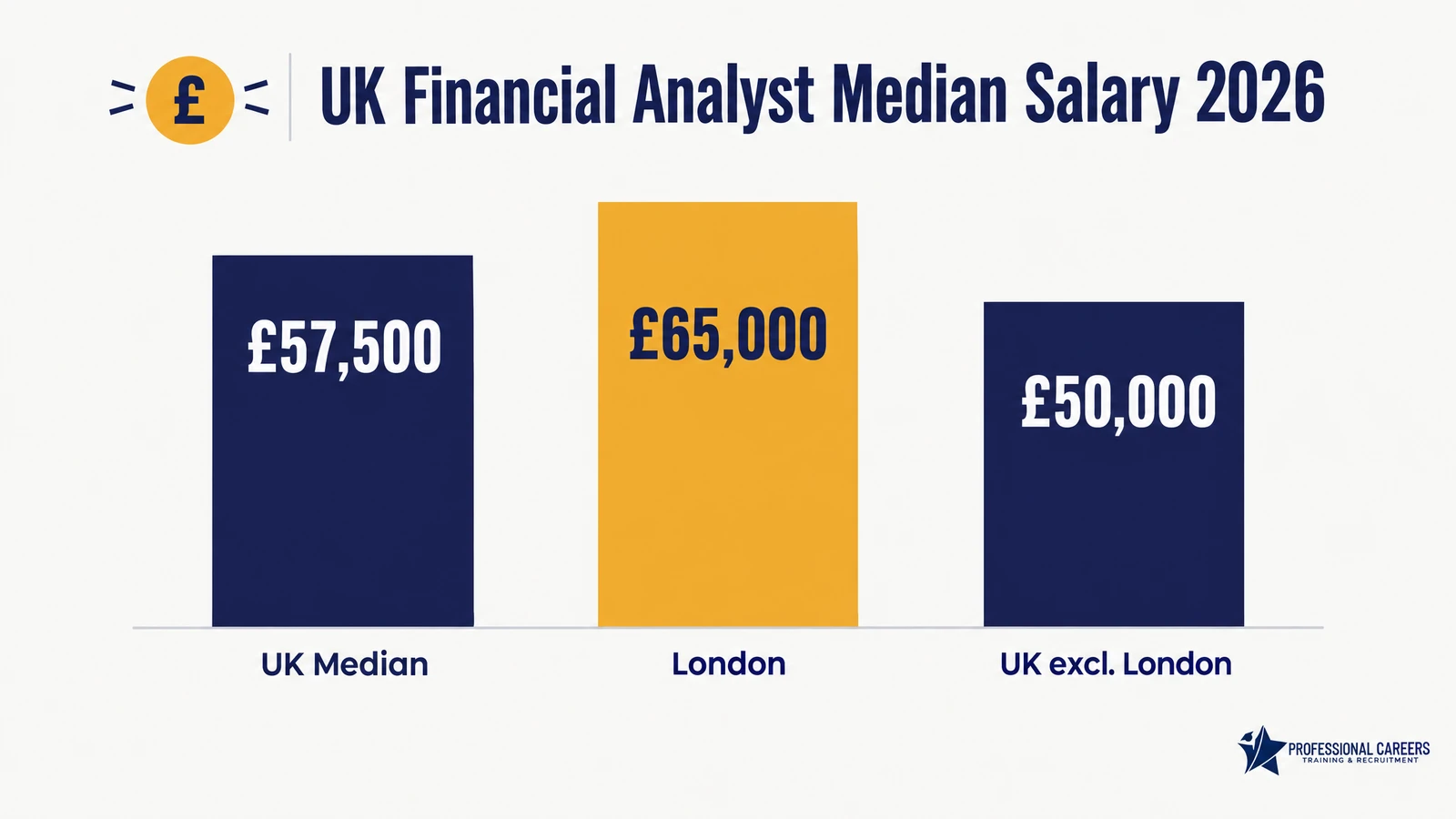
Location still makes a real difference to this role. London’s median financial analyst salary is £65,000, against £50,000 for the UK excluding London.
That’s a gap of £15,000. Both figures have grown over the past year, but the rest of the UK is catching up faster, up 11.11% year on year against London’s more modest growth.
That narrowing gap matters if you’re weighing up a move to London purely for the pay bump.
Once you account for the cost of living difference, a £50,000 role outside London can leave you better off in real terms than a £65,000 role in the capital.
UK financial analyst pay has a wide spread, from around £40,000 at entry level to £85,000-plus for experienced specialists, and the regional gap between London and the rest of the UK is narrowing as demand grows outside the capital.
What Pushes a Financial Analyst’s Salary Up
Four factors do most of the work in explaining why one financial analyst earns considerably more than another doing a similar-sounding job.
Sector
Financial services, investment banking and private equity consistently pay more for this role than general industry or the public sector.
A financial analyst inside a bank or asset manager is often doing more technically demanding modelling work, and carries more direct influence over investment decisions. The pay reflects that.
Qualifications
A relevant professional qualification is one of the clearest, most controllable ways to move up the pay scale.
The CFA (Chartered Financial Analyst) charter is the specialist qualification most directly aimed at this role.
CIMA, ACCA and AAT all build the financial modelling, reporting and analysis skills employers are paying for too, even without the word “analyst” in the qualification’s name.
If you’re not sure which of these routes fits your situation, our AAT vs ACCA vs CIMA comparison breaks down the cost, time commitment and career fit of each one.
Experience and Specialism
General financial analysis pays reasonably well. Specialising in a high-demand area such as financial modelling, risk analysis or M&A support pays noticeably better.
Fewer people can do these well, and the cost of getting them wrong is higher, so employers pay accordingly. Practical ways to build toward that specialism tend to follow a similar pattern, regardless of which one you pick:
- Get fluent in Excel well beyond basic formulas, including pivot tables and financial modelling structures
- Learn a BI or visualisation tool such as Power BI so you can present findings clearly, not just produce them
- Build real, practical familiarity with the accounting software your target sector actually uses
- Pick one professional qualification route, CFA, CIMA or ACCA, and commit to it rather than starting several
- Look for roles or projects that let you own a forecast or model end to end, not just update someone else’s
Financial Analyst vs Business Analyst vs Data Analyst: How the Pay Compares
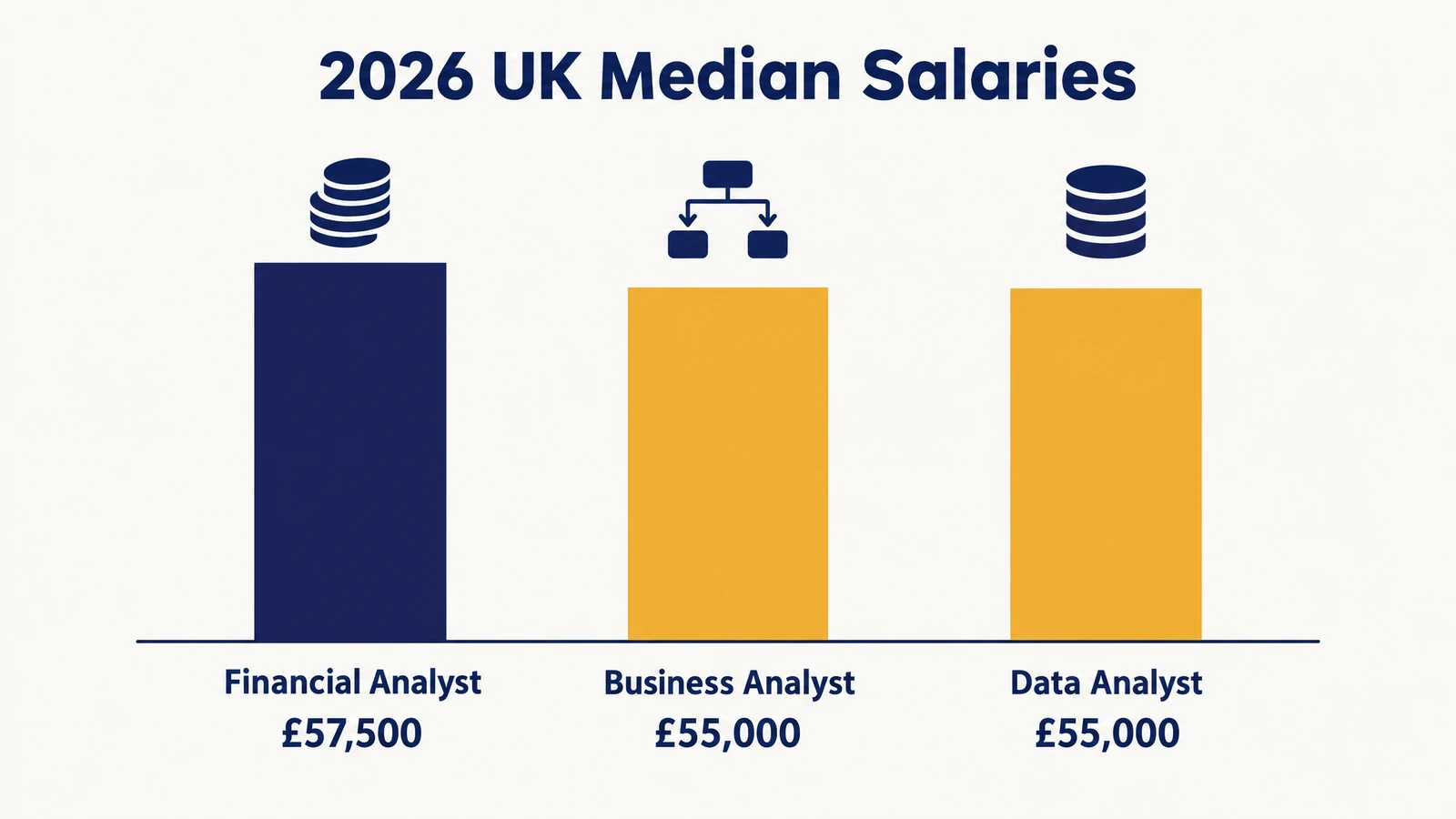
These three job titles get mixed up constantly. The salary data shows why the confusion is understandable, since their UK median pay has converged to within a couple of thousand pounds of each other in 2026.
| Role | UK median salary | Year-on-year change |
|---|---|---|
| Financial Analyst | £57,500 | +4.55% |
| Business Analyst | £55,000 | -4.35% |
| Data Analyst | £55,000 | +22.22% |
The roles themselves are genuinely different, even though the pay looks similar. A financial analyst’s work centres on money: forecasting, valuation and investment decisions.
A business analyst focuses on processes and requirements, working out what a business needs and whether a change will actually deliver it.
A data analyst works across any kind of data, not only financial, cleaning, modelling and visualising it to answer a specific question.
If you’re trying to decide between the business and data analyst paths specifically, our Business Analyst vs Data Analyst comparison goes into that choice in more depth, including which existing skills transfer best to each.
Financial analyst, business analyst and data analyst pay has converged to within a couple of thousand pounds of each other in the UK, but the day-to-day work behind each title is still genuinely different.
Career Progression: Where This Role Can Lead
Financial analyst pay doesn’t stop climbing once you’re past entry level. IT Jobs Watch data on the next rung up, senior financial analyst, shows a UK median of £75,000, with experienced analysts reaching £93,000 at the 90th percentile.
From there, the usual next step is into a broader finance management role rather than a more senior analyst title specifically.
| Role | UK median salary | 90th percentile |
|---|---|---|
| Financial Analyst | £57,500 | £85,000 |
| Senior Financial Analyst | £75,000 | £93,000 |
| Finance Manager | £65,000 | £142,500 |
That Finance Manager row is worth reading carefully rather than skimming. The median sits lower than Senior Financial Analyst, because “Finance Manager” covers a much wider range of seniority, including some smaller, more junior roles.
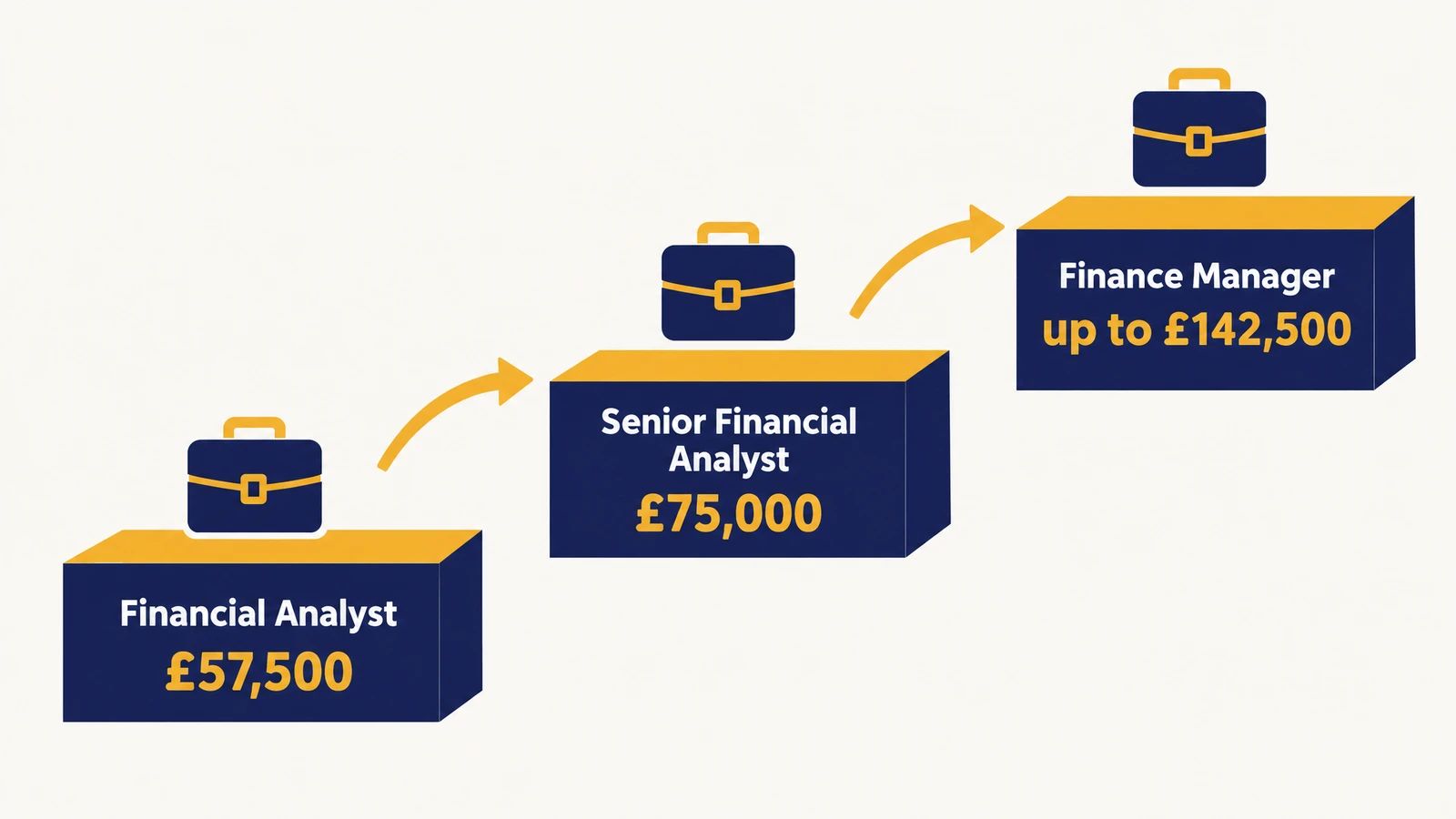
But the ceiling is far higher: the 90th percentile for Finance Manager reaches £142,500, well beyond what most senior analyst titles pay. Progression here isn’t a straight line upward, and the honest picture is more useful than a tidy one.
From Finance Manager, the realistic next steps are Head of FP&A, Finance Director, or a move into investment analysis or portfolio management if you came up through the financial services route.
The Qualifications and Skills That Employers Actually Pay For
Job titles aside, employers are paying for a specific, checkable set of skills.
Ranked roughly by how often they show up in job ads: advanced Excel, financial modelling and forecasting, and accounting software fluency such as Xero or Sage.
After those, SQL for pulling data directly rather than waiting on someone else, and a BI tool such as Power BI for presenting the output clearly.
We’ve written a full breakdown of these in our financial analyst skills guide, including how to build proficiency in each one. It’s worth reading alongside this article if pay is only half of what you’re deciding on.
If interviews are the more immediate concern, our financial analyst interview questions guide covers the ones that come up most often, with example answers.
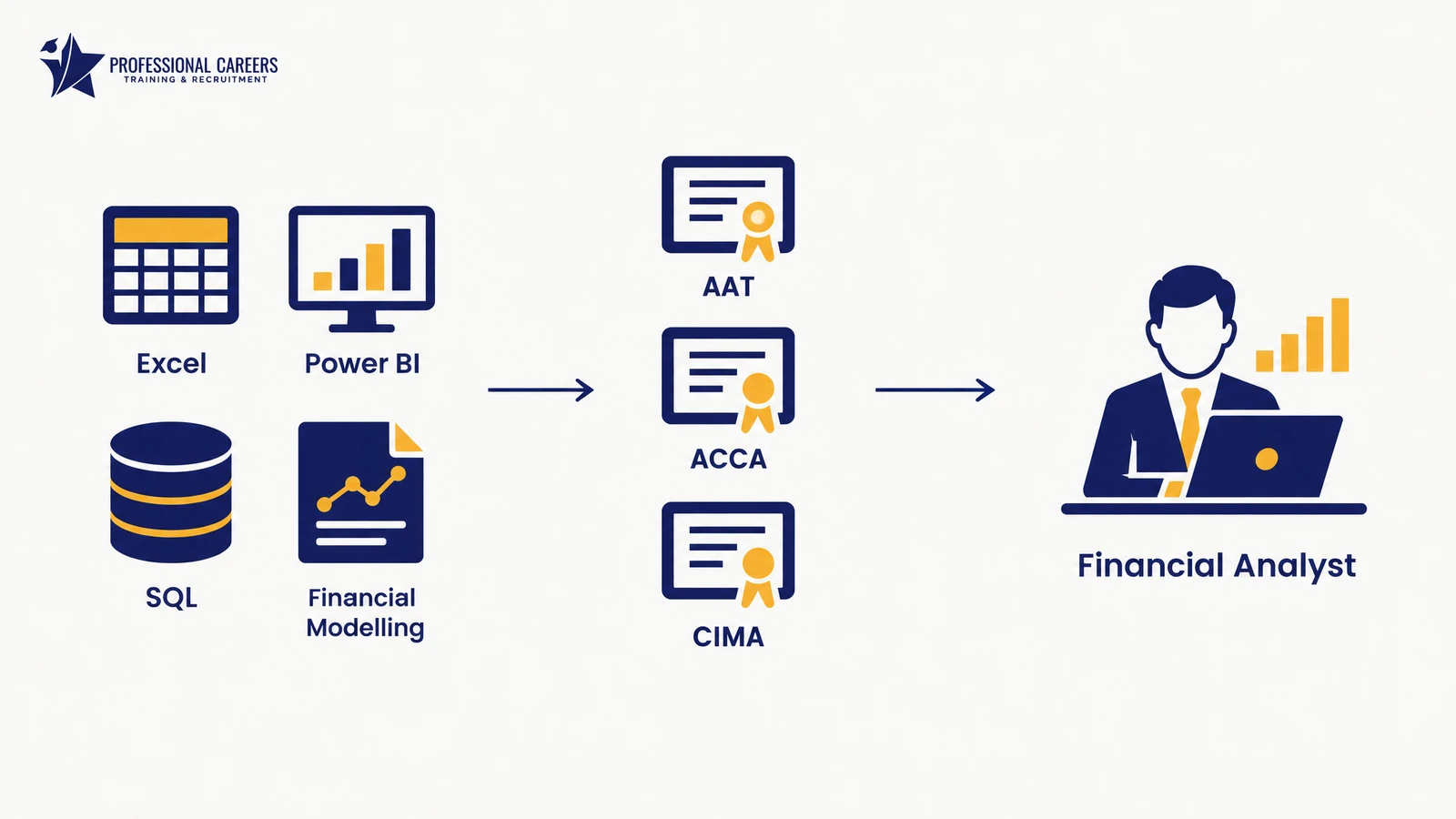
On the qualification side, CIMA in particular is built around exactly this kind of commercial, forward-looking financial analysis. That’s why it tends to come up so often alongside this role, more so than the more compliance-focused ACCA route.
Building Toward a Financial Analyst Career
PC Training doesn’t run a course called “Financial Analyst Training”, and it’s worth being upfront about that rather than stretching a different course to fit the title.
What we do train people in are the specific, transferable skills this role is actually hired on.
Our Data Analyst Training course covers Excel, Power BI, SQL and practical business projects, the same technical toolkit financial analysts use day to day to build and present models.
For the accounting and reporting side of the role, our Bookkeeping & VAT Training and the AAT route covered in our qualifications comparison build the financial literacy that underpins good analysis.
Neither path hands you a CFA charter, and we wouldn’t claim otherwise.
What they do give you is a genuine, demonstrable skillset to point to in interviews, backed by CPD certification and our guaranteed recruitment support, while you decide whether a specialist qualification like CFA or CIMA is worth adding later.
There’s no shortcut course straight into a financial analyst title, but the Excel, Power BI, SQL and financial literacy skills behind the role are ones you can build and demonstrate directly.
Is a financial analyst a well-paid job in the UK?
Yes, relative to the wider UK job market. The 2026 median is £57,500, with experienced specialists in financial services regularly earning £80,000 or more.
Do you need a degree to become a financial analyst?
Most analysts are graduates, often in finance, economics, maths or statistics, but it’s not an absolute requirement. Apprenticeships, work-based qualifications and a strong, demonstrable skillset in Excel, modelling and accounting software can open the same doors.
What’s the difference between a financial analyst and an accountant?
Accountants mainly record, report and ensure compliance for financial transactions. Financial analysts use those numbers to forecast, model and recommend decisions. The two roles overlap but point in different directions, backward-looking versus forward-looking.
Is CFA worth it for a financial analyst role in the UK?
For roles in investment banking, asset management or equity research, CFA carries real weight and can meaningfully lift your ceiling.
For a general corporate financial analyst role, CIMA or ACCA alongside strong Excel and modelling skills is often a faster, cheaper route to the same salary bracket.
Can a data analyst move into a financial analyst role?
Yes, and it’s a common move. The technical toolkit of Excel, SQL, Power BI and working with large datasets transfers directly.
The gap to close is usually financial and commercial knowledge, which is where an accounting-focused qualification like AAT or CIMA helps.