If you're training to become a business analyst, or you already work as one, you've probably noticed AI tools turning up in more of your...
Your Starting Point for a UK Bookkeeping Career
Think of a skilled bookkeeper as the financial guardian of a business. They track the day-to-day financial health of an organisation. This means making sure every transaction is accurately recorded, categorised, and balanced. It’s more than just crunching numbers—it’s about creating a clear, reliable financial story that helps with important business decisions.
From the local coffee shop to fast-growing tech startups, qualified bookkeepers are the foundation of financial stability. They handle everything from sales invoices and supplier payments to payroll and VAT returns. This keeps the company compliant and its financial records spotless. This detailed work allows business owners to understand their cash flow, profitability, and overall performance at a glance.
Why Demand for Bookkeepers Is High
The need for precise financial management has never been greater. This makes bookkeeping a secure and rewarding career path. As the UK’s business landscape continues to expand, there is a constant demand for professionals who can manage the money side of things effectively.
This growth is especially clear among smaller firms. The number of small accounting practices and independent bookkeepers has risen by almost 40% since 2018. Some industry estimates suggest there are now nearly 100,000 practitioners. This boom has created huge opportunities for newly qualified people, as these smaller practices often need entry-level support. You can find out more in the full CCAB accountancy report.
A qualification in bookkeeping is not just a certificate—it’s your entry ticket to the world of finance. It shows employers you have the core knowledge and technical skills to manage their most critical asset: their money.
Navigating Your Qualification Journey
This guide is your map to the different bookkeeper qualifications UK providers offer. We’ll walk you through the main awarding bodies—AAT, IAB, and ICB—and explain what each path involves. Whether you dream of being a freelance bookkeeper, an accounts assistant in a large company, or moving into data analysis later, understanding these qualifications is your first vital step.
Once you have the qualifications, the next challenge is to present your new skills professionally. It’s worth learning about the perfect accountant curriculum vitae format.
For more initial insights, check out our guide on how training to be a bookkeeper can kickstart your career.
Comparing the Main UK Bookkeeping Qualifications
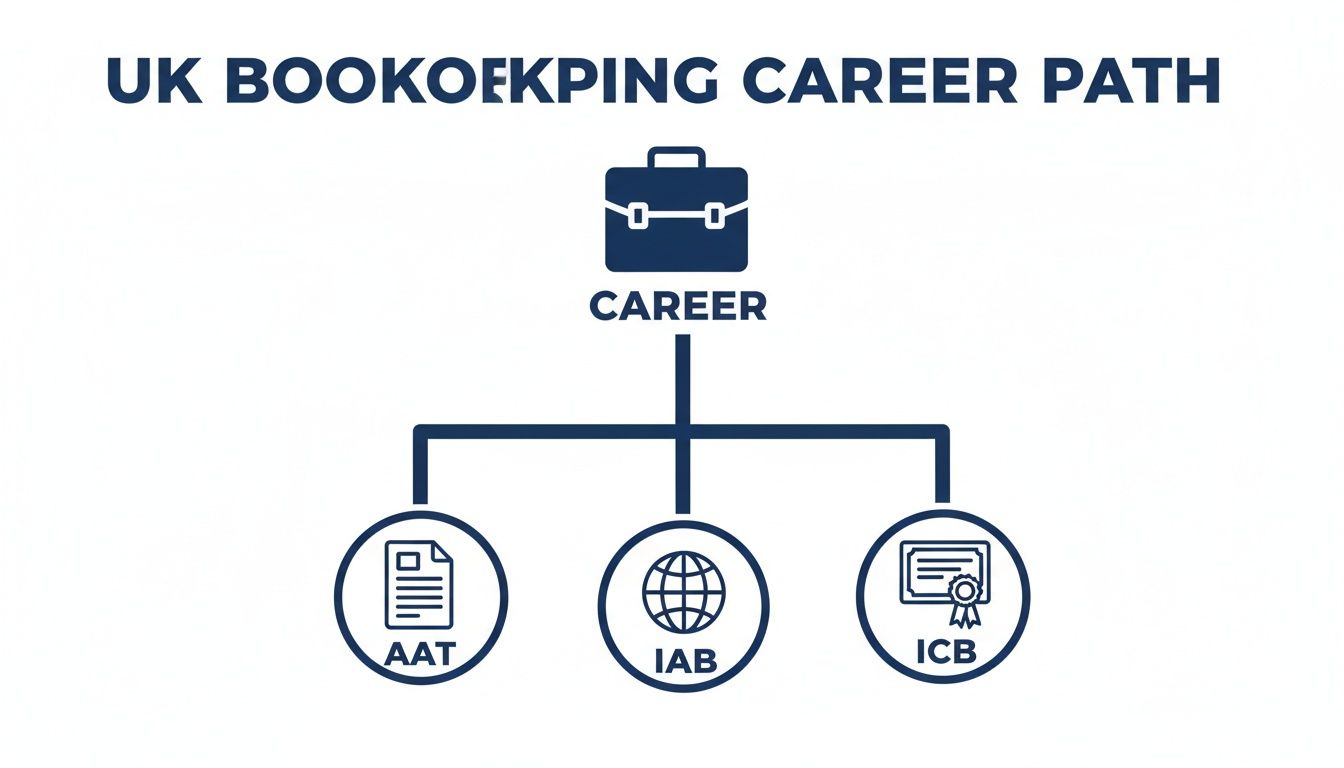
Choosing the right qualification can feel complicated. In the UK, the journey to becoming a professional bookkeeper is guided by three main awarding bodies: the Association of Accounting Technicians (AAT), the Institute of Certified Bookkeepers (ICB), and the International Association of Book-keepers (IAB).
Each one offers a distinct path. The best choice for you depends on your career goals.
Think of the AAT as a broad route into the wider world of finance. It’s not just about bookkeeping. An AAT qualification provides a solid foundation that can lead directly to a chartered accountancy career. It’s often seen as the most versatile option for those who want to keep their career doors open.
In contrast, the ICB offers a more specialised route. This path is for those who want to master the craft of pure bookkeeping. The ICB focuses deeply on the practical, day-to-day skills needed to manage a business’s books perfectly. This makes it ideal for aspiring freelance bookkeepers or anyone who wants to be the go-to expert within a company.
This diagram shows how each qualification body provides a structured pathway towards a professional bookkeeping career, each with its own unique focus.
To help you get a clearer picture, here’s a quick comparison of what each body is best known for.
Comparing Key UK Bookkeeping Qualification Bodies
This quick-glance comparison of the AAT, IAB, and ICB qualifications is designed to help you decide which is the right fit for your career goals.
| Qualification Body | Best For | Typical Entry-Level Course | Progression Path |
|---|---|---|---|
| AAT | Aspiring accounting technicians and those wanting a pathway to chartered accountancy. Broadest recognition among UK employers. | Level 2 Certificate in Bookkeeping | Progresses from bookkeeping basics to the full AAT Level 4 Diploma in Professional Accounting. |
| ICB | Individuals aiming to start their own bookkeeping practice or specialise purely in bookkeeping roles. Strong focus on practical, day-to-day skills. | Level 2 Certificate in Bookkeeping | A focused ladder from core bookkeeping skills to advanced topics like self-assessment tax returns and payroll. |
| IAB | Bookkeepers with ambitions to work internationally or who want a qualification with global recognition. | Level 2 Award in Bookkeeping | Offers a solid foundation in bookkeeping and payroll, with qualifications recognised in many countries. |
Ultimately, your choice will come down to where you see yourself in five or ten years. Do you want to be a specialist, a generalist with options, or a professional with global mobility?
Breaking Down the Qualification Levels
Understanding the different levels within these qualifications is crucial. A Level 2 certificate is your starting point, like learning the basic rules of the road. At this stage, you’ll master the fundamentals: double-entry bookkeeping, processing invoices, and basic financial admin. This qualification makes you job-ready for entry-level roles like an Accounts Assistant or Purchase Ledger Clerk.
Progressing to Level 3 is like getting your full driving licence. You move beyond the basics to tackle more complex tasks such as preparing VAT returns, advanced bookkeeping, and putting together final accounts for sole traders. A Level 3 qualification signals to employers that you can work independently and handle core accounting functions with confidence.
A Level 4 qualification is the advanced driving course of the bookkeeping world. It often forms the final stage of technician-level training and can be equivalent to the first year of a university degree. With a Level 4 Diploma, you’re equipped for senior roles, managing junior staff, and providing higher-level accounting support.
The AAT Pathway Explained
The AAT is arguably the most recognised bookkeeper qualifications UK provider. Its qualifications are respected by employers across all sectors and are often considered the gold standard for accounting technicians.
- AAT Level 2 Certificate in Bookkeeping: This is the ideal starting block. It covers the basics of recording financial transactions and is perfect for anyone completely new to finance.
- AAT Level 3 Certificate in Bookkeeping: Building on Level 2, this certificate delves into more complex areas like payroll and final accounts preparation, making you a highly capable bookkeeper.
- AAT Level 4 Diploma in Professional Accounting: While not a pure bookkeeping qualification, this is the natural next step for AAT students. It covers advanced topics like financial statements for limited companies, budgeting, and management accounting.
The demand for these technician-level credentials remains strong. For instance, while AAT student numbers saw a drop of 17.7% in 2023, there was a significant rebound with a student enrolment increase of over 30% between 2023 and 2024. Furthermore, Level 3 certificates saw a massive increase of 88,200 in the same period, showing a renewed interest in these practical qualifications. You can explore more about these trends in the latest Key Facts and Trends report from the FRC.
Understanding ICB and IAB Qualifications
The ICB is globally recognised as a specialist body dedicated entirely to the profession of bookkeeping. Its qualifications are laser-focused on practical application.
The ICB prides itself on setting a high standard for bookkeepers, ensuring its members are equipped with the skills to run their own practices or become invaluable assets to businesses.
Similarly, the IAB offers a range of qualifications with a strong international flavour. This makes it a great choice if you have ambitions to work abroad. It covers bookkeeping, payroll, and accounting, providing a solid foundation that is recognised in many countries around the world. Choosing between these bodies often comes down to your specific career goals and whether you see yourself as a UK-based specialist or a global finance professional.
Building Practical Skills Beyond the Certificate
Earning a formal qualification is your entry into the finance industry. But it’s the practical, hands-on skills that you’ll use every day. Think of it this way: a certificate proves you understand the theory; applied skills show you can deliver real value from day one. Employers don’t just want someone who knows the rules of bookkeeping—they need someone who can apply them effectively.
This means mastering the tools of the trade. Fluency in accounting software like Xero, Sage, and QuickBooks is no longer a ‘nice-to-have’. It’s an absolute essential. These platforms are where modern bookkeeping happens, and being proficient is a core expectation for almost any role.

Mastering Bookkeeping & VAT
One of the most critical skills you can develop is managing Bookkeeping & VAT with complete confidence. For any UK business, navigating HMRC’s regulations isn’t optional, and mistakes can be very costly. A bookkeeper who can expertly handle VAT returns is an indispensable asset.
This goes beyond just entering numbers into a form. It means truly understanding:
- VAT Schemes: Knowing the difference between standard, cash accounting, and flat rate schemes and advising which is best for a business.
- Compliance: Ensuring every record is compliant with Making Tax Digital (MTD) requirements, a key part of modern finance.
- Reconciliation: Accurately reconciling VAT reports with the business’s accounts before submission to avoid errors and potential penalties.
By mastering these tasks, you position yourself as a guardian of a company’s financial integrity, protecting them from serious compliance risks.
The Details of Advanced Payroll
Payroll is another area where your practical expertise really shines. While basic payroll might seem simple, Advanced Payroll involves complex calculations and strict deadlines that demand absolute precision. An error in someone’s pay isn’t just a numerical mistake; it directly impacts their life and can damage the company’s reputation.
Beyond theoretical knowledge, practical expertise in critical areas like payroll management is vital for a successful bookkeeping career. Strong payroll management skills ensure employees are paid correctly and on time, which is fundamental to business operations.
Specialist payroll training covers crucial elements that standard qualifications might only touch upon. These include statutory payments (maternity, paternity, and sick pay), pension auto-enrolment, and correctly processing starters and leavers.
Preparing Final Accounts and Assisting Teams
As you gain experience, you’ll naturally progress towards preparing Final Accounts. This is the process of summarising a whole year’s worth of transactions into formal financial statements, like the Profit and Loss statement and the Balance Sheet. It requires a keen eye for detail and a deep understanding of how all the pieces of the financial puzzle fit together.
This is a skill often developed in an Accounts Assistant role, a versatile position that supports many finance departments. Here, you’ll apply your bookkeeping knowledge to a huge variety of real-world tasks, including:
- Managing purchase and sales ledgers.
- Conducting bank reconciliations.
- Assisting with month-end and year-end procedures.
- Handling credit control and chasing outstanding invoices.
These duties transform your theoretical knowledge into real competence. They turn your CV from a simple list of qualifications into a powerful portfolio of proven abilities. Employers want candidates who can not only pass exams but can also step into a role and immediately contribute to the financial health of the business.
From Bookkeeper to Business and Data Analyst
A bookkeeping qualification isn’t just an endpoint; it’s a launchpad for a dynamic career in finance and business. The skills you gain—attention to detail, analytical thinking, and a deep understanding of how money moves through an organisation—are the perfect foundation for many exciting roles.
Think of your qualification as your core training. From there, you can specialise based on what you enjoy most. Love compliance and rules? A deep dive into VAT training could make you an expert. Fascinated by the patterns hidden in the numbers? Combining your accounting knowledge with analytics can set you on the path to becoming a Data Analyst.
Branching Out into Specialist Roles
Your foundational bookkeeping skills open doors to several career progressions. Let’s explore some of the most common and rewarding paths.
- Accounts Assistant: This is often the first step after qualifying. As an Accounts Assistant, you’ll be the backbone of a finance team, handling everything from purchase and sales ledgers to bank reconciliations. It’s a fantastic role for building broad, practical experience.
- Payroll Manager: If you have a knack for precision and enjoy the human side of finance, specialising in payroll is a great choice. You’ll manage everything from calculating wages and deductions to ensuring compliance with pensions and statutory pay.
The accountancy profession is facing a significant skills shortage, making qualified candidates highly valuable. Recent data shows that around 45% of UK accounting firms are struggling to find skilled staff, particularly for entry-level technician roles. This high demand means your prospects after qualifying are strong. You can learn more about the current talent shortage in UK accountancy and how it benefits new professionals.
The Leap from Bookkeeper to Analyst
The true power of a bookkeeping qualification lies in its potential to springboard you into more strategic roles. The analytical mindset you develop is the perfect stepping stone to becoming a Business Analyst or Data Analyst, where interpreting financial data is essential for guiding major company decisions.
A bookkeeper tracks what has happened financially. An analyst uses that same data to predict what could happen next.
A Business Analyst bridges the gap between the finance department and other parts of the business. They use financial data to identify problems, find opportunities for growth, and recommend strategic changes to improve efficiency and profitability.
To make this transition, you would build upon your accounting foundation with skills in data modelling, forecasting, and reporting. You’ll learn to use tools that turn raw numbers into clear, actionable insights for senior leadership. Check out our guide to see what a Business Analyst certification in the UK involves.
Charting Your Career Progression
So, what does this journey look like in practice? Here’s a typical progression map.
- Start with the Foundation: Complete a Level 2 or 3 bookkeeping qualification to master the core skills.
- Gain Practical Experience: Secure a role as an Accounts Assistant or Junior Bookkeeper to apply your knowledge.
- Choose Your Specialism: Identify the areas you enjoy most, such as Advanced Payroll, Final Accounts, or VAT compliance.
- Upskill with Advanced Training: Pursue further courses in your chosen specialism. This is where you might explore business or data analysis training.
- Move into Senior Roles: With experience and specialised skills, you can advance to positions like Senior Bookkeeper, Payroll Manager, or Finance Analyst.
Each step builds on the last, turning your initial investment in a bookkeeping qualification into a versatile and future-proof career. The journey from recording transactions to influencing business strategy is more accessible than you might think.
How to Choose the Right Training Provider
Knowing what qualification you need is only half the battle. Choosing where you study is what truly sets you up for long-term success.
The right training provider does more than just walk you through a curriculum—they become a partner in your career journey. It’s essential to look beyond the course name to find an institution that will deliver a genuine return on your investment.

One of the first things to check is who will be teaching you. Learning from trainers who are also ACCA-qualified Chartered Accountants brings a layer of real-world insight that a textbook simply can’t offer. These professionals can explain the theory with practical examples, industry warnings, and invaluable career advice.
Look for Practical, Hands-On Training
A quality provider understands that employers hire for practical ability, not just theoretical knowledge. Your training should be packed with hands-on experience using the software that UK businesses actually rely on day-to-day.
Seek out providers that offer official certifications for major platforms like:
- Xero: Hugely popular with small businesses and startups.
- Sage: A long-standing staple in many established UK companies.
- QuickBooks: Another dominant force in the SME market.
Having these official software certifications on your CV is a powerful signal to employers. It proves you can step into a role and contribute from day one without needing extensive on-the-job software training.
Flexibility and Support Are Key
Life is busy, and a good provider understands that. Look for flexible study options, like evening and weekend classes, that allow you to fit learning around your existing work or family life. This flexibility is key to ensuring you can complete your bookkeeper qualifications UK without putting everything else on hold.
To dig deeper into this, you might find our article about choosing the right bookkeeping course format helpful.
Beyond the classroom, what kind of support is on offer? Can you get one-to-one sessions if you’re struggling with a concept? Is there technical support if you have trouble installing software? This kind of ongoing assistance can make a massive difference to your learning experience.
Evaluating Career and Recruitment Support
Let’s be honest: the ultimate goal of your training is to land a great job. A top-tier provider is as invested in this outcome as you are and offers robust recruitment support to help you cross that finish line. This support system is often what separates an average course from a truly career-changing one.
A great training provider doesn’t just give you a certificate and wish you luck. They actively build a bridge between your studies and your first professional role, providing the tools and connections you need to succeed.
Look for institutions that provide comprehensive career services. This should include practical workshops on CV preparation, coaching for interviews, and help optimising your LinkedIn profile to attract recruiters. Access to a network of employers and direct references can also give you a huge advantage in a competitive job market.
Before you commit, ask any potential provider some direct questions:
- Are your trainers professionally qualified accountants with real industry experience?
- Do you provide official certifications for Xero, Sage, and QuickBooks?
- What kind of one-to-one support is available outside of class hours?
- Can you give me tangible examples of your recruitment support in action?
- What percentage of your students find a relevant job after qualifying?
Asking these questions helps ensure you partner with an institution that offers not just an education, but a complete pathway to your new career.
Frequently Asked Questions About Bookkeeping Qualifications
Stepping into the world of finance qualifications can feel a bit like learning a new language. To help you make sense of it all, here are some straightforward answers to the questions we hear most often from aspiring bookkeepers.
Do I Need a Degree to Become a Bookkeeper in the UK?
Absolutely not. A university degree isn’t a prerequisite for a successful bookkeeping career in the UK. What employers really value are the industry-standard credentials offered by professional bodies like AAT, ICB, or IAB.
These bookkeeper qualifications uk are designed to be intensely practical and job-focused. This makes bookkeeping a fantastic and accessible career for school leavers, career changers, or anyone who wants a direct route into finance without the time and expense of a three-year degree.
How Long Does It Take to Get a Basic Bookkeeping Qualification?
This really comes down to the course you choose and how much time you can dedicate to your studies. An entry-level qualification, like an AAT Level 2 Certificate, can often be wrapped up in as little as three months with consistent effort.
Higher-level certificates might take between six months and a year. The good news is that many training providers offer flexible evening and weekend classes, so you can learn at a pace that fits around your life, whether you’re working full-time or juggling other commitments.
Which Accounting Software Is Most Important to Learn?
If you want to maximise your chances of getting hired, your goal should be to get comfortable with the UK’s ‘big three’ accounting software packages: Xero, QuickBooks, and Sage. While Xero and QuickBooks are massively popular with small and medium-sized businesses, Sage is still the go-to for many larger, more established companies.
Gaining official certification in all three through a quality training provider will make your CV stand out. It sends a clear signal to employers that you’re adaptable, technically skilled, and ready to get stuck in from day one.
What Is the Difference Between a Bookkeeper and an Accountant?
It’s a common point of confusion, but the distinction is quite simple. Think of it this way: bookkeeping is about recording financial transactions, while accounting is about interpreting and analysing that data to tell a story.
- A bookkeeper is on the front line, managing the day-to-day financial records—logging sales, processing purchases, and handling payments.
- An accountant takes that information and uses it to create financial reports, offer strategic advice, and handle complex tax planning.
A solid bookkeeping qualification is often the first, and most crucial, step on the path to becoming a fully qualified chartered accountant. It provides the essential foundation upon which all other accounting skills are built.
At Professional Careers Training, we provide the hands-on training and recruitment support you need to launch a successful career. Our courses, taught by ACCA-qualified Chartered Accountants, offer official software certifications and a direct pathway to your next job. Explore our accountancy training programmes at https://professionalcareers-training.co.uk to get started.