
If you're training to become a business analyst, or you already work as one, you've probably noticed AI tools turning up in more of your...
Why a Career Change After 40 Is a Smart Move
The thought of starting over can be daunting, but the reality is much more empowering. Forget the myth that you’re ‘too old to learn’. Your decades of professional experience in solving problems, communicating with stakeholders, and managing projects give you an immediate edge over younger candidates. You are not starting from scratch; you’re simply redirecting your expertise.
This move is also a practical response to major shifts in the UK workforce. People are working longer than ever, and staying relevant is the key to career longevity. In fact, employment among 50–64-year-olds has shot up by 40% in the last 20 years.
But there’s a catch. New research highlights a significant training gap, showing that older workers are often overlooked for job-related training. You can read the full research about lifelong learning for older workers on CIPD to get the full picture. The takeaway is clear: taking control of your own upskilling is the single most effective way to secure your future.
Capitalise on In-Demand Fields
Fields like finance and data are not just growing; they are actively looking for mature professionals who bring a steady hand and real-world perspective to the table. These sectors offer roles that are both rewarding and stable, providing a secure path for the next chapter of your career.
A career change after 40 isn’t about erasing your past experience. It’s about combining it with new, targeted skills to become an indispensable asset in a modern, data-driven economy.
The same principle holds if you are changing direction earlier too. Our guide to how to change career at 30 covers the equivalent roadmap for anyone making this move a decade or so sooner.
Consider these high-demand areas where your experience is a huge plus:
- Bookkeeping & VAT: Every single business needs meticulous financial records. These skills are perpetually valuable.
- Advanced Payroll: With complex regulations, skilled payroll professionals are essential for keeping businesses compliant and running smoothly.
- Accounts Assistant & Final Accounts: These roles are a fantastic entry point into the world of finance, blending your administrative and organisational skills with new accounting duties.
- Business Analyst: Your years of experience give you the ability to see the bigger picture—a key trait for analysing business needs and proposing solutions. If this sounds interesting, you can learn more about business analyst training for career changers.
- Data Analyst: Companies are desperate for people who can do more than just read data; they need people who can interpret it to drive decisions. That’s a skill that pairs perfectly with seasoned business acumen.
This is not just about switching jobs. It is about investing in a future where your skills are not only relevant but highly sought after. With modern, flexible training options designed to fit around your existing commitments, making the transition is smoother than you might think.
How to Pinpoint Your Transferable Skills
Decades of professional life have given you a powerful toolkit. When you are thinking about retraining after 40, you’re not starting from scratch—far from it. You are building on a solid foundation of real-world experience. The first, most crucial step is to take stock of these existing abilities and see how they map directly onto your new career goal.
So many people underestimate the value of their so-called ‘soft skills’, but in roles like business analysis and accounting, they are gold dust. Think about your career so far. Have you ever managed a budget, led a project, or navigated a tricky client conversation? These are not just past duties; they are highly valuable assets.
Kicking off a career change means first understanding your personal and transferable skills to see how they line up with new opportunities. This self-audit does wonders for your confidence, shifting the focus from what you lack to the incredible value you already bring.
Bridging Your Past Experience to Your Future Role
Let’s make this practical. Your past experience, no matter the industry, contains the DNA of your future success. The trick is learning how to translate it into the language of your new field.
Take a real-world scenario. A retail store manager decides to retrain as a business analyst. At first glance, the two jobs seem worlds apart. But when you look closer, the connections are obvious:
- Inventory management is just another name for data analysis and resource planning.
- Managing staff rotas and sales targets is a form of project management and stakeholder coordination.
- Handling customer complaints builds top-tier problem-solving and communication skills.
This manager already has 80% of the core competencies needed to succeed. That last 20% is the technical know-how—like mastering SQL or getting to grips with business modelling software—which is exactly what targeted training is for.
Your career history isn’t something to downplay. It’s your unique selling point. Frame it as a rich source of practical wisdom that makes your new technical qualifications even more valuable.
Identifying Your Specific Training Needs
Once you have mapped out all the skills you already possess, the gaps become crystal clear. This is not a sign of weakness; it is your roadmap for smart, efficient learning. The goal is not to learn everything, but to learn the right things that will get you hired.
A simple ‘Skills Gap’ list is a great way to do this. On one side, list the key requirements for your dream role (e.g., Accounts Assistant). On the other, list the skills you already have from your previous jobs. The empty spaces point directly to your training priorities.
For roles in finance and data, these gaps often fall into a few key areas:
- Accounting & Bookkeeping Software: Getting comfortable with tools like Sage, Xero, and QuickBooks is non-negotiable for most accounts assistant or bookkeeping jobs.
- Data Manipulation & Analysis: For data or business analyst paths, skills in Advanced Excel, SQL, and Power BI are fundamental for turning raw information into useful insights.
- Regulatory Knowledge: Roles in payroll, VAT, or final accounts require a solid understanding of HMRC compliance, tax returns, and accounting standards.
By pinpointing these specific needs, you can hunt down training that fills those gaps directly, making your journey into a new career much faster and far more effective.
Finding the Right UK Training Programme
Choosing how and where to learn is probably the biggest decision you will make when retraining after 40. The UK training scene is massive, but not all programmes are right for mature learners juggling work, family, and everything else. Your goal should be to find practical, job-focused training that gets you into a new role, fast.
For careers in bookkeeping, payroll, or as an accounts assistant, getting official software certifications is absolutely vital. Qualifications from big names like Sage, Xero, and QuickBooks are more than just a line on your CV. They tell employers you have the hands-on skills they desperately need from day one. These are the tools that run UK businesses, so proficiency is not just a “nice-to-have”—it is essential.
The same goes for aspiring business or data analysts. Courses that dig deep into Advanced Excel, SQL, and Power BI will give you the technical toolkit you need to hit the ground running.
Why Flexible One-to-One Training Works
Let’s be honest, the traditional classroom model rarely works for a mid-career change. This is where flexible, one-to-one training can be a real game-changer. It lets you build a learning schedule around your life, not the other way around.
Just think about the benefits:
- A Pace That Suits You: You can spend extra time on the tricky topics and speed through the bits you already get. It makes your learning time far more efficient.
- Direct Access to an Expert: Having a dedicated mentor—often a qualified accountant or analyst themselves—means you can ask specific, practical questions about your future career.
- Real-World Scenarios: The best training is built around real-world problems and projects, which is infinitely more valuable than just learning the theory.
Choosing a training model that respects your experience and fits your life isn’t a luxury; it’s a necessity for successfully retraining after 40.
This visual decision path helps to show how your existing skills, like problem-solving and communication, can be channelled into a new career through the right training.
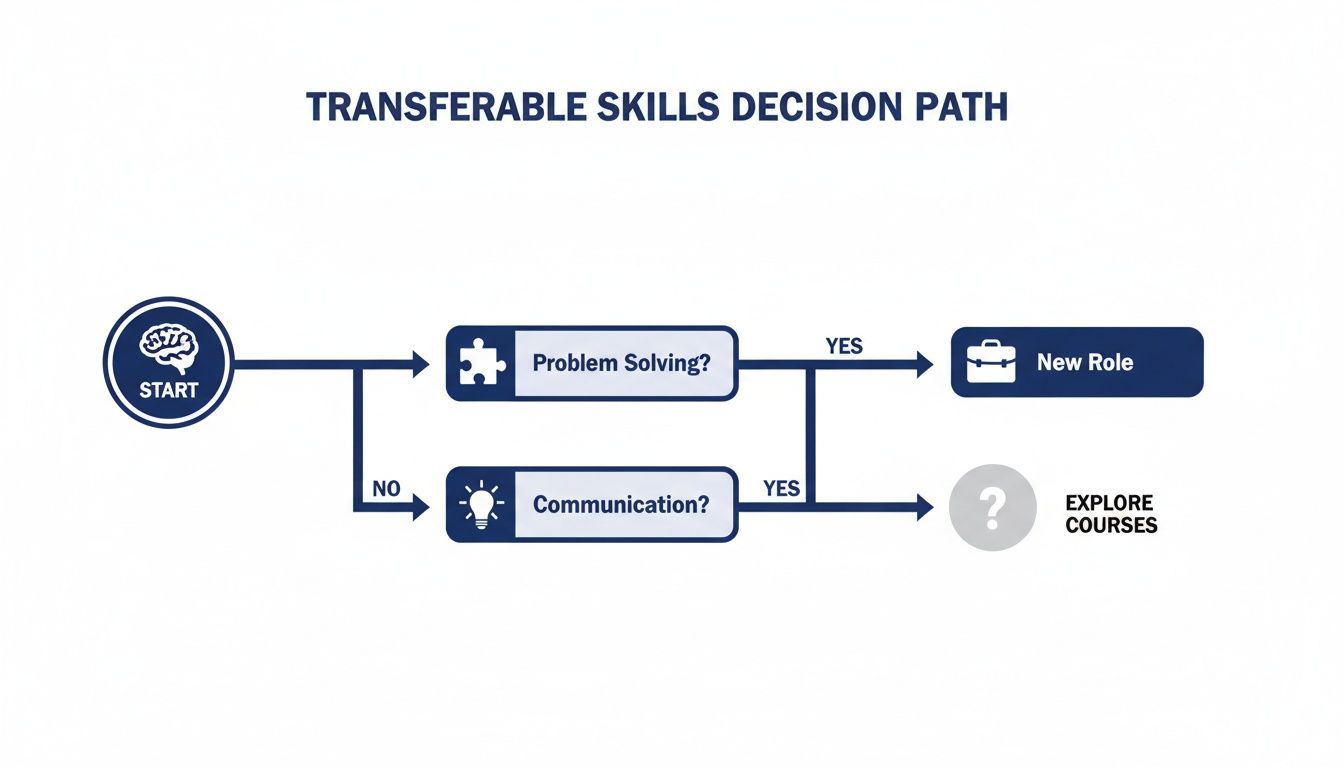
The key takeaway here is that your life experience and soft skills are the foundation. The right training programme is the bridge that connects them to an in-demand technical role.
Taking Control of Your Professional Development
Unfortunately, UK data shows a pretty stark training inequality for workers over 40. Research from the Age Diversity Forum found that employers fund 82% of all training, but this is often heavily skewed towards younger employees or those already in senior roles. This can leave many experienced professionals feeling like they have hit a wall.
This is exactly why investing in your own targeted, self-funded training can be the most powerful move you make.
It puts you firmly in the driver’s seat of your career, letting you sidestep employer-funded schemes that might not be open to you. By proactively gaining the exact skills and certifications that companies are hiring for, you make yourself a top-tier candidate—entirely on your own terms.
For more on this, have a look at our guide on how to choose the right training course for your career goals.
Building Your Job-Ready Toolkit

Finishing your course is a fantastic achievement, but it’s really just the starting whistle. Now, the real work begins: turning those hard-earned qualifications into a job offer. The secret to successfully retraining after 40 is not just about having the new skills, it’s about knowing how to package them with the decades of professional experience you already have.
Your CV and LinkedIn profile are no longer just records of your past; they are your personal marketing campaigns. They need to tell a powerful story about why a mature, motivated career changer is exactly who a hiring manager needs to hire.
Reimagining Your CV for a New Career
Let’s be blunt: your old CV format is now redundant. A chronological list of past jobs just won’t cut it. Instead, you need a skills-first CV that puts your new abilities squarely in the spotlight. The aim is to get your certifications in Sage, Xero, SQL, or Power BI seen within the first few seconds.
Start with a punchy professional summary at the very top. This is your two or three-sentence elevator pitch, making it crystal clear what your new career goal is and how your past experience is a major asset.
For instance, you could say: “A newly qualified Accounts Assistant with certifications in Sage and Xero, bringing over 15 years of project management experience to guarantee meticulous financial accuracy and efficiency.”
Immediately after that summary, create a bold ‘Key Skills’ section. This is where you list all the good stuff:
- Technical Proficiencies: Be specific. List the software you have truly mastered, like QuickBooks, Advanced Excel, Tableau, or Python.
- Core Competencies: Include the exact skills for the job, such as VAT returns, payroll processing, data modelling, or database querying.
- Transferable Strengths: Pull in those high-value skills from your previous life—stakeholder management, client communication, problem-solving, and team leadership.
Only after you’ve showcased your new expertise should you list your work history. And when you do, reframe your old responsibilities to highlight achievements that align with your new path, even if the job title seems worlds away.
Optimising Your LinkedIn Profile
Recruiters practically live on LinkedIn, so your profile needs to be a magnet for them. The single most important part is your headline. Ditch your old job title and replace it with your new professional identity.
Instead of “Project Manager at ABC Corp,” try something like this:
“Aspiring Data Analyst | Certified in SQL & Power BI | Seeking Opportunities in Business Intelligence”
That one change makes you instantly visible to recruiters searching for people with those specific skills. Your ‘About’ section should mirror the compelling story from your CV, and make sure to add your new qualifications to the ‘Licences & Certifications’ section to give them that official stamp of approval. Our guide on how our courses help students get job ready has even more tips on this.
An optimised LinkedIn profile works for you 24/7. It’s your digital handshake, introducing your new skills to potential employers before you even apply for a role.
Nailing the Interview
The “So, why the career change?” question is coming. It’s guaranteed. Your answer needs to be confident, positive, and strategic. This is not the time to air grievances about your old job; it is your chance to radiate enthusiasm for the new one.
Frame your answer around the future. Explain what specifically drew you to accounting or data, highlighting how your mature perspective and previous experience make you uniquely equipped to handle the role’s challenges.
Talk about your reliability, your work ethic, and your proven ability to navigate complex professional situations. These are the qualities that only come with experience, and they are incredibly valuable to employers.
Overcoming Hurdles and Staying Motivated
Making the decision to retrain after 40 is a huge step, but let’s be honest—it’s completely normal for doubts to creep in. Worries about getting to grips with new technology, battling imposter syndrome, or feeling like you’re competing with younger applicants are all very real and valid.
The key is not to pretend these feelings do not exist. It’s about having a plan to manage them so you can keep moving forward. Every single person who has successfully switched careers has faced these exact same hurdles. The only difference is they found ways to push through the discomfort. Just knowing you’re not alone is the first step toward building resilience.
This is especially true here in the UK. Workers over 40 are facing longer careers but can often feel stuck in roles as training opportunities dry up. The statistics show a clear gap in employment rates, with 71.6% for those aged 50-64 compared to 85.7% for the 35-49 age group.
Despite this, the appetite for change is massive—57% of UK workers are ready and willing to retrain, seeing lifelong learning as the best way to adapt. You can discover more insights about the UK labour market on Ageing Better and see just how timely your decision is.
Building Your Support System
You absolutely do not have to do this alone. In fact, building a solid support network is one of the most powerful things you can do to stay motivated when your own self-belief starts to wobble. This should be a mix of personal and professional connections.
- Find a Mentor: Connect with someone who has already made a similar career change. Their practical advice and firsthand encouragement are priceless.
- Join Online Communities: Platforms like LinkedIn are full of groups for professionals retraining in bookkeeping, data analysis, and business analysis. Sharing your experiences with people on the same path makes the challenges feel normal.
- Lean on Family and Friends: Be open with your loved ones about your goals and what you need from them. Their belief in you can be a massive boost on tough days.
The most important conversation you’ll have is the one with yourself. Acknowledge your fears, but don’t let them drive. Remind yourself daily why you started this journey and celebrate every small victory along the way.
Practical Strategies for Staying on Track
Motivation is not something you just have; it is a resource you need to manage and top up. A structured approach can make all the difference, especially when you’re juggling studying with work and family. This is why a flexible study schedule is so crucial for success.
For example, imagine you are retraining as a payroll administrator while still working full-time. Your week might involve dedicating two evenings to online modules and spending a couple of hours on a Saturday morning getting hands-on with software exercises. This breaks the learning down into manageable pieces and stops you from feeling overwhelmed.
Celebrating the small wins is just as important. Did you finally get that tricky Excel formula to work? Did you complete your first mock VAT return? Take a moment to acknowledge these achievements. They are tangible proof that you’re making progress, and that’s the fuel you need to keep going. Resilience is built one small step at a time.
Taking the Next Step on Your New Career Path
You now have the complete roadmap for making a successful career change. We’ve covered everything from auditing your existing skills and choosing the right course to building a job-ready toolkit and tackling the inevitable hurdles along the way. Each stage is a deliberate step towards a more secure and fulfilling professional future.
The key takeaway is simple but powerful: retraining after 40 in the UK is not a retreat. It is a proactive, intelligent choice. It opens doors to stable, rewarding work in future-proof sectors like finance and data analysis, where your decades of experience are a genuine asset. This is not about starting over; it is about building on the solid foundation you have already laid.
From Thinking to Doing
The leap from thinking about a change to actually making one starts with a single, small action. It’s time to move from planning to doing and take decisive control of your next chapter. Your ambition to retrain is valid, and the opportunities are real—all that is left is to begin.
This next phase is all about translating your new qualifications and extensive experience into a compelling story that employers want to hear. As you shape this new professional identity, a comprehensive guide on how to build a personal brand on LinkedIn can be invaluable for showcasing your updated skills and journey.
Don’t wait for the ‘perfect’ moment to start. The perfect moment is right now, while you have the motivation and clarity to invest in yourself. Every day you delay is another day you could have been moving closer to your new career.
Your first moves do not have to be monumental. In fact, it is the small, manageable tasks that build momentum and turn a plan into reality.
Your Immediate Action Plan
So, where to start? Focus on one of these clear, achievable goals this week:
- Explore Specific Courses: Dive deeper into the training options for roles like Accounts Assistant, Bookkeeper, or Data Analyst. Look at the specific software they cover, the certification you will get, and how flexible the timetable really is.
- Schedule a Consultation: Sometimes, the best first step is to talk to someone who has guided others down this path. A career consultation can provide personalised advice, answer your specific questions, and help map out a training plan that actually fits your life.
- Update Your Skills Audit: Go back to your list of transferable skills with fresh eyes. Actively connect your past achievements to the requirements you are seeing in job descriptions for bookkeeping or business analyst roles.
This is about more than just finding another job. It’s about strategically building a career that offers longevity, satisfaction, and financial security for the years ahead. The tools and roadmap are in your hands. Now is the time to use them.
The journey to a rewarding new career begins with the right training and support. At Professional Careers Training, we specialise in helping career changers like you gain the practical, job-ready skills needed to succeed in accounting and data analysis. Explore our flexible, one-to-one courses today.