If you work in payroll, or you're training to, "statutory payments" is one of those phrases that sounds dry until you realise how much rests...
Why CPD Is More Than Just a Box-Ticking Exercise
For many UK accountants, the term Continuing Professional Development (CPD) can feel like a chore—just another list of hours to tick off before a looming deadline. But if you see it that way, you are missing the bigger picture. CPD is the bridge between staying qualified and becoming truly indispensable in your career.
In a profession governed by ever-changing regulations, shifting client expectations, and relentless technological advances, standing still is the quickest way to fall behind. A smart CPD plan is your most powerful tool. It ensures you not only meet but consistently exceed the standards your clients and employers demand.
Building Your Professional Credibility
Look at your qualifications as the foundation of your career. CPD is the ongoing maintenance that keeps that foundation solid. Every course you take and skill you master adds another layer of credibility. It shows clients and colleagues that you are committed to excellence. This proactive approach keeps your expertise current and, most importantly, trustworthy.
This is exactly why major UK accounting bodies like the Association of Chartered Certified Accountants (ACCA), the Institute of Chartered Accountants in England and Wales (ICAEW), and the Chartered Institute of Management Accountants (CIMA) place such a strong emphasis on CPD. They know the public’s trust in our profession hinges on its members’ dedication to high standards of competence and ethics.
Staying Competitive in a Growing Field
The accountancy profession in the UK is proving resilient, constantly attracting fresh talent. This steady growth means the competition for the best roles is always on.
Your commitment to continuous learning is what sets you apart. While others might do the bare minimum, those who strategically invest in their skills are the ones who land promotions, lead high-stakes projects, and become the go-to experts in their field.
The Financial Reporting Council’s recent report highlights a 0.8% increase in membership across UK professional bodies between 2023 and 2024. It also noted a huge 12.3% rise in students converting to full membership worldwide. This growth paints a clear picture: you are in a thriving profession where standing out is essential. You can find more detail in the FRC’s Key Facts and Trends in the Accountancy Profession report.
This drive to upskill isn’t just about personal ambition; it’s a direct response to a market that needs professionals who can navigate complex challenges with confidence. You can learn more about how professional training is the best investment you’ll make in your career.
A Framework for Future-Proofing Your Career
Ultimately, CPD gives you a structured way to future-proof your career. It forces you to step back, take an honest look at your current skills, and identify the knowledge gaps you need to fill to reach your long-term goals.
Whether you want to specialise in business analysis, master advanced payroll systems, or become a data-driven advisor, CPD provides the roadmap. It turns learning from a passive requirement into an active, career-shaping strategy, making sure you are always ready for whatever comes next.
Navigating CPD Requirements for UK Accounting Bodies
Understanding the specific Continuing Professional Development (CPD) rules for UK accounting bodies can feel like learning a new language. Each organisation—ACCA, ICAEW, CIMA—has its own set of requirements, units, and standards. However, they all share the same fundamental goal: making sure you stay at the top of your professional game.
So, let’s break down what this actually means for you day-to-day.
The first thing to understand is the difference between verifiable and unverifiable CPD. Think of verifiable CPD as any learning you can prove you have done. It is structured, official, and leaves a paper trail. Attending a formal training course, a live webinar that tracks attendance, or any learning that ends with a certificate all count.
Unverifiable CPD is the opposite—it is more informal and self-led. This is the learning you do on your own, like reading an industry journal, listening to a finance podcast, or researching a new tax law for a client project. It’s incredibly valuable for your growth, but there is no third-party confirmation to back it up.
These strict standards aren’t just bureaucracy. They are driven by the need to uphold the integrity and credibility of the entire UK accountancy profession.
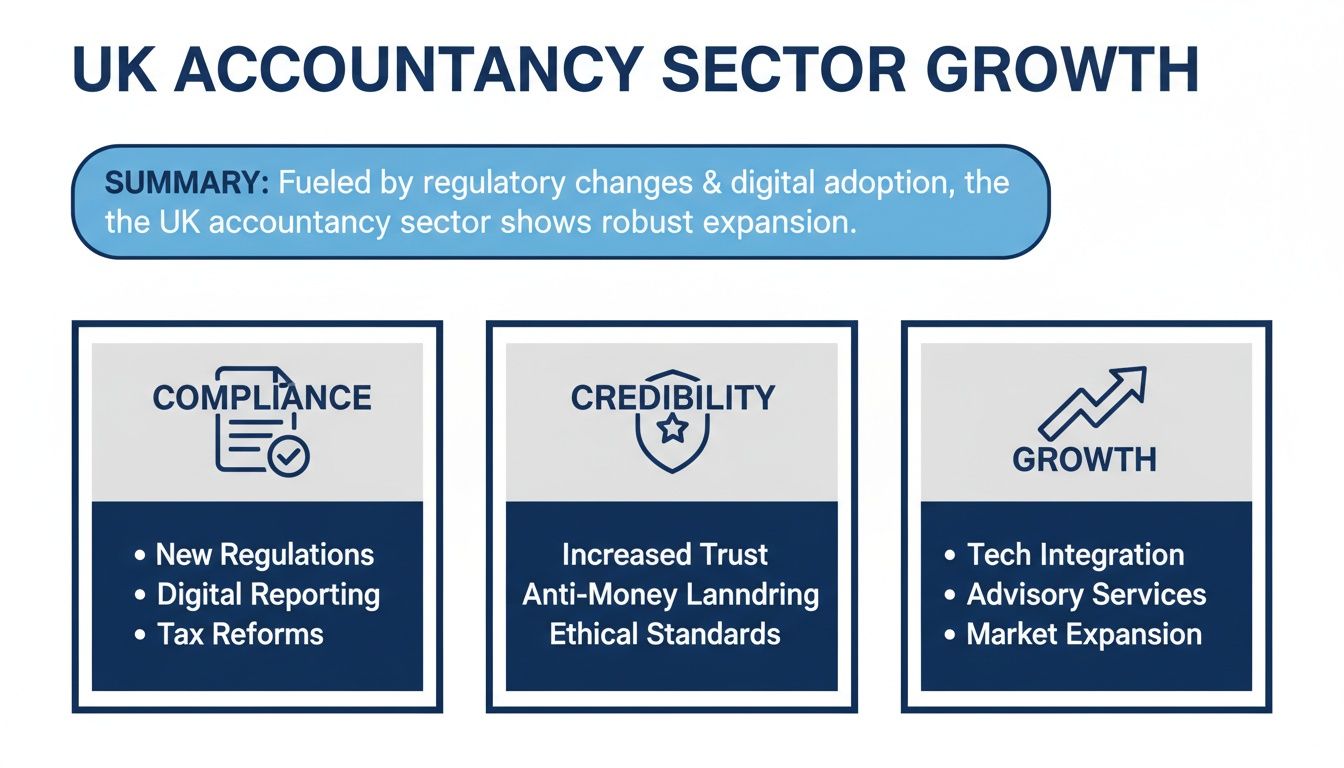
As you can see, a solid commitment to compliance and learning directly fuels both your professional credibility and your long-term career growth.
CPD Requirements for Major UK Accounting Bodies at a Glance
While the goal is the same, the specifics can vary quite a bit between the major UK bodies. For instance, ACCA members are required to complete 40 units of CPD annually (21 verifiable), whereas ICAEW members must complete a minimum of 20 verifiable hours plus any other learning they deem necessary.
This table gives a clear, side-by-side comparison to help you see exactly what is expected.
| Professional Body | Annual CPD Requirement | Minimum Verifiable/Structured Hours | Key Notes |
|---|---|---|---|
| ACCA | 40 units per year | 21 units must be verifiable | ACCA uses a ‘unit’ system, where one unit typically equals one hour of learning. |
| ICAEW | At least 20 verifiable hours | 10 hours must be structured, with the remaining hours being verifiable | Members must also complete an ethics module and any non-verifiable learning needed for their role. |
| CIMA | No set number of hours | No minimum hours specified | CIMA uses a reflective ‘CPD Cycle’. Members define, act on, and reflect on their learning needs. |
As you can see, each body has its own unique approach. CIMA, for example, trusts its members to drive their own learning based on professional judgement, while ACCA and ICAEW provide more structured frameworks. The key is to know which rules apply to you and plan accordingly.
The Importance of Verifiable Learning
Verifiable CPD is the bedrock of your compliance because it provides undeniable proof of your efforts. It is not just about turning up; it is about engaging with the material and walking away with a measurable outcome.
This is exactly why choosing the right training provider is so important. A quality course doesn’t just teach you a new skill; it gives you the formal, hassle-free evidence you need to satisfy your professional body’s requirements.
For instance, completing a certified course in Xero or advanced Excel gives you a verifiable certificate. That single activity can tick off a good chunk of your annual target while making you more efficient at your job. It is a win-win.
This approach ensures your learning is both practical and compliant, which is a vital part of the journey if you’re working towards professional qualifications. If that’s your goal, you might find our guide on how to become a chartered accountant in the UK helpful.
Ultimately, navigating these requirements is about embedding meaningful, provable learning into your career, ensuring you stay skilled, relevant, and in good standing with your governing body.
Exploring Different Types of CPD Activities
You finish a busy week and wonder whether any of it counts as CPD. You joined a VAT webinar, fixed a reconciliation issue that had appeared for three months, and spent an hour learning a better Excel formula from a colleague. Many accounting and finance professionals leave activities like these out of their record, even though they often produce the clearest improvement in day-to-day work.
A useful way to sort CPD is to place it into two buckets. One bucket is formal and planned. The other is informal and work-based. That simple split helps when your professional body expects reflection, but does not require formal peer review. In that situation, your judgement matters more. You need a sensible way to choose learning, explain why it mattered, and show what changed.
Structured CPD
Structured CPD usually starts with a defined objective. It has a title, a timetable, and some form of evidence such as registration, attendance, or a certificate. It works like studying from a map rather than exploring side streets. You know where the session is meant to take you.
Examples include:
- Bookkeeping or VAT courses: useful for building confidence in transaction posting, ledger control, invoice treatment, and VAT return preparation
- Advanced payroll training: suitable for professionals who handle payroll processing, statutory payments, or payroll software checks
- Accounts assistant programmes: helpful if you need stronger skill in journals, reconciliations, control accounts, and finance systems
- Final accounts training: relevant when your role is shifting from routine processing to month-end or year-end support
- Business analyst or data analyst courses: practical if your work now includes reporting, Excel modelling, SQL, Power BI, or process improvement
- Time management training: helpful if your technical learning is being held back by missed deadlines, poor prioritisation, or inconsistent study habits. A short time management course for professional development can support the practical side of keeping CPD on track
Unstructured CPD
Unstructured CPD is less formal, but it often reflects how people grow at work. It includes the learning that happens while solving problems, testing ideas, and improving routines. In firms where no one checks your development plan line by line, this category becomes especially important.
Common examples include:
- Reading and research: reviewing VAT updates, payroll guidance, software help articles, or technical commentary
- Problem-solving at work: resolving a suspense account issue, correcting repeat posting errors, or improving a reconciliation method
- Mentoring and shadowing: observing how a senior colleague reviews exceptions, or helping a junior teammate understand a process
- Software practice: testing Excel functions, building a Power BI visual, or practising tasks in Sage, Xero, or QuickBooks
This type of learning needs stronger notes because there is often no certificate to do the talking for you. A short record is enough if it answers three questions. What did I do and what did I learn? What changed in my work after that?
Choose the right activity for the right gap
A short article and a full training course can both count. They do different jobs.
If your knowledge gap is narrow, such as checking one VAT rule or learning one payroll report, a focused reading session may be enough. If your gap affects performance across a whole area, such as bookkeeping accuracy or month-end confidence, formal training is usually the better choice.
That is the practical framework many professionals need. Match the size of the learning activity to the size of the problem. Then write a short reflection that links the activity to your work. This turns CPD from a compliance task into a plan you can direct yourself.
Choosing CPD Courses That Accelerate Your Career

Moving beyond mere compliance, the real power of CPD lies in choosing your courses strategically. The right training doesn’t just tick a box for your professional body; it builds a direct path to promotions, higher pay, and more satisfying work. This is where you shift your mindset from what you have to do, to what you could achieve.
By carefully choosing where to invest your time, you actively align yourself with the skills employers want. It is about matching your learning to the real-world demands of a modern finance team. This transforms you from a competent accountant into a high-value, strategic asset for any business.
Mastering the Core Essentials
Before you can advise on complex business strategy, your foundational skills must be flawless. Courses focused on the core functions of an accounting department provide the rock-solid base upon which great careers are built. They ensure you are not just compliant, but highly efficient and confident in your day-to-day responsibilities.
-
Bookkeeping & VAT: Getting the intricacies of bookkeeping and VAT right is fundamental. With the ongoing rollout of Making Tax Digital (MTD), businesses need experts who can guarantee seamless compliance and accurate reporting. A dedicated course sharpens these skills, making you an indispensable resource for any small or medium-sized enterprise.
-
Advanced Payroll: Payroll is much more than just processing salaries; it is a complex area governed by ever-changing legislation. Advanced payroll training positions you as a compliance expert. You will become capable of managing auto-enrolment pensions, statutory payments, and tricky tax calculations with total confidence. This specialism is always in high demand.
Building Your Technical Foundation
Once the essentials are second nature, the next step is to build on that foundation with skills that broaden your technical toolkit. This is how you make the jump from an entry-level position to a role with greater responsibility and oversight. This could include preparing financial statements or managing entire accounting functions for a client.
Courses in these areas prove you can handle more complex tasks and contribute to the financial health of an organisation at a much higher level.
Think of your career as a building. Core skills are the foundation, but technical expertise provides the structure. Without a strong framework of final accounts preparation and accounts assistant skills, you can’t build towards more advanced advisory or analytical roles.
Here are two crucial areas to focus on:
-
Accounts Assistant Essentials: A comprehensive accounts assistant course solidifies your understanding of the entire accounting cycle. It covers everything from sales and purchase ledger management to credit control and bank reconciliations. This gives you the holistic view needed to excel and progress.
-
Final Accounts Preparation: The ability to prepare final accounts is a critical milestone for any accountant. This skill involves taking raw financial data and turning it into a complete set of financial statements, such as the profit and loss account and balance sheet. Training in this area proves you can manage the end-to-end accounting process, a key requirement for more senior roles.
Evolving into a Strategic Advisor
The most significant career acceleration happens when you move beyond recording history and start shaping the future. This is the leap from number-cruncher to strategic advisor, and it is powered by analytical skills. Businesses today want finance professionals who can interpret data and provide the insights that drive decision-making.
By developing skills in business and data analysis, you fundamentally change your contribution. You stop just reporting what happened and start explaining why it happened and predicting what might happen next. This makes you a vital part of the strategic conversation.
-
Business Analyst Skills: A business analyst bridges the gap between finance and operations. They use financial data to identify problems, find efficiencies, and recommend practical solutions. Training in this area equips you with process mapping, requirements gathering, and stakeholder management skills.
-
Data Analyst Skills: A data analyst goes deeper into the numbers. They use technical tools like Power BI, Python, or advanced Excel to clean, analyse, and visualise large datasets. This uncovers trends and insights that would otherwise stay hidden. This skill set is incredibly valuable for forecasting, budgeting, and performance analysis, making you a key player in strategic planning.
Matching Your CPD to In-Demand Technical Skills

It is no longer enough to just understand the principles of accounting. To thrive, you need to master the tools of the trade. Aligning your CPD with the technical software skills that define a modern accountant isn’t just a smart move—it is essential for career survival and growth.
Proficiency in key accounting platforms is now a baseline expectation for most roles. Employers simply assume you can navigate the big names with confidence. Likewise, an ability to handle and interpret data is quickly becoming a non-negotiable skill for anyone looking to move into a more strategic position.
The best way to start is with a thorough training needs assessment. This helps you pinpoint exactly where you stand and which training will give you the highest return on your investment of time and effort.
Core Software Skills That Are Non-Negotiable
For roles in bookkeeping, accounts assistance, or general practice, some software skills are fundamental. Lacking experience with these platforms can be an immediate barrier, so your CPD plan should prioritise these if you have any gaps.
-
Xero: Hugely popular with small businesses and startups, Xero has become an industry standard. Demonstrating certified proficiency shows you can manage day-to-day finances for a modern, cloud-based business.
-
Sage: A long-standing giant in the accounting world, Sage (especially Sage 50) is still used extensively across the UK. Expertise here is vital, particularly for roles within more established small to medium-sized enterprises.
-
QuickBooks: Another major player in the cloud accounting space, QuickBooks is favoured by many for its user-friendly interface. Being comfortable with this platform broadens your appeal to a huge range of potential employers.
Advanced Skills for Top-Tier Candidates
Once you have the fundamentals covered, the next step is to acquire skills that elevate you from a competent accountant to a top-tier candidate. These are the tools that unlock roles in financial analysis, business intelligence, and strategic advisory.
The shift towards tech and data literacy is clear. Digital learning powered over 68% of all CPD in Europe in 2024, highlighting the huge demand for accessible, tech-focused training that equips accountants with the right skills for today’s market.
-
Advanced Excel: Basic spreadsheet skills are a given, but true mastery of functions like PivotTables, VLOOKUPs, macros, and data modelling is a game-changer. It allows you to manipulate and analyse data with incredible speed and precision.
-
Power BI: This business analytics tool from Microsoft lets you create interactive dashboards and compelling data visualisations. Turning complex spreadsheets into clear, actionable insights is an incredibly valuable skill for any finance team.
-
Python: While once seen as a tool for developers, Python is increasingly used in finance for data analysis, task automation, and predictive modelling. Even basic knowledge can set you miles apart, especially for roles in data-heavy sectors. To succeed here, you need to know the right analytical tools. Check out our guide on the essential financial analyst skills needed for today’s market.
Choosing the Right Training Provider
Picking the right provider is just as important as choosing the right course. A great provider offers more than just a certificate; they deliver real-world value that you can apply from day one.
When evaluating a training provider, look for evidence that their courses are practical, not just theoretical. The goal is to gain hands-on experience that directly translates to on-the-job competence and confidence.
Use this checklist to make your decision:
- Hands-On Software Access: Does the provider give you access to the actual software (like Xero or Sage) to practise with?
- Instruction from Qualified Professionals: Are the instructors ACCA-qualified accountants or industry experts who use these tools daily?
- Flexible Schedules: Do they offer evening and weekend classes to fit around your existing work commitments?
- Official Certification: Will you receive an official, verifiable certificate upon completion to use as evidence for your CPD?
How to Plan and Record Your CPD Without the Headache

Let’s be honest: planning and recording your Continuing Professional Development can feel like more work than the learning itself. It often ends up as a year-end scramble to find records and remember what you actually did.
But with a little structure, you can flip this on its head. A good plan turns CPD from a chore into a powerful tool for managing your career.
Think of it as a simple, repeating cycle. Breaking it down into manageable steps makes it easy to maintain flawless records and stay on top of your goals. Not only will you be ready for any potential CPD audit, but you will also see a genuine return on your investment of time.
Step 1: Reflect on Your Career Goals
Before you even think about courses or hours, take a step back. Where do you actually want to be in one, three, or five years? This is not about vague ambitions; it is about setting clear, professional targets.
Maybe your goal is to transition from an accounts assistant to a management accountant. Perhaps you want to become the go-to expert on VAT compliance in your firm, or you are aiming to move into a more strategic business analyst role.
Whatever it is, write it down. Having a clear destination makes it so much easier to plot the route. This ensures your CPD choices are purposeful and directly contribute to where you’re headed.
Step 2: Identify Your Skill Gaps
With your goals in mind, it’s time for an honest self-assessment. What knowledge or expertise are you missing to get from where you are now to where you want to be? This is the most critical part of building a relevant CPD plan.
Let’s look at a couple of examples:
-
Goal: Move into a data analyst role.
-
Skill Gap: You are an Excel whiz but have zero experience with Power BI or Python for data visualisation and automation.
-
Goal: Manage the bookkeeping for a portfolio of MTD-compliant small businesses.
-
Skill Gap: You know Sage inside out, but you have no hands-on experience with Xero, the preferred software for many of your target clients.
Identifying these gaps turns your CPD from a random collection of activities into a targeted training plan designed to make you more valuable.
Step 3: Set Clear Learning Objectives
Now, let’s turn those gaps into specific, achievable learning objectives. Instead of a vague goal like “learn more about payroll,” create a concrete objective.
For instance: “Complete an advanced payroll course to master statutory payments and auto-enrolment regulations by the end of Q3.”
This simple reframe gives you a clear target and a deadline. It makes it much easier to find the right training and stay motivated. Using professional development plan templates can help you track your progress against these objectives and keep everything organised.
A well-structured plan not only simplifies compliance but also serves as your personal roadmap for professional growth. It transforms CPD from a reactive requirement into a proactive strategy for building the career you want.
Step 4: Document Everything as You Go
The final step is to make recording your CPD a habit, not an afterthought. Waiting until the end of the year to piece everything together is a recipe for stress and missed details. The best approach? Log your learning as soon as you complete it.
And what counts as evidence? It is more than just formal certificates.
- Course Certificates: The most obvious and essential form of verifiable evidence.
- Attendance Records: Confirmation emails or even screenshots from webinars are perfect.
- Personal Notes: Summarise what you learned from an article or podcast. Crucially, add how you applied it. For example, “Read an article on new VAT rules for construction; updated our internal checklist to reflect the changes.”
- Meeting Agendas: If you attended a technical update at work, the agenda and your notes can serve as solid evidence.
Keeping a simple spreadsheet or using a dedicated app makes this process painless. A good record demonstrates not just what you learned, but how that learning actually made you a better accountant.
The Real Payoff of Lifelong Learning in Accountancy
Forget the points and hours for a moment. Let’s talk about the true, career-altering impact of adopting a lifelong learning mindset. Committing to continuing professional development is not just a regulatory chore. It is a direct investment in your professional future, your job satisfaction, and your long-term success.
This commitment genuinely transforms your role. Instead of just recording financial history, you build the confidence and expertise to interpret it. You become a trusted advisor who helps shape business strategy. Each course you take sharpens your problem-solving skills, giving you the ability to tackle complex challenges with a calm, analytical approach.
From Keeping Up to Getting Ahead
In a competitive market, just maintaining your existing skills means you are effectively standing still. Consistent learning, on the other hand, puts you ahead of the curve. It opens doors to exciting, high-demand specialisms that command higher salaries and offer far more engaging work.
Continuing professional development is not an expense. It is the single most important investment you can make in your own success, turning your career into an asset that appreciates in value over time.
Think about the opportunities that open up when you proactively build your skillset:
- ESG Reporting: As environmental, social, and governance factors become critical, companies are desperate for accountants who can measure and report on these non-financial metrics.
- Data Analytics: By mastering tools like Power BI or Python, you can move from preparing reports to creating predictive financial models that guide crucial business decisions.
- Forensic Accounting: Specialised training can position you to investigate financial discrepancies and fraud, a highly respected and lucrative niche.
The Ultimate Career Investment
Ultimately, a proactive approach to your development changes everything. It boosts your confidence, increases your professional credibility, and ensures you remain not just relevant, but indispensable. You stop worrying about automation and start seeing technology as a tool to amplify your expertise.
By viewing every learning opportunity as a step towards your bigger career goals, you build a resilient, adaptable, and future-proof professional life. This mindset is the real payoff of lifelong learning in accountancy.
Answering Your Top CPD Questions
When it comes to Continuing Professional Development, it’s natural to have questions. Getting the details right is crucial for staying compliant and making the most of your learning. To clear things up, we’ve put together answers to some of the most common queries we hear from accountants across the UK.
What Happens if I Don’t Complete My CPD Hours?
Ignoring your CPD requirements is a bad idea. Your professional body, whether it’s the AAT, ICAEW, or another, takes compliance seriously. Failing to meet your hours can have real consequences for your career — typically starting with a formal warning or a fine, and escalating to a mark on your public professional record or, in the worst case, a suspended or revoked membership.
How Much Should I Budget for CPD Courses?
This is a bit like asking “how long is a piece of string?” The cost of CPD can vary widely, so it is all about planning what works for you and your career goals.
There is a whole spectrum of options out there. On one end, you have completely free resources like webinars, podcasts, and industry articles—perfect for hitting your unverifiable learning targets. On the other, a specialised, in-person certification in something like data analysis could set you back several hundred pounds or more. The price usually reflects the provider’s reputation, the depth of the content, and whether you get hands-on time with key software.
The trick is to find high-value training that aligns with where you want to go, without breaking the bank. Keep an eye out for providers that offer bundled courses or flexible payment plans to help your budget stretch further.
Can I Carry Over Extra CPD Hours to Next Year?
This is a classic question, and the answer is a firm “it depends.” Every professional body has its own rules. Assuming they are all the same is a sure way to get caught out. You absolutely have to check the specific guidance for your qualification.
For example, ACCA is known for its flexibility, sometimes allowing members to carry forward up to 21 verifiable units to the next year if they have gone above and beyond. However, a body like ICAEW typically takes a different approach—they do not permit hours to be carried over, so your slate is wiped clean at the start of each compliance period.
Always go straight to the source: your professional body’s own handbook or website. That’s the only place to find the most accurate, up-to-date policy on carrying forward surplus CPD hours.
What Actually Counts as Verifiable CPD?
Think of it this way: verifiable CPD is any learning you have done where you can point to independent, third-party proof of completion. It is structured, and the key thing is that it can be objectively confirmed by someone else.
Here are a few real-world examples:
- Finishing an assessed online course and getting a certificate of completion.
- Attending a live, structured webinar where the provider officially tracks attendance.
- Going to a conference or a technical seminar and receiving a formal record of attendance.
Unverifiable CPD, on the other hand, is just as valuable but is more self-directed and lacks that formal proof. Reading an industry journal, listening to a finance podcast, or even having an insightful chat about a new regulation with a colleague all fall under this umbrella.
What Are the CPD Rules If I Am Not Currently Working?
Taking a career break, semi-retiring, or finding yourself between roles does not mean your CPD obligations simply vanish, but they do change. Most professional bodies have clear rules for members who are not actively in a role.
You might be eligible for a partial or even a full exemption from your CPD requirements, but it’s not automatic—you usually need to apply for it. The outcome often depends on your specific situation, like how long your break is and if you plan to return to practice. The single most important thing you can do is talk to your professional body. Be proactive, let them know your status, and make sure you understand exactly what is required to remain in good standing.
Ready to invest in your career with CPD courses that deliver real-world skills? At Professional Careers Training, we offer expert-led, flexible training in everything from Xero and Sage to advanced data analysis. Explore our CPD-approved courses today and take the next step in your professional journey.