
If you're training to become a business analyst, or you already work as one, you've probably noticed AI tools turning up in more of your...
What AAT Level 2 Distance Learning Really Involves
Embarking on AAT Level 2 distance learning is the first foundational step toward a rewarding career in finance. It offers a flexible, self-paced route to an essential accounting qualification, designed specifically for beginners to build the core bookkeeping and finance skills employers are actively looking for. The online format is a huge plus, allowing you to fit your studies around your existing work and life commitments.
Who Is This Qualification Designed For?
The great thing about the AAT Level 2 is how accessible it is. It’s perfectly suited for a whole range of people, regardless of their background or previous experience. You might be:
- A Complete Beginner: Someone with zero accounting knowledge who wants a clear, structured way into the finance industry.
- A Career Changer: An individual coming from another field, like retail or administration, looking for a more stable and progressive career path.
- A Returner to Work: Someone re-entering the workforce who needs a current, valuable qualification to stand out to employers.
- An Ambitious Junior Employee: A person already in an office role who wants to specialise in finance to unlock new opportunities within their company.
The common thread is the desire for a practical qualification that leads directly to a job.
Why Choose the Distance Learning Format?
The AAT Level 2 distance learning format is a game-changer. It lets you fit your studies around your life, not the other way around. It completely removes the barriers of fixed classroom schedules and daily commutes, giving you total control over when and where you learn. The AAT Level 2 Certificate in Accounting has become a cornerstone for aspiring accountants in the UK, especially in its flexible online format. Data from leading providers shows the average completion time is between 6 to 12 months, which allows most students to easily balance their studies with a full-time job.
A key part of deciding if this is for you is weighing up the differences between Instructor Led Training vs Self Paced Learning to see which model truly suits your needs. This choice will shape your entire study experience.
Ultimately, taking this first step is all about building a solid foundation. It opens doors to practical roles and creates a clear pathway for advancement to higher AAT levels and more specialised positions like an Accounts Assistant, Bookkeeper, or even a future Business Analyst. It’s the perfect launchpad for a stable and fulfilling career in finance.
Navigating The AAT Level 2 Syllabus and Modules
Think of the AAT Level 2 syllabus as your roadmap to becoming a confident finance professional. It’s been carefully designed to build your skills step-by-step, making sure every new topic rests on a solid foundation of what you’ve already learned. It’s not just a dry list of subjects; it’s a toolkit where each module gives you a new, practical skill that employers are looking for right now.
When you start your AAT Level 2 distance learning journey, you’re not just memorising theory—you’re learning the real-world mechanics of finance. The curriculum is built to mirror the day-to-day tasks you’d handle in key roles. This means what you learn on Monday could genuinely be applied in a real job by Friday. That direct link between study and practice is what makes this qualification so valuable for aspiring bookkeepers, payroll administrators, and accounts assistants.
This visual guide shows how the AAT Level 2 qualification is structured to support learners, build essential skills, and launch careers.
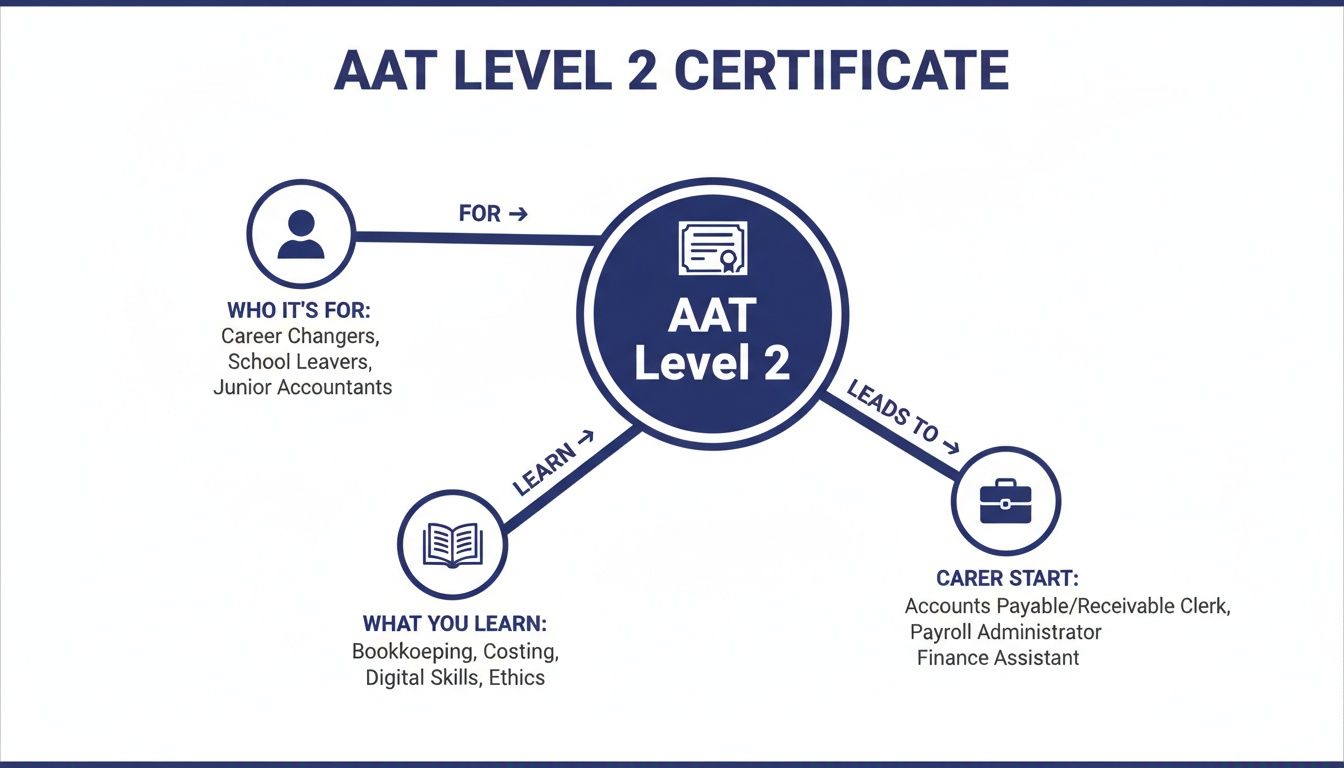
As you can see, the course directly connects the needs of career starters with the specific knowledge required for those crucial entry-level finance roles.
AAT Level 2 Syllabus At a Glance
The syllabus is broken down into four core modules. Together, they create a complete picture of foundational finance tasks, getting you ready for roles such as Accounts Assistant, Purchase Ledger Clerk, or Payroll Administrator. Let’s break down what each unit covers and how it translates into skills you’ll use on the job.
| Module Title | Key Learning Outcomes | Real-World Application |
|---|---|---|
| Introduction to Bookkeeping & VAT | Learn double-entry bookkeeping, process customer and supplier transactions, handle cash, and understand the fundamentals of Value Added Tax (VAT). | You will be processing supplier invoices, calculating VAT on sales, and preparing the initial figures for a VAT return. |
| Principles of Bookkeeping Controls | Master essential checks to keep financial records accurate. This includes bank reconciliations, control accounts, and using journals to correct errors. | Your manager asks you to figure out why the bank statement doesn’t match the company’s records. That’s a bank reconciliation in action. |
| Principles of Costing | Understand how businesses track costs, essential for budgeting and profitability analysis. Learn about coding and classifying costs. | Helping a business analyst to gather data on production costs to inform pricing strategies for a new product. |
| The Business Environment (Synoptic) | Get the wider context. This unit covers business law, ethics, and sustainability, culminating in a synoptic assessment that tests all modules. | Handling sensitive financial data ethically, and preparing the final accounts for a sole trader, demonstrating your all-round competence. |
Each of these modules is designed not just to be learned, but to be applied. It’s this focus on practical competence that makes AAT graduates so sought-after by employers.
From Syllabus to Workplace Scenarios
Let’s make this even more concrete. Imagine you’ve just started as an Accounts Assistant.
Your manager asks you to process a stack of supplier invoices, ensuring VAT is correctly accounted for. You’ll be drawing directly on your skills from Introduction to Bookkeeping & VAT. Later, you’re tasked with reconciling the company bank account to hunt down a discrepancy. That’s a direct application of Principles of Bookkeeping Controls. This practical alignment is what the AAT qualification is all about, preparing you for tasks from bookkeeping to advanced payroll support.
The modern AAT syllabus goes beyond just crunching numbers. It integrates crucial principles of ethics and sustainability, reflecting the growing expectation for finance professionals to act as responsible business partners.
The AAT Level 2 course is also constantly updated to reflect how businesses actually work today. This includes understanding the impact of technology on finance and the non-negotiable importance of data security. You’ll learn how to handle sensitive financial information professionally, a skill that every single employer demands, whether you’re a bookkeeper, data analyst, or preparing final accounts.
How Online AAT Study Fits Into Your Life
One of the biggest questions people have about AAT Level 2 distance learning is simple: what does it actually look like week to week? The thought of slotting study time into an already packed schedule can feel a bit overwhelming, but the reality is far more manageable than you might think. Distance learning is built for flexibility, giving you the power to create a study routine that works for you, not against you.
This approach means you can learn from anywhere—your living room, a quiet coffee shop, or even during your lunch break at work. Instead of being locked into a rigid classroom timetable, you’re in control. This freedom is the secret sauce to successfully balancing your qualification with your job, family, and personal life.

Your Weekly Study Rhythm
So, what does a typical study week involve? For most students, setting aside a consistent 4-5 hours per week is the sweet spot. This allows you to make steady, confident progress through the modules without feeling rushed or overloaded. A well-designed course provides a mix of resources to keep you engaged and make every hour count.
You’ll typically log into a student portal where you can access everything you need. Think of it as your digital campus, complete with on-demand video tutorials that break down tricky topics and interactive workbooks that let you test your knowledge as you go.
The core of online learning is self-discipline combined with high-quality resources. It’s not just about reading textbooks on a screen; it’s about having a full suite of tools at your fingertips.
This blend of materials means you can learn in a way that suits your style. If you’re a visual learner, the video lectures are perfect. If you prefer to roll up your sleeves and get hands-on, the practice questions and digital workbooks will be your go-to resource.
A Sample Study Schedule
To make this more concrete, here’s what a realistic 5-hour study week could look like for someone working a standard 9-to-5 job:
- Monday Evening (1 hour): Watch the introductory video lecture for this week’s topic, like ‘Double-Entry Bookkeeping’.
- Wednesday Evening (1.5 hours): Work through the corresponding chapter in your digital workbook, completing practice questions to solidify your understanding.
- Friday Lunch Break (30 minutes): A quick review of key concepts using online flashcards or summary notes.
- Saturday Morning (2 hours): Time to tackle a larger practice assessment. This is where you test yourself and identify any areas that need a bit more focus.
Of course, this schedule is just an example. The real beauty of distance learning is that you can adapt it completely to your life. If you’re a night owl, you can study late into the evening. Have a long commute on the train? Use that time to review notes or listen to audio resources. The choice is always yours.
The Assessment Process Explained
Another common area of uncertainty is how you’re actually assessed. With AAT Level 2 distance learning, the process is straightforward and designed to test your practical skills in a real-world context.
Assessments are computer-based exams (CBEs) that you sit at an AAT-approved assessment centre. There are thousands of these centres across the UK, so you can book your exams at a location and time that’s convenient for you. This flexibility is a huge advantage over traditional college courses with fixed, immovable exam dates.
The exams for each module will test the specific skills you’ve learned, from processing invoices to reconciling a bank statement. Finally, you’ll take a synoptic assessment. Think of this as the final boss—a comprehensive exam that tests your ability to apply knowledge from all the modules to solve real-world problems. It’s the ultimate proof that you’re truly work-ready. For a deeper dive into different educational methods, check out our guide on online training vs classroom learning.
Understanding how educational technologies can support your journey is also key. For instance, exploring how modern online tutoring services can boost student skills provides insight into the broader world of digital education. By demystifying the weekly commitment and assessment process, you can see a clear, confident picture of how to successfully manage your studies from home.
What’s the Investment and What’s the Return?
When you’re thinking about a new qualification, it always boils down to two things: how much will it cost, and what will I get back? An AAT Level 2 distance learning course isn’t just an expense—it’s a direct investment in your future career. Getting a clear picture of the costs and the potential career boost is the key to making a decision you feel good about.
The total price isn’t just the number you see on the course page. It’s made up of a few different parts that you’ll want to budget for. Knowing this upfront helps you plan properly and avoids any surprises later on, so you can focus on what really matters: your studies.
Breaking Down the Costs
Your total spend for the AAT Level 2 qualification is usually split into three main areas. Looking at them separately helps you see exactly where your money is going.
- Course Fees: This is what you pay your training provider. It covers all your learning materials, one-to-one tutor support, access to online learning platforms, and often includes training on essential software like Sage or Xero.
- AAT Membership Fees: To study AAT and sit your exams, you have to register as an official AAT student member. This annual fee gives you access to AAT’s own resources and career support, and it’s a must-have for becoming qualified.
- Assessment Fees: Each module ends with a computer-based exam. You’ll pay for these separately, usually directly to the assessment centre where you choose to sit the test.
Thinking about these costs from the start helps you build a realistic budget right from day one.
Can I Get Funding in the UK?
For many people, the cost of training can feel like a hurdle, but there are some great funding options available in the UK. One of the most significant is the Adult Skills Fund (which used to be called the Adult Education Budget). It’s a government scheme set up specifically to help adults gain valuable new skills and qualifications.
Whether you can get full funding often depends on your age, what qualifications you already have, and how much you earn. AAT Level 2 distance learning is often a great candidate for funding because of its clear progression routes. The Adult Skills Fund frequently targets adults aged 19 and over who are earning below a certain amount, which can be around £25,750-£26,009 a year, depending on where you live.
And it pays off. AAT’s own statistics show that 70% of people who complete Level 2 move on to higher levels within 18 months. This opens doors to roles like business analyst or data analyst, where median salaries can hit over £28,000.
Getting funding isn’t just about the money. It’s about using a system designed to fuel career growth and make professional development a real option for everyone, no matter their financial situation.
Your Career Path and Salary Potential
Now for the exciting part—the return on your investment. Completing AAT Level 2 gives you a clear, structured career path with real salary growth. It’s the perfect launchpad into several in-demand, entry-level finance roles that form the backbone of any accounts department.
You’ll be a strong candidate for jobs like:
- Accounts Assistant: Helping the finance team by processing invoices, handling VAT, and balancing accounts.
- Bookkeeper: Keeping accurate financial records and preparing final accounts for smaller businesses.
- Purchase or Sales Ledger Clerk: Keeping track of the money coming into or going out of the business.
- Payroll Administrator: Making sure everyone in the company gets paid correctly and on time, including advanced payroll calculations.
These jobs typically have starting salaries in the £22,000 to £25,000 range, depending on your location and the size of the company. Crucially, they aren’t dead-end positions. They’re the first step on a ladder that leads to more senior roles and better pay.
As you can see from our detailed breakdown of jobs for AAT Level 2 graduates, the opportunities are significant. With more study, like AAT Level 3 and 4, you can progress into roles like Accountant, Finance Manager, or even Business Analyst, where salaries can easily push past £35,000 and keep climbing. This clear pathway is what makes your initial investment so powerful.
Choosing The Right AAT Training Provider For You
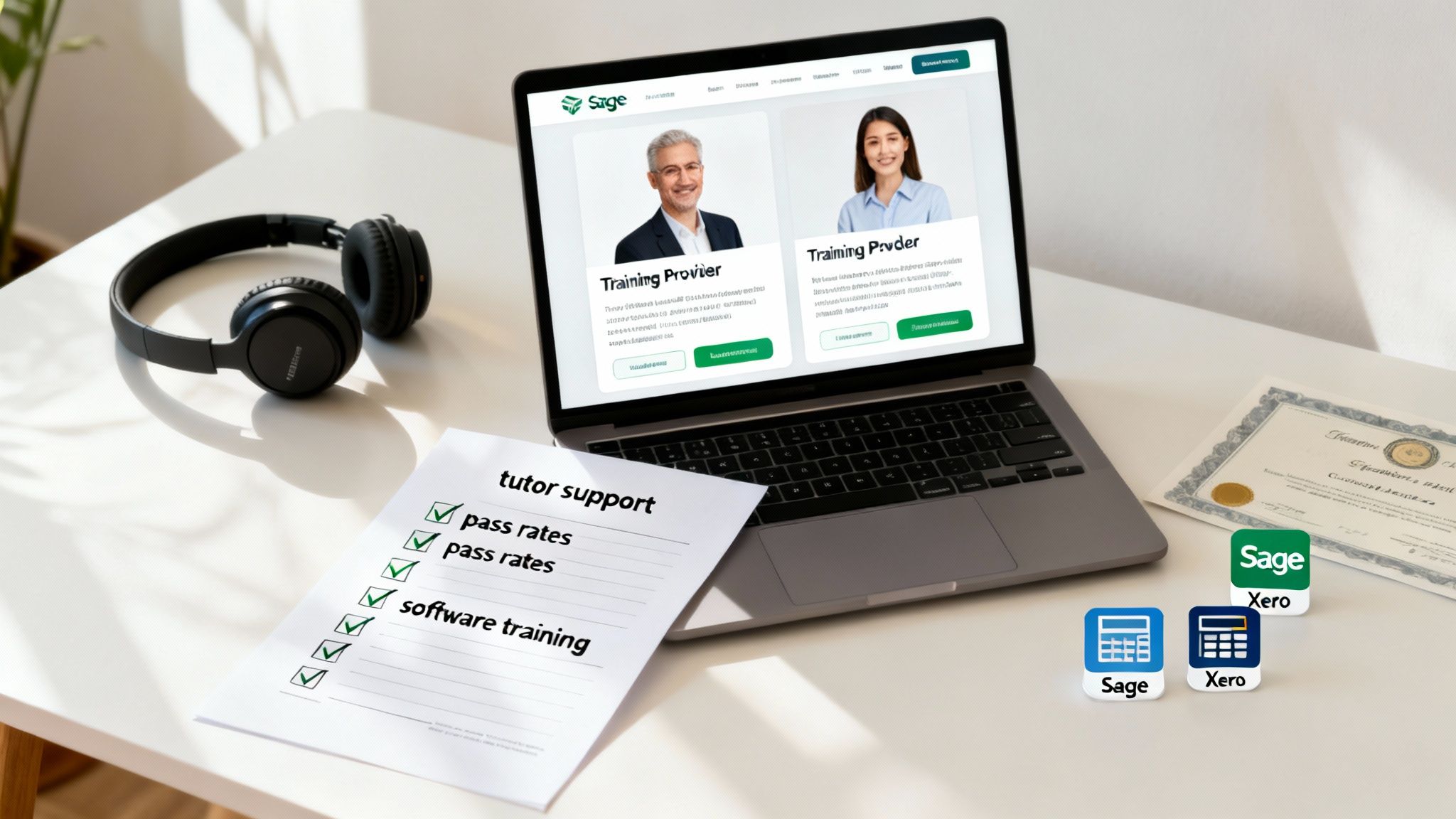
Picking an AAT Level 2 distance learning provider is one of the biggest decisions you’ll make on your journey into finance. It’s easy to think all courses are the same, but your choice of partner can be the difference between just getting a certificate and actually launching a successful career.
You’re not just buying a course; you’re investing in a support system. The right provider does more than just hand over learning materials. They become your mentor, your tech support, and your career coach all rolled into one. With so many options out there, it’s vital to know what to look for to make sure your time and money are well spent.
What Really Matters In A Training Provider
When you start comparing providers, you can quickly get lost in a sea of features and promises. To cut through the noise, you need to focus on what will directly impact your success: the quality of the support, the practical skills you’ll learn, and the provider’s track record.
First things first, make sure any provider you’re considering is AAT-approved. This is non-negotiable. It’s your guarantee that their course materials and teaching standards have been officially checked and meet the high standards set by the AAT. You can verify this in a couple of minutes on the AAT’s official website.
Next, you need to dig into the level of tutor support. This is where providers really differ. Some offer little more than email assistance, which can feel incredibly isolating when you’re stuck on a tricky concept. The best providers, like Professional Careers Training, offer one-to-one sessions with ACCA-qualified accountants, giving you expert, personal guidance exactly when you need it.
Beyond The Syllabus: Software and Career Support
An AAT qualification gets your foot in the door, but it’s practical software skills that make you instantly valuable to an employer. Just look at any job advert for an Accounts Assistant or Bookkeeper—they almost always ask for experience with programs like Sage, Xero, or QuickBooks.
A top-tier training provider will weave this software training right into your course. This hands-on experience means you’re not just learning the theory of bookkeeping; you’re learning how to do it using the exact tools businesses rely on every single day. This combination—AAT knowledge plus software skills—puts you leagues ahead of other candidates.
The ultimate goal of your AAT Level 2 distance learning course isn’t just to pass exams; it’s to secure a great job. Your training provider should be an active partner in helping you achieve that outcome.
This is where career support makes all the difference. Look for providers that offer services that go beyond the curriculum, such as:
- CV preparation workshops to help you show off your new skills.
- Interview coaching to build your confidence and help you shine.
- Recruitment support and connections with real employers.
These services bridge that critical gap between getting qualified and getting hired, turning your course from an expense into a genuine career investment. If you’re weighing your options, our guide on how to choose the right training course for your career goals offers some more detailed advice.
Comparing Distance Learning Provider Features
To help you properly size up different providers, here’s a quick checklist. It highlights the key features that separate a standard course from an exceptional one that truly sets you up for success.
| Feature | Why It Matters | What Professional Careers Training Offers |
|---|---|---|
| Tutor Support | Personalised guidance is key to overcoming challenges and staying motivated. Generic support can lead to frustration. | Unlimited one-to-one support from qualified accountants, available evenings and weekends to fit your schedule. |
| Software Training | Employers expect practical skills. Without software training, you are only half-prepared for the modern workplace. | Official certification training for Sage, Xero, and QuickBooks, including software support and installation. |
| Pass Rates | A high pass rate is a strong indicator of quality materials and effective teaching support, showing the provider delivers results. | We pride ourselves on consistently high pass rates, reflecting the quality of our dedicated tutor support. |
| Flexibility | Your study plan needs to fit your life. Rigid timetables can be a major barrier to completion for working adults. | Fully flexible timetables, allowing you to create a schedule that works for you. |
| Career Services | A qualification is the first step. Getting a job is the goal. Career support helps you cross the finish line. | Dedicated recruitment support, including CV optimisation, job hunting strategies, and direct employer references. |
By focusing on these criteria, you can cut through the marketing fluff and choose a provider that offers not just a course, but a complete pathway into your new finance career.
Your AAT Level 2 Questions Answered
Deciding to start a new qualification is a big step, and it’s completely normal to have a few questions before you commit. When it comes to AAT Level 2 distance learning, you want to be sure it’s the right move for you.
We’ve put together clear, straightforward answers to the most common queries we hear. This section is all about giving you the confidence to move forward, covering everything from what you need to get started to the kinds of jobs that will be waiting for you once you qualify.
Do I Need Any Previous Experience To Start AAT Level 2?
Not at all. Think of the AAT Level 2 Certificate in Accounting as the ground floor of a finance career—it’s designed for absolute beginners. The course assumes you have no prior knowledge, which makes it perfect whether you’re a school leaver, returning to work after a break, or making a complete career change.
The only things you really need are a decent grasp of English and maths, plus basic computer skills. If you’ve got that covered, you’re ready to go. The course will teach you everything else from scratch, building your knowledge one step at a time.
The AAT Level 2 is structured to be an accessible starting line, not a hurdle. Its entire purpose is to open the door to a finance career for people from all backgrounds, regardless of their previous experience.
How Long Does It Realistically Take To Complete While Working?
This is where the flexibility of AAT Level 2 distance learning really shines. Most of our students who are also working manage to complete the qualification in 6 to 12 months. All it takes is a steady 4-6 hours of study per week to make solid progress without feeling burned out.
The trick is to find a rhythm that works for you. Maybe that’s a couple of evenings during the week and a few hours on a Saturday morning. It’s a marathon, not a sprint. That’s why providers like Professional Careers Training offer evening and weekend tutor support—so you never have to put your current job on hold to build your future one.
What Kind of Job Can I Get After Completing AAT Level 2?
Once you have your AAT Level 2 qualification, you’ll immediately become a strong candidate for a range of vital, entry-level finance roles. These are the jobs that keep the accounts department of any business running smoothly, and they’re always in demand across every sector in the UK.
You’ll be well-equipped to apply for job titles like:
- Accounts Assistant: Supporting the wider finance team with daily tasks.
- Bookkeeper: Learning the ropes of managing financial records, including VAT returns.
- Purchase or Sales Ledger Clerk: Focusing on invoices and tracking payments.
- Payroll Administrator: Assisting with payroll calculations and ensuring everyone gets paid correctly.
At Professional Careers Training, we don’t just leave you with a certificate. We actively help you bridge the gap between learning and earning with dedicated recruitment support, helping you polish your CV and land that crucial first role.
Are The Exams Difficult and Are They Online?
The exams are designed to be a fair assessment of the practical skills you’ve learned, not to trip you up. Every exam is computer-based and takes place at an official AAT-approved assessment centre. With thousands of centres across the UK, you have complete flexibility to book your exams when and where it suits you.
Your training provider makes a huge difference here. A good one will give you plenty of mock exams and practice questions so you can walk into the real thing feeling confident and familiar with the format. With consistent study and proper preparation, the exams are very manageable.
Ready to take the first step towards a rewarding career in finance? At Professional Careers Training, we offer more than just a qualification. We provide the one-to-one support, practical software skills, and dedicated career guidance you need to succeed. Explore our AAT Level 2 distance learning course today and build the future you deserve.