If you're training to become a business analyst, or you already work as one, you've probably noticed AI tools turning up in more of your...
Your Essential Guide to Modern Business Analysis
In today’s world, every decision has weight. Knowing how to properly analyse, adapt, and improve isn’t just a useful skill anymore—it’s a business necessity. This guide is your roadmap to the core concepts that help organisations tackle their biggest problems and seize new opportunities. We’ll be diving into a powerful toolkit, covering everything from high-level strategic frameworks to the nitty-gritty of data analysis.
A business analyst is essentially a translator. They bridge the gap between where a company is right now and where its leaders want it to be. This role is absolutely vital for professionals in accounting, finance, and data analytics who want to be the ones driving meaningful change. To really get a grip on modern business analysis, you have to understand the critical soft skills vs hard skills and find the right balance between technical know-how and great communication.
The Core Purpose of Business Analysis
At its heart, business analysis is all about bringing clarity and direction to the table. It helps organisations cut through the noise by focusing on three primary objectives:
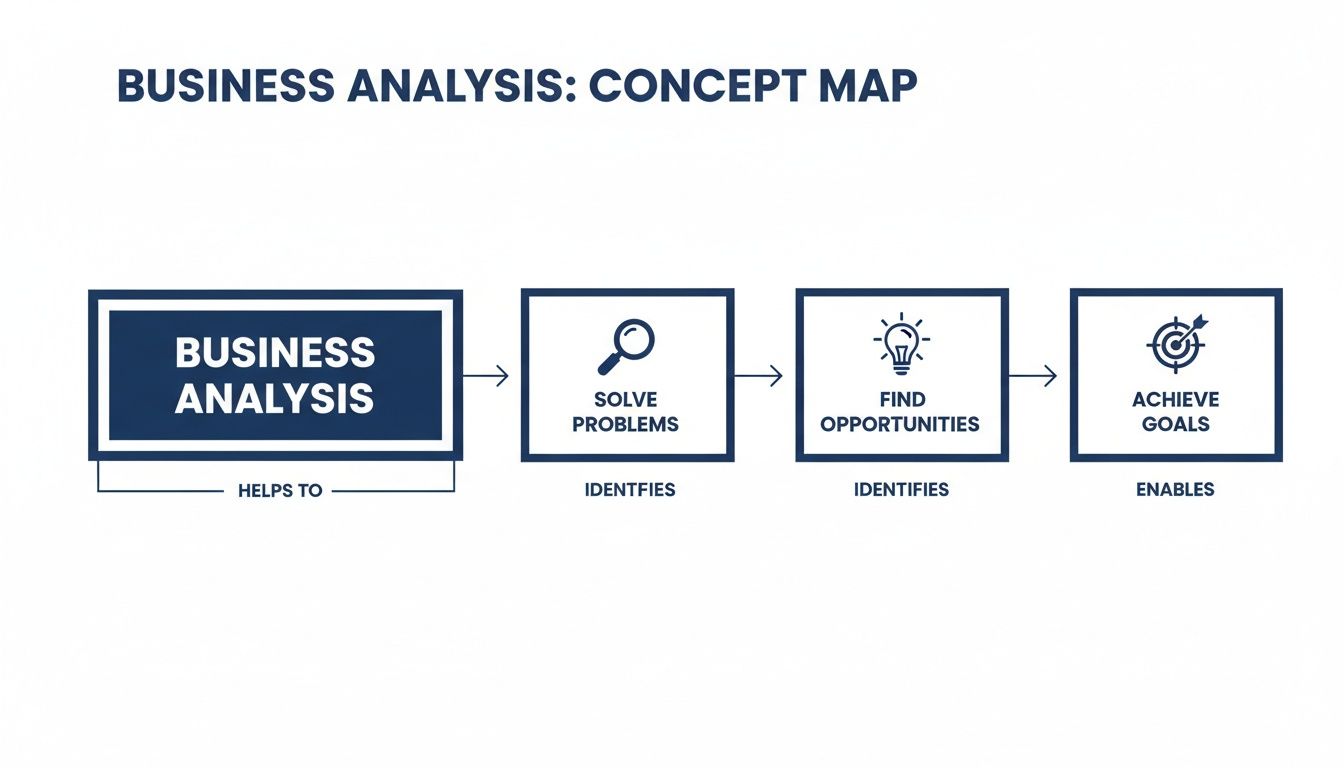
This process shows how an analyst moves from untangling current issues to uncovering potential growth and, ultimately, making sure strategic goals are met. It’s the core value cycle of what we do.
Whether you’re starting a career as an accounts assistant, bookkeeper, or payroll specialist, or aiming to become a business or data analyst, these concepts are fundamental. As you’ll see, getting hands-on training with tools like Excel, SQL, and Power BI is what turns theory into job-ready expertise.
If you’re curious about how this all fits into the bigger tech picture, you might find our guide on how business analyst training prepares you for tech-driven roles useful. By the time you finish this guide, you’ll have a clear framework for applying these methods to create real business value.
Thinking Strategically with Big Picture Analysis
To improve any organisation, you first need to get a clear view of the world it operates in. Strategic business analysis methods are all about providing this essential high-level perspective, helping you understand the market forces and internal dynamics that shape every single decision.
Think of it as the difference between standing on a street corner and looking at a map of the entire city. Both views are useful, but only the map shows you how everything connects. These frameworks help you diagnose a company’s current position before you even think about prescribing changes. They answer the big questions: What are we genuinely good at? Where are we vulnerable? What’s happening out there that could help or harm us?
Getting this big picture right is the foundation for effective problem-solving and sustainable growth.
SWOT Analysis: Uncovering Your Internal Realities
One of the most foundational techniques in any analyst’s toolkit is the SWOT analysis. It’s a straightforward but powerful way to examine the internal factors you can control and the external factors you can’t. SWOT stands for Strengths, Weaknesses, Opportunities, and Threats.
Strengths and weaknesses are internal to the business, while opportunities and threats are external—they exist in the wider market or environment.
- Strengths: What does your company do exceptionally well? This could be a stellar brand reputation, a highly skilled accounts team handling bookkeeping and final accounts, or super-efficient internal processes.
- Weaknesses: Where does the business fall short? Maybe it’s grappling with outdated payroll software, a skills gap in data analysis, or high staff turnover.
- Opportunities: What outside trends could the business ride to its advantage? Think new technologies, changing regulations, or a sudden shift in what clients are asking for.
- Threats: What external factors could cause trouble? This might be new competitors entering the market, a looming economic downturn, or disruptive fintech innovations.
Imagine a small UK accounting firm wants to launch a new business advisory service. A SWOT analysis would force them to look inward at their team’s existing expertise (a definite strength) but also acknowledge their limited marketing budget (a weakness). This kind of honest internal audit is critical for making realistic plans.
PESTLE Analysis: Scanning the External Horizon
While SWOT looks both inward and outward, the PESTLE analysis zooms out to focus exclusively on the external, macro-environmental factors hitting a business. It’s an essential tool for understanding the wider market dynamics and potential risks that are completely beyond the company’s control.
PESTLE is an acronym for:
- Political (e.g., government policies, VAT changes, trade stability)
- Economic (e.g., inflation, interest rates, consumer spending)
- Social (e.g., demographic shifts, changing consumer attitudes)
- Technological (e.g., automation, new accounting software, AI disruption)
- Legal (e.g., employment law, data protection regulations like GDPR)
- Environmental (e.g., sustainability demands, climate change policies)
Let’s go back to our accounting firm. A PESTLE analysis would highlight opportunities like new government grants for small businesses (Political) or threats like the rapid rise of AI-driven bookkeeping platforms (Technological). It provides the vital context needed to make smart, informed strategic decisions.
A recent government study tracking small UK businesses from 2020 to 2023 found that just 14.5% managed to sustain growth over all four years. Despite challenges, training remained a key focus, with 47.2% of firms providing it in 2023, highlighting its importance for improving business performance and adaptability. You can explore the complete findings in the longitudinal Small Business Survey 2023.
These strategic frameworks aren’t just academic exercises; they are practical, everyday tools for any aspiring business analyst, accounts assistant, or payroll specialist. Mastering them equips you to contribute to high-level conversations and guide your organisation with confidence, turning abstract data into a clear, strategic direction.
Mapping and Improving Core Business Processes
Every business runs on processes, from paying an invoice to onboarding a new client. But when these workflows are inefficient, they become silent drains on time, money, and morale. This section explores the essential methods and techniques business analysts use to visualise, analyse, and streamline these critical workflows, turning friction into flow.

Think of a process as a recipe for a specific business outcome. Process mapping is simply writing that recipe down so everyone can see, understand, and improve it.
Visualising Workflows With BPMN
The industry-standard language for this is Business Process Model and Notation (BPMN). It’s a set of universally understood symbols that allows everyone from accountants to IT specialists to read a process map clearly. Using BPMN, you can create a visual flowchart that documents every single step, decision, and outcome.
Take a typical accounts payable process, a key task for any accounts assistant. A BPMN diagram would show things like:
- The starting point (an invoice is received).
- The tasks involved (verifying details, entering data into Xero or QuickBooks).
- The decision points (is the invoice over £1,000 and needs manager approval?).
- The final outcome (the supplier is paid).
This visual clarity makes it so much easier to spot the bottlenecks and inefficiencies that often stay hidden in day-to-day operations. If you’re keen to dive deeper, our guide on modelling business processes provides a great starting point.
Identifying Shortfalls With Gap Analysis
Once you have a clear map of your current process (the ‘as-is’ state), the next step is to envision a better one (the ‘to-be’ state). This is where Gap Analysis comes in. It’s a refreshingly straightforward method for comparing your current reality to your desired future and identifying exactly what’s missing.
The analysis is all about asking three key questions:
- Where are we now? This means documenting the existing ‘as-is’ process in detail.
- Where do we want to be? Here, you define the ideal ‘to-be’ process, which might involve automation or fewer manual steps.
- How do we get there? This is where you pinpoint the specific “gaps” and create an action plan to bridge them.
For an accounts assistant, a gap might be the time wasted manually cross-referencing bank statements. To ensure the integrity of your financial data and support decisive business actions, a thorough understanding of financial reconciliation processes is essential. The ‘to-be’ state could involve using software features to automate this, and the action plan would be to implement and get training on that feature.
Finding The Real Problem With Root Cause Analysis
It’s far too easy to treat the symptoms of a problem without ever finding the cure. If a company constantly pays suppliers late, the symptom is the late payment fee. But the real cause might be much deeper. Root Cause Analysis (RCA) is a technique for digging past these surface-level issues to find the underlying source of a problem.
A simple yet incredibly effective RCA technique is the ‘5 Whys’. By repeatedly asking “Why?” you can drill down from an obvious symptom to an actionable root cause.
Let’s apply this to our late payment problem:
- Problem: We paid a supplier late.
- 1. Why? Because the invoice wasn’t approved on time.
- 2. Why? Because the department head didn’t see the email request.
- 3. Why? Because their inbox is flooded with hundreds of emails daily.
- 4. Why? Because there is no dedicated system for tracking invoice approvals.
- 5. Why? Because we haven’t implemented the approval workflow feature in our accounting software.
Suddenly, the solution isn’t just “try to get approvals faster.” It’s “implement the approval workflow in QuickBooks.” This approach ensures you are fixing the actual problem, not just patching over its effects. Mastering these process-focused business analysis methods and techniques is fundamental for creating lasting operational improvements.
Mastering Stakeholder Needs and Requirements
At its heart, a business analyst is a translator. You take the complex, sometimes conflicting needs of everyone involved in a project and turn them into clear, actionable requirements for the technical teams. When that translation gets lost, projects go off the rails, wasting time, money, and morale.
This part of our guide is all about the people-centric techniques that ensure everyone—from the payroll manager to the lead developer—is on the same page from day one.

Think of it like building a house. Before a single brick is laid, the architect has to understand exactly what the family wants. How many bedrooms? An open-plan kitchen? What’s the flow of the space? Gathering requirements is the business world’s equivalent of that critical design phase.
Identifying Key Players with Stakeholder Analysis
Before you can figure out what people need, you first have to know whose needs actually matter. Stakeholder Analysis and Mapping is your starting point. It’s a methodical way to identify every single person, group, or department that will be affected by a project and then figure out their level of influence and what they expect to get out of it.
This isn’t just about making a list of names. It’s about plotting each stakeholder on a grid based on their power (or influence) and their level of interest in the project. This simple map tells you where to focus your energy.
- High Power, High Interest: These are your key players, like the project sponsor or a Head of Department. You need to manage them closely and keep them in the loop constantly.
- High Power, Low Interest: This group, which might include senior management not directly involved, needs to be kept satisfied. Give them the headlines, not the nitty-gritty details.
- Low Power, High Interest: Think of end-users here, like an accounts assistant or payroll specialist who will use the new system all day. They need to be kept informed and are a goldmine for practical feedback.
- Low Power, Low Interest: This group needs the least effort—maybe just a mention in a company-wide email.
Mapping stakeholders like this helps you build a smart, targeted communication plan, making sure the right people are involved at the right time.
Uncovering The Real Needs With Elicitation Techniques
Once you know who you’re talking to, you need to ask the right questions. Requirements Elicitation is the process of drawing out information from your stakeholders. It’s more of an art than a science because what people say they want isn’t always what they actually need.
Good elicitation uses a mix of different methods:
- Structured Interviews: Formal one-to-one chats are perfect for getting deep, detailed information from key individuals.
- Collaborative Workshops: Getting multiple stakeholders in a room for a facilitated session is a brilliant way to uncover requirements fast and build consensus.
- Targeted Surveys: When you need to gather opinions from a large group, surveys are an efficient tool for collecting quantitative data. This approach has become one of the most vital business analysis techniques for large-scale projects. The Office for National Statistics, for instance, expanded its business research sample to 37,000 businesses in 2022—up from just 4,000—to get a more accurate picture of the UK economy. You can read more about these statistical advancements to see how data gathering has evolved.
The real goal here is to get past the surface-level requests and dig down to the core business problem you’re actually trying to solve.
Crafting Clear and Actionable User Stories
In modern, agile project environments, User Stories are an incredibly popular and effective way to capture requirements from the end-user’s point of view. They use a simple, powerful format that keeps the focus firmly on the value being delivered.
The standard user story format is: “As a [type of user], I want [some goal], so that [some reason].”
This structure might look simple, but it’s packed with value. For example:
- “As a payroll manager, I want to generate a monthly VAT summary report, so that I can complete our tax filing accurately and on time.”
This single sentence instantly tells the development team who the feature is for, what they need it to do, and—most importantly—why it matters. It provides context that a dry, technical spec list just can’t match.
For bigger, more complex features, these stories can be grouped into larger narratives or supported by formal Use Cases, which offer more detailed, step-by-step descriptions of how a user will interact with the system. By mastering these people-focused techniques, a business analyst can ensure that the final product doesn’t just work, but that it solves the right business problem.
Turning Data into Decisive Business Actions
In today’s world, knowing your data is knowing your business. The traditional lines separating a business analyst from a data analyst are fading fast, and a strong command of data is no longer optional—it’s essential for any professional aiming to drive meaningful change. This is where data analysis techniques become a core part of the modern business analyst’s toolkit.
The real skill isn’t just about being a technical wizard. It’s about the ability to interpret numbers, turn them into a clear story, and guide better business decisions. It’s about transforming raw information into a narrative that points towards decisive action. This isn’t guesswork; it follows a structured journey through four distinct levels of analytics.
The Four Levels of Data Analytics
To deliver genuine insights instead of just a spreadsheet full of numbers, a data analyst moves through a logical progression of questions. Each level builds on the last, taking you from a simple look at the past to a strategic recommendation for the future.
These four levels are:
-
Descriptive Analytics (What happened?): This is the foundation of everything. It’s all about summarising past data to get a clear picture of what has occurred. Think of your monthly sales reports or bookkeeping summaries—they describe a reality that’s already happened.
-
Diagnostic Analytics (Why did it happen?): This is the investigative stage. Once you know what happened, you start digging deeper to understand the cause. It involves drilling down into the data, spotting anomalies, and connecting the dots to find relationships.
-
Predictive Analytics (What will happen next?): Using historical data, this level applies statistical models and forecasting to predict what’s coming around the corner. This is where your analysis shifts from being reactive to proactive.
-
Prescriptive Analytics (What should we do?): This is the final and most valuable stage. It takes those predictions and suggests a specific course of action to achieve a goal, often using advanced modelling to recommend the best possible decision.
In the UK, the rise of data analytics has completely changed how companies operate, with the market valued at roughly £5 billion in 2023. This growth shows just how much businesses now rely on methods like these to understand performance and plan ahead. In fact, research shows that organisations using these techniques are five times more likely to make faster decisions than their competitors. You can discover more insights about data analysis methods and their impact on Fortray.com.
A Practical Example: Analysing Client Costs
Let’s walk through how these levels work in a real-world scenario. Imagine an accounting firm notices its client acquisition costs (CAC) have been creeping up, and they need to figure out why.
-
Descriptive: A data analyst fires up Advanced Excel to pull reports from the marketing and sales systems. They create a dashboard showing that the average CAC has jumped by 20% over the last six months. They’ve answered, “What happened?”
-
Diagnostic: To find out why, the analyst uses SQL to query the customer database directly. By joining data from different sources, they discover the cost increase is driven almost entirely by one marketing channel—paid social media ads—which is bringing in fewer high-value clients. They now know, “Why it happened.”
-
Predictive: Next, the analyst builds a simple forecast model. It predicts that if spending continues on the same path, the CAC will climb another 15% in the next quarter, putting serious pressure on profitability. They have answered, “What will happen next?”
-
Prescriptive: Finally, the analyst uses Power BI to build a compelling visual story for management. The dashboard doesn’t just show the problem; it models two alternative scenarios. The recommendation? Reallocate 50% of the social media budget to more profitable channels to bring the CAC back in line. They have answered, “What should we do?”
This example shows how essential tools map directly to the analysis process. Excel is perfect for that initial exploration, SQL is vital for digging deep into the data, and Power BI is the key to presenting insights that get people to act. These business analysis methods and techniques are what transform an analyst from a simple data reporter into a trusted business advisor.
Choosing the Right Business Analysis Tool for the Job
Knowing which tool to use for a specific task is a massive part of being an effective analyst. It’s not about mastering every single piece of software out there, but about building a versatile toolkit that lets you tackle any problem that comes your way.
The table below breaks down some of the most critical tools in the business and data analysis world, showing what they’re best for and how they align with the skills you’ll build in our courses, whether focused on being an accounts assistant, a business analyst, or a data analyst.
| Tool | Primary Use in Business Analysis | Key Techniques Supported | Relevant Training Path |
|---|---|---|---|
| Advanced Excel | Data manipulation, basic modelling, and creating initial reports and dashboards. It’s the go-to for quick descriptive analysis. | Descriptive analytics, data cleaning, pivot tables, basic forecasting, financial modelling. | Practical Data Analyst Course |
| SQL | Extracting, filtering, and aggregating large datasets directly from databases. Essential for deep-dive diagnostic analysis. | Diagnostic analytics, data extraction, database querying, joining multiple data sources. | Practical Data Analyst Course |
| Power BI / Tableau | Creating interactive dashboards and visualisations to communicate complex data stories. The primary tool for prescriptive insights. | Descriptive, diagnostic, and prescriptive analytics, storytelling with data, KPI tracking. | Practical Data Analyst Course |
| MS Visio / BPMN Tools | Visual process modelling and workflow mapping to understand and redesign business processes. Perfect for gap and root cause analysis. | Business Process Modelling (BPMN), workflow analysis, process mapping, gap analysis. | Practical Business Analyst Training |
Ultimately, the right tool depends on the question you’re trying to answer. By equipping yourself with a range of skills—from Excel’s foundational power to the visual storytelling of Power BI—you ensure you’re ready to turn any data challenge into a clear, actionable business strategy.
Building Your Career in Business Analysis
Getting to grips with these business analysis methods and techniques is a fantastic launchpad for a career in finance, accounting, or data analytics. You now have a solid overview of the strategic, process, and data-driven frameworks that are so sought-after in the UK job market. But turning all that knowledge into real capability? That comes from hands-on experience.

This is where practical, career-focused training really makes its mark. Theoretical understanding is the foundation, but employers need professionals who can walk in and deliver tangible results from day one.
From Theory to Employability
Our courses are designed to drop you right into real-world scenarios. We’re all about bridging that gap between academic concepts and what you’ll actually be doing on the job. You won’t just learn about process mapping; you’ll be building workflows using the exact tools employers use in roles like bookkeeping, advanced payroll, and accounts assistant. You’ll also learn the advanced skills needed for business analyst and data analyst careers.
This hands-on approach is so important for a few key reasons:
- You develop practical skills. You’ll work directly with tools like Xero, Power BI, and SQL, building the muscle memory needed for essential tasks like preparing final accounts.
- You build a portfolio. Instead of just talking about what you can do, you can show it. Tangible projects, from data dashboards to process improvement plans, prove your abilities to recruiters.
- It boosts your confidence. Applying these techniques in a supported environment means you’ll be ready to tackle challenges in a live business setting without hesitation.
For anyone serious about this career path, understanding the first steps is crucial. To get a clear roadmap, you might want to explore our detailed guide on how to become a business analyst.
An Ecosystem for Your Career Development
Effective training is much more than just software instruction. We provide a complete ecosystem to support your journey from learning to earning. With personalised support from qualified professionals, you can ask questions and get expert feedback tailored to your progress. Our flexible learning schedules, including weekend and evening options, mean you can upskill without putting your life on hold.
On top of that, our dedicated recruitment assistance helps you find your footing in the competitive UK job market. This includes:
- CV Optimisation: We’ll help you craft a CV that shines a spotlight on your new skills and gets you noticed by hiring managers.
- Interview Coaching: We prepare you for common interview questions, helping you explain your value with genuine confidence.
Investing in CPD-approved training isn’t just about learning a new skill. It’s about building the confidence and competence to become the analytical, problem-solving professional that top UK employers are looking for right now.
When you combine theoretical knowledge with practical application and career support, you create a powerful combination. You’ll not only understand the diverse business analysis methods and techniques but also be able to prove you can apply them to drive real business value.
Your Questions Answered
Diving into business analysis often sparks a lot of questions, especially if you’re just starting out or thinking about getting your skills officially recognised. We get it. To help clear things up, we’ve put together straightforward answers to the queries we hear most often from aspiring analysts.
Think of this as your practical guide to the fundamentals. Let’s get these common questions sorted.
Which Business Analysis Technique Is Best for Beginners?
If you’re new to the field, your best bet is to start with SWOT Analysis and the basics of Requirements Elicitation. They’re a fantastic entry point. SWOT teaches you how to think strategically about a business’s strengths, weaknesses, opportunities, and threats—a core skill for any analyst. It gives you a simple but powerful framework to assess a company from the inside out and the outside in.
At the same time, get comfortable with simple requirements elicitation, like conducting informal interviews or drafting basic user stories. Figuring out what stakeholders actually need is the heart of almost every project. Mastering these two areas gives you a solid foundation in both strategy and communication before you move on to more technical methods like BPMN or complex data analysis.
How Do I Choose the Right Business Analysis Method?
The secret here is that there’s no single “best” method. An experienced analyst is like a skilled tradesperson; they have a full toolkit and know exactly which tool to pull out for the job at hand. The right technique depends entirely on the problem you’re trying to solve.
Here’s a simple way to think about it:
- For big-picture strategic planning? Reach for frameworks like PESTLE and SWOT to understand the wider environment.
- Need to improve a clunky process or find savings? Start with Process Mapping (using BPMN) and Root Cause Analysis.
- Developing a new software feature or system? User Stories and Use Cases are your go-to for capturing what needs to be built.
- Trying to understand performance or predict what’s next? Data Analysis techniques are what you need.
The key is to match your technique to the project’s goals, scope, and the people involved.
Do I Need an IT Background to Be a Business Analyst?
While you don’t need to be a former developer, having strong technical literacy is a massive advantage in today’s world. The core of the role is still about communication and problem-solving, but most business problems today have a technology component. So, no, you don’t need to code, but you do need to be comfortable with technology.
Being proficient in tools like Advanced Excel, knowing how to pull data with SQL, and creating visualisations in software like Power BI is becoming essential. These skills allow you to work more effectively with IT teams and, just as importantly, let you perform your own data-driven analysis without having to wait for someone else. Our data analyst and business analyst training is specifically designed to build these practical tech skills.
How Can I Get Practical Experience Without a BA Job?
This is the classic chicken-and-egg problem, but it’s solvable. First, look for hands-on training that throws you into real-world case studies using the software you’ll be expected to know. Second, consider offering your skills to a non-profit. Many smaller charities would love help analysing their processes or making sense of their donor data.
Third, create your own projects. This shows real initiative. For instance, you could conduct a detailed SWOT analysis on a local company you admire or map out a familiar process, like applying for a university course. Document everything in a portfolio. Bringing that to an interview is a powerful way to show an employer what you can do, not just what you’ve studied.
Ready to turn theory into job-ready skills? Professional Careers Training offers practical, hands-on courses in bookkeeping & VAT, advanced payroll, accounts assistant, final accounts, business analysis, and data analysis designed to get your career started.