If you work in payroll, or you're training to, "statutory payments" is one of those phrases that sounds dry until you realise how much rests...
Is a Career in Accounting Right for You?
Making a big career jump can feel overwhelming, but you are not alone. Many professionals are looking for more stability and purpose, especially when the economy feels a bit shaky. For a growing number of people, switching to accounting is the perfect answer. It is a career that is built to last and far more accessible than you might think.
This is a huge trend across the UK right now. In 2025, an incredible 37% of UK workers are considering a career switch, a massive leap from 29% in 2023. Recruitment experts often call accountancy ‘recession-proof’ because every single business, no matter its size or industry, needs sharp financial oversight to survive and grow. You can dig deeper into these trends over at alumni.lincolncollege.ac.uk.
Beyond the Stereotypes
Let go of that old-fashioned image of an accountant buried under dusty ledgers. The role has completely transformed. Today’s accountants are problem-solvers, business analysts, and trusted advisors who turn financial data into clear, actionable strategy. It has become an exciting, dynamic field for anyone with an analytical mind and a good eye for detail.
The real skills you need are logic, attention to detail, and a knack for problem-solving. It is far more about analytical thinking than it is about advanced maths. Once people realise this, it opens the door for professionals from all sorts of backgrounds to make a successful move into finance.
Your Skills Are More Relevant Than You Think
One of the biggest mental blocks for career changers is the fear of starting from square one. The good news? You are not. Many of the skills you already have from your current or past roles are exactly what accounting firms are looking for.
Think about it:
- Project Management: Have you ever managed deadlines, handled budgets, or led a team? That is exactly what is needed to manage financial projects and client accounts.
- Customer Service: If you have dealt with clients or customers, you have built the communication and relationship skills essential for advisory roles.
- Data Analysis: Ever used a spreadsheet to track team performance or build a report? You have already got a solid foundation in handling and interpreting data.
This guide is here to show you exactly how to make the switch into accounting. We’ll walk you through the qualifications you’ll need, the practical skills employers are crying out for, and how to build a CV that gets you noticed in the UK job market. Your journey to a stable, fulfilling new career starts right here.
Choosing Your UK Accountancy Qualification Pathway
So, you have decided to make the switch to accounting. That is the first big step. The next, and arguably one of the most important, is figuring out which qualification will get you where you want to go. The UK’s accountancy landscape can feel a bit like alphabet soup at first—AAT, ACCA, CIMA—but do not worry. Once you understand who is who, you can pick the path that genuinely fits your background and career goals.
Think of these qualifications less as exams to pass and more as different roads to the same destination. Some are very practical, hands-on routes perfect for someone brand new to finance. Others are designed for people with their eyes on high-level, strategic management roles. Your choice here really does lay the foundation for your entire career.
This little decision tree can help you visualise if an accounting career aligns with your desire for stability and a more strategic role.
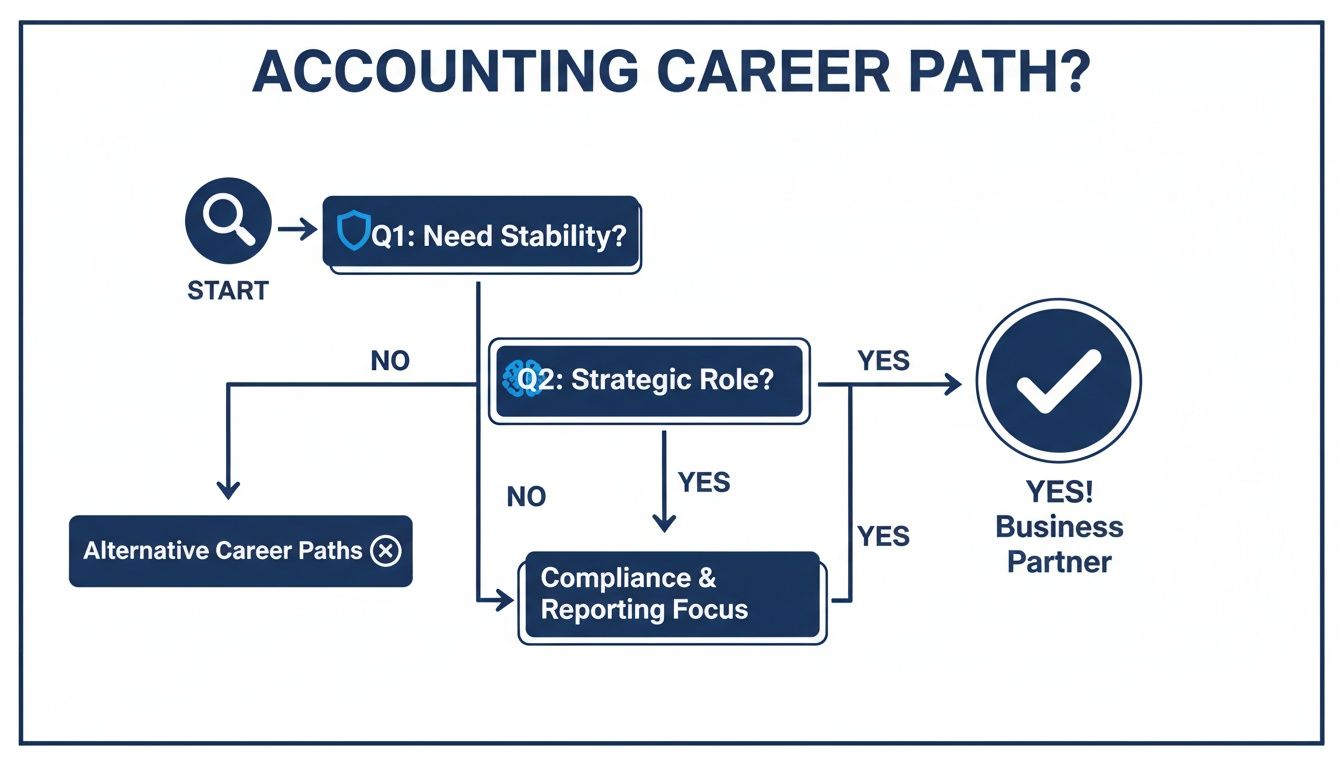
As the flowchart shows, if you are looking for a stable career where you can play a key part in business strategy, accounting is often the perfect fit. It cuts through the noise and focuses on what really motivates people to make this change.
AAT: The Practical Starting Point
For most career changers, especially those coming from a non-finance background, the Association of Accounting Technicians (AAT) is the go-to starting point. It’s respected by employers everywhere and is laser-focused on giving you solid, practical skills you can use on day one of a new job.
The AAT qualification is broken down into levels, which is great because you can jump in where you feel most comfortable and build your knowledge—and confidence—step by step. It is far less about abstract theory and much more about the real-world tasks you will be doing as a Bookkeeper or Accounts Assistant.
- Who it’s for: Anyone without prior accounting experience, school leavers, or professionals from other fields who want a structured, hands-on way into finance.
- What you learn: The essentials—bookkeeping, costing, preparing VAT returns, and using accounting software. As you move up, you’ll tackle final accounts, ethics, and budgeting.
- Where it leads: AAT is a direct route into roles like Accounts Assistant, Payroll Administrator, or Bookkeeper. It’s also a fantastic springboard for going on to become chartered with bodies like ACCA or CIMA later.
ACCA: The Global Chartered Qualification
The Association of Chartered Certified Accountants (ACCA) offers one of the world’s most recognised chartered qualifications. This is the path for those aiming high—think Financial Controller or Finance Director.
Let’s be clear, the ACCA qualification is a serious commitment, but the rewards are huge. It gives you a deep, all-encompassing understanding of finance, covering everything from management accounting and audit to tax and corporate law. You can dive deeper into what’s involved with our guide on how to become ACCA qualified.
An ACCA qualification is not just a piece of paper; it’s a global passport. It signals to employers anywhere that you have top-tier technical skills, solid professional ethics, and a sharp strategic mind, opening doors to the best roles and industries.
CIMA: The Management Accounting Route
What if you are more interested in business strategy, performance management, and helping a company make smarter decisions from the inside? If that sounds like you, the Chartered Institute of Management Accountants (CIMA) is likely your best bet. CIMA is all about preparing you for a career in business and industry, rather than in a traditional accountancy practice.
CIMA-qualified professionals often become Management Accountants, Business Analysts, or Finance Business Partners. Their job is to analyse data and provide insights that guide senior leadership in making crucial strategic moves.
Let’s look at a couple of real-world scenarios:
- Sarah, a Retail Manager: Sarah is great with people and managing budgets but has zero formal finance training. She starts with AAT Level 2 to nail the fundamentals of bookkeeping and VAT. This helps her land an Accounts Assistant role while she continues studying, gaining practical experience and a qualification at the same time.
- David, a Business Graduate: With a degree in business, David wants to get into corporate finance. He’s eligible for exemptions from some of the early ACCA exams, giving him a head start. He finds a trainee accountant position in a large firm, allowing him to earn while he learns and gains the required on-the-job experience.
Comparing Key UK Accountancy Qualifications
To make things a little clearer, this table breaks down the key differences between the main qualifications, helping you compare them at a glance.
| Qualification | Best For | Entry Requirements | Typical Starting Roles |
|---|---|---|---|
| AAT | Career changers without a finance background | No formal requirements to start Level 2 | Accounts Assistant, Bookkeeper, Payroll Clerk |
| ACCA | Aspiring Chartered Accountants with global goals | Two A-Levels and three GCSEs (or equivalent) | Trainee Accountant, Audit Junior, Financial Analyst |
| CIMA | Those aiming for strategic management roles | Same as ACCA, with exemptions for relevant degrees | Trainee Management Accountant, Assistant Cost Analyst |
Ultimately, choosing your qualification is a personal decision. It depends on where you’re starting from, how you like to learn, and where you picture yourself in five years. Do not be afraid to begin with a foundational course like AAT. It provides invaluable practical skills and can always be a stepping stone to chartered status later on, ensuring your career change to accounting is built on a strong, confident footing.
Gaining the Practical Skills Employers Demand

While formal qualifications like AAT or ACCA are your ticket to an interview, they are only half the story. Employers are not just looking for someone who understands accounting theory; they need people who can step in and handle the day-to-day financial tasks that keep a business running.
This is where practical, hands-on skills become your most valuable asset.
For anyone making a career change to accounting, bridging the gap between academic knowledge and real-world application is the most important step. It is the difference between knowing what a VAT return is and being able to confidently prepare and submit one before the deadline.
Core Practical Skills That Make You Hireable
When hiring for roles like Accounts Assistant, companies want to see evidence that you can manage fundamental accounting functions from day one. This means moving beyond textbooks and getting comfortable with the actual processes and software used in a modern finance department.
The key areas to focus on include:
- Bookkeeping & VAT: This is the bedrock of most entry-level accounting roles. It involves maintaining accurate financial records, handling sales and purchase ledgers, performing bank reconciliations, and correctly preparing and filing VAT returns under Making Tax Digital (MTD) rules.
- Advanced Payroll: Managing payroll is a critical responsibility. Practical training should cover everything from calculating statutory pay (like maternity and sick pay) and deductions to understanding RTI (Real Time Information) submissions to HMRC.
- Preparing Final Accounts: This involves taking raw financial data from the year and turning it into formal financial statements, such as the Profit & Loss statement and the Balance Sheet. It demonstrates a much deeper understanding of the full accounting cycle.
Understanding different operational models can also give you an edge. For instance, learning about strategies like outsourcing bookkeeping for small businesses provides valuable insights into efficient financial management that employers appreciate.
To see how these skills are covered in detail, you can explore the hands-on skills you’ll gain from our accounts assistant training.
Mastering Essential Accounting Software
In today’s accounting world, software proficiency is non-negotiable. Manually keeping ledgers is a thing of the past. UK businesses of all sizes rely on cloud accounting software to manage their finances efficiently.
Listing these programmes on your CV is good, but having official certifications is far better. It provides concrete proof to employers that you have been trained and tested on the platforms they use every single day. The “big three” you absolutely must know are:
- Sage: A long-standing favourite in the UK, particularly with small and medium-sized enterprises (SMEs). Sage 50 is a powerful desktop application that many established businesses still rely on.
- Xero: A leader in the cloud accounting space, known for its user-friendly interface. Xero is incredibly popular with start-ups and modern, forward-thinking businesses.
- QuickBooks: Another major cloud accounting platform with a strong global presence. Its features are particularly well-suited to small businesses and self-employed individuals.
Merely knowing about these platforms is not enough. An employer will expect you to be able to navigate the software confidently, set up new clients, process invoices, run reports, and troubleshoot common issues. Certification is the fastest way to prove you have that capability.
Expanding Your Skillset for Future Roles
While the skills above are crucial for your first role, thinking ahead can set you apart. As accounting becomes more data-driven, skills in analysis are becoming increasingly sought after. This is where training in roles like Business Analyst and Data Analyst becomes so valuable.
These positions use financial and operational data to provide insights that guide business strategy. Developing skills in these areas can open up exciting new career paths as you progress.
Consider training in:
- Business Analyst: Learn how to analyse an organisation’s needs, identify problems, and propose effective solutions. This involves mapping business processes and understanding how financial data impacts key decisions.
- Data Analyst: Gain skills in tools like Advanced Excel, SQL, or Power BI. These allow you to extract, manipulate, and visualise large datasets to uncover trends and insights that a standard financial report might miss.
By building a strong foundation in core accounting tasks like bookkeeping, VAT and payroll, and supplementing it with modern software and analytical skills, you transform your profile. You are no longer just a trainee; you become a versatile and valuable candidate ready to contribute from your very first day.
Building Your Profile and Gaining Experience

You have got the new qualifications and the software skills. Now comes the crucial part: packaging it all into a professional profile that gets you noticed. This is not just about a quick update; it is about crafting a new identity that convinces recruiters you are a serious accounting professional, not just someone dipping their toes in a new field.
Your CV and LinkedIn profile are your sales pitch. They need to tell a clear, consistent story that connects your past experience to your future in accountancy. Every word counts, especially when a recruiter might only spend a few seconds scanning your application.
Reframing Your CV for an Accounting Role
Your old CV will not cut it. No matter how impressive it was in your previous industry, it needs a complete overhaul. You have to start thinking like a finance hiring manager.
First, add a punchy Professional Summary right at the top. Ditch the old-school objective and write a 3-4 line pitch that instantly flags your new direction. Mention your recent training, highlight key skills like bookkeeping or Sage proficiency, and state your ambition to launch a career change to accounting.
Next, it is time to tackle your work history. Do not just list your old duties. Instead, translate your transferable skills into the language of business and finance.
-
Instead of: “Handled customer complaints.”
-
Try: “Managed client relationships, resolving complex issues to ensure satisfaction and retention.”
-
Instead of: “Organised team schedules.”
-
Try: “Coordinated project timelines and managed resources to meet critical deadlines, ensuring operational efficiency.”
This simple shift in wording makes a world of difference. It aligns your past achievements with the skills every accounting team needs.
Optimising Your LinkedIn Profile
Think of your LinkedIn profile as more than just a digital CV. It is your chance to actively demonstrate your commitment to this new career path.
Your headline is prime real estate. Change it from your old job title to something aspirational and packed with keywords. Think “Aspiring Accounts Assistant | AAT Qualified | Proficient in Xero & Sage”. This immediately tells recruiters searching on LinkedIn that you are the candidate they are looking for.
Your LinkedIn ‘About’ section is your chance to tell your story. Explain why you decided to change careers. Frame it as a deliberate move towards a field that better suits your analytical and problem-solving skills, showing passion and commitment.
Do not forget to add your new qualifications and software certifications to the “Licences & Certifications” section. It adds instant credibility and makes your profile more searchable. For more tips, check out our guide on how to use LinkedIn for your job search.
Securing Your First Practical Experience
Training gives you the theory, but real-world experience—even a small amount—is what makes your application truly compelling. It proves you can apply what you have learned.
Here are a few routes to get your foot in the door:
- Internships and Placements: Many training providers, including us, have connections with local firms that offer work placements. These are invaluable for getting hands-on experience and a glowing reference.
- Volunteering: Offer your new bookkeeping skills to a local charity or a non-profit. It shows initiative and allows you to start building a portfolio of real work.
- Apprenticeships: An apprenticeship is a fantastic option for career changers, letting you earn while you learn on the job.
The market is competitive. Recent analysis shows that while 58% of managers plan to hire more permanent staff, they are specifically looking for candidates with a blend of tech and finance skills. This makes combining your practical software training with any experience you can get absolutely critical. It is this powerful combination that will turn your career change into a successful new career.
Finding Your First Role in the Accountancy Market
You have put in the hard work, learned the software, and polished your CV. Now comes the exciting part: stepping into the job market. But where do you even start looking when you are new to the field? Knowing the hiring landscape is the key to focusing your search and landing a role where you can really build your career.
The great news is that skilled accounting professionals are in seriously high demand right across the UK. It’s no longer just about the major financial hubs; regional growth is creating fantastic openings far beyond London.
Where the Jobs Are UK-Wide
A recent look at the UK accountancy hiring market shows a massive boom in demand, particularly within commerce and industry. These sectors have seen a 17% surge in hiring, largely driven by regional business growth and new ESG (Environmental, Social, and Governance) reporting rules.
It is not just a London-centric boom, either. While vacancies in the capital are up by 15%, the regions are showing an even stronger 18% increase. Some areas are seeing explosive growth, including the South West (47%), the West Midlands (29%), and Yorkshire & The Humber (37%). You can dive deeper into these trends in this 2025 accountancy market report.
What this all means is that opportunities are everywhere. You do not necessarily need to uproot your life to kickstart your accounting career. Growing businesses in retail, construction, and engineering are all actively looking for fresh talent to join their finance teams.
Realistic Roles to Target
With practical training under your belt, you are perfectly positioned for several key entry-level and junior roles. These jobs are brilliant starting points, letting you apply your new skills and build that all-important foundation of experience.
Here are a few of the main job titles to keep an eye out for:
-
Accounts Assistant: This is the classic, versatile entry point. You will get involved in the day-to-day running of a finance department—things like processing invoices, reconciling bank statements, and managing ledgers using software like Sage or Xero.
-
Payroll Administrator: If you found you have a knack for the detail-oriented work in payroll training, this specialist role is always in high demand. You will be responsible for managing employee salaries, deductions, and making sure all HMRC submissions are spot on.
-
Bookkeeper: This role is perfect if you enjoy the idea of maintaining clean and accurate financial records for small to medium-sized businesses. You will often handle everything right up to preparing VAT returns.
Your transferable skills are your secret weapon. If you come from a customer service background, you will be a natural at credit control. If you have managed projects, you will have no trouble handling month-end processes. Always connect your past experience to what the job description is asking for.
Preparing for the Interview
Getting the interview is a huge win. Now you just need to prove you are the right person for the job. For a career changer, the interview is your chance to shine. It is not just about showing off your new technical knowledge, but also highlighting the valuable skills you have brought with you from your previous career.
Get ready to answer common accounting interview questions, such as:
- “Can you walk me through the process of a bank reconciliation?”
- “What do you understand about Making Tax Digital for VAT?”
- “Which accounting software are you most comfortable with and why?”
For technical questions like these, always use specific examples from your training. Talk about a project where you prepared a set of accounts or processed a complex payroll run using QuickBooks. This shows you have practical competence, not just textbook knowledge.
Most importantly, you need a great answer for why you made a career change to accounting. Frame your story positively. Talk about your search for a role with more stability, your natural aptitude for problem-solving, and how you are genuinely excited for the challenges the profession offers. A compelling, honest story about your journey can be just as impressive as a perfect technical answer.
Your Questions About Changing to an Accounting Career Answered
Making a big career move always brings up a lot of questions. It’s a huge decision, and it’s completely normal to feel a bit uncertain before you jump in. To give you some clarity and confidence, we’ve put together straightforward answers to the queries we hear most often from people thinking about a career change to accounting.
How Long Does It Realistically Take to Change Career to Accounting?
There is no single answer for everyone, but you can definitely map out a realistic timeline. Getting an entry-level qualification like AAT usually takes somewhere between six and eighteen months, depending on how much time you can dedicate to studying.
Once you add in time for practical skills training and a proper, focused job search, it is smart to plan for around one to two years to get fully settled into your first accounting role. Of course, choosing a more flexible or accelerated training programme can often get you there faster.
Do I Need a Maths Degree to Become an Accountant?
This is probably the biggest myth out there, and we’re always happy to bust it. While you obviously need to be comfortable with numbers, the skills that really matter are logic, a sharp eye for detail, and a methodical way of solving problems. It is much more about analytical thinking than it is about advanced calculus.
Any good accountancy qualification will teach you all the specific maths you need. For most entry-level courses, having a good GCSE in Maths is all you will need to get started.
Accounting is often called ‘the language of business’ because it helps show where inefficiencies lie and tells the story of a company’s success. This is about interpretation and strategy, not just complex calculations.
What Are the Initial Costs to Retrain for Accounting?
It is important to be clear about the investment from the start. The main costs you will need to think about are:
- Qualification Registration Fees: These are paid directly to the awarding body, like AAT.
- Exam Fees: You will pay a fee for each exam you sit as part of your qualification.
- Course Tuition: This is the cost of your training programme, which covers all the learning materials and support.
Think of it as a direct investment in a stable, well-paid, and in-demand career. Many training providers also offer flexible payment plans or financing options, which can make the costs much more manageable by spreading them out over time.
Can I Train for an Accounting Career While Working Full Time?
Absolutely. In fact, this is how the vast majority of career changers do it. The training industry has really adapted to what working professionals need, so you will find plenty of flexible learning options. For additional insights into common challenges and solutions during a professional transition, you might consult a resource with general career FAQs.
Look for providers that offer evening classes, weekend workshops, or fully online, self-paced courses. These programmes are specifically designed to fit around a full-time job, letting you build new skills and get qualified without having to give up your current income.
Ready to take the next step in your career change to accounting? At Professional Careers Training, we provide the practical, hands-on training and recruitment support you need to succeed. Explore our courses and find your path to a new career today.