
If you work in payroll, or you're training to, "statutory payments" is one of those phrases that sounds dry until you realise how much rests...
Why Management Accounts Are Your Business Compass
Think of management accounts as the live dashboard for your company’s financial health. Unlike the year-end statutory accounts, which are a historical snapshot, these regular reports give you the timely information needed to make smart, forward-looking decisions. For any UK business, getting this process right is crucial for navigating today’s market.
These reports do more than just tick a compliance box. They tell the story of your business performance, month by month. They help you spot trends, manage your cash flow, and steer the company towards sustainable growth. Without them, you are flying blind, reacting to problems long after they have happened instead of getting ahead of them.
The Strategic Edge of Timely Reporting
The real value of management accounts comes from their frequency. A year-end report tells you where you were; a monthly report tells you where you are right now. This immediacy is a game-changer. It allows you to:
- Measure Performance Accurately: Compare your actual results against your budget each month to see what is working and what is not. This is a fundamental skill for anyone in an accounts assistant or management role.
- Secure Funding: When you apply for a business loan, banks and investors will almost always ask for up-to-date management accounts to check your current financial stability.
- Improve Decision-Making: Pinpoint your most profitable service lines or catch rising costs before they spiral out of control. This level of detail is exactly what you need for sharp strategic planning.
The real power of management accounts is turning historical data into a predictive tool. It’s the difference between looking in the rearview mirror and using a GPS to navigate the road ahead.
Skills You Will Develop
Learning how to prepare management accounts builds a strong foundation of practical skills that employers value highly. The process touches on key competencies taught in specialised training, such as the principles of bookkeeping & VAT needed to record transactions accurately.
You will also find that calculating payroll journals deepens your understanding of advanced payroll. Analysing financial statements is a core task for a business analyst or data analyst. This guide walks you through the practical bookkeeping and analysis techniques needed to turn raw numbers into a powerful decision-making tool, putting you on a clear path for career advancement.
Building Your Foundation: The Month-End Close
Think of your management accounts like a house. For it to be solid, the foundations must be flawless. In accounting, that foundation is your month-end close. This is the process where you draw a line in the sand at the end of each month. You must make sure every single transaction is captured, checked, and correctly recorded.
Get this part right, and everything else falls into place. If you skip it or rush it, small errors can quickly snowball into major headaches. It is the disciplined routine that separates messy bookkeeping from meaningful financial reporting.
This simple infographic neatly sums up how we turn raw data into strategic action.
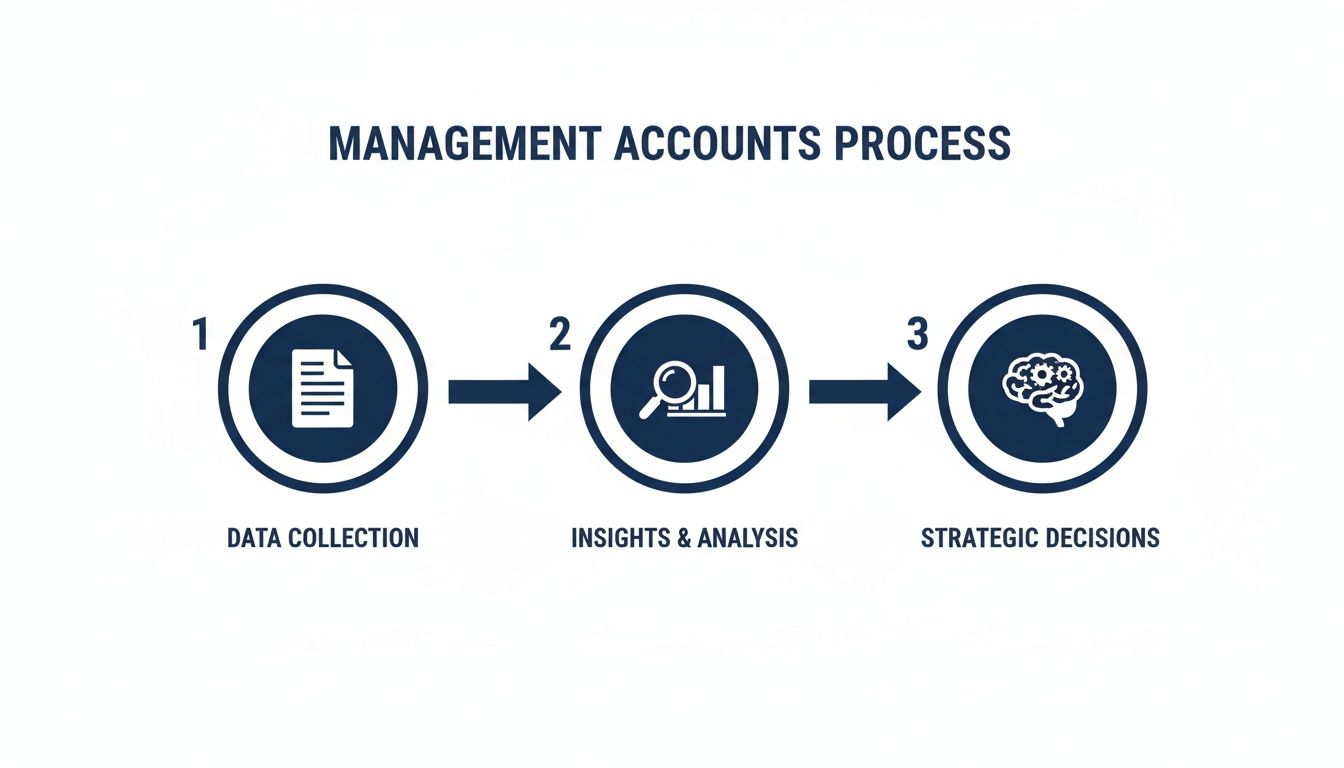
As you can see, it all starts with accurate data collection. Without a solid close, the insights and decisions that follow will always be built on shaky ground.
Your Essential Month-End Close Checklist
When the pressure is on, a systematic checklist becomes your best friend. It is not about mindlessly ticking boxes. It is about creating a reliable rhythm that ensures nothing gets missed.
For anyone just learning the ropes, a structured list is a game-changer. It cuts down on stress and massively improves accuracy. Every business is a bit different, so you will want to tweak this over time. But there are some universal, non-negotiable tasks you’ll find everywhere.
To help you build an efficient and accurate process, here’s a checklist covering the core tasks you’ll need to complete every month.
| Task | Objective | Key Action |
|---|---|---|
| Bank & Card Reconciliations | Confirm your cash position is 100% accurate. | Match every transaction on your bank statements to an entry in your accounting software (e.g., Xero, Sage, QuickBooks). |
| Sales & Purchase Invoices | Ensure all revenue and costs for the period are captured. | Verify all sales invoices have been raised and sent; enter all received supplier invoices. |
| Payroll Journals | Accurately reflect staff costs for the month. | Post the journal entry for gross wages, PAYE, National Insurance, and pension contributions. |
| VAT Reconciliation | Confirm the VAT liability or refund is correct. | Reconcile the VAT control account to ensure the amount owed to or from HMRC is accurate. |
Using a checklist like this not only keeps you organised but also provides a clear audit trail. This demonstrates a robust and controlled finance process.
Dealing with Late Invoices: A Common Hurdle
So, what do you do when a supplier invoice for work done in January lands on your desk in early February, after you’ve closed the month? It is one of the most common challenges you will face.
The one thing you don’t do is just post it into February. That would distort the profitability of both months. It would make January look better than it was and February worse. The correct approach is to use an accrual—something we will dive into in the next section. For now, the key takeaway is that your month-end close process should include actively looking for these missing costs.
Why Lenders Value a Disciplined Close
A clean and timely month-end process is not just for your own benefit. It sends a powerful signal to the outside world, especially when you’re looking for funding. Lenders see organised, up-to-date records as a sign of financial discipline and good management.
The British Business Bank highlights monthly management accounts as a critical tool for success. They are almost always requested during funding applications. Having these prepared and ready to go can seriously speed up loan approvals, giving lenders the confidence they need in your company’s performance and stability.
A consistent, accurate month-end close is the hallmark of a well-managed finance function. It builds trust not only with management but also with banks, investors, and other external stakeholders.
Key Control Account Reconciliations
Beyond the bank, there are several other crucial balance sheet accounts, known as control accounts, that you absolutely must reconcile every single month. These are your internal safety nets, designed to catch errors before they ripple through your reports. Getting your head around what reconciliation in accounting is is a fundamental skill for any accounts professional.
Your must-do list of reconciliations should include:
- Sales Ledger Control Account (Debtors): Does the balance in your general ledger match the total on your aged debtors report? If not, there is likely an error in a sales invoice or receipt posting that needs investigating.
- Purchase Ledger Control Account (Creditors): The same principle applies here. This account’s balance must agree perfectly with your aged creditors report.
- Wages Control Account: After you post the payroll journal, this account should clear to zero. If it does not, it means the net pay and liabilities have not been accounted for correctly.
- VAT Control Account: This check ensures the VAT you’ve charged on sales and reclaimed on purchases is correctly calculated. This leaves a balance that reflects what you expect to pay or get back from HMRC.
Getting to Grips with Month-End Adjustments
Once your day-to-day transactions are logged and reconciled, the real craft of management accounting begins. This is where you shift from simple bookkeeping to applying principles that paint a true picture of your company’s performance. The key? Month-end adjustments, or journals.
These adjustments ensure you stick to the matching principle, a cornerstone of accrual accounting. In short, it means you must match revenues with the expenses used to generate them in the same period, no matter when the cash actually moves. Getting this right is a fundamental skill for everyone, from an accounts assistant just starting out to a seasoned financial controller.

Unpacking Accruals and Prepayments
Accruals and prepayments are two of the most common—and often confusing—adjustments you’ll handle. Think of them as two sides of the same coin. Both are designed to get costs and revenues into the correct month.
An accrual is for a cost you’ve already benefited from but have not been invoiced for yet. The classic example is your monthly electricity bill. You used the power in March, so the cost belongs in March’s Profit & Loss (P&L), even if the invoice does not arrive until mid-April. You post a journal to accrue for this estimated cost.
A prepayment, on the other hand, is when you have paid for something upfront that covers a future period. Your annual business insurance premium is a perfect example. Paying it in January does not mean the whole cost should hit January’s P&L. Instead, you “prepay” the cost on your Balance Sheet and then release one-twelfth of it to the P&L each month.
Getting accruals and prepayments right is the difference between a reactive cash report and a proactive financial statement. It’s about reflecting economic reality, not just cash movement.
A Practical Example: Posting an Accrual
Let’s imagine your average monthly utility bill is around £500. It’s the end of March, and the bill is nowhere in sight.
To make sure your March accounts are accurate, you would post this journal:
- Debit the Electricity expense account in your P&L with £500. This correctly records the cost in March.
- Credit the Accruals account on your Balance Sheet with £500. This creates a liability, showing you owe this amount.
When the real invoice for, say, £520 arrives in April, you simply reverse the original accrual and post the actual invoice. This keeps the cost perfectly matched to the period it belongs in.
Handling Depreciation and the Fixed Asset Register
Another non-negotiable month-end task is depreciation. When your business buys a big-ticket item like a company van or new computer equipment, you don’t expense the entire cost in one go. Instead, you capitalise it on the Balance Sheet as a fixed asset and spread its cost over its useful life.
This process rests on two key pillars:
- The Fixed Asset Register: This is your master list of every fixed asset the company owns. It tracks the purchase date, cost, depreciation method, and current net book value. Keeping this register accurate is a critical task, often managed by an accounts assistant and essential knowledge for anyone studying for their final accounts.
- The Depreciation Journal: Every month, you post a journal to record the depreciation charge. A common approach is the straight-line method. For a £30,000 van with a 5-year useful life, you would depreciate it by £500 per month (£30,000 / 60 months).
The journal entry would be to debit Depreciation expense (P&L) and credit Accumulated Depreciation (Balance Sheet). This reduces the asset’s value over time while matching the cost of using it to the revenue it helps generate.
Getting these disciplines right has a much wider impact than just a tidy P&L. Strong financial habits, tracked through management accounts, directly influence cash flow and overall business health. For instance, detailed analysis shows that top-quartile UK accountancy firms have debtor days of just 52 days, compared to 88 for the bottom quartile. That 36-day difference in collecting cash proves how robust financial management, rooted in accurate monthly reporting, separates the best from the rest. You can dig deeper into how billing discipline impacts firms by exploring these UK accounting insights on capsulecrm.com.
Ultimately, these month-end adjustments are what transform a trial balance from a raw list of transactions into a powerful decision-making tool. They provide the accuracy needed for any business analyst or manager to perform meaningful variance analysis and ensure the financial story you tell is both complete and correct.
Assembling Your Management Accounts Pack
Once you’ve posted the month-end adjustments and finalised the trial balance, it’s time to turn those raw numbers into something meaningful. This is where you assemble the management accounts pack—the collection of reports that tells the story of your company’s performance for the period. For anyone eyeing a business analyst or data analyst role, getting this part right is absolutely essential.
The pack is not just a data dump; it is a communication tool. A well-constructed set of reports allows managers to quickly grasp what is going on, spot areas needing attention, and make informed decisions. It bridges the gap between the detailed work of the finance team and the strategic needs of business leaders.

The Core Financial Statements
Every management accounts pack is built around three core financial statements. Each one gives you a different lens through which to view the business’s health.
- Profit & Loss (P&L) Statement: This is the headline report. It shows your revenue, costs, and ultimate profit or loss over a specific period—usually the month and the year-to-date.
- Balance Sheet: This is a snapshot of your company’s financial position at a single point in time, typically the last day of the month. It lists what you own (assets) and what you owe (liabilities), giving a clear picture of your net worth.
- Cash Flow Statement: While the P&L shows profitability, the cash flow statement tracks the actual movement of cash in and out of the business. It’s vital for understanding your liquidity and solvency.
These three statements work together to provide a complete picture. A company can look profitable on its P&L but still run out of cash if it does not manage its customer invoices and supplier payments effectively.
Uncovering the Story with Variance Analysis
Simply presenting the numbers is not enough. The real value comes from variance analysis—comparing your actual results to what you expected. This usually means putting your actual P&L figures side-by-side with the budget or forecast for the month.
This process turns your report from a statement of fact into a diagnostic tool. Why was revenue £10,000 higher than budget? What caused marketing costs to run £5,000 over? Answering these questions is where you, as a finance professional, add immense value. You will need to dig into the reasons behind the variances and provide clear, concise explanations. If you want to dive deeper, you can explore our detailed guide on what variance analysis involves.
The insights you pull from your management accounts are a form of business intelligence reporting. This skill is a core competency for any modern finance role. It moves you from just reporting the numbers to explaining what they actually mean for the business.
Crafting a Compelling Executive Summary
Not everyone reading the management accounts pack is an accountant. That is why the executive summary, or management commentary, is arguably the most important part of the entire report. It is a short, written overview that summarises the key takeaways in plain English.
A good summary should:
- Highlight the key performance headlines (e.g., “Profit for the month was £25k vs a budget of £20k“).
- Explain the main drivers behind any significant variances.
- Point out any emerging trends or potential risks you’ve spotted.
- Recommend actions where necessary.
This commentary is what brings the numbers to life for senior management, giving them the context they need to act.
Visualising Data with Dashboards
In a world saturated with information, visual aids are incredibly powerful. Supplementing your traditional reports with a dashboard can make complex financial data much easier to digest. Tools like Microsoft Power BI or even advanced Excel charts can transform rows of numbers into intuitive graphs and key performance indicator (KPI) visuals.
A dashboard might track metrics like:
- Gross Profit Margin (%) month-on-month.
- Top 10 customers by revenue.
- Debtor days and creditor days.
- Cash balance trends.
This visual approach is particularly valuable for non-finance managers and is a skill highly prized in business and data analyst positions.
An effective management accounts pack does more than just report the past; it provides a clear, actionable roadmap for the future. It’s about delivering insight, not just information.
Software Tips and Common Pitfalls to Avoid
Knowing the theory behind preparing management accounts is one thing, but bringing it to life happens inside your accounting software. Platforms like Xero, Sage, and QuickBooks are the modern accountant’s toolkit. Getting comfortable with them is essential for both speed and accuracy.
Of course, even the best software cannot prevent human error.
This is where practical experience really counts. Understanding the common mistakes people make is just as important as knowing which reports to run. This hands-on knowledge separates a bookkeeper from a trusted financial advisor. It is a core skill we focus on in practical accounting training courses, especially our bookkeeping & VAT program.
Getting the Most From Your Accounting Software
Modern accounting packages are packed with features designed to make preparing management accounts easier. To really benefit, you need to go beyond basic invoicing and bank reconciliations. The right setup can automate huge chunks of your month-end process.
Investing in the right small business accounting software can make a significant difference, as most modern systems offer powerful tools to help you.
Here are a few features to really dig into:
- Tracking Categories (Xero/QuickBooks) or Departments (Sage): This is probably the most powerful tool for deeper analysis. Set up categories to track revenue and costs by department, project, or location. This lets you produce a P&L for each part of the business, which is invaluable information for any manager.
- Repeating Journals: For predictable month-end adjustments like depreciation, prepayments, or even the monthly payroll journal, set them up to repeat automatically. This saves a surprising amount of time and, more importantly, reduces the risk of forgetting to post them.
- Custom Report Layouts: Do not just settle for the default P&L and Balance Sheet reports. Most software lets you create custom layouts, grouping accounts in a way that makes more sense to your managers and adding columns for budget variance analysis.
Your accounting software should be more than just a digital filing cabinet. Treat it as an analytical engine. The more detail you put in, like using tracking categories, the more powerful the insights you can pull out.
Common Pitfalls You Must Avoid
Mistakes in management accounts can lead to some seriously poor business decisions. While every company has its own quirks, some errors crop up time and time again. Just being aware of them is the first step to making sure your reports are reliable.
One of the most frequent issues is the misclassification of expenses. Putting a large capital purchase, like a new server, through the P&L as an IT expense instead of capitalising it on the Balance Sheet will dramatically understate your profit for the month. Likewise, coding personal expenses to the business is a huge compliance risk.
Another classic mistake is failing to reconcile key control accounts. Many people diligently reconcile the bank but completely forget about other crucial balances.
You must always reconcile:
- The VAT Control Account: An unreconciled VAT account is a red flag. It could mean you’re over or underpaying HMRC, which can lead to hefty penalties.
- The PAYE/NI Control Account: This balance must agree perfectly with what you owe from your payroll run. Any difference, no matter how small, points to an error in your payroll journal.
- Directors’ Loan Accounts: These need to be monitored closely. If they become overdrawn, it can trigger some significant and unwelcome tax implications for the director.
The Biggest Mistake? Sending Reports Without Commentary
Perhaps the single biggest pitfall is emailing a manager a pack of reports with no explanation. A spreadsheet full of numbers is just data; it is not information. Without any context, it is almost useless for a non-financial manager.
Your job is not done when the reports are printed. The final, most important step is to add your executive summary or management commentary. Explain what the numbers actually mean. Why is the gross margin down this month? What caused that spike in travel costs? What does the cash flow look like for the next quarter?
This commentary is where you demonstrate your real value. It shows you understand the business, not just the bookkeeping. You can learn more about the practical functions of these platforms by reading about the top software tools we teach in our bookkeeping & VAT course. This is what transforms your technical skills into a strategic asset for any company.
How These Skills Shape Your Accounting Career
Learning how to prepare a solid set of management accounts is much more than just a box-ticking exercise. It is the single most direct path to genuine career progression in accounting. The skills you build are not isolated; they are the bedrock for more senior, strategic roles that make you indispensable to any business.
Think of it as the springboard that launches you from routine bookkeeping into the world of strategic finance. The ability to close a month accurately, post complex journals, and actually analyse the numbers is exactly what employers are looking for when they hire for senior positions. It proves you understand how a business really works.
From Bookkeeper to Strategic Partner
An accounts assistant might spend their days reconciling the bank and processing invoices. But once you can confidently pull together a full set of management accounts, you are operating on a completely different level. You start asking why the numbers look the way they do—and that is the first step towards becoming a true business partner.
This shift opens up several exciting career paths:
- Final Accounts Preparation: Management accounts are the monthly rehearsal for the year-end statutory accounts. Get comfortable with regular adjustments for accruals, prepayments, and fixed assets, and you’ll have a solid foundation for tackling the complexities of final accounts.
- Advanced Payroll Management: Understanding how payroll journals hit the Profit & Loss and Balance Sheet is vital for anyone aiming to specialise in advanced payroll. It connects staff costs directly to overall business performance.
- Bookkeeping & VAT Specialisation: A deep knowledge of the month-end close and control account reconciliations makes you an expert in bookkeeping & VAT. You’ll be the person trusted to ensure total compliance and accuracy.
The Gateway to Analyst Roles
The modern finance professional is also an analyst. The skills you use to dissect a P&L and write management commentary are the exact same skills needed for analyst positions, which are increasingly in demand across the UK.
Preparing management accounts teaches you to find the story within the data. This ability to translate numbers into actionable insights is the core skill of both business and data analysts.
When you dig into why sales are below budget or what is driving up overheads, you are performing business analysis. When you use software to build dashboards and forecast performance, you are stepping into the role of a data analyst. This makes management accounting the perfect training ground for these sought-after career paths.
These roles demand a blend of technical accounting knowledge and commercial awareness—a combination you build every single month. You become the person who not only reports what happened but explains why it happened and recommends what to do next. This proactive, insight-driven approach is what truly shapes a successful and rewarding accounting career.
At Professional Careers Training, we provide the practical, hands-on training you need to master these essential skills and accelerate your career. Our courses in bookkeeping & VAT, advanced payroll, accounts assistant and final accounts are designed by chartered accountants to give you the job-ready expertise employers are looking for. Learn more and enrol at https://professionalcareers-training.co.uk.