If you're training to become a business analyst, or you already work as one, you've probably noticed AI tools turning up in more of your...
Your Guide to Financial Planning Fundamentals
Let’s use an analogy. Imagine you’re planning a big road trip across the country.
Your budget is the detailed, pre-planned itinerary. It’s a carefully crafted document listing every expected cost, from petrol and hotels to food and attraction tickets. You create this plan before you even start the engine. It’s a static, approved guide that dictates how you’ll spend your money to reach your destination without any nasty surprises.
Forecasting, however, is like checking the live traffic reports and long-range weather updates while you’re on the road. It doesn’t change your final destination, but it gives you a heads-up about potential storms, roadblocks, or clear stretches ahead. This real-time information helps you adapt—maybe you take a different route to avoid a jam or decide to stop earlier for the night because of bad weather. Forecasting is dynamic; it gives you the foresight to react to changing conditions.
The Foundation of Financial Careers
For anyone building a career as an Accounts Assistant, Business Analyst, or in Advanced Payroll, a solid grasp of budgeting and forecasting is essential. These aren’t just about crunching numbers; they’re about delivering the insights that steer a business towards profit and stability. Practical training courses are designed to build these exact skills.
- For Bookkeeping & VAT specialists, accurate budgets are essential for managing cash flow and ensuring VAT obligations are met on time. Training in this area ensures you can handle company funds responsibly.
- For Business and Data Analysts, forecasting is a critical tool for spotting trends, modelling different scenarios, and turning raw data into powerful business intelligence. Courses focused on data analytics provide the skills needed to make these predictions.
- For aspiring Accounts Assistants, understanding the budget is key to processing invoices, tracking expenses, and preparing reports that measure how the company is performing against its plan. An accounts assistant course covers these day-to-day duties.
A budget gives you control by setting clear financial targets and allocating resources. A forecast provides strategic insight by predicting future performance and flagging potential risks or opportunities. Both are absolutely essential for sound financial management.
When you master these skills through practical training, you stop being just a number-cruncher and become a strategic partner in the business. You gain the ability to not only report on what’s already happened but to actively influence what happens next.
To make the distinction crystal clear, the table below offers a quick side-by-side comparison.
Budgeting vs Forecasting At a Glance
This quick-glance table summarises the core differences, helping you instantly see how each function contributes to a company’s financial health.
| Characteristic | Budgeting | Forecasting |
|---|---|---|
| Purpose | To plan and control operations and spending. | To predict future performance and inform decisions. |
| Timeframe | Fixed, usually for one financial year. | Flexible, can be short-term (monthly) or long-term. |
| Flexibility | Static and rarely changed once approved. | Dynamic and updated regularly with new information. |
| Focus | Outlines desired financial outcomes and goals. | Estimates probable financial outcomes. |
As you can see, one is about setting a firm plan (the budget), while the other is about looking ahead and adjusting to reality (the forecast).
Budgeting vs Forecasting: A Deeper Comparison
At first glance, budgets and forecasts seem to do the same thing—they both deal with a company’s financial future. But dig a little deeper, and you’ll find they play fundamentally different roles. They answer two distinct, yet equally vital, questions every business needs to ask.
A budget asks, “What do we plan to achieve?“
A forecast asks, “What is likely to happen?“
One is a rigid plan you measure yourself against; the other is a dynamic prediction that helps you navigate the road ahead. For anyone training to be an accounts assistant or business analyst, getting this distinction right is the first step towards effective financial management. The budget gives you control, while the forecast gives you the foresight to be agile.
Think of it like this: a budget is your fixed road map for a journey, while a forecast is the live weather report telling you what conditions to expect along the way.
This visual reinforces the core idea. You set a deliberate course with a budget based on your goals, but you use forecasting to anticipate and react to the changing conditions you’ll inevitably face.
Purpose: Control vs Agility
A budget’s main job is control and performance measurement. It’s a static document, usually locked in for a financial year, that assigns resources, sets clear spending limits, and defines revenue targets for every department. It’s the official benchmark you measure actual results against.
Forecasting, on the other hand, is all about agility and decision-making. It’s a living document, updated regularly—often monthly or quarterly—to reflect the latest information. This could be fresh sales data, unexpected market shifts, or sudden changes in operating costs. Training for a business analyst role will heavily focus on developing these agile forecasting skills.
To really get a grip on financial performance and understand why you’re hitting or missing your targets, a detailed Budget vs Actual analysis is essential.
Inputs and Creation Process
Putting a budget together is a deliberate, detailed, and often lengthy process. It requires input from every department head and must align perfectly with the company’s long-term strategic goals.
- Budget Inputs: Primarily built on historical data, strategic objectives, and detailed departmental plans.
- Forecast Inputs: Uses recent actuals, real-time market data, economic trends, and current operational metrics.
Because a forecast is a prediction, it naturally pulls from a much wider set of external data. For instance, a data analyst might factor in new economic indicators or emerging industry trends to refine sales predictions—variables a static budget wouldn’t typically account for. This is a core competency taught in data analyst courses.
A budget is an expression of what a business wants to happen, based on its goals and plans. A forecast is a projection of what is likely to happen, based on current reality and future expectations.
A Real-World UK Example
Let’s imagine a UK-based retail company planning for the all-important Christmas trading season.
- The Budget: Created months ahead of time, their budget would set a firm sales target of £5 million for December. It would allocate specific amounts for seasonal staff, marketing campaigns, and buying extra stock. This budget is the master plan.
- The Forecast: In October, a rolling forecast might predict that sales are more likely to hit £4.5 million due to recent reports on weak consumer confidence. This insight allows management to adjust stock orders and marketing spend before it’s too late, preventing the business from being stuck with excess inventory and wasted resources.
This example shows how the two work together perfectly. The budget provides the goal, while the forecast provides the real-time intelligence needed to steer the ship effectively. This interplay is a key topic in courses on preparing final accounts, where understanding the full financial picture is paramount.
Exploring Key Budgeting and Forecasting Methods
Once a business gets its head around the core differences between a budget and a forecast, the next question is obvious: how do you actually build one? In practice, finance professionals rely on several distinct methods, each with its own strengths and ideal scenarios. Picking the right approach is a crucial skill, one that’s honed in advanced accounting and business analysis training.
The method you choose will come down to your organisation’s circumstances. A stable, established company has very different needs to a fast-growing startup where every penny must be justified from the ground up. Let’s walk through four of the most common techniques you’ll find in UK businesses.
Incremental Budgeting
This is probably the most straightforward and widely used method out there. Incremental budgeting takes last year’s actual financial results as a starting point, then simply adds or subtracts a percentage to account for expected changes like inflation or modest growth.
For example, a mature manufacturing firm that spent £100,000 on marketing last year might simply increase it by 5% for the upcoming year. That gives them a new budget of £105,000. Simple.
- Advantage: It’s quick, simple, and easy for everyone to understand, making it perfect for stable organisations with predictable revenue streams.
- Disadvantage: Its biggest weakness is that it can encourage wasteful spending. It assumes last year’s costs were necessary and doesn’t challenge any existing inefficiencies.
You’ll often find this approach covered in bookkeeping and accounts assistant courses precisely because it’s so common in small and medium-sized enterprises (SMEs).
Zero-Based Budgeting
In complete contrast to the incremental method, Zero-Based Budgeting (ZBB) forces you to start from scratch every single year. Instead of just tweaking last year’s figures, each department must justify every single expense from a “zero” base, proving its value for the upcoming period.
A rapidly scaling tech startup is a perfect candidate for ZBB to maintain strict cost control. The marketing team can’t just ask for a 10% increase; they must build a compelling case for every pound, linking each proposed cost directly to a specific business goal, like customer acquisition.
Zero-Based Budgeting forces a critical evaluation of all spending, eliminating outdated costs and reallocating resources to the highest-value activities. It’s more time-consuming but leads to a much leaner, more efficient financial plan.
Rolling Forecasts
While the first two methods are all about budgeting, rolling forecasts are a powerful forecasting technique. Instead of creating a single, static forecast for the year and leaving it, a rolling forecast is continuously updated.
As one month or quarter ends, a new one is added to the end of the forecast period. A business might maintain a constant 12-month forward view, so in April, the forecast already extends to March of the following year. This keeps the outlook fresh and relevant.
This continuous updating gives management a live picture of expected performance, allowing them to react much faster to market shifts. For anyone interested in performance management, check out our guide on what is variance analysis to see how these forecasts are measured against actual results.
Driver-Based Forecasting
Finally, Driver-Based Forecasting connects financial predictions directly to key operational metrics, or “drivers.” Instead of just forecasting sales revenue in isolation, this method links it back to tangible business activities.
For instance, a data analyst might discover that sales are directly correlated with the number of website visitors and the conversion rate. To forecast future sales, they would focus on predicting those two drivers first, creating a much more accurate and insightful model. This technique is a cornerstone of modern business and data analyst training courses, which emphasise data-driven decision-making.
Essential Tools and Software for Modern Finance
Knowing the methods behind budgeting and forecasting is one thing, but bringing them to life requires the right set of tools. Today’s finance professionals rely on a powerful mix of software to turn raw data into actionable plans and predictions. From the trusty spreadsheet to advanced business intelligence platforms, the technology you master will directly shape your career path.
For anyone pursuing training in roles like an accounts assistant, payroll specialist, or data analyst, becoming proficient in these platforms is essential. It’s not just about understanding the theory of “what is budgeting and forecasting”; it’s about having the practical skills to execute these tasks efficiently. Employers across the UK are actively looking for candidates who can hit the ground running with the industry’s preferred software, a key focus of vocational training courses.
The Ever-Reliable Spreadsheet
Microsoft Excel remains the bedrock of financial planning for millions of businesses, and for good reason. Its flexibility is its greatest strength. You can build anything from a simple departmental budget to a complex financial model with multiple scenarios.
For an aspiring bookkeeper, Excel is often the first tool they learn for tracking expenses and income against a budget. Advanced payroll courses often use it to demonstrate how to calculate salary projections and associated costs like National Insurance and pension contributions. While dedicated software often handles the final processes, Excel is indispensable for ad-hoc analysis and initial planning.
Dedicated Accounting Software
As businesses grow, they almost always move from spreadsheets to dedicated accounting software. These platforms integrate budgeting and forecasting features directly into their financial ecosystem, creating a single source of truth. Three names dominate the UK market for small to medium-sized enterprises.
- Sage: A long-standing favourite in the UK, Sage offers robust tools for creating detailed budgets, managing cash flow, and generating variance reports. An accounts assistant might use Sage 50 to assign budget codes to different departments, ensuring all spending is tracked against the plan.
- Xero: Known for its user-friendly, cloud-based interface, Xero makes collaborative budgeting simple. A business owner or financial manager can easily set budgets and view real-time performance dashboards, making financial data accessible to non-accountants.
- QuickBooks: Similar to Xero, QuickBooks provides excellent cloud-based accounting with intuitive budgeting tools. It’s particularly strong in creating profit and loss budgets and running forecast scenarios to see how potential decisions could impact future finances.
Official certifications in Sage, Xero, or QuickBooks are a major advantage in the UK job market. Practical training courses that offer these certifications demonstrate to employers that you have hands-on experience with the exact tools they use daily.
Business Intelligence and Data Analysis Platforms
For larger organisations or those with complex data needs, the next step up is Business Intelligence (BI) software. These tools are designed to analyse massive datasets and create interactive, visual reports that tell a story.
Power BI, Microsoft’s leading BI platform, has become a critical tool for modern business and data analysts. Instead of static reports, a data analyst uses Power BI to connect to various data sources (like accounting software and sales systems) to build dynamic forecasting dashboards. This is a highly sought-after skill taught in specialist data analyst courses.
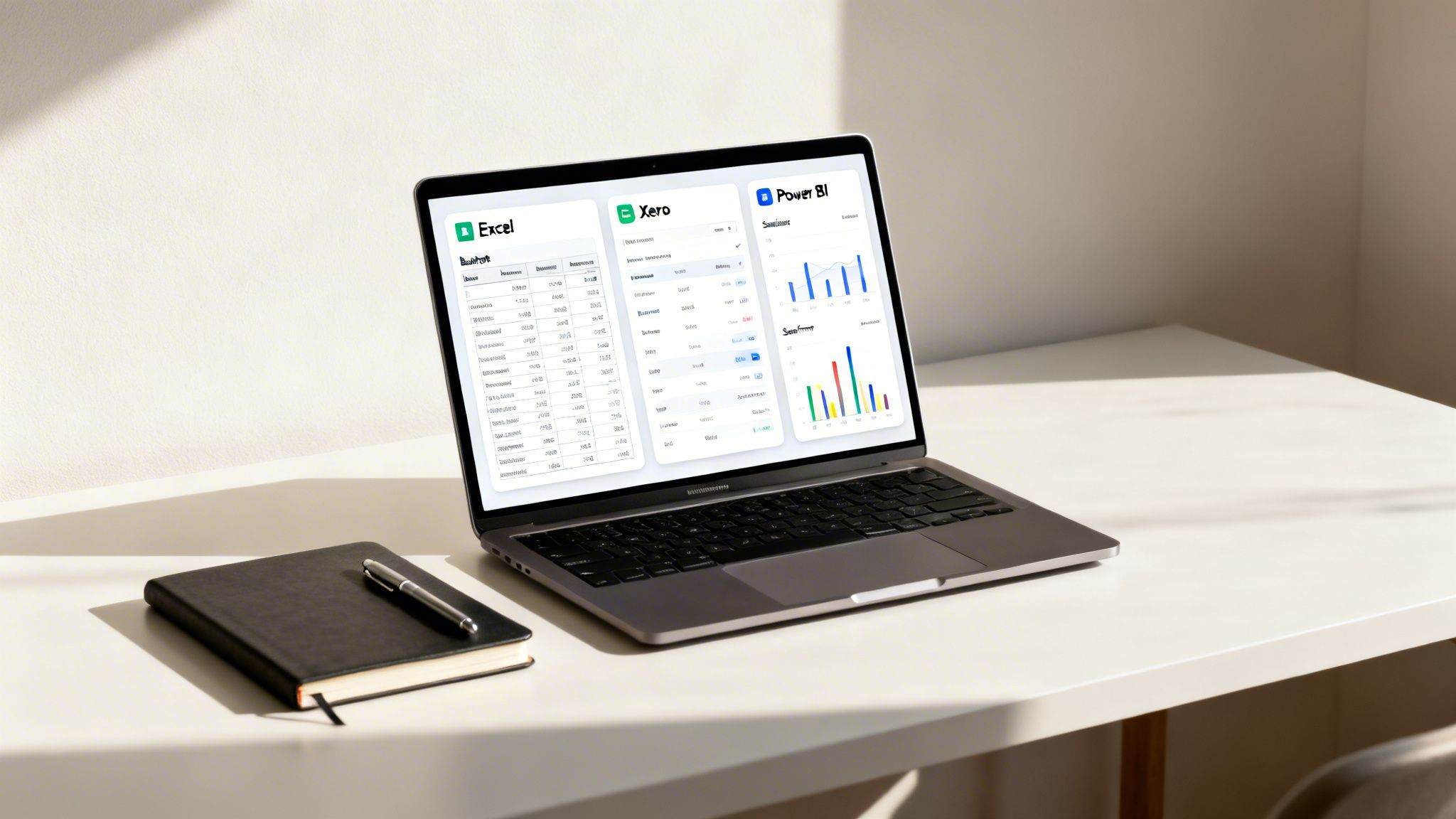
These dashboards visualise key performance indicators (KPIs), allowing users to filter data and drill down into specific details. This turns a forecast from a simple number into a rich, exploratory experience.
Practical Applications Across Different Roles
To see how this all comes together, let’s look at how these tools are used in specific day-to-day tasks:
- Accounts Assistant: Tasked with setting up the annual budget in the company’s accounting software. They would use Xero to import last year’s actuals, apply a 5% increase based on the incremental budgeting method, and then manually adjust specific lines as directed by management.
- Business Analyst: Asked to assess the financial viability of launching a new product. They would use Excel to build a detailed financial model, forecasting sales, costs, and profitability over three years based on market research.
- Data Analyst: Responsible for creating a monthly sales forecast report for the leadership team. They would use Power BI to pull real-time sales data, combine it with historical trends, and present it in a visual dashboard that automatically updates and highlights key variances against the budget.
Choosing the right tool ultimately depends on the complexity of the task and the size of the organisation. But to make yourself a highly versatile and valuable finance professional, you’ll want a foundational knowledge of Excel, proficiency in at least one major accounting package, and a solid understanding of a BI tool like Power BI.
Choosing Your Financial Planning Tool
Deciding which software to learn or implement can feel overwhelming. The table below breaks down the most common tools, highlighting who they are for and what they do best, helping you match the right technology to the right task.
| Tool | Best For | Ideal For Role | Key Benefit |
|---|---|---|---|
| Excel | Ad-hoc analysis, detailed financial modelling, and creating custom budget templates from scratch. | Business Analyst, Financial Planner, Small Business Owner | Unmatched flexibility and universal accessibility. It’s the Swiss Army knife of finance. |
| Xero/QuickBooks | Integrated, real-time accounting, budgeting, and financial reporting for small to medium businesses. | Bookkeeper, Accounts Assistant, SME Financial Manager | Cloud-based collaboration and a user-friendly interface that simplifies daily financial management. |
| Sage | Robust, detailed budgeting, VAT management, and in-depth reporting for established UK businesses. | Accounts Assistant, Management Accountant | Comprehensive features and deep integration with UK accounting standards and payroll. |
| Power BI | Analysing large, complex datasets and creating interactive, visual dashboards for forecasting. | Data Analyst, Business Intelligence Analyst, Senior Manager | Powerful data visualisation that turns complex numbers into clear, actionable insights. |
Ultimately, the best tool is the one that fits the scale of your business and the depth of analysis you need. For aspiring professionals, gaining experience across a few of these platforms is the surest way to build a future-proof skill set.
Best Practices and Common Pitfalls to Avoid
Knowing the theory behind budgeting and forecasting is one thing, but making it work in the real world is where the real skill lies. The difference between an effective finance professional and someone just going through the motions often comes down to understanding best practices—and knowing which common mistakes to sidestep.
Mastering this takes more than just technical ability; it requires professional judgement. This is where structured training in bookkeeping, business analysis, and final accounts proves its worth, giving you the tools to handle the messy, complex scenarios you’ll face every day. Let’s break down a few key principles to keep your financial planning sharp and relevant.

Cultivate Collaboration and Communication
One of the biggest mistakes in financial planning is creating budgets in a silo. When the finance team builds a budget without talking to the people who actually have to deliver on it, the plan is almost always disconnected from reality.
Imagine a finance director sets an ambitious sales target of £2 million for the next quarter, a 15% jump from the last period. The problem? They didn’t speak to the sales team, who know their biggest competitor just launched a huge discount campaign. The result is almost inevitable: the target is missed, morale drops, and the budget becomes useless.
The best approach is to involve department heads from the very beginning. This collaborative method doesn’t just make your numbers more accurate; it creates a powerful sense of shared ownership and accountability across the entire business.
Embrace Regular Reviews and Adjustments
A budget isn’t a document you create in January and forget about until December. Likewise, a forecast built on outdated information is worse than having no forecast at all. The business world moves fast, and your financial plans need to keep up.
- Best Practice: Set up regular variance analysis meetings—monthly is ideal—to compare your actual results to the budget. This isn’t about pointing fingers; it’s about digging into why a variance happened and what that means for the road ahead.
- Common Pitfall: Relying on stale data is a classic error. A forecast made in Q1 using last year’s economic assumptions is probably not going to be reliable by Q3. This leads to poor decisions, like over-ordering stock based on a sales prediction that’s no longer realistic.
The goal of a forecast is not to be perfectly correct, but to be a useful guide for decision-making. Regularly reviewing and adjusting your forecast is essential to maintaining its utility and relevance.
Maintain Realistic Expectations
Ambition is great, but wildly unrealistic budgets and forecasts can be toxic. When you set goals that are impossible to reach, you don’t inspire your teams—you demotivate them and destroy the credibility of the entire financial planning process.
Think of a startup that budgets for massive growth but hasn’t secured the funding or operational capacity to support it. When they inevitably miss their targets, it can create a crisis of confidence among investors and staff.
To keep your plans grounded, it’s crucial to follow established financial modeling best practices. This ensures your predictions are built on solid logic and good data, not just wishful thinking. A well-crafted plan should be challenging but achievable, giving everyone in the organisation a clear and motivating path to follow.
How These Skills Can Transform Your Career
Getting to grips with budgeting and forecasting does more than just make you good with numbers—it turns you into a vital asset for any UK business. Think of these skills as the bridge between raw financial data and smart, forward-thinking business strategy. When you learn to build a solid budget and an accurate forecast through dedicated courses, you provide the critical insights that drive growth, manage risk, and secure long-term stability.
This ability to translate financial information into a clear plan and a reliable prediction is exactly what employers are looking for. It shows you can think strategically, understand the bigger commercial picture, and contribute directly to the company’s bottom line. In a competitive job market, that’s what separates a good candidate from a great one.
Paving Your Way to In-Demand Roles
Proficiency in budgeting and forecasting opens doors to some of the most stable and rewarding careers in finance. These skills are a core requirement for a whole range of roles, each offering a clear path for progression.
- Accounts Assistant: A training course for this role will teach you how to use budgeting skills daily to track departmental spending, check invoices against allocated funds, and help pull together variance reports.
- Business Analyst: A huge part of your job will involve developing financial models and forecasts to see if new projects or business ideas are actually viable. Business analyst courses focus on these modelling skills.
- Data Analyst: You’ll use tools like Power BI to dig into historical data, spot trends, and build sophisticated forecasting dashboards that guide senior leadership, a key outcome of data analyst training.
Even if you’re in advanced payroll or aiming to prepare final accounts, these skills are just as crucial. They let you project salary costs, manage departmental budgets effectively, and contribute to the overall financial health of the organisation.
The Value You Bring to a Business
When you can confidently manage budgeting and forecasting, you deliver real, tangible value. You empower a business to make smarter decisions, put its resources where they’ll have the most impact, and navigate economic uncertainty with far greater confidence. This is why companies are willing to invest heavily in professionals with these proven abilities.
Possessing strong budgeting and forecasting skills means you are no longer just reporting on the past; you are actively shaping the future of the business. This strategic contribution makes you a vital part of the decision-making process.
Practical, certified training is the key to unlocking these opportunities. When you learn to use industry-standard software like Sage, Xero, and Power BI, you prove to employers you have the hands-on skills they need right now. To find out more about the specific competencies employers are searching for, you might be interested in our detailed breakdown of the essential skills needed to become a financial analyst.
Investing in practical courses that give you hands-on experience, CV support, and expert job-hunting guidance is the most direct way to turn your ambition into a successful career. By building a strong foundation in budgeting and forecasting, you aren’t just learning a new skill—you’re building a secure and prosperous future in the world of finance.
Got Questions? We’ve Got Answers
Even when you’ve got the basics down, a few practical questions always pop up. Let’s tackle some of the most common ones to give you that extra bit of clarity for when you’re applying these skills in the real world.
How Often Should a Business Update Its Forecast?
There’s no single magic number here—it really depends on how fast your industry moves and what the business needs. One thing is for sure, though: a static annual forecast just doesn’t cut it in today’s markets.
A monthly review cycle is a solid best practice. It lets management react to new information without getting bogged down in constant updates. For more volatile sectors, a rolling forecast is even better. With this method, you always maintain a 12-month forward view by adding a new month as the current one closes. This is a crucial skill for business and data analysts who are expected to deliver timely, strategic insights.
What’s the Difference Between a Static and a Flexible Budget?
Getting this right is fundamental, especially for anyone in an accounts assistant or bookkeeping role.
-
A static budget is set in stone. It doesn’t change, no matter what the business activity looks like. For instance, if a company budgets £10,000 for production costs to make 1,000 units, that figure stays the same even if they only end up making 800. It’s simple to create and great for predictable costs like rent.
-
A flexible budget, as the name suggests, adapts to the actual volume of activity. In the same example, the flexible budget would recalculate the production costs based on the 800 units that were actually made. This gives you a far more accurate yardstick for measuring performance, particularly for variable costs.
Can I Really Learn This Without an Accounting Degree?
Absolutely. A formal degree can give you a strong theoretical background, but it’s definitely not the only route into a successful finance career. In fact, employers often value practical, hands-on training more because they need people with job-ready skills.
Many successful professionals working as business analysts, data analysts, and accounts assistants built their expertise through focused, certified courses. These programmes are all about practical application, teaching you to use the exact software—like Sage, Xero, and Power BI—that businesses rely on every single day.
This approach lets you pick up in-demand skills in bookkeeping, VAT, or data analysis much faster, offering a direct and effective path into the finance industry without the time and cost of a full degree.
Ready to build the practical skills that will transform your career? At Professional Careers Training, we provide hands-on, expert-led courses designed to make you a valuable asset in the finance industry. From Sage and Xero certifications to advanced data analysis, we offer the targeted training and recruitment support you need to succeed. Explore our courses and start your journey today.