If you're training to become a business analyst, or you already work as one, you've probably noticed AI tools turning up in more of your...
It isn’t a different career. It’s a modern version of business analysis, and for many UK employers it’s the version they now expect.
That’s why business analysis agile matters. If you understand how Agile teams work, how analysts add value inside them, and which practical skills employers look for, you move from “interested applicant” to “credible candidate”. This is especially important if you’re changing careers or trying to translate existing experience into a new job title.
A good Agile BA isn’t just someone who writes requirements. They help teams make better decisions, reduce confusion, and keep delivery tied to real business value. Those are employable skills. They’re also learnable skills.
Thriving in Change The Rise of the Agile Business Analyst
You open a UK job advert expecting a familiar Business Analyst role. Halfway down, you hit terms like Scrum, sprint planning, epics, backlog refinement, and MVP. The title still says Business Analyst, but the working style has changed.
That shift catches many career changers out. It can look like employers want a completely different kind of professional, when in reality they want an analyst who can work closely with delivery teams, respond to change quickly, and keep the work tied to business value.
Agile is a way of delivering work in smaller, testable pieces. Instead of trying to define everything at the start, teams learn as they go, check progress often, and adjust based on feedback. If you have improved a payroll process after repeated errors, changed a reporting format after stakeholder feedback, or tightened a finance workflow because the first version caused delays, you have already used the kind of practical judgement Agile teams rely on.
Why the role has grown
UK employers now build and change products, services, and internal systems at a faster pace than traditional project models were designed for. That has increased demand for Business Analysts who can stay involved throughout delivery rather than handing over requirements once and stepping back.
An Agile BA works like a site lead who keeps the build aligned with the plan while solving issues as they appear. The role is less about producing one large requirements document and more about asking the right questions at the right time, clarifying priorities, and helping teams avoid expensive misunderstandings early.
For a simple overview of how this working style moves from idea to release, Aakash Gupta’s piece on the Agile product development process is useful because it shows Agile as a series of feedback-led decisions rather than a set of buzzwords.
Why this matters if you want an Agile BA role in the UK
This is not just theory. It affects who gets interviews.
Many UK employers now ask for practical evidence that you understand Agile ways of working. That usually means some mix of user stories, acceptance criteria, stakeholder workshops, backlog work, Jira familiarity, process mapping, and clear communication with technical and non-technical teams. A candidate who can explain those skills in plain English is usually in a stronger position than someone who only knows the terminology.
That is why retraining needs to be targeted. You are not trying to collect random course certificates. You are building a job-ready profile that matches what hiring managers ask for. If you are comparing options, it helps to review careers that are in demand so you can see where Agile BA skills fit into the wider UK hiring market.
Why this suits career changers
People moving from adjacent fields often have more relevant experience than they realise.
- Bookkeeping and VAT experience builds accuracy, process discipline, and comfort with rules and exceptions.
- Advanced payroll work teaches you how small gaps in requirements can create costly problems later.
- Accounts assistant experience often includes stakeholder queries, reconciliations, deadlines, and issue resolution.
- Final accounts work develops logic, structure, and the ability to explain complex information clearly.
- Data analysis builds evidence-based thinking and confidence in turning raw information into business decisions.
Those strengths transfer well into Agile business analysis because employers still need analysts who can spot problems, ask good questions, organise messy information, and help teams make sound decisions.
A useful rule is simple. Treat Agile as a working environment, not a separate profession. Then focus your training on the tools, techniques, and communication habits that make you employable in that environment.
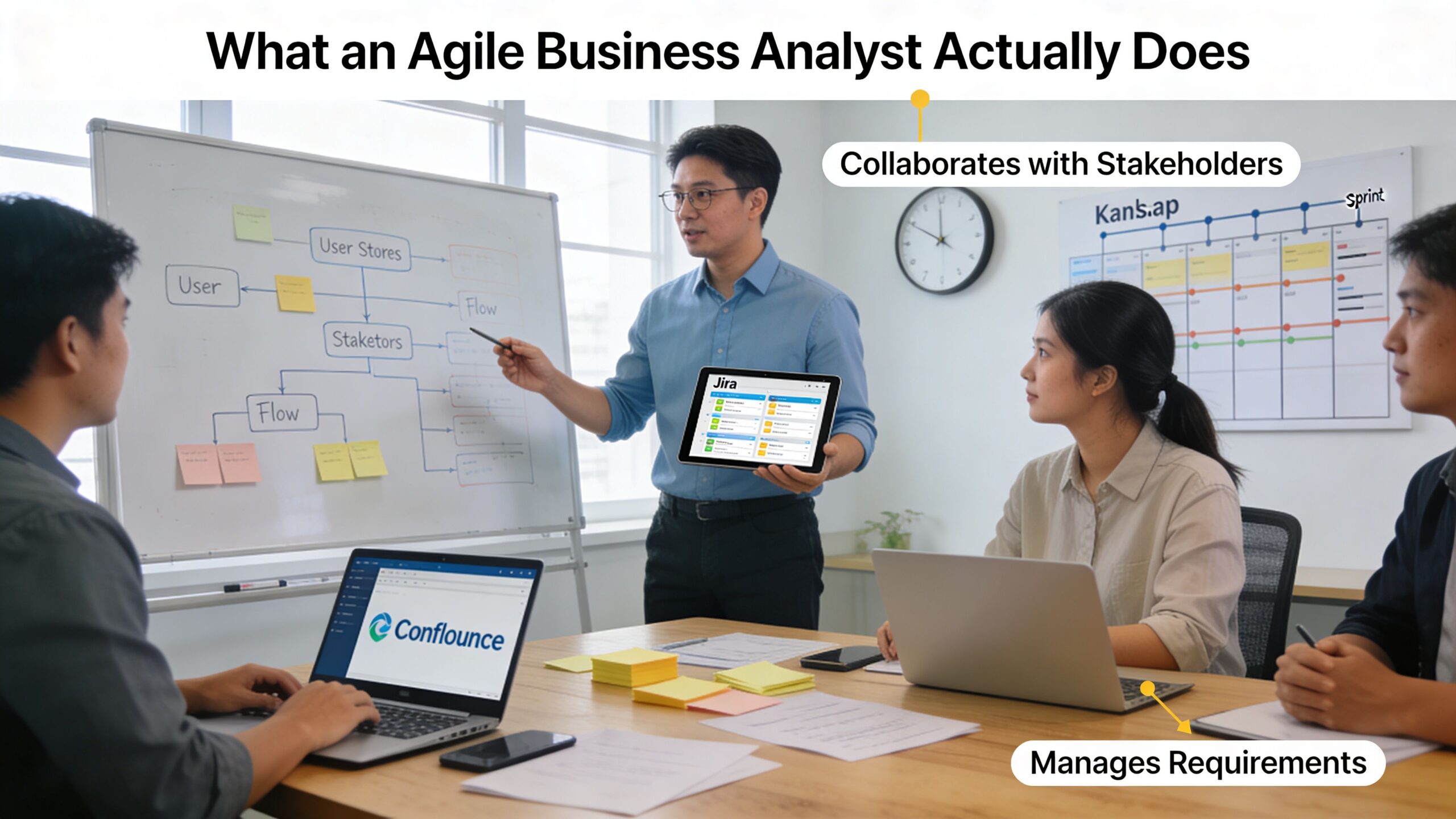
What an Agile Business Analyst Actually Does
A traditional BA and an Agile BA may both work on business needs, requirements, and stakeholder communication. The big difference is timing and involvement.
A traditional model often expected the BA to define as much as possible upfront. An Agile model expects the BA to help the team learn as they build.
 business analyst leads a team meeting while presenting project workflows and management tools on tablets.” width=”627″ height=”353″ />
Think architect versus site lead
A simple comparison helps.
| Approach | Traditional BA | Agile BA |
|---|---|---|
| Working style | More upfront definition | More continuous clarification |
| Main output | Large requirement documents | User stories, acceptance criteria, workshop outcomes |
| Team contact | Heavy at the start, lighter later | Ongoing through delivery |
| Change handling | Often treated as disruption | Treated as normal and managed actively |
The traditional BA can feel like an architect producing a full blueprint before the build begins. The Agile BA is closer to someone on site every day, checking what’s needed, resolving questions quickly, and adjusting detail without losing the bigger goal.
What the job looks like day to day
An Agile BA usually works across several practical activities:
- Clarifying business needs by asking what problem the team is solving and why it matters.
- Breaking work down so large ideas become small, testable items.
- Running workshops with stakeholders, product people, and delivery teams.
- Writing and refining user stories so developers understand the intent of the work.
- Defining acceptance criteria so everyone knows when something is complete.
- Supporting delivery conversations during planning, build, testing, and review.
- Reducing ambiguity before it turns into rework.
That’s why the role is valuable. The Agile BA is often the person who spots confusion early enough to stop it becoming wasted time.
Why people get confused about the role
Many job seekers struggle because existing guidance often doesn’t reflect how the UK market describes the role in practice. The Agile Alliance notes that organisations struggle with “evolved sets of tasks”, and job seekers often don’t get clear guidance on whether employers want a standalone BA or a blended BA and Product Owner profile in Agile teams, as discussed in this article on where business analysts play in an enterprise agile field.
That lack of clarity creates two mistakes.
First, some applicants undersell themselves because they think they need the exact job title before they can claim the skill set. Second, some candidates assume Agile means “no analysis”, which is wrong. Agile still needs analysis. It just happens in smaller cycles and closer to delivery.
The title may vary, but employers still need someone who can connect stakeholder needs, delivery detail, and business outcomes.
If you want a broad external explanation of the role in simple terms, What Does A Business Analyst Do gives a useful baseline. The ultimate test, though, is whether you can show how you’d do that work inside an Agile team, not just define the title.
Core Techniques for the Agile Business Analyst Toolkit
A strong Agile BA is judged less by theory and more by what they can turn into clear, usable work for the team.
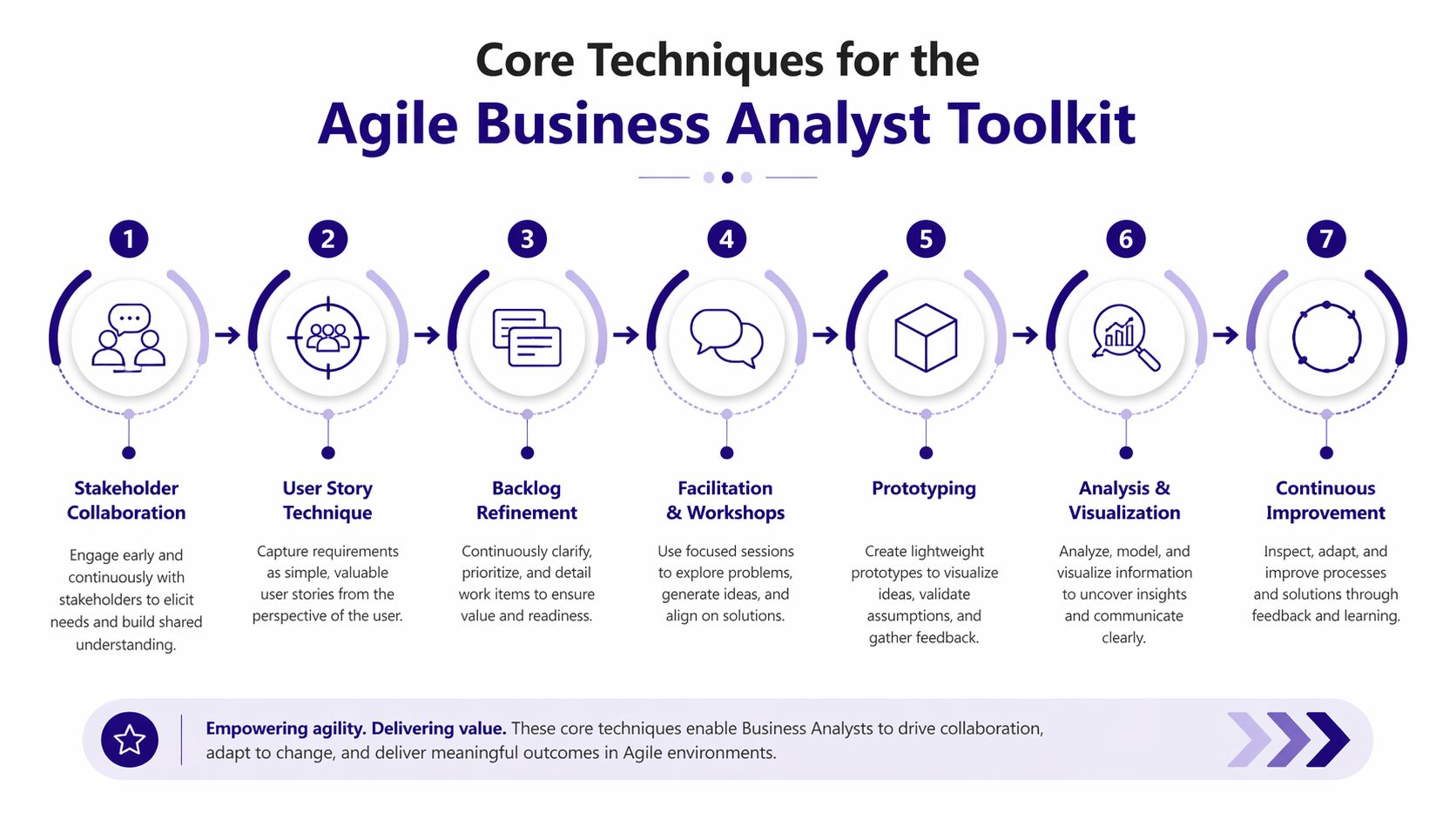
UK employers often look for evidence that you can break down needs, shape backlog items, define acceptance criteria, and support delivery conversations without slowing the team down. That is the practical side of business analysis agile. It is also the part that helps candidates move from “I understand Agile” to “I can do the job”.
User stories that are small and useful
A user story captures a need from the user’s point of view. Its job is simple. Give the team enough context to build the right thing, without burying the point under too much documentation.
A common format is:
- As a user type
- I want some capability
- So that I achieve a benefit
Example:
- As a payroll administrator
- I want to review flagged overtime entries before approval
- So that incorrect payments don’t go through month-end processing
That format looks easy, but writing a good story takes judgement. A weak story is often either too broad to estimate or too vague to test. A stronger story gives the team a clear outcome and stays small enough to fit into delivery planning.
Many teams use the INVEST check. Stories should be independent, negotiable, valuable, estimable, small, and testable. If you are training for an Agile BA role, this is one of the first habits to build because interviewers often test it with practical examples.
Backlog refinement keeps analysis close to delivery
The product backlog is the current list of work the team may take on. Backlog refinement is where that list gets cleaned up, clarified, split, challenged, and reordered.
Agile analysis is evident in day-to-day work. A BA may help the team question whether an item still matters, whether it is too large for a sprint, whether the business rule is clear, or whether the request solves the underlying problem at all. If that sounds simple, it is not. Good refinement saves time because it catches confusion before development starts.
A backlog refinement session might involve:
- Checking whether a high-priority item still solves the right problem.
- Splitting a large epic into smaller user stories.
- Removing a request that no longer fits business need.
- Tightening acceptance criteria before the next sprint.
For job seekers, this matters because employers rarely hire for “Agile mindset” alone. They hire people who can contribute in these working sessions. If you want a clearer view of the practical methods taught in training, this guide to tools and techniques taught in business analyst training gives a useful picture of the skills employers expect you to recognise and use.
User story mapping shows the whole journey
One common delivery mistake is treating each story as a separate task with no view of the wider user journey. User story mapping fixes that by laying out the steps a user takes from start to finish, then grouping supporting stories underneath each step.
It works like laying out the scenes of a film before filming starts. You can see the sequence, spot missing parts, and decide what belongs in the first release.
If you were mapping an expenses system, the top row might include submit claim, attach receipt, manager review, finance check, and payment confirmation. Under each step, the BA helps identify the smaller stories, business rules, and exceptions. That makes prioritisation more realistic because the team can see which parts create a usable journey and which parts can wait.
This technique is especially useful in interviews and portfolio discussions. It shows you can think beyond isolated requirements and understand how value is delivered across a process.
Acceptance criteria stop avoidable rework
Acceptance criteria set the conditions a story must meet before it is accepted. New BAs often write criteria that are too broad, such as “system should work correctly”. That does not give a developer enough direction or a tester a clear basis for checking the outcome.
Stronger acceptance criteria are specific and observable.
Example for the payroll story above:
- Overtime entries above the policy threshold are marked for review.
- The payroll administrator can approve or reject each flagged entry.
- Rejected entries are excluded from the pay run.
- The system records who reviewed the item and when.
Workplace check: If two people can read your story and picture different outcomes, the story is not ready.
This is one of the clearest signs of job-readiness. Employers want BAs who reduce rework, not people who pass ambiguity into the sprint and hope the team sorts it out later.
The strongest Agile BAs use these techniques routinely. They write clearly, ask better questions, and keep analysis close to delivery. That is what makes them useful to Agile teams, and it is what helps candidates stand out in the UK hiring market.
Collaborating with Product Owners Developers and Scrum Masters
An Agile BA doesn’t work from the side of the project. They work inside the conversations that shape delivery.
The role is often best understood through relationships. The BA helps different people work from the same understanding, even when they speak in different terms. A stakeholder may describe a business pain point. A Product Owner may talk about priority. A developer may ask about edge cases. A tester may ask what “done” means. The BA helps those ideas line up.
Working with the Product Owner
The Product Owner is usually accountable for priority and value. The BA often supports that work by sharpening the detail behind those priorities.
A healthy BA and Product Owner partnership looks like this:
- The Product Owner says which problem matters most now.
- The BA helps define what that problem means in practice.
- Together they check whether a proposed feature is clear enough to build.
Many teams don’t fail from lack of effort; they fail because everyone starts with a slightly different interpretation of the need.
Working with developers
Developers rarely need more words. They need the right words.
The BA helps by turning broad requests into buildable items. That includes clarifying business rules, exceptions, workflows, and edge cases. It also means answering questions quickly during the sprint instead of disappearing after planning.
Here’s a familiar example. A stakeholder says, “Users should be able to edit an invoice.” A developer needs much more than that.
They need to know:
| Question | Why it matters |
|---|---|
| Who can edit it | Permission and security rules |
| When can they edit it | Process control |
| What happens after approval | Business rule handling |
| Should changes be logged | Audit and compliance needs |
The BA helps surface those details before they become blockers.
Working with the Scrum Master
The Scrum Master protects the process and supports team effectiveness. The BA and Scrum Master aren’t doing the same job, but they often help each other.
The Scrum Master may spot that stories enter sprint planning in a poor state. The BA can improve refinement and clarify what “ready” should mean. The Scrum Master may notice recurring confusion in ceremonies. The BA can redesign how information is shared.
Good Agile teams don’t rely on one person to create order. They build habits that make clarity normal.
A key point from agile business analysis practice is that User Story Mapping and clear Acceptance Criteria are core technical competencies. Unclear criteria directly cause development rework and scope disputes, while well-defined criteria created collaboratively build shared understanding before development starts. This is linked to why 98% of companies report positive outcomes from agile adoption in this overview of agile business analysis.
What a sprint often feels like for the BA
The BA’s week may include several modes of work:
-
Before planning
Refine upcoming stories, check gaps, and confirm examples with stakeholders. -
During planning
Help the team understand the scope and answer questions that affect estimation. -
During delivery
Clarify details, support testing logic, and resolve conflicting interpretations. -
At review
Compare what was delivered with the intended outcome and gather feedback.
That’s why communication matters so much in this role. The BA isn’t there just to document. They help the team keep moving with shared understanding.
Measuring Impact and Navigating Common Agile BA Challenges
A weak way to judge an Agile BA is by counting outputs. How many stories did they write. How many meetings did they run. How many pages of notes did they produce. Those measures are easy to count, but they miss the point.
A stronger view looks at whether the BA helped the team make better decisions and deliver with less confusion.
What good impact looks like
Strong Agile BAs usually improve the quality of delivery in ways the team can feel. You see it when sprint conversations get clearer, when fewer items stall because a requirement was vague, and when stakeholders spend less time correcting misunderstandings late in the process.
Useful signs include:
- Cleaner handovers where developers don’t need to keep guessing business intent
- Fewer scope disputes because the acceptance boundaries were set early
- Healthier backlog flow because the team isn’t pulling in poorly defined work
- Better stakeholder confidence because progress is visible and understandable
These signs are often more meaningful than volume. Writing more stories doesn’t prove value. Writing the right stories, at the right level, with the right clarity does.
A short explainer often helps here:
Common traps that hold new BAs back
Many early-career BAs fall into one of four patterns.
-
Becoming a scribe
They write down whatever the loudest stakeholder says without testing assumptions. That isn’t analysis. It’s transcription. -
Overwriting everything
They try to remove uncertainty by producing too much detail too soon. Agile work still needs clarity, but not every answer must exist on day one. -
Avoiding challenge
They don’t ask difficult questions because they worry about sounding inexperienced. Good analysis often starts with, “What problem are we solving?” -
Forgetting the user
They focus on internal requests and system features but lose sight of who benefits and how.
A practical self-check
Ask yourself these questions after a piece of work:
- Did I help the team understand the business problem more clearly?
- Did I reduce ambiguity before build started?
- Did I challenge anything that didn’t make sense?
- Did I keep the focus on outcome, not just requested feature?
- Did I help the right people reach a shared view?
Mentor note: If your contribution only exists in documents, you’re underusing your value. Agile analysis is visible in decisions, conversations, and delivery quality.
The best Agile BAs stay analytical without becoming rigid. They know when to add detail and when to leave room for learning. That balance is what makes them useful in real teams.
Building Your Career Path in Agile Business Analysis
This is the part most readers care about most. How do you get into the role, especially in the UK, without already having “Agile BA” on your CV?
The hard truth is that many resources still don’t answer that clearly. Current guidance often explains what business analysts do in Agile environments, but it doesn’t give practical UK-specific direction for career changers. There is no clear data on which upskilling routes UK employers value most, which CPD-accredited options matter most, or how skills from accounting and finance transfer into the role, as discussed in this article on how business analysis fits with agile environments.
That gap is frustrating, but it also creates an opportunity. Candidates who can build a practical pathway stand out quickly.

Your previous experience may be more relevant than you think
If you come from bookkeeping, VAT, payroll, accounts support, final accounts, or data work, don’t assume you’re starting from zero.
You may already have:
- Process thinking from handling structured financial workflows
- Attention to detail from reconciliations, submissions, and reporting
- Stakeholder communication from dealing with clients, managers, or internal departments
- Problem diagnosis from tracing errors back to source
- Tool confidence from working with spreadsheets, accounting software, reporting tools, or data platforms
Those are not small advantages. They map directly to BA work when you learn how to present them.
For example, a payroll professional can talk about translating policy rules into repeatable system logic. A data analyst can show how they turn broad questions into precise reporting needs. An accounts assistant can describe balancing deadlines, stakeholder requests, and control requirements. That is business analysis thinking.
What employers usually want to see
UK employers often look for a mix of practical and behavioural evidence rather than one perfect certificate.
A strong entry or junior profile usually shows:
| Area | What employers tend to look for |
|---|---|
| Analysis basics | Clear requirements thinking, process understanding, structured questioning |
| Agile awareness | Understanding of stories, backlog work, sprints, collaboration |
| Tool exposure | Familiarity with Jira, Confluence, Excel, and workshop tools |
| Communication | Ability to explain issues simply to different audiences |
| Commercial sense | Awareness that requirements must support business outcomes |
A certification can help, but it won’t replace practical examples. If you say you understand user stories, an interviewer may ask you to write one. If you claim stakeholder skills, they may ask how you handled conflicting views. If you mention Jira, they may ask how you’d manage a story from draft to ready state.
That’s why practical training matters more than theory alone.
Build a route that leads to job-readiness
A sensible pathway often includes a blend of learning and evidence-building:
- Learn core BA methods such as requirements gathering, process mapping, user stories, and acceptance criteria.
- Practise Agile delivery tools such as Jira and Confluence rather than only reading about them.
- Use adjacent strengths from finance, accounting, or data to shape your examples.
- Build interview stories that show problem-solving, not just course completion.
- Understand recognised learning routes by reviewing options around business analyst certification in the UK.
Employers hire people who can contribute in context. They don’t hire course titles on their own.
If your wider career interest sits across business analysis, data analysis, and finance operations, that can be an advantage rather than a distraction. Many employers value people who understand both process and numbers. Someone who can read a workflow, question a business rule, and make sense of supporting data is often more useful than someone with only textbook Agile knowledge.
Your Next Steps to Becoming a Job-Ready Agile BA
A career in business analysis agile becomes much less intimidating once you strip away the jargon. The role is about helping teams solve the right problems, define work clearly, and adapt as they learn. That takes analysis, communication, structure, and confidence.
If you’re moving in from bookkeeping, VAT, advanced payroll, accounts assistant work, final accounts, or data analysis, you don’t need to abandon your previous experience. You need to translate it. Employers want people who can think clearly, collaborate well, and use practical tools to support delivery.
The biggest mistake is waiting until you feel “fully ready” before taking action. Readiness comes from practice. Learn the core techniques. Get comfortable with Agile tools. Build examples you can talk through in interviews. Focus on job-readiness, not just terminology.
Agile BA roles can be a strong fit for people who like detail, logic, and business improvement, but success won’t come from theory alone. It comes from learning how real teams work, how requirements evolve, and how to support delivery without losing sight of value.
If you want structured, practical support to move into business analysis, data analysis, bookkeeping, VAT, payroll, final accounts, or accounts assistant roles, explore the training options at Professional Careers Training. Their flexible programmes, software-focused learning, 1-to-1 support, and recruitment guidance can help you turn existing ability into job-ready evidence for the UK market.