
If you're weighing up a move into business analysis, or you're already a business analyst wondering whether you're being paid fairly, the honest answer is...
If you’re weighing up a move into business analysis, or you’re already a business analyst wondering whether you’re being paid fairly, the honest answer is that UK salaries in this field vary a lot.
Location, sector, qualifications and the specific skills you bring can each shift your pay by thousands of pounds a year.
This guide pulls together current UK salary data for business analysts at every stage, from your first junior role through to senior positions, so you know what to expect and what actually moves the number up.
How Much Does a Business Analyst Earn in the UK?
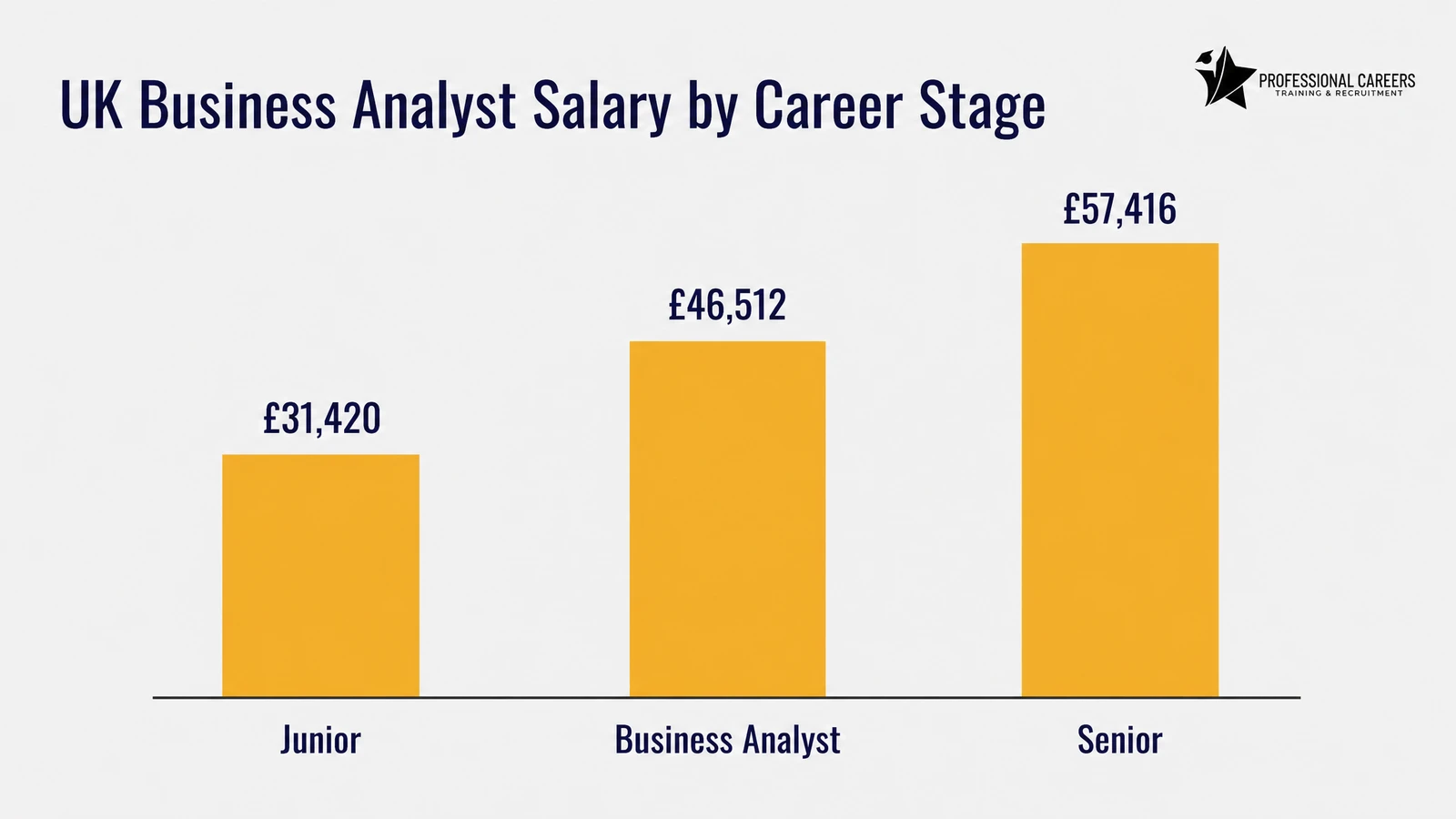
The average business analyst salary in the UK is £46,512 a year, based on more than 3,100 salaries reported to Indeed as of August 2026. Typical pay ranges from around £30,300 to £71,400, depending on experience, location and employer.
A separate industry data source, IT Jobs Watch, puts the median permanent business analyst salary slightly higher at £55,000, with the middle half of roles paying between £45,000 and £66,125.
The gap between the two figures comes down to methodology. Indeed’s average includes a wider spread of job titles and seniority levels, while IT Jobs Watch tracks permanent vacancy postings specifically.
Either way, business analyst pay sits well above the UK-wide average. Across all employees in Great Britain, mean total earnings were £756 a week in July 2026, according to the Office for National Statistics, which works out at roughly £39,300 a year.
| Measure | Figure |
|---|---|
| National average (Indeed) | £46,512 |
| Typical range | £30,302 to £71,393 |
| Median, permanent roles (IT Jobs Watch) | £55,000 |
| Senior business analyst average | £57,416 |
| UK average earnings, all employees (ONS) | ~£39,300 |
Business analysts in the UK earn well above the national average, but the published “average” figure hides a wide range. Where you sit in that range depends far more on experience, sector and location than on the job title alone.
Business Analyst Salary by Experience Level
Business analyst pay climbs steeply with experience, more so than in many other office-based careers. The jump from a first role to a senior position can more than double your salary.
Junior and entry-level business analyst
The National Careers Service puts starter salaries for business analysts at around £23,000 a year.
Indeed’s data on junior analyst roles specifically shows a slightly higher average of £31,420, with a typical range of £25,420 to £41,093. This reflects the mix of graduate schemes and career-changer entry points into the role.
Most people land their first business analyst role either through a graduate scheme, an apprenticeship, or by moving across from a related role such as project support, finance or IT, often after completing a structured course that teaches the core methods and tools.
Business analyst (standard level)
Once you’ve built two to four years of experience, the national average of £46,512 becomes a realistic benchmark. At this stage, employers are paying for demonstrated delivery, not just theoretical knowledge, so a track record of completed projects matters more than qualifications alone.
Senior business analyst
Senior business analysts average £57,416 a year, and the top quartile on IT Jobs Watch’s data reaches £66,125 and above. At this level, pay reflects not just technical skill but the ability to manage stakeholders, lead requirements-gathering across whole projects, and mentor junior analysts.
Business Analyst Salary by Region
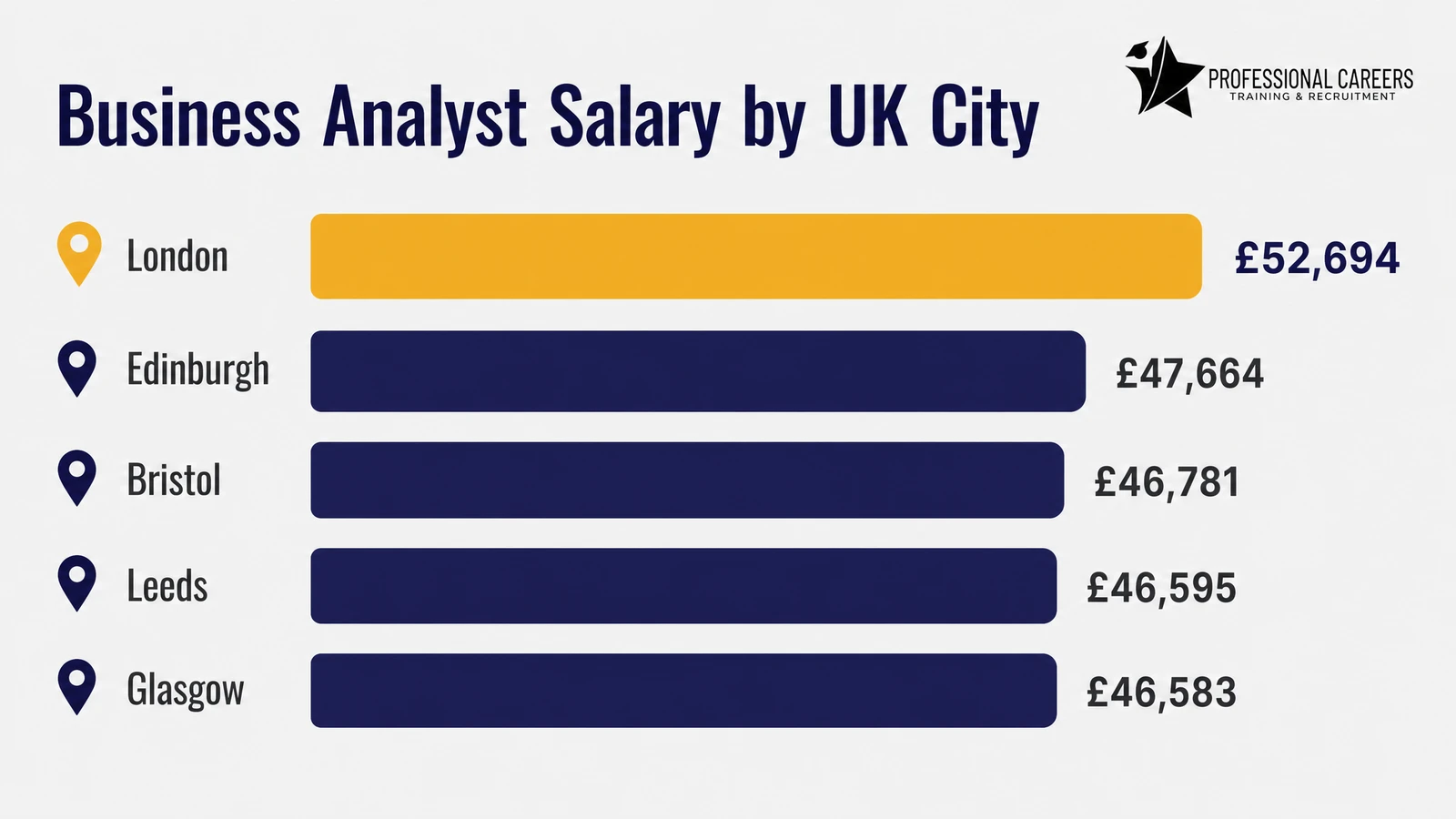
Location remains one of the biggest single factors in business analyst pay, though the gap has narrowed as more roles offer hybrid or fully remote working.
- London: £52,694 a year on average, the highest-paying UK city and roughly 13% above the national figure.
- Edinburgh: £47,664 a year, consistently one of the strongest-paying cities outside London for both business analysis and junior analyst roles.
- Bristol: £46,781 a year, close to the national average and reflecting the city’s strong financial and tech sectors.
- Leeds: £46,595 a year, broadly in line with the national figure and a major hub for financial services business analysis.
- Glasgow: £46,583 a year, also close to the national average.
If you’re weighing up a London role against a remote or regional one, remember to weigh the London premium against London’s cost of living, particularly housing. A £46,595 salary in Leeds and a £52,694 salary in London don’t buy the same lifestyle.
A London salary looks larger on paper, but once you account for the cost of living, a regional business analyst role, or a remote one paying close to the national average, can leave you better off in real terms.
Why Business Analyst Salaries Vary So Much
Beyond location and experience, several other factors explain why two business analysts with similar job titles can be paid very differently.
Industry sector
Financial services, insurance and technology tend to pay above the national average for business analysis, reflecting both higher margins and more complex, higher-stakes projects.
Public sector and charity-sector roles typically pay below the private-sector average, though they often come with stronger job security and pension benefits.
Qualifications and certifications
A recognised qualification, such as the BCS International Diploma in Business Analysis or a certification from the International Institute of Business Analysis, signals to employers that you understand the discipline’s core techniques, not just the tools.
This matters most when you’re moving into your first role or changing sectors, where you don’t yet have a track record to point to. Our guide to business analyst certification in the UK covers which qualifications employers actually ask for.
Technical and domain skills
Business analysts who can also work directly with data, using SQL, Excel modelling or a BI tool such as Power BI, tend to command a premium over those who rely purely on documentation and stakeholder workshops.
Domain knowledge in a specific industry, such as banking regulation or NHS systems, adds further value because it shortens the time it takes a new analyst to become useful.
Company size
Large organisations and consultancies generally pay more than small and medium-sized employers for equivalent seniority, partly because they can offer structured pay bands and partly because the projects tend to be bigger and more complex.
Business Analyst Pay Compared to Other Finance and Data Roles
If you’re deciding between business analysis and a related career path, it helps to see how the numbers stack up against similar UK roles.
| Role | Typical UK average |
|---|---|
| Business analyst | £46,512 |
| Senior business analyst | £57,416 |
| Data analyst | Around £50,000, range roughly £25,000 to £55,000+ |
| Accounts assistant | Around £27,000 to £27,500, London ~£29,000 |
Business analysis sits in a strong position on this table: it pays noticeably more than entry-level finance roles like accounts assistant work, while offering a comparable ceiling to data analysis, particularly once you add technical skills like SQL to your business analysis toolkit.
Business analysis pays a clear premium over entry-level finance roles and sits close to data analysis at the senior end, which makes it a strong option if you’re weighing up which analytical career path to train for.
Contract and Freelance Business Analyst Day Rates
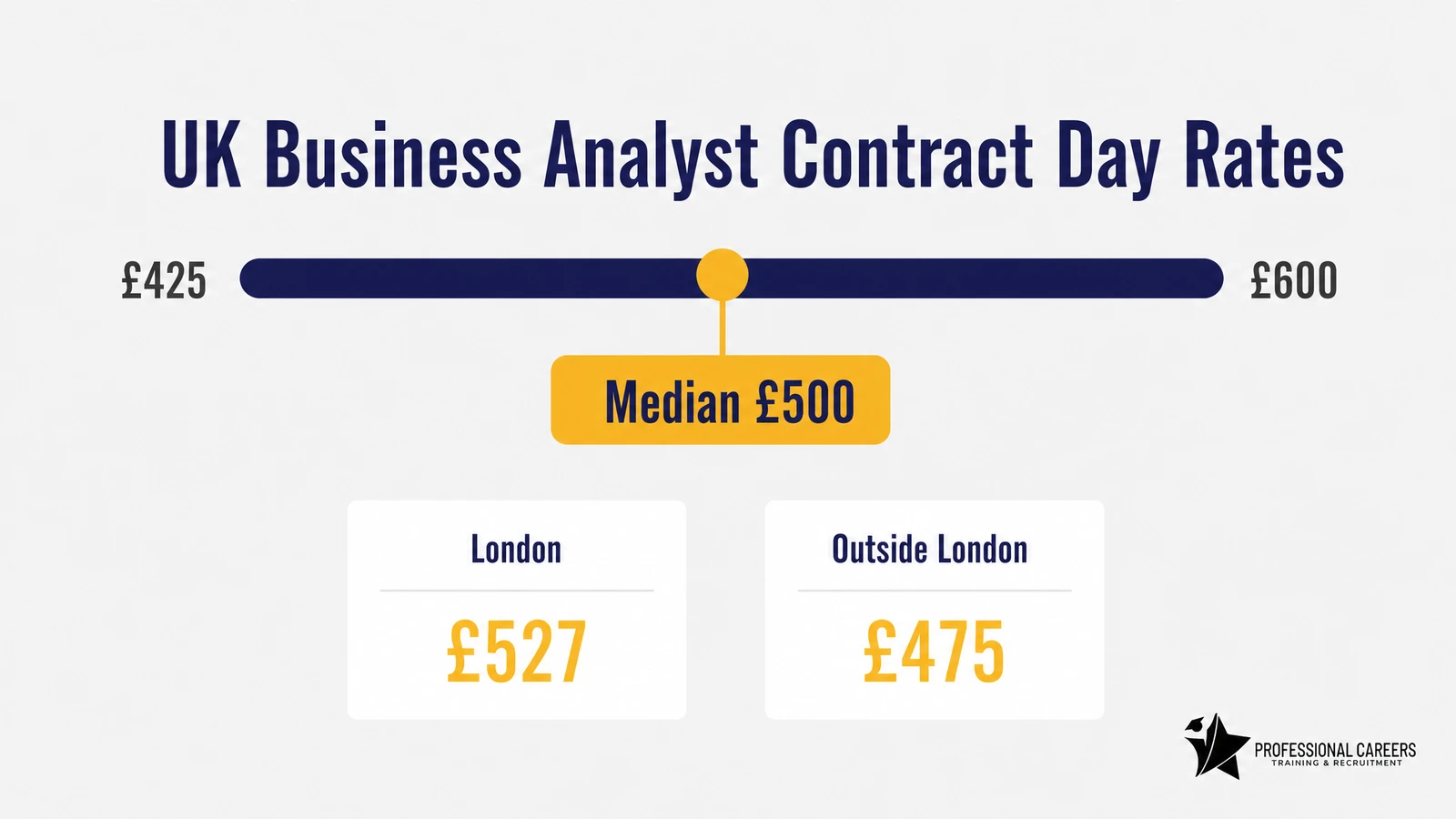
Business analysis is also a career where working as a contractor is common, particularly once you’ve built a few years of permanent experience.
The median contractor day rate is £500 a day, with the middle half of contracts paying between £425 and £600 a day, based on IT Jobs Watch’s contract data for the six months to September 2026.
As with permanent salaries, London commands a premium: £527 a day on average, against £475 outside London. There are currently more than 2,000 contract business analyst vacancies advertised across the UK, which points to steady demand for experienced contractors specifically.
Contracting isn’t usually the right move straight out of training. Most contract roles expect you to hit the ground running with minimal onboarding.
It tends to suit analysts who’ve already built two or more years of permanent experience and a track record they can point to.
Why Business Analyst Salaries Dipped This Year
One trend worth flagging honestly: IT Jobs Watch’s median figure of £55,000 is down 8.33% on the same period last year, when the median stood at £60,000. This sits alongside 1,585 permanent business analyst vacancies currently listed, so demand for the role hasn’t disappeared.
A dip in the median doesn’t necessarily mean individual salaries have been cut. It more often reflects a shift in the mix of roles being advertised, for example more junior and mid-level vacancies relative to senior ones.
More roles outside London, where pay is naturally lower, also pull the median down. Broader hiring caution across the UK tech and financial services sectors this year has played a part too.
For anyone training into the profession now, this is a reason to be realistic about starting salaries rather than a reason to avoid the career.
Long-term demand for people who can bridge business needs and technical delivery has stayed consistent, even as short-term hiring patterns shift.
How to Increase Your Earning Potential as a Business Analyst
If you’re already working as a business analyst, or training towards your first role, a handful of moves reliably increase what you can earn.
- Build a recognised qualification, such as a BCS or IIBA certification, so you have formal proof of your methodology alongside your practical experience.
- Add a technical skill that most business analysts don’t have, such as SQL, data visualisation or basic process automation, so you can take on higher-value, more technical projects.
- Specialise in a sector with above-average pay, such as financial services or insurance, where your domain knowledge becomes as valuable as your analysis skills.
- Move roles rather than waiting for an internal promotion. Employers typically pay a premium to bring in analysts with proven delivery experience, which internal pay reviews rarely match.
- Keep a clear record of the business outcomes your work has delivered, in pounds, hours saved or risk reduced, so you can make a concrete case at your next salary review or interview.
A strong CV matters just as much as the underlying skills, particularly when you’re applying outside your current employer.
Our guide to the key skills to put on a business analyst CV covers how to present your experience so it matches what recruiters are actually screening for.
If you’re changing careers into business analysis from accounting, finance or another operational background, you already have a real advantage. You understand how businesses actually work, which is exactly what the role requires.
A structured course that teaches the formal business analysis techniques, and shows you how business analyst training prepares you for today’s tech-driven roles, can close the gap quickly.
The biggest single lever most business analysts have over their own salary isn’t waiting for a pay rise. It’s building a specific, provable skill or qualification and using it to move roles.
Is a Career in Business Analysis Right for You?
Business analysis suits people who enjoy solving practical problems, are comfortable talking to people at every level of a business, and want a career with a clear route from entry-level to senior, well-paid roles.
It’s also one of the more accessible routes into a well-paid analytical career, since it doesn’t require a maths or computer science degree to get started.
Our complete guide to becoming a business analyst in the UK covers the skills, qualifications and typical career path in more depth.
If you’d rather see exactly what a structured route into the role looks like, our Business Analyst Training course is built around the same techniques and tools employers are paying for, with guaranteed recruitment support once you finish.
What is the average business analyst salary in the UK?
The average is £46,512 a year according to Indeed’s 2026 data, though the median for permanent roles specifically runs higher, at £55,000 according to IT Jobs Watch. Expect a typical range of roughly £30,000 to £71,000 depending on experience and location.
How much do junior business analysts earn?
Junior and entry-level business analysts typically earn between £25,420 and £41,093, averaging around £31,420. The National Careers Service lists starter salaries from around £23,000.
Do business analysts earn more in London?
Yes. London pays a clear premium, averaging £52,694 a year against a national average of £46,512. Other cities such as Edinburgh, Bristol and Leeds pay close to the national average.
What qualifications increase a business analyst’s salary?
A recognised qualification such as the BCS International Diploma in Business Analysis or an IIBA certification helps most when you’re entering the profession or changing sectors, since it proves you understand the core methods before you’ve built a UK track record.
Is business analysis a good career to train into right now?
Yes. Although the median salary has softened slightly this year, there were still over 1,500 permanent business analyst vacancies at the time of writing, and long-term demand for people who can bridge business needs and technical delivery remains strong.