If you're training to become a business analyst, or you already work as one, you've probably noticed AI tools turning up in more of your...
That’s where the CIMA Certificate in Business Accounting often stands out. It gives you a structured start in business and finance, especially if you want more than a narrow technical role. It helps you understand how organisations operate, why managers need financial information, and how accounting supports planning.
Your First Step into the World of Business and Finance
Take a common example. A learner has worked in admin, retail, customer service, or operations. They’re organised, they’re comfortable with spreadsheets, and they like solving problems. But they’re stuck between too many choices. Should they study bookkeeping, payroll, business analysis, data analysis, or a full accounting qualification?
The confusion usually comes from thinking these paths are separate. In practice, they overlap. A strong finance career often starts with learning how a business works as a whole. That means understanding costs, reports, ethics, and commercial decisions, not just entering numbers into a system.
That’s why the certificate in business accounting CIMA route makes sense for many beginners in the UK. It gives you a clear academic base without expecting years of prior experience. If you’re drawn to roles where finance supports decisions, performance, and strategy, it can be a smart first move.
Why this route appeals to ambitious beginners
Some learners know they enjoy numbers but don’t want a job that feels disconnected from the rest of the business. They want to sit closer to decision-making. They want to understand why margins change, why budgets slip, or why one department performs better than another.
The CIMA Certificate helps with that wider view. It doesn’t treat accounting as a back-office task only. It introduces the commercial side of finance, which is one reason it appeals to people aiming for management accounting, finance support, business analyst, or data-led business roles later on.
- If you want structure, it offers a defined starting point.
- If you’re changing career, it gives you a recognised way in.
- If you want progression, it lays foundations you can build on.
A good starting qualification doesn’t just help you pass exams. It helps you see how businesses make decisions.
There’s also a useful mindset shift here. Finance knowledge isn’t only for people who plan to become accountants in the traditional sense. It also helps people who want to work in planning, reporting, operations support, and analysis. Even if your long-term aim is broader business work, understanding the financial side makes you more valuable.
If you’re also trying to understand the commercial reality behind small firms and start-ups, Coachful’s business structure advice is a helpful read because it shows how legal structure and business decisions affect the way owners think about money, risk, and growth.
What Is the CIMA Certificate in Business Accounting
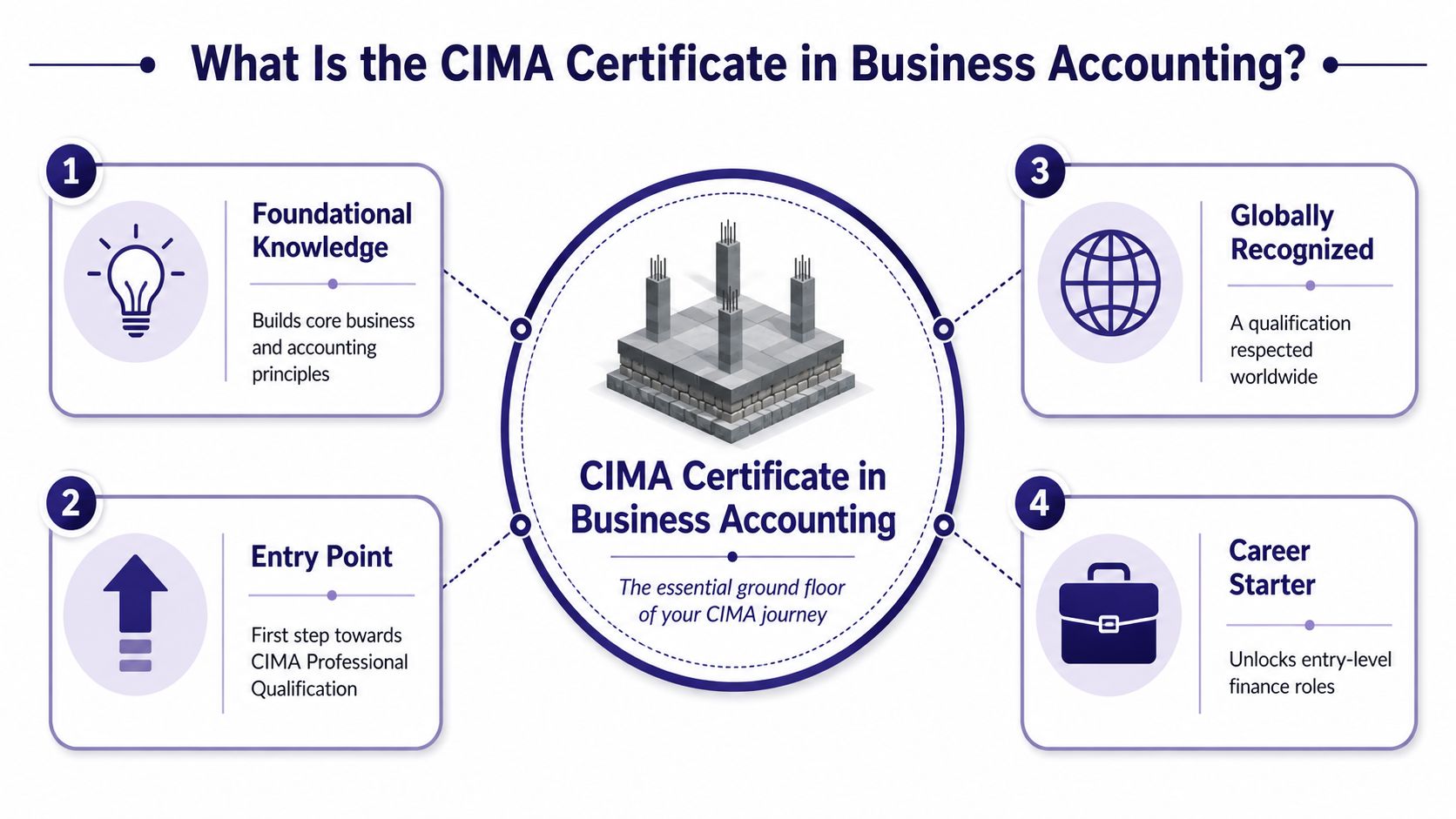
The CIMA Certificate in Business Accounting is an entry qualification designed to build core knowledge in business and finance. It’s often the right starting point for people who have little or no accounting background but want a professional route into the field.
The easiest way to understand it is to think of it as the ground floor of a professional skyscraper. If the later levels of a finance career involve deeper reporting, analysis, planning, and leadership, this certificate is the solid base underneath. Without that base, later learning can feel shaky.
What it helps you understand
This qualification is broader than many people expect. It doesn’t only teach bookkeeping logic or exam language. It introduces the main building blocks of business accounting and shows how they connect.
That matters because beginners often get confused by the difference between financial accounting and management accounting.
- Financial accounting looks at recording and reporting business activity properly.
- Management accounting focuses on information that helps managers plan and decide.
- Business economics helps you understand the wider environment around the organisation.
- Ethics and governance shape how decisions should be made.
When those pieces come together, you start to see the business properly.
Why employers value that foundation
A learner with this background doesn’t just know a few definitions. They can start to interpret what’s happening inside a company. They can look at costs and ask useful questions. They can read financial information and link it to performance. They can understand why controls, judgement, and professional behaviour matter.
That’s one reason the qualification appeals to people beyond pure accountancy roles. If you later move into accounts assistant, final accounts support, business analyst, or even data analyst work, this foundation still helps. You’ll be better at asking what the figures mean and what action should follow.
Practical rule: If you want a career where finance links to decisions, not just data entry, this qualification gives you the language and logic to start.
It also suits learners who want confidence before specialising. Some people begin with this certificate, then discover they enjoy payroll. Others move towards VAT work, reporting, or analyst-style roles. Starting broad can be a strength because it stops you from choosing too narrowly too early.
Who Should Study for the CIMA Certificate
This qualification suits more than one type of learner. In fact, that’s one of its strengths. You don’t need to fit one narrow profile to benefit from it.
Many people assume professional accounting study is only for school leavers who already know they want that path. That isn’t true. The CIMA Certificate often works best for people who are still shaping their direction but know they want a serious role in business or finance.
School leavers and early-career starters
If university doesn’t feel like the right next step, or if you want a more direct route into professional learning, this certificate can be a strong alternative. It gives you business and finance knowledge in a structured way and helps you build credibility early.
For this group, one of the biggest benefits is clarity. Instead of drifting through entry-level office work with no progression plan, you start developing a recognised professional base.
Graduates from non-accounting backgrounds
A business, marketing, economics, or humanities graduate often reaches the same point. They want to move into finance or commercial roles, but employers want proof that they understand accounting fundamentals.
The CIMA Certificate helps bridge that gap. It shows commitment, gives you technical grounding, and makes your CV more focused. If your degree gave you broad academic skills but not practical finance knowledge, this is a sensible way to sharpen your direction.
Career changers and office professionals
This is one of the most overlooked groups. Plenty of people already work in administration, customer support, office management, purchasing, or operations. They’ve seen invoices, reports, budgets, and internal processes. They already understand how organisations function.
What they often lack is formal finance training. The CIMA Certificate gives them a way to convert existing workplace experience into a more specialist career path.
A person in an admin role, for example, may already reconcile information, handle records, and support teams with deadlines. Once they add finance knowledge, roles like accounts assistant or trainee finance support become much more realistic.
People who want business understanding, not only accounting tasks
Some learners aren’t aiming to become traditional accountants. They want to move towards commercial analysis, business support, or data-focused work. This qualification can still help because it teaches how financial information feeds decisions.
That makes it relevant for people interested in:
- Business analyst pathways, where commercial awareness matters
- Data analyst roles, where financial context improves reporting
- Bookkeeping and VAT work, where solid fundamentals prevent costly mistakes
- Payroll and final accounts support, where accuracy and wider understanding both matter
If you’ve ever thought, “I’m interested in finance, but I’m not sure where I fit yet,” this qualification was built for that stage.
It’s also useful for small business owners and self-employed professionals who want to understand their numbers better. Even if they never move into a formal finance job, the learning supports better decisions.
Syllabus and Exams Explained
The structure is often simpler than people expect. The CIMA Certificate in Business Accounting requires four objective tests, covering business economics, management accounting, financial accounting, and ethics, corporate governance, and business law. CIMA says candidates complete the four sections in about six months on average, while another major UK training provider says most students take around 12 months, which shows the pathway is structured but flexible. CIMA also lists a £99 one-time registration fee with the first-year subscription included, and from 1 January 2026 the objective test fee starts at £89 to £123 per exam depending on location. You can see that cost and structure on CIMA’s Certificate in Business Accounting page.
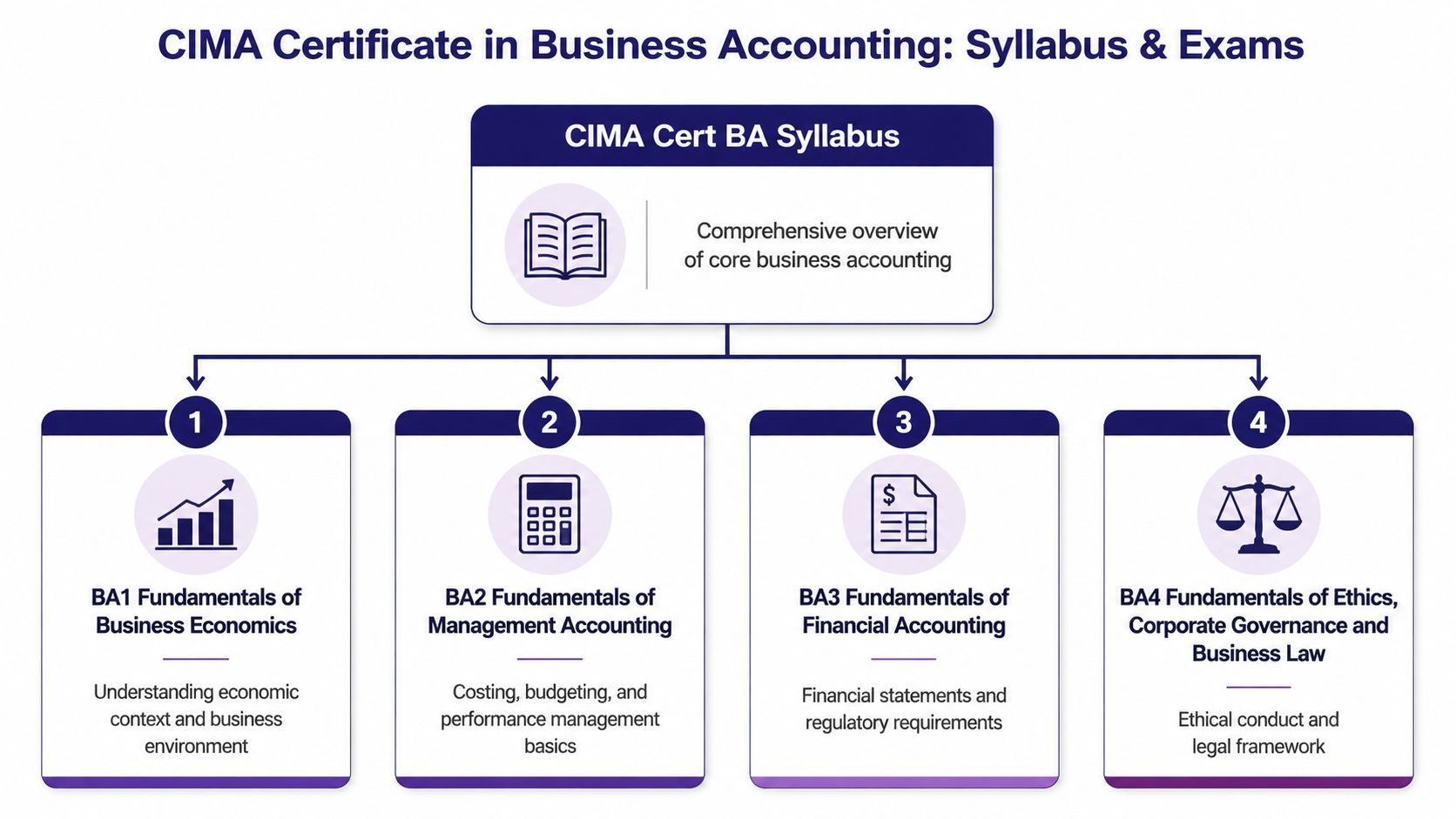
A helpful way to think about the syllabus is this. Each subject answers a different workplace question.
BA1 Fundamentals of Business Economics
This paper helps you understand the environment a business operates in. That includes markets, competition, and the economic forces that affect decisions.
In real work, this matters because finance staff don’t work in isolation. If costs rise, demand falls, or pricing changes, the numbers on a report need context. BA1 helps you build that context.
BA2 Fundamentals of Management Accounting
Many learners begin to grasp the practical side of finance. Management accounting focuses on costing, budgeting, and performance information used inside a business.
If a manager wants to know whether a product line is worth continuing, or whether a department is overspending, this is the kind of thinking behind the answer. It’s useful preparation for later work involving internal reports and decision support.
Here’s a quick overview if you want a visual introduction.
BA3 Fundamentals of Financial Accounting
This paper covers the principles behind financial records and statements. Beginners often find this section reassuring because it starts to explain where the figures come from and how accounts fit together.
If you later work in bookkeeping, purchase ledger, sales ledger, reconciliations, or final accounts support, this subject gives you the logic behind the tasks.
BA4 Fundamentals of Ethics Corporate Governance and Business Law
Many learners underestimate this paper at first. They shouldn’t. Employers need people who can handle financial information responsibly and understand the standards around decision-making.
This part of the syllabus reminds you that finance isn’t only about getting the arithmetic right. It’s also about doing the right thing, following rules, and understanding accountability.
What the exam format means for your planning
Because the qualification is split into objective tests, many learners find it easier to plan around work, family, or other commitments. You can build momentum one subject at a time instead of facing everything at once.
A practical next read is Professional Careers Training’s CIMA course guidance, which helps learners understand how this route fits into broader study planning.
CIMA Certificate vs AAT and ACCA Foundations
Choosing between entry-level qualifications can feel harder than choosing the career itself. Most learners aren’t asking, “Which qualification is best?” They’re asking, “Which one fits the work I want to do?”
The right answer depends on whether you’re drawn to management accounting, practical accounting operations, or the financial accounting and audit route.
The core difference in plain English
The CIMA Certificate tends to suit people who want to understand how finance supports business decisions. It has a management and commercial flavour.
AAT is often the stronger fit for learners who want highly practical accounting skills from the start. If your goal is bookkeeping, VAT processing, payroll support, ledger work, or becoming an accounting technician, AAT is a very common choice. Our guide to what AAT actually stands for covers what the letters mean and how the qualification is structured, if you want the fuller picture.
ACCA Foundations usually appeals to those who are already thinking ahead to the ACCA route and want a pathway that aligns with financial accounting, reporting, and audit-focused progression.
Entry-level accounting qualifications compared
| Qualification | Primary Focus | Ideal For | Progression Route |
|---|---|---|---|
| CIMA Certificate in Business Accounting | Business awareness and management accounting foundations | Learners interested in commercial finance, management accounting, business-facing roles | Progression into the wider CIMA pathway |
| AAT | Practical accounting tasks and technician-level skills | Learners aiming for bookkeeping, VAT, payroll, accounts preparation, and operational finance work | Progression into advanced accounting technician roles and further study |
| ACCA Foundations | Introductory route linked to financial accounting and audit direction | Learners who already see themselves following the ACCA route | Progression into the main ACCA qualification |
How to choose without overthinking it
Try matching the qualification to the work you want to do first.
- Choose CIMA Certificate if you like business decisions, performance, internal reporting, and management information.
- Choose AAT if you want practical day-to-day accounting work and a hands-on start.
- Choose ACCA Foundations if you’re already committed to the ACCA direction.
Some learners worry that picking one route means shutting every other door. Usually, it doesn’t. Early study often gives you direction, not a life sentence. What matters most is that your first qualification aligns with the way you want to work.
A qualification is easiest to stick with when its subject matter matches the kind of job you can picture yourself doing.
If you want a broader overview before deciding, Professional Careers Training’s guide to the best accounting qualifications in the UK is a useful comparison point.
From Qualification to Career Progression
Once you’ve built the academic base, the next question is simple. What can you do with it?
The immediate value of the CIMA Certificate is that it helps you speak the language of business finance. That can support entry into roles such as accounts assistant, finance assistant, and trainee positions where employers want people who understand more than basic processing. It can also help learners who want to move towards business analyst or reporting support work, especially where financial data forms part of decision-making.
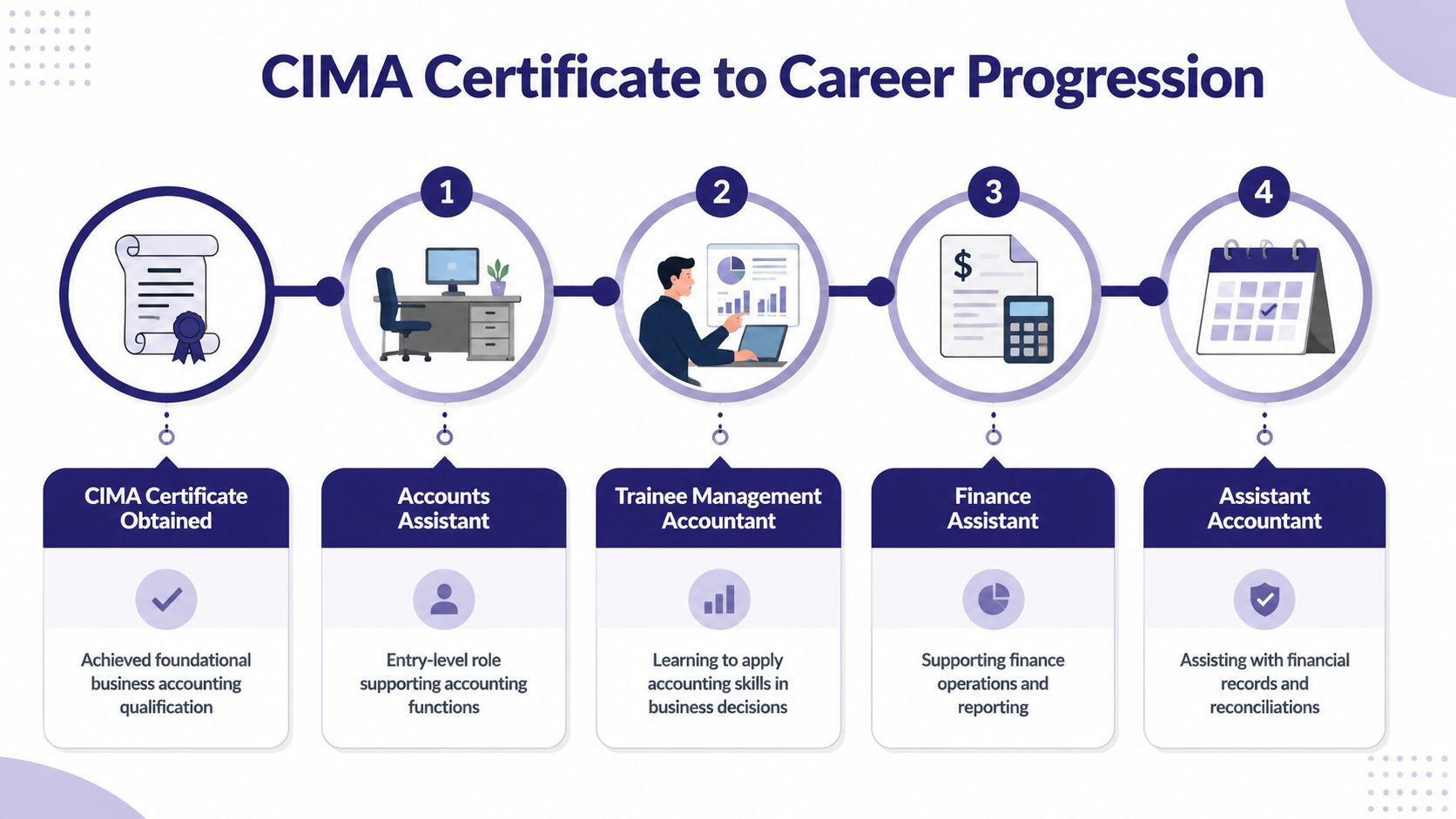
Where learners often get stuck
A qualification gives you the theory. Employers usually want evidence that you can apply it.
That’s the gap many beginners don’t see until they start applying for jobs. Knowing what VAT is isn’t the same as processing transactions correctly in Sage or Xero. Understanding payroll terms isn’t the same as working through real payroll tasks. Knowing what final accounts are isn’t the same as helping prepare them from source records.
This is why some people finish study but still feel unready in interviews. They can describe concepts, but they struggle when asked how they’d use software, handle reconciliations, or support reporting in practice.
The roles that benefit most from practical application
This matters particularly in jobs such as:
- Accounts assistant, where software confidence and routine finance processes matter
- Bookkeeping and VAT support, where accuracy in real systems matters every day
- Advanced payroll support, where process discipline is essential
- Final accounts preparation support, where source data must be organised correctly
- Business analyst and data analyst support roles, where interpreting business figures is often as important as presenting them
For learners aiming high, it also helps to understand the professional standards behind longer-term progression. Understanding chartered accountant standards offers a useful snapshot of how qualifications signal competence and credibility in the wider profession.
Why this foundation still matters later
The point of the certificate isn’t only the first job. It’s that you start with business understanding that can grow with you. As your responsibilities increase, that grounding helps you move beyond routine tasks and into support for decisions, reporting, and planning.
If you’re mapping that first move into the profession, Professional Careers Training’s guide to getting into accounting is a practical resource for seeing how early roles connect to longer-term progression.
Your Path to Success with Professional Careers Training
The strongest career moves usually combine academic knowledge with hands-on practice. That’s where many learners need proper support. Passing exams is important, but employers also want people who can open the software, process the work, and explain what they’ve done.
Professional Careers Training is built around that real-world gap. Instead of stopping at theory, the training focuses on practical skills that employers recognise in day-to-day finance and analyst roles.

What practical training adds to a CIMA foundation
A learner with a CIMA base already understands the language of business finance. Add practical training and that learner becomes much more employable.
Professional Careers Training offers support across areas that employers regularly ask for:
- Bookkeeping and VAT, including practical work in systems used in UK businesses
- Advanced payroll, where accuracy and process matter
- Accounts assistant skills, built around routine finance tasks employers expect
- Final accounts, so learners can connect records to reporting
- Business analyst and data analyst development, where finance understanding strengthens commercial analysis
The software element matters too. Training that includes tools like Sage, Xero, and QuickBooks helps turn knowledge into evidence. Employers often want to see that a candidate can contribute from the start, not just learn everything after joining.
Why support beyond the classroom matters
Technical training is only part of the picture. Many capable learners lose out because they don’t present their skills well enough.
Professional Careers Training also supports learners with:
- 1-to-1 training with qualified professionals
- Flexible study times, including options that fit around work and family life
- CV preparation and career coaching
- LinkedIn optimisation and job hunting support
- References to employers
That mix can make a real difference for career changers, recent graduates, and newcomers to the UK job market. It helps turn study into a credible job application, which is often the hardest step.
If you’re serious about building on the CIMA Certificate with practical accounting and analyst skills, Professional Careers Training can help you move from theory to job-ready confidence with flexible training, software experience, and career support suited for UK employers.