
If you're training to become a business analyst, or you already work as one, you've probably noticed AI tools turning up in more of your...
If you want to change career at 30, stop treating it like a crisis. Treat it like a project. In the UK, the smartest moves right now are practical, skills-led moves into roles with clear entry points. That’s why accounting, bookkeeping, payroll, business analysis, and data analysis make so much sense. They reward structured training, they value competence, and they give career changers a direct path into real jobs.
Is It Too Late to Change Career at 30?
No. It’s not too late. It’s a sensible time to do it.
By 30, you know more about your tolerance for stress, your working style, and what kind of job drains you. That self-awareness is useful. It stops you making random choices and pushes you towards a career that fits your strengths.
The bigger point is this. The idea that changing careers at 30 is reckless is outdated. 80% of career changers report being happier in their new field, and 77% earn the same or more within two years, according to MyPassion.AI’s career change at 30 analysis. The same source notes that the average person changes careers 5 to 7 times in a lifetime. A pivot at 30 isn’t unusual. It’s normal. If you are weighing this up a decade later instead, our companion guide to how to change career at 40 covers the equivalent roadmap for that stage.
What 30 gives you that 22 doesn’t
You’re not starting from nothing. You already have evidence of how you work under pressure, how you communicate, how you manage deadlines, and how you solve problems. Those things matter in finance and data roles.
A good Accounts Assistant isn’t just someone who can enter figures. They need accuracy, follow-through, and judgement. A solid Data Analyst isn’t just someone who can open Power BI. They need to ask the right question, spot bad assumptions, and explain findings clearly.
Practical rule: Don’t compare yourself with school leavers or fresh graduates. You’re bringing work maturity they don’t have.
There’s another issue sitting in the background for many people at 30. Money pressure. Rent, bills, children, debt, savings goals. That pressure is real, and it can make you stay stuck. If you’re trying to work out whether you can afford a transition, Fintrack’s 2026 savings target analysis is a useful reality check because it helps you think about the move in the context of your wider financial life, not just course fees.
Why finance and data are strong pivot options
Some career changes are vague. These aren’t.
Finance and data roles tend to have clearer entry routes than many other fields. You can train for a specific outcome. For example:
- Bookkeeping and VAT suits people who like structure, records, and detail.
- Advanced payroll fits people who want process-heavy work with clear rules.
- Accounts assistant roles often suit organised career changers who want a broad entry into finance.
- Final accounts training helps build progression beyond basic processing work.
- Business analyst work suits people who can gather requirements, map processes, and work with stakeholders.
- Data analyst roles suit people who enjoy logic, spreadsheets, reporting, and trend analysis.
If you’re serious about moving, don’t sit in uncertainty for months. Read practical guidance for career changers exploring their next move and start narrowing your target.
Assess Your Skills and Define Your New Path
A common mistake made first is asking, “What should I do next?” before asking, “What am I already good at?”
That backwards thinking wastes time.
Start with your evidence, not your frustration
Write down the work you’ve done well over the last few years. Not your job titles. Your actual tasks.
Look for patterns such as:
- Detail-heavy work like checking records, reconciling information, or spotting mistakes
- Process work such as handling repeat tasks accurately and on time
- People-facing work including client communication, coordination, or resolving issues
- Analytical work like reporting, forecasting, comparing options, or using spreadsheets
- Project work involving deadlines, handovers, tracking, and documentation
These patterns point to likely career fits.
Match your strengths to real job outcomes
Here’s a simple way to understand this:
| Role | Good fit if you enjoy | Typical strengths that help |
|---|---|---|
| Bookkeeper | Accurate records, transactions, VAT work | Attention to detail, consistency, organisation |
| Accounts Assistant | Broad finance support, reconciliations, purchase and sales ledger | Reliability, admin strength, numerical confidence |
| Payroll Administrator | Rules, deadlines, routine, compliance | Precision, confidentiality, calm under pressure |
| Business Analyst | Gathering requirements, improving processes | Communication, stakeholder management, structured thinking |
| Data Analyst | Reporting, dashboards, trends, data cleaning | Logic, Excel confidence, problem-solving |
Honesty matters. If you hate detail, bookkeeping will frustrate you. If you dislike stakeholder conversations, business analysis may not suit you, and if spreadsheets make you want to leave the room, data analysis probably isn’t the move.
Don’t rely on transferable skills alone
Transferable skills matter, but they won’t carry you by themselves in regulated sectors.
UK employers in regulated fields like accounting and finance prioritise professional body recognition and specific qualifications. Career changers must overcome the “no direct experience” barrier, which generic advice on transferable skills often fails to address. Structured training is key to bridging this credibility gap.
That’s the bit many people miss. Generic career advice says, “Just tell your story well.” That’s not enough when employers want evidence that you understand bookkeeping systems, payroll processes, VAT basics, or finance workflows.
You don’t beat the credibility gap with confidence. You beat it with proof.
Questions that will clarify your path
Use these before you spend money on training:
- Do I want a role with clear rules or open-ended problem solving?
- Do I prefer independent work or constant stakeholder contact?
- Do I need a fast route into work, or can I invest in a longer qualification path?
- Do I want finance operations, business change, or technical data work?
- Can I study alongside my current job consistently?
If your answers point to finance operations, target bookkeeping, payroll, accounts assistant, and final accounts pathways. If they point to business improvement and reporting, business analysis or data analysis is likely the better fit.
Choose Your Training Your Key to the Industry
Once you know the direction, choose training that leads to a job title. Not training that just sounds impressive.
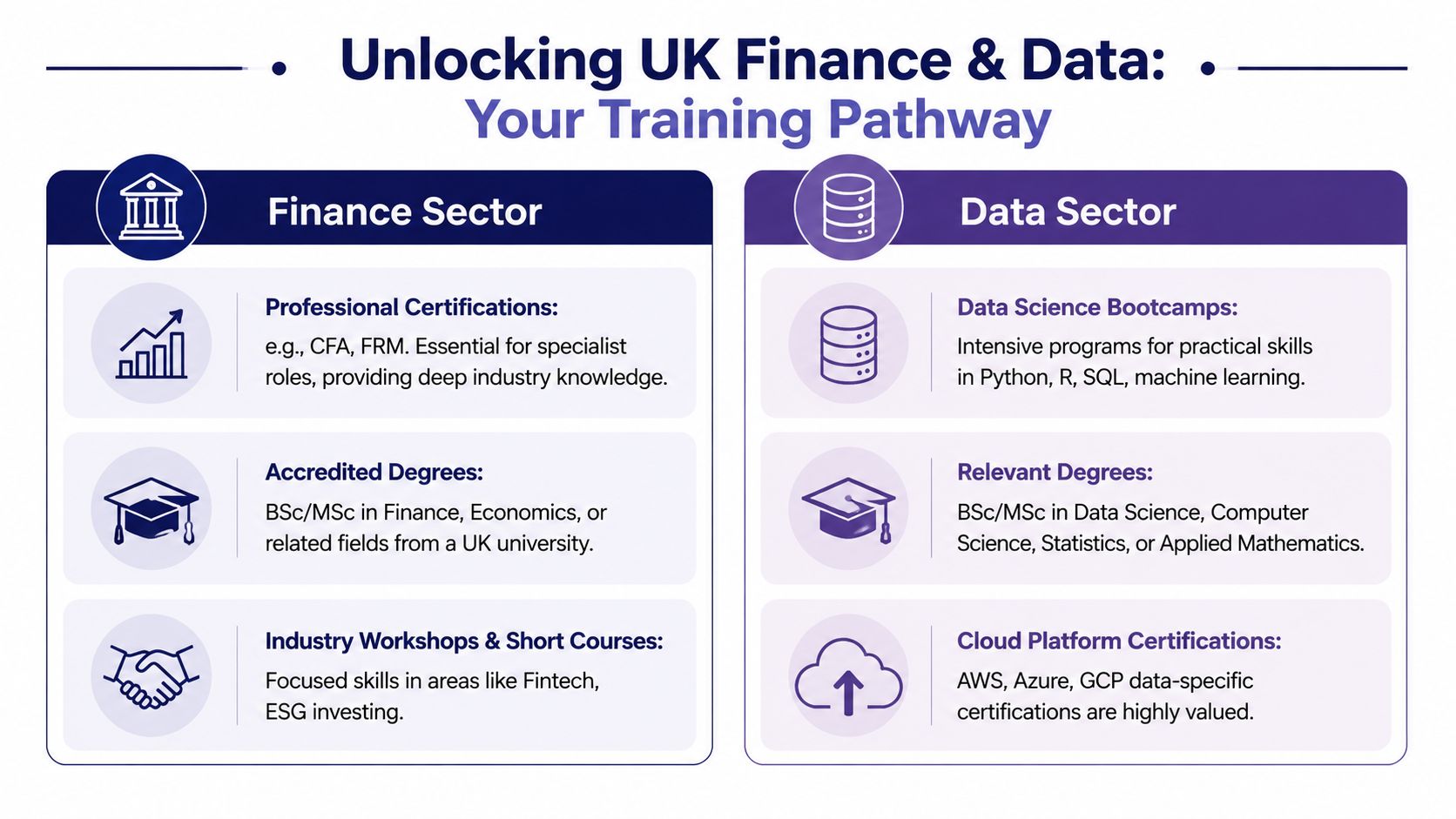
That distinction matters. A lot of people lose months on broad learning that doesn’t improve employability. If your goal is to change career at 30, your training must be practical, recognisable, and linked to entry-level hiring needs in the UK.
Certifications usually beat going back for another degree
For career changers, speed matters. So does return on effort.
33.58% of career changers use field-specific certifications as their primary qualification route, compared with 20.44% pursuing a new Bachelor’s and 15.33% pursuing a Master’s, according to Drexel’s analysis of career change education pathways. The same analysis notes that this route can support market entry within 6 to 12 months.
That’s why I usually tell career changers not to default to university. In many finance and data roles, targeted training gets you moving faster.
For help comparing options sensibly, read this guide on choosing the right training course for your career goals.
Best training routes by job target
Bookkeeper and Accounts Assistant
This is one of the best entry points for career changers who want a practical route into finance.
Useful training usually includes:
- Bookkeeping and VAT to understand core finance processes
- Sage, Xero, and QuickBooks because employers want software confidence
- Advanced Excel because finance teams still rely heavily on spreadsheets
- Final accounts exposure if you want progression beyond junior processing work
This route suits people coming from admin, retail, customer service, operations, or office support. If you’ve handled records, invoices, schedules, or reconciled information before, the transition can make sense.
Payroll
Payroll is underrated.
It gives you a specialist function, regular deadlines, and a clear operational role. If you’re methodical and comfortable with confidential information, advanced payroll training can be a smart move. It also works well for people who like process and want less ambiguity in their day-to-day work.
Business Analyst
Business analysis is not just “good communication”. Employers want people who can document requirements, map processes, work with stakeholders, and think clearly.
Training should focus on:
- Business analysis foundations
- Process mapping
- Excel
- Reporting and documentation
- A portfolio of requirements or workflow examples
This path often works well for people moving from operations, project support, customer-facing roles, or management positions.
Data Analyst
Data analysis is a strong option if you enjoy working with data. Not if you just like the salary headlines online.
Prioritise:
- Advanced Excel
- SQL
- Power BI
- Data cleaning and reporting projects
Python can help, but don’t hide behind endless technical study. Most career changers need a clear analyst toolkit first, not a year of drifting through random tutorials.
My advice: Choose the shortest training path that gives you credible proof of competence for the role you actually want.
Build Your 6 to 12 Month Career Change Timeline
A career change feels overwhelming when you think in years. It feels manageable when you think in phases.
The best approach is structured action. The 90-Day Strategic Acceleration Framework breaks career transitions into market validation, skill-building, and strategic applications, and it helps counter the common problem that 87% of career changers stall in endless research, as outlined by SUCCESS in its guide to changing careers at 30, 40 or 50.

Months 1 to 3
This phase is about clarity and first proof.
Pick one target. Not three. If you’re torn between payroll and data analysis, decide which one you’ll pursue first. Split focus kills momentum.
Your priorities:
- Research real roles by reading job adverts carefully
- Speak to people in the field through short informational conversations
- Start core training in the tools and tasks employers ask for
- Rewrite your CV headline so it points towards your new direction
If you’re moving into bookkeeping or accounts assistant work, get hands-on with Sage, Xero, QuickBooks, bookkeeping workflows, and VAT. If you’re aiming for data analyst roles, build confidence in Excel, SQL, and Power BI early.
Months 3 to 6
Now you need evidence.
Learning without output won’t get you hired. You need examples you can show, discuss, and put on your CV or LinkedIn profile.
Create things like:
- A bookkeeping practice file with transactions, reconciliations, and VAT tasks
- A payroll workflow example showing process understanding
- A final accounts practice exercise
- A dashboard in Power BI
- An Excel reporting workbook
- A business analysis sample such as requirements notes or a process map
Action creates clarity. You don’t think your way into confidence. You build it by doing the work.
Months 6 to 12
This is application mode.
Target roles that match your current level, not your old seniority. If you used to manage people in another sector, you may still need to enter finance or data through a junior or mid-level role. That isn’t failure. It’s a repositioning move.
Focus on:
- Targeted applications, not mass applying
- Recruiter conversations in your chosen niche
- Interview rehearsal
- LinkedIn updates that reflect your new skill set
- Warm introductions where possible
The people who complete a successful change career at 30 plan usually aren’t the smartest on paper. They’re the ones who keep moving each week.
Finance Your Transition and Secure Your Future
This is the part many articles dodge. They tell you to be brave and follow your purpose. That’s useless if you can’t pay your rent.
Changing career at 30 needs a money plan. A proper one.
Expect a transition cost and control it
You may face three costs at once:
- Training fees
- Time cost from studying evenings or weekends
- A temporary income dip if your first role in the new field starts lower
That doesn’t mean the move is a bad idea. It means you need to reduce the risk.
The strongest approach is usually:
- keep earning while you train
- choose direct, job-focused learning
- avoid bloated courses that delay employability
- start applying before you feel “perfect”
Think in terms of runway
Your financial runway is how long you can sustain the transition without panic taking over.
Work out:
- Your fixed monthly costs
- What you can cut temporarily
- How much buffer you already have
- How long you can study while employed
- Whether your household income can absorb a short adjustment
This isn’t glamorous, but it’s decisive. Career changers who ignore finances often rush into the wrong role out of fear.
Be realistic about salary expectations
There’s a common fear that changing careers means permanently damaging your earnings. That fear is often exaggerated.
As noted in the earlier discussion on career outcomes, many career changers recover financially. For UK-specific transitions, the more useful point is this: while many fear a permanent pay cut, UK-specific data is often missing from generic advice. While an initial dip is possible, roles in accounting and finance have strong salary progression. The key is to minimise the income gap by choosing efficient training that leads directly to employment, making the ROI on certifications like ACCA, Sage, or Xero extremely high, as discussed in this analysis of salary concerns during career change.
Financial test: If a course delays your route to work without adding hiring value, it’s too expensive, even if the fee looks manageable.
Make your first move financially smart
A smart move isn’t always the dream role immediately. Sometimes it’s the first credible role that gets you into the sector.
That might mean:
- starting as an Accounts Assistant before moving into assistant accountant work
- taking a bookkeeping role and building software confidence
- entering through payroll and specialising
- landing a junior data analyst or reporting role before moving into broader analytics
- taking a business support role with reporting or systems exposure and then stepping across
That kind of staged move often protects your income better than waiting for a perfect opportunity.
Launch Your Job Search with a Winning CV and Interview
Most career changers undersell themselves badly.
Their CV reads like a history lesson, and LinkedIn profile points backwards. Their interviews sound apologetic. Then they wonder why employers hesitate.
You need a sharper approach.

Write a CV for the role you want
Your CV must be built around relevance.
If you’re applying for Accounts Assistant roles, the reader should quickly see software training, bookkeeping exposure, reconciliation work, Excel use, and finance-related tasks. If you’re targeting Data Analyst roles, they should see reporting, data tools, dashboards, analysis projects, and commercial thinking.
Use a skills-led structure if your old titles don’t match your new direction.
Good CV content for a career changer includes:
- A focused headline such as “Trainee Accounts Assistant with hands-on bookkeeping and Excel training”
- A profile that explains the move clearly and briefly
- Relevant tools and training near the top
- Project examples that prove your new skills
- Transferable achievements rewritten in the language of the target field
For extra help, use these UK CV writing tips for practical job applications.
Fix your LinkedIn profile
LinkedIn should support your pivot, not confuse it.
That means:
- Change your headline so it reflects your target role
- Update your About section with your transition story and current training
- Add projects and certifications
- Use keywords employers search for, such as Sage, Xero, QuickBooks, SQL, Power BI, bookkeeping, payroll, business analysis, and reporting
- Engage sensibly with industry content so your profile looks active and current
Don’t pretend to be something you’re not. But don’t present yourself as trapped in your old career either.
Answer the career change question properly
You will be asked why you’re changing careers. Good. That’s your chance.
Bad answer:
“I just wanted something different.”
I wanted to move into a role with clearer progression and stronger alignment with the work I enjoy doing. In my previous roles, I found myself most engaged by detail-driven tasks, reporting, and process improvement, which led me to train in bookkeeping and finance systems.
For data roles, you might say:
“I realised the part of my job I enjoyed most was working with information, spotting patterns, and improving decisions. I’ve now built practical skills in Excel, SQL, and Power BI to make that shift properly.”
Employers don’t need your life story. They need a credible reason, evidence of action, and confidence that you’ll stick.
Show proof, not just enthusiasm
Interviewers hear “I’m a fast learner” all the time. It means nothing by itself.
Bring proof:
- a bookkeeping file you’ve worked through
- a payroll example
- a final accounts practice piece
- a Power BI dashboard
- an Excel analysis workbook
- a business process map or requirements sample
Even basic projects can help if you can explain them clearly. That explanation matters. Hiring managers want to know how you think, not just what course you completed.
Apply like a strategist
Don’t spray applications everywhere.
A stronger method is:
- target a shortlist of suitable roles
- tailor your CV
- write a brief, direct cover message
- follow up professionally
- track your applications
- adjust based on interview feedback
For career changers, focused applications usually beat volume. You’re asking an employer to take a chance on your new direction. Make that choice easy for them.
Your New Career Starts Now
If you want to change career at 30, stop waiting to feel fully ready. You won’t.
The people who make this work do five things well. They:
- assess their strengths accurately
- choose training linked to real jobs
- build a timeline and follow it
- make a money plan
- market themselves properly
That’s the roadmap.
You do not need to blow up your life to make a better decision. You need a practical target and disciplined action. For many people in the UK, that means moving into bookkeeping, payroll, accounts, business analysis, or data analysis through focused training and a smart job search.
If you’re exploring finance roles, it also helps to understand how modern accounting work operates day to day. This guide on how small firms can save time on business accounting gives useful context on the kind of processes, systems, and efficiency thinking that now shape bookkeeping and finance support work.
Start now. Not someday. A year from now, you could still be stuck, or you could be established in a new field.
If you want structured support to move into bookkeeping, payroll, accounts, business analyst, or data analyst roles, Professional Careers Training offers flexible training with 1-to-1 support from ACCA-qualified Chartered Accountants and CPD-approved trainers, official Sage, Xero and QuickBooks certifications, software support, and practical recruitment help including CV preparation, LinkedIn optimisation, job hunting strategy, interview coaching, and employer referrals.