If you're training to become a business analyst, or you already work as one, you've probably noticed AI tools turning up in more of your...
A good change management qualification helps you bridge that gap. It teaches you how to support adoption, reduce resistance, communicate clearly, and make new systems stick. For accounts assistants, payroll staff, business analysts, and data analysts, that can be the difference between being seen as the person who runs tasks and the person who leads improvement.
Why Change Management Matters for Your Finance Career
Finance teams now sit close to business transformation. An accounts assistant may help move purchase ledger work into a cloud system. A payroll professional may support a new advanced payroll process with different approval routes. A data analyst may build reporting in Power BI, only to find managers still ask for old Excel files.

The pattern is familiar. The software goes live, but habits don’t change. People don’t understand the reason for the switch, they worry about mistakes, or they feel the new process was imposed on them. That’s where change management stops being abstract and becomes practical.
Technical delivery isn’t the same as adoption
You can install Xero perfectly and still have a poor result. You can launch a final accounts workflow with clear deadlines and still get inconsistent data. Finally can train staff on Power BI and still find that nobody uses the dashboard in meetings.
Project work focuses on building the thing. Change management focuses on helping people accept, use, and sustain the thing.
For finance professionals, that often means:
- Bookkeeping and VAT changes: helping staff move from manual posting habits to a new cloud ledger and compliant review process
- Advanced payroll upgrades: preparing line managers for new approval steps, pay element coding, and tighter deadlines
- Accounts assistant progression: showing that you can support process change, not just process completion
- Business analysis work: translating operational changes into stakeholder actions
- Data analysis roles: making sure reports are trusted, understood, and used in decision-making
Practical rule: If a new system changes behaviour, not just screens, someone needs change management skills.
Why employers notice this skill
Employers don’t just want people who know the software. They want people who can help colleagues move from the old way to the new one with less friction. In many finance and analyst roles, that shows maturity.
Think about a payroll migration. The technical team may configure the system correctly. But employees still need reassurance about accuracy, deadlines, payslip access, and escalation routes. If you can manage those people-side issues, you become more valuable.
The same is true in reporting projects. Many teams invest heavily in dashboards, then struggle with low adoption. If you’re interested in why that happens, this breakdown of root causes of BI project failure is useful because it connects weak adoption, unclear ownership, and poor communication to failed business intelligence outcomes.
What this means for career progression
A change management qualification can help reposition you. Instead of being viewed only as a bookkeeping technician, payroll processor, or report builder, you’re seen as someone who can support transformation. That matters when you’re applying for roles such as:
| Role type | How change management helps |
|---|---|
| Accounts assistant | Shows readiness for process improvement and systems support |
| Payroll officer | Demonstrates confidence in rollout, communication, and issue handling |
| Business analyst | Strengthens stakeholder work and implementation credibility |
| Data analyst | Improves dashboard adoption and business engagement |
| Finance officer | Adds leadership value during software and policy changes |
A lot of readers get confused here and think, “Do I need to become a full-time change manager?” Usually, no. In many cases, you need enough structured training to lead the people side of the changes already happening in your role.
That’s why a change management qualification has become so relevant in finance and data careers. It isn’t a detour from your technical path. It’s often the skill that helps your technical work land properly.
Understanding Core Change Management Skills
A simple way to understand change management is this. Project management is the blueprint. Change management is the homeowner’s guide. One makes sure the build is completed. The other makes sure people can live in it comfortably and use it as intended.
That distinction matters in finance and analytics. A team might complete a system build on time, yet still struggle because nobody feels confident using the new chart of accounts, payroll workflow, or reporting tool.
The skills most qualifications teach
Most respected programmes cover a common set of abilities, even if they use different terminology.
- Stakeholder analysis: You identify who is affected, how strongly they’re affected, and what each group needs. Before automating a VAT process, for example, you’d map the bookkeeper, finance manager, external accountant, and operations staff because each group sees different risks.
- Communication planning: You decide what needs to be said, by whom, and when. In an advanced payroll launch, staff may need one type of message about payslips and timing, while managers need another about approvals and cut-off dates.
- Resistance management: You learn to spot why people push back. Sometimes it’s lack of clarity. Sometimes it’s fear of errors. Sometimes they trust the old spreadsheet more than the new system.
- Training and support design: Good change work doesn’t stop at one training session. It creates practical support, such as quick guides, checklists, drop-in sessions, or super-user networks.
- Adoption measurement: You look beyond “system installed” and ask whether people are really using the change. Are reports being opened? Are approvals happening in the new process? Are teams reverting to workarounds?
A change succeeds when daily behaviour changes, not when the software contract is signed.
How this looks in real finance and data work
If you’re in bookkeeping, stakeholder analysis might mean asking who enters supplier invoices, who reviews VAT codes, and who deals with exceptions. If you’re in data, it might mean identifying which department heads rely on old reports and what would make them trust a new Power BI dashboard.
A good qualification also teaches you to work with managers, not around them. That’s one area many junior professionals miss. Change sticks faster when line managers reinforce it in day-to-day conversations.
For teams dealing with mindset shifts as well as process changes, this guide on cultural change management for leadership teams is worth reading because it shows why leadership behaviour shapes adoption.
Where learners often get stuck
People often assume communication means sending more emails. It doesn’t. Good communication means giving the right message to the right audience at the right moment.
They also assume resistance is a sign that staff are difficult. Often it means the change hasn’t been explained well, the training was too generic, or the process doesn’t fit real working conditions.
Here are some plain-language examples:
-
New Xero setup
The issue isn’t just “staff need training”. The issue may be that the sales team doesn’t know when to raise invoices in the new workflow. -
Power BI rollout
The issue isn’t just “dashboard usage is low”. The issue may be that managers still get the same numbers by email and don’t see a reason to switch. -
Advanced payroll process
The issue isn’t just “approvals are late”. The issue may be that managers don’t understand the impact of missing the new payroll cut-off.
When you study for a change management qualification, you’re learning how to diagnose these people-side barriers before they damage the project.
Comparing Major UK Change Management Qualifications
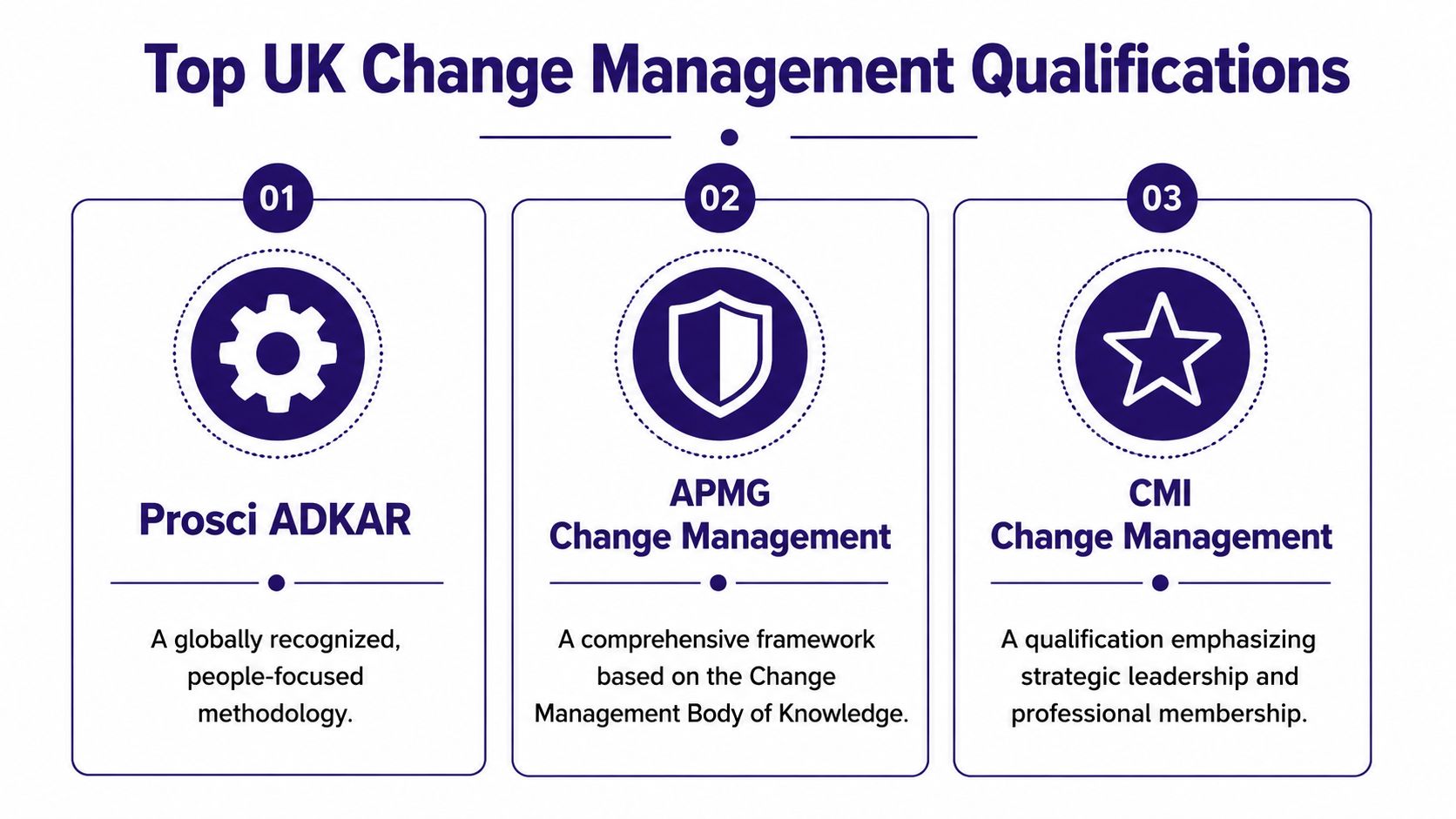
UK learners usually come across three major routes first. Prosci, APMG International, and the Change Management Institute. Each has a different feel, and the right choice depends on your career stage, job target, and how deep you want to go.
APMG for broad UK recognition
APMG is often the easiest route to explain to UK employers because it fits neatly into a familiar certification structure. It usually starts with Foundation, then moves to Practitioner. That makes it attractive if you’re coming from accounts, payroll, or analyst work and want a clear progression path.
The Practitioner level has a 2.5-hour exam with a 60% pass mark, and UK-specific data cited in this comparison source says certified Practitioners deliver an 18% higher Net Promoter Score in stakeholder engagement. You can see that in this review of major UK change qualification outcomes.
If you want a closer look at the syllabus style and how the qualification is positioned, this guide to APMG Change Management training is useful.
APMG tends to suit:
- Finance staff moving into project-heavy roles
- Business analysts who need a recognised UK credential
- Professionals working with structured governance environments, especially where process, compliance, and formal documentation matter
Prosci for a people-focused framework
Prosci is strongly associated with the ADKAR model. That’s popular because it’s easy to remember and practical to use. It focuses on moving individuals through awareness, desire, knowledge, ability, and reinforcement.
For someone introducing a new payroll or accounting system, that logic is helpful. It reminds you that knowledge alone isn’t enough. A colleague can know how to use the software and still resist using it if they don’t believe the change is necessary or useful.
Prosci often suits learners who want:
- a simple model they can apply straight away
- a people-centred approach to adoption
- a framework that works well for tech implementations and process changes
It’s especially appealing to business analysts and data professionals who need to improve stakeholder adoption without getting lost in overly academic language.
CMI for long-term professional standing
The Change Management Institute route usually appeals to people who want a stronger professional identity in change leadership. It can feel more advanced and more membership-oriented than a single exam-based certificate.
For experienced professionals, that can be a good fit. The pathway places more emphasis on applied competence, professional standards, and strategic leadership. That makes it relevant if you’re already leading transformations, mentoring others, or trying to move into senior change, transformation, or programme roles.
Some qualifications help you enter the field. Others help you establish credibility once you’re already influencing major change.
A quick side-by-side view
| Qualification | Best fit | Style | Useful for finance and data roles |
|---|---|---|---|
| APMG | Career changers and professionals wanting a recognised UK certificate | Structured Foundation and Practitioner route | Strong for business analyst, payroll systems, accounts process change |
| Prosci | Learners who want a practical adoption model | People-focused, ADKAR-led | Strong for software adoption, dashboards, workflow rollouts |
| CMI | Experienced professionals building leadership credibility | Competency and professional pathway | Strong for senior finance transformation and strategic change roles |
What about ILM or CIPD options
Some learners don’t want to jump straight into a major certification. That’s reasonable. Introductory learning through leadership or people-management routes can help you build confidence before committing to a full practitioner path.
That can be helpful if you’re still testing whether change management is central to your career, or if your current role only touches change projects occasionally. For many readers in bookkeeping, payroll, or entry-level analyst work, an introductory route can be a sensible first move before pursuing a full change management qualification.
Which Qualification Path Suits Your Career
The right path depends less on the brand name and more on where you’re starting from. A recent graduate doesn’t need the same route as an experienced payroll lead or a finance analyst trying to move into business analysis.

A useful way to decide is to match the qualification to the job problem you’re trying to solve. Are you trying to stand out on a CV, move sideways into a new field, or prove you’re ready to lead bigger change?
If you’re a recent graduate
Graduates in accounting, finance, business analysis, or data often have the same challenge. They know the tools, but they don’t yet have enough evidence of workplace impact.
A foundation-level change management course can help because it shows employers that you understand how real organisations adopt new processes. That’s attractive if you’re applying for trainee accountant, accounts assistant, junior analyst, or finance systems support roles.
For example, if you’ve learned Xero, Sage, Excel, SQL, or Power BI, a change qualification adds another layer. It says you can do more than operate software. You can help teams move onto it.
If you’re changing career into business analysis
This group often benefits the most from a recognised practitioner route. Employers hiring business analysts want someone who can gather requirements, but they also want someone who understands stakeholder impact.
A 2023 CIPD report covering 1,500 UK HR professionals found that 55% prioritise change-qualified candidates for business analysis roles, and certified individuals earn 18% higher salaries on average. In practical terms, that makes a change management qualification a strong signal for people moving from finance, bookkeeping, payroll, or operations into analyst work. This comparison source is cited earlier, so the same finding is reflected here qualitatively.
If your background is in accounts payable, payroll, or reporting, this can be your bridge skill. It helps employers see your move into business analysis as credible, not speculative.
If you’re already experienced and need CPD
Experienced staff usually don’t need an entry-level overview. They need something that strengthens leadership credibility. That may mean a practitioner-level route or a more advanced professional pathway, depending on how much responsibility you already hold.
This is common for:
- Payroll leads managing system or compliance changes
- Finance officers involved in process redesign
- Accounts seniors helping teams adopt new month-end routines
- Data analysts driving reporting changes across departments
Here, the qualification isn’t just about getting hired. It’s about being trusted with cross-functional change.
The more senior your role becomes, the less employers judge you only on technical accuracy. They also judge how well you bring people with you.
After you’ve reflected on your path, this short video gives a useful overview of how change management thinking applies in practice.
If you’re an international student or newcomer to the UK
A UK-recognised qualification can help translate your skills for local employers. That’s especially valuable when your previous job title, training route, or software background doesn’t map neatly onto the UK market.
Employers often understand a known qualification faster than they understand an unfamiliar overseas job description. If you’re aiming for roles in finance operations, payroll support, business analysis, or data reporting, a UK-facing change management qualification can reduce that ambiguity.
A simple fit guide
| Your situation | Best starting point |
|---|---|
| Graduate with technical training but limited experience | Foundation-level programme |
| Finance professional moving into BA work | Practitioner-level UK-recognised certificate |
| Experienced professional building CPD | Advanced practitioner or professional pathway |
| International student entering the UK market | Recognised qualification with clear employer visibility |
If you’re still torn between options, choose the route that matches your next job target, not your ideal role five years from now. Qualifications help most when they solve today’s hiring problem.
How to Prepare for and Showcase Your New Qualification
A change management qualification only pays off if you pass it and present it well. Many learners do the first part and neglect the second. That’s a mistake, especially in competitive UK finance and analyst hiring.

According to the Robert Half UK Salary Guide coverage of CMI Specialist certification, professionals holding a Change Management Institute Specialist certification can command £65,000 to £85,000, representing a 15% premium over non-certified peers.
How to prepare without overcomplicating it
Many professionals struggle with scenario-based questions rather than definitions. They can remember the model names, but they freeze when asked what to do first in a messy workplace situation.
Use a simple prep checklist:
- Study the framework actively: Don’t just read notes. Turn each model into a workplace example from payroll, bookkeeping, final accounts, or reporting.
- Practise scenario thinking: Ask yourself what the barrier is. Is it lack of awareness, poor training, weak sponsorship, or resistance from one group?
- Revise with your current job in mind: If you work with Xero, Sage, QuickBooks, Excel, or Power BI, map the theory onto those systems.
- Keep a mini glossary: Write plain-English meanings for key terms so you don’t get trapped by jargon in the exam.
- Review mistakes, not just scores: If you get a practice question wrong, identify why your logic missed the people-side issue.
How to add it to your CV and LinkedIn
Once you’ve passed, make it visible immediately. A qualification hidden at the bottom of your CV won’t do much for you.
You can create a short Professional Development section like this:
-
APMG Change Management Practitioner
Applied change principles to stakeholder communication, training support, and adoption planning for finance systems and reporting change. -
Prosci ADKAR training
Focused on user adoption, resistance management, and reinforcement in technology-driven process change.
For LinkedIn, keep the wording clear. Recruiters scan quickly.
Headline example
Data Analyst | Power BI Specialist | Change Management Practitioner
Summary example
Finance and data professional with experience in reporting, process improvement, and system adoption. Trained in change management with a focus on stakeholder engagement, communication planning, and supporting successful rollout of new tools and workflows.
If you need help sharpening your profile, this guide on using LinkedIn for job search is a practical next step.
Put the qualification where recruiters can see it in seconds. Headline, certifications section, and CV summary matter more than a buried line in page two.
What to say in interviews
Don’t stop at naming the certificate. Explain how you’ll use it.
Try answers like these:
- “It helped me understand how to support adoption when teams move to a new finance process.”
- “I can now plan communication and training more effectively during systems change.”
- “It strengthened my ability to spot resistance early and respond in a structured way.”
That turns your qualification from a badge into evidence of judgement.
Becoming a Future-Ready Leader in Finance and Data
Finance and data careers are changing fast. Employers still care about accuracy, reporting quality, compliance, and software skills. But they also need people who can guide others through change without creating confusion or delay.
That’s why a change management qualification has become such a smart addition for professionals working in bookkeeping, VAT, payroll, accounts support, business analysis, and data analysis. It adds the human side to your technical ability. You don’t just know the new process. You know how to help a team adopt it.
The next shift is already visible. A CIPD Q1 2026 report summary says 71% of UK organisations now mandate CPD in AI-augmented change management for compliance roles. That should matter to finance and data professionals because more workflows now mix automation, analytics, and human judgement.
Why this matters for the next few years
If you’re working with digital records, payroll platforms, BI tools, or document-heavy finance processes, you’ll increasingly be expected to handle both systems and adoption. For example, teams that extract data from documents with automation still need people who can redesign workflows, train users, and make the new process reliable in day-to-day practice.
That means future-ready professionals will combine three strengths:
- Technical fluency in tools such as Xero, Sage, QuickBooks, Power BI, Excel, SQL, or payroll systems
- Change capability so people use the improved process
- Leadership judgement so projects stay aligned with business needs
A qualification won’t do all of that on its own. But it gives you a structure for thinking and acting more like a leader.
For readers who want to keep building that wider skill set, this resource on leadership skills for managers fits naturally alongside change training.
Choose the qualification that matches your next career step. Study it with real workplace examples in mind. Then present it clearly on your CV, LinkedIn profile, and in interviews. That’s how a course becomes a career move.
If you’re ready to build practical finance, accounting, bookkeeping, payroll, business analysis, or data skills alongside recognised career support, Professional Careers Training offers flexible training, software-focused learning, and job-search guidance designed for the UK market.