Your day might already depend on team quality more than you realise. If you're learning bookkeeping, helping with payroll, preparing final accounts, or building dashboards...
You might be searching for COSHH courses online because someone has just added “health and safety” to your job. That happens a lot in smaller UK firms. An accounts assistant becomes the person who orders supplies. A bookkeeper takes on office management. A business analyst starts visiting client sites and gets asked to sign off that staff have seen the right documents.
At that point, COSHH stops sounding like a factory-only issue. It becomes a practical office question. What about cleaning sprays in the cupboard, printer toner, adhesives, descaling liquids, or stockroom products in a mixed retail and office business? What if your finance team sits upstairs, but the company also runs a workshop, clinic, warehouse, gym, salon, or lab downstairs?
That's where a basic understanding helps. You don't need to become a chemist. You do need to know when hazardous substances are present, what the legal duties look like, and whether a short online course is enough for your role.
Hazardous Substances Are Not Just a Factory Problem
Sarah is an accounts assistant in a growing company. Her main work is invoices, VAT support, and helping prepare final accounts. Then her manager goes on leave and asks her to “keep an eye on office admin” for a few weeks.
At first, it sounds simple. Then she opens the cleaner's cupboard.
There are bleach-based products, aerosol sprays, washing-up liquids, dishwasher chemicals, spare toner cartridges, glue, and a box of disposable gloves. She also remembers that the company has a small archive room with dust, poor ventilation, and occasional mould around a window frame. A visiting contractor left a solvent-based product in the maintenance area. Suddenly, Sarah has a new question. Are these substances hazardous to health?
In many workplaces, the answer is yes. Not always in a dramatic way, and not always at a high level of risk. But yes, they can fall within the sort of health risks that COSHH is concerned with.

Where office staff get caught out
The confusion usually starts because people hear “hazardous substances” and think of drums, pipes, and warning sirens. Office workers often deal with lower-risk materials, but they still may handle products that need safe storage, clear labelling, or controlled use.
Common examples include:
- Cleaning products: Surface sprays, bleach, toilet cleaners, limescale removers, and hand sanitising products.
- Printer and maintenance items: Toner, inks, adhesives, and specialist wipes.
- Building-related issues: Dust during refurbishment, mould in poorly ventilated rooms, or pest control products.
- Mixed-site exposure: Staff in payroll, bookkeeping, or analysis roles who also visit warehouses, clinics, gyms, or production areas.
A finance professional may not use these products directly. But they may order them, store them, record training, support audits, or cover office manager duties. That puts them close to the compliance process.
A role can be office-based and still involve real COSHH responsibilities.
If your business manages shared facilities, cleaning standards matter too. For example, operators looking after staff wellbeing spaces or client gyms may benefit from science-backed gym cleaning advice that helps them think more carefully about product use, hygiene routines, and cross-contamination risks.
Why this matters to career-focused office staff
If you're training for work in bookkeeping, advanced payroll, accounts support, business analysis, or data analysis, you're often being prepared for broader responsibility. Employers like people who understand how operations work. COSHH awareness is part of that.
You might never carry out a detailed assessment yourself. But if you can spot an issue, ask the right question, and keep records in order, you're already more useful than someone who assumes health and safety belongs to “someone else”.
What Is COSHH and Why Does It Matter for Office Staff
At 8:30 on a Monday, an office manager opens a cupboard to find leaked cleaning fluid, a half-used air freshener, and no clear label on either bottle. Ten minutes later, a finance colleague asks where the safety sheet is because a contractor is due on site. That is the point where COSHH stops sounding like “factory training” and starts looking like an office problem.
COSHH stands for Control of Substances Hazardous to Health. In simple terms, it is the UK system for identifying substances that can harm people, working out how exposure could happen, and putting sensible controls in place.
For office staff, the confusing part is usually this: “I do not handle chemicals, so why would this apply to me?” A good answer is that COSHH often works like a chain. One person orders the product. Another stores it. Someone else uses it. An office manager, accountant, analyst, or bookkeeper may be the person who keeps the records, checks contractor paperwork, or notices that something is being used in the wrong place.
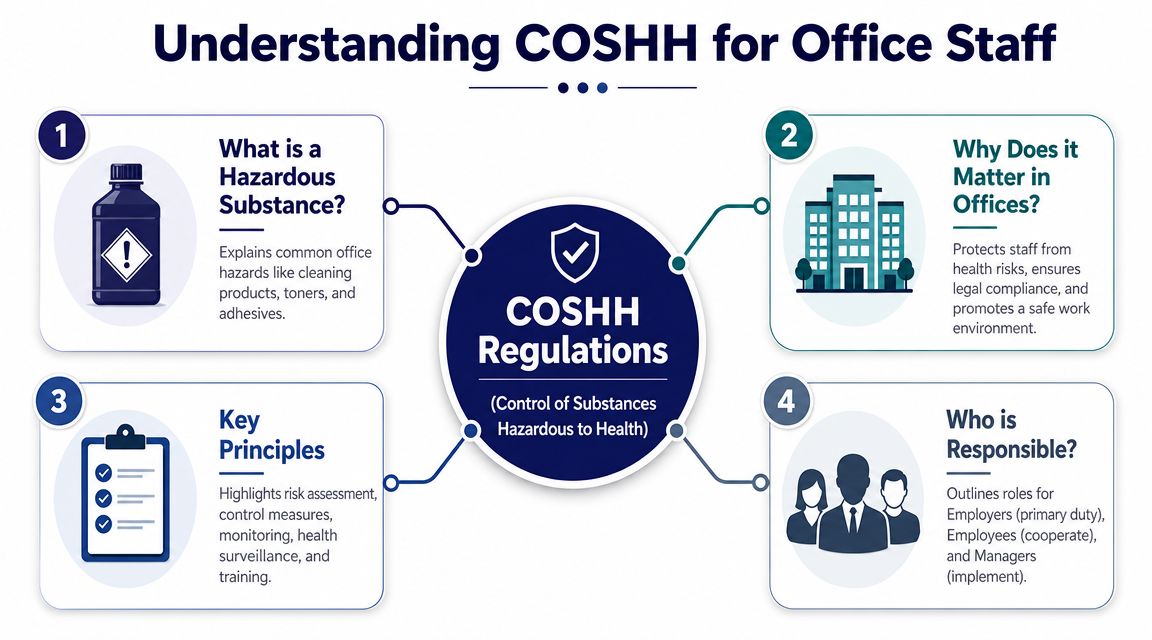
What COSHH means in an office setting
In a normal office, COSHH rarely appears as a dramatic incident. It shows up in everyday decisions.
A printer room may have toner and cleaning materials. A records area may collect dust or damp. A serviced office may bring cleaners, maintenance contractors, and visiting staff into the same shared space. A finance employee in a mixed-environment business might spend most of the week at a desk, then walk through a warehouse, clinic, gym, or plant room during a stock check, audit visit, or process review.
The key point is exposure, not job title.
That is why COSHH awareness can matter for people in accounts, payroll, reporting, and analysis roles. If your work includes approving purchases, keeping compliance files, supporting audits, arranging contractor access, or covering office management tasks, you may be part of the control process even if you never spray, mix, or decant a product yourself.
The practical questions COSHH asks
A useful way to understand COSHH is to picture it as a short checklist behind the scenes of daily work:
- What is the substance or material?
- How could someone come into contact with it?
- Who could be affected?
- What safety steps are already in place?
- What should happen if there is a spill, leak, or misuse?
Those questions are simple on purpose. They help non-technical staff spot whether something needs attention before it turns into a problem.
For example, an accountant in a small company may also order janitorial supplies. A business analyst may visit an operational site and need to understand why access is restricted in one area. A bookkeeper may be asked to file safety data sheets with other compliance records. In each case, COSHH knowledge helps that person recognise what matters and who to ask.
If your company is formalising responsibilities, a clear health and safety policy guide can also help office teams understand where COSHH-related tasks sit alongside purchasing, facilities, and staff supervision.
Why online COSHH training is relevant
Online COSHH courses are useful for office-based professionals because they explain the logic of the system without assuming a laboratory or industrial background. The better courses translate labels, exposure routes, storage rules, and record-keeping into situations that make sense in ordinary workplaces.
That matters if you are career-focused. Employers often value finance and admin staff who can do more than process numbers. Someone who can keep documents organised, spot a missing safety sheet, question unsafe storage, or support an audit calmly is easier to trust with broader responsibility.
A short explainer helps many learners. This video is a useful starting point for seeing COSHH concepts in a more visual format.
Practical rule: If your role includes ordering, storing, checking, recording, supervising, or visiting areas where substances are used, COSHH awareness is relevant to you.
Your Legal COSHH Obligations Explained
A finance manager signs off a new cleaning supplier for head office. An analyst visits the warehouse once a month. An office manager keeps spare toner, descaler, screen wipes, and contractor chemicals in a locked cupboard. None of those jobs sound like chemical safety work, yet each can pull someone into COSHH duties very quickly.
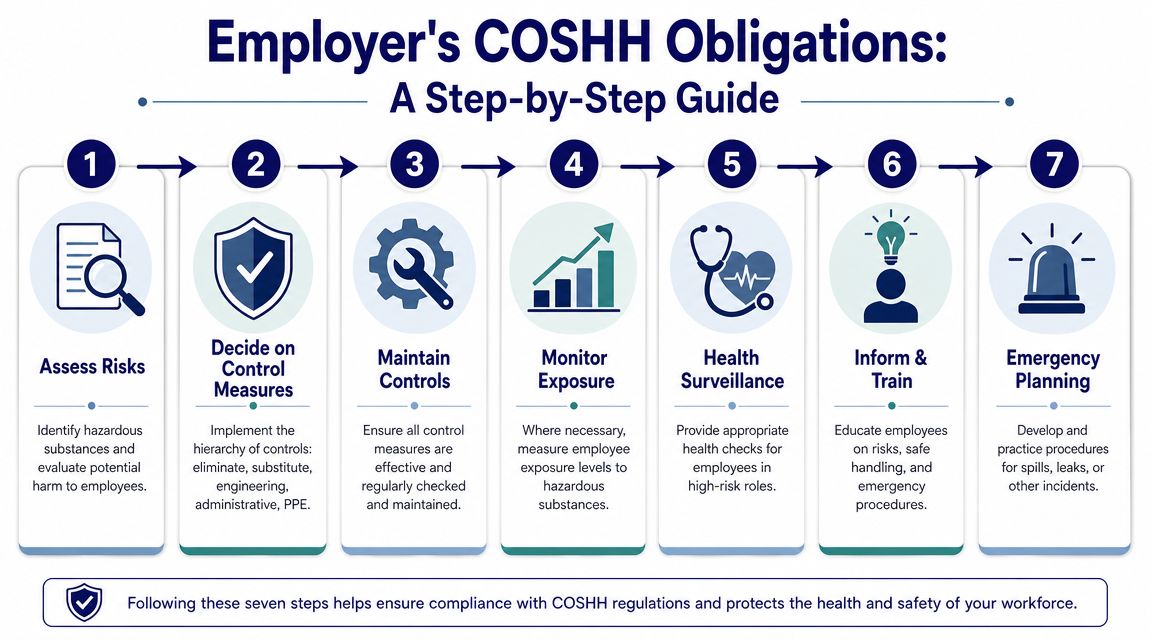
The legal starting point is the same across all of them. In the UK, employers must assess the risks from hazardous substances and control exposure under the Control of Substances Hazardous to Health Regulations 2002 (as amended). A training certificate can support that process, but the law expects more than attendance on a course. It expects sensible action.
The risk assessment is the core duty
The heart of COSHH is the assessment. In plain English, the employer needs to know what substance is present, how people might be exposed, who could be harmed, and what controls are needed to prevent or reduce that exposure.
For office-based staff, this can feel abstract at first because the substances are often ordinary products rather than drums of industrial chemicals. But COSHH does not only apply to dramatic hazards. Cleaning sprays, printer chemicals, adhesives, maintenance products, and dusts created during certain tasks can all matter if they present a health risk.
A useful way to read the duty is this. COSHH works like a checklist before a purchase, before a task, and after a change. If a product comes onto site, someone should ask what it is, how it is used, where it is stored, and whether existing controls still make sense.
A practical workflow in plain English
Good online training should explain the legal process in the order people use it at work. A sensible COSHH workflow usually looks like this:
Identify the substance
List the products, materials, dusts, fumes, or biological hazards people may come into contact with.Understand the harm
Check the label, safety data sheet, and the way the substance is used. A product can be low risk when sealed on a shelf and much more relevant when sprayed, mixed, heated, or used in a poorly ventilated room.Work out the exposure route
People may breathe it in, get it on their skin, splash it into their eyes, or transfer it from hands to mouth.Decide on controls
The best answer is often changing the product or the process first. Safe storage, clear instructions, restricted access, ventilation, and sensible housekeeping usually come before PPE.Record the findings and share them
The people buying, storing, using, cleaning, or supervising need the same clear information.Review the assessment
New suppliers, different tasks, contractor visits, office moves, refurbishment work, or complaints about irritation are all signs to revisit it.
That sequence matters because COSHH is a management system, not a one-off form.
What this means in an office or mixed-environment business
Many office employees are not the legal duty-holder, but they often hold part of the paper trail or trigger the decision that creates the risk. That is why accountants, bookkeepers, analysts, and office managers sometimes need COSHH awareness even when they never handle substances directly.
An accounts assistant might notice that a supplier has delivered a different cleaning product with no updated paperwork. A bookkeeper may process orders for maintenance chemicals and need to know why a manager is asking for safety information before approving spend. An analyst in a manufacturing business may spend part of the week in office space and part on the shop floor, where the controls are very different.
In practice, office-based professionals often help with tasks such as:
- keeping assessment records organised
- checking that safety data sheets are current
- spotting gaps in storage or labelling
- raising concerns when contractors bring new substances on site
- supporting audit preparation
- linking COSHH arrangements with wider procedures and responsibilities
If your business is reviewing those wider responsibilities, a broader health and safety policy guide can help place COSHH within the full policy structure.
Where employers often go wrong
A common mistake is treating training as the whole answer. It is only one part of compliance. Employers may also need maintenance of control measures, monitoring, health surveillance in some cases, clear emergency arrangements, and regular review when work changes.
The level of formality depends on the work. A small office with limited products may need a straightforward system. A professional services firm that shares space with cleaners, maintenance contractors, archives, workshops, or warehouse operations needs a more careful approach because the exposure routes and responsibilities are wider.
That is one reason online learning suits many office roles. A good course gives staff enough context to recognise when something needs escalating, and the choice between self-paced and tutor-led formats often depends on how much discussion your role requires. This comparison of online training and classroom learning options is useful if you are deciding how your team should complete that training.
Navigating Online COSHH Courses Levels and Content
Not all COSHH courses online do the same job. Some are built for general staff awareness. Others are aimed at people who need to manage assessments, supervise teams, or make decisions about controls.
That difference matters. A payroll administrator who occasionally handles office supplies doesn't need the same depth as an office manager in a cleaning company or an analyst who regularly visits production areas.
What a mainstream awareness course looks like
The UK market often frames training around the legal baseline. One provider's CPD and RoSPA Assured COSHH course lasts 2–3 hours and costs £26.00 + VAT, which shows how mainstream short online delivery has become for compliance training in the UK, as shown on High Speed Training's COSHH course page.
That kind of course usually suits people who need a clear grounding, not specialist assessor-level depth.
COSHH online course levels compared
| Course Level | Primary Audience | Key Learning Outcomes | Typical Duration |
|---|---|---|---|
| Awareness | Office staff, bookkeepers, payroll staff, accounts assistants, analysts | Understand what COSHH is, recognise common hazardous substances, read basic safety information, know when to escalate concerns | Often short-format online learning |
| Manager or Supervisor | Office managers, team leaders, facilities leads, compliance coordinators | Apply COSHH in workplace decisions, oversee controls, understand documentation and staff instruction responsibilities | Usually more detailed than awareness training |
| Assessor-focused or role-specific | Staff with direct responsibility for assessments in higher-risk settings | Evaluate substances, exposure routes, controls, review arrangements, and task-specific risks | More in-depth and usually tied to workplace context |
What to look for in the syllabus
Good course content usually covers:
- Hazard recognition: Cleaning products, toners, adhesives, dust, and biological risks where relevant.
- Exposure routes: Inhalation, skin contact, and accidental ingestion.
- Safety data and labels: Enough to help staff read and act on product information.
- Control measures: Storage, handling, ventilation, supervision, and emergency actions.
- Limits of awareness training: When specialist support or a fuller assessment is needed.
If you're weighing online study against face-to-face delivery, this guide to online training versus classroom learning is useful for thinking through flexibility, record-keeping, and how people learn in a busy workplace.
For many office-based learners, the best course is the one that matches their real responsibility level, not the one with the broadest title.
Choosing the Best COSHH Training Provider
A good provider doesn't just sell a certificate. It helps you understand where training fits within the wider compliance picture.
That's important because a short course can be completely suitable for one role and nowhere near enough for another. A bookkeeper in a low-risk office may only need awareness. A manager in a healthcare, cleaning, manufacturing, or laboratory setting may need more detailed training plus workplace-specific instruction.
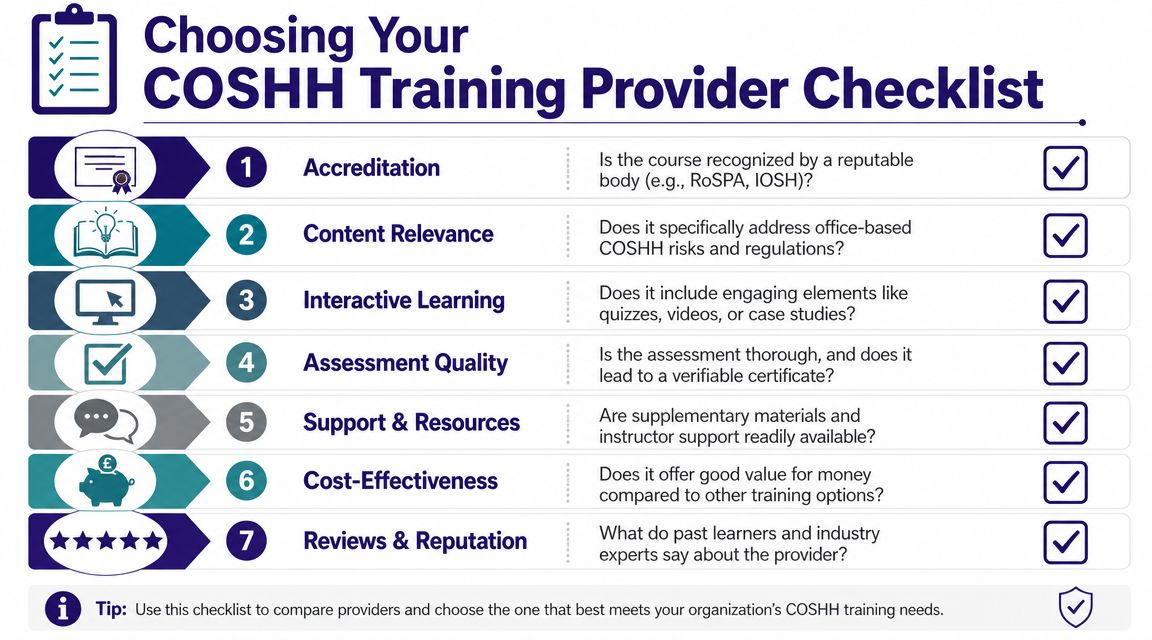
The provider checklist that actually matters
Use these questions before you buy:
- Is the course clearly positioned? You should be able to tell whether it's awareness-level or meant for managers.
- Does it explain real duties? The course should make clear that training is only one part of COSHH compliance.
- Is there recognised assurance? CPD, RoSPA, or similar recognition can help you judge credibility.
- Does the content fit office and mixed-use workplaces? A course that only talks about factories may miss your actual risks.
- Will you get a certificate and record? That matters for audits and staff files.
- Can learners complete it easily? Good online delivery should be simple to access and easy to track.
Is a short online course enough
That depends on the job.
The key point from the NHS Learning Hub summary of HSE expectations is that an employer's duty is not just training. It also includes assessment, control measures, maintenance, monitoring, and emergency planning. So a short course can be enough for awareness, but it can't carry the whole compliance burden by itself.
For many office-based professionals, awareness training is a sensible fit when they need to:
- understand the basics
- spot obvious concerns
- follow procedures
- support record-keeping
- know when to ask for a fuller assessment
For higher-risk tasks, employers should add workplace-specific instruction, supervision, and practical arrangements.
Why delivery quality matters
Online training works best when people can use it. Clear modules, quizzes, short videos, and easy access on demand make completion more likely in busy workplaces. If you're comparing digital formats, MEDIAL's video on demand training solutions offer a useful example of why flexible learning design matters for staff who can't all leave their desks at the same time.
You can also use a broader course-buying checklist like this guide on choosing the right training course for your career goals to decide whether you need compliance awareness, management-level depth, or something more specialised.
A decent COSHH course tells you both what to do and what still needs to happen after the course ends.
How COSHH Awareness Boosts Your Professional Value
A COSHH certificate won't turn an accountant into a safety manager. That's not the point. Its value is that it shows you understand how risk, compliance, and day-to-day operations connect.
That matters in finance and analyst careers because employers rarely promote people on technical skill alone. They promote people who notice operational risk, keep records straight, and ask sensible questions before a small issue turns into a bigger one.
Why employers notice this
The practical aim of COSHH compliance is to produce staff who can identify hazardous substances, judge whether existing controls are enough, and recognise when monitoring or health surveillance may be needed over time, as set out in HSQE's COSHH training overview.
For office and professional roles, that can translate into strong workplace habits:
- Better judgement: You're less likely to ignore a problem because it doesn't look dramatic.
- Stronger admin: You understand why records, access, and updates matter.
- Commercial awareness: You see that compliance links to continuity, reputation, and staff wellbeing.
- Leadership signals: Managers trust people who can handle responsibility outside a narrow job description.
How this helps specific career paths
An accounts assistant may end up coordinating office documents or supplier records.
A bookkeeper in a small firm may support purchasing and site administration.
Someone in advanced payroll may help track staff roles, locations, or training records in a multi-site business.
A business analyst may need to understand operational controls before mapping a workflow.
A data analyst may work with facilities, compliance, or HR data and need to understand what sits behind the records.
None of these roles are “about chemicals”. But all can touch the systems around hazardous substances.
A wider kind of competence
A lot of training only improves your narrow task skills. COSHH awareness does something different. It broadens your understanding of how a workplace stays compliant and safe.
That's useful CPD for professionals who want to move into senior support, operations, team leadership, or office management. If you're building that kind of profile, these CPD courses for accountants show how compliance knowledge can sit alongside finance and software skills.
A key advantage is credibility. When someone asks, “Can you take ownership of this?”, you're in a stronger position to say yes.
If you're building job-ready skills in accounting, payroll, bookkeeping, business analysis, or data analysis, Professional Careers Training offers practical learning designed to improve employability and support career progression. Their programmes combine technical training with flexible study options, software support, and career guidance, which can help you develop the broader workplace competence employers expect.