
If you're training to become a business analyst, or you already work as one, you've probably noticed AI tools turning up in more of your...
The issue usually isn’t competence. It’s communication under pressure.
That’s why courses in assertiveness matter so much for analytical professionals in the UK. Used properly, assertiveness isn’t a personality makeover and it isn’t an invitation to become blunt. It’s a practical skill set for protecting accuracy, managing workload, and making sure good analysis influences decisions.
What Assertiveness Means in an Analytical Role
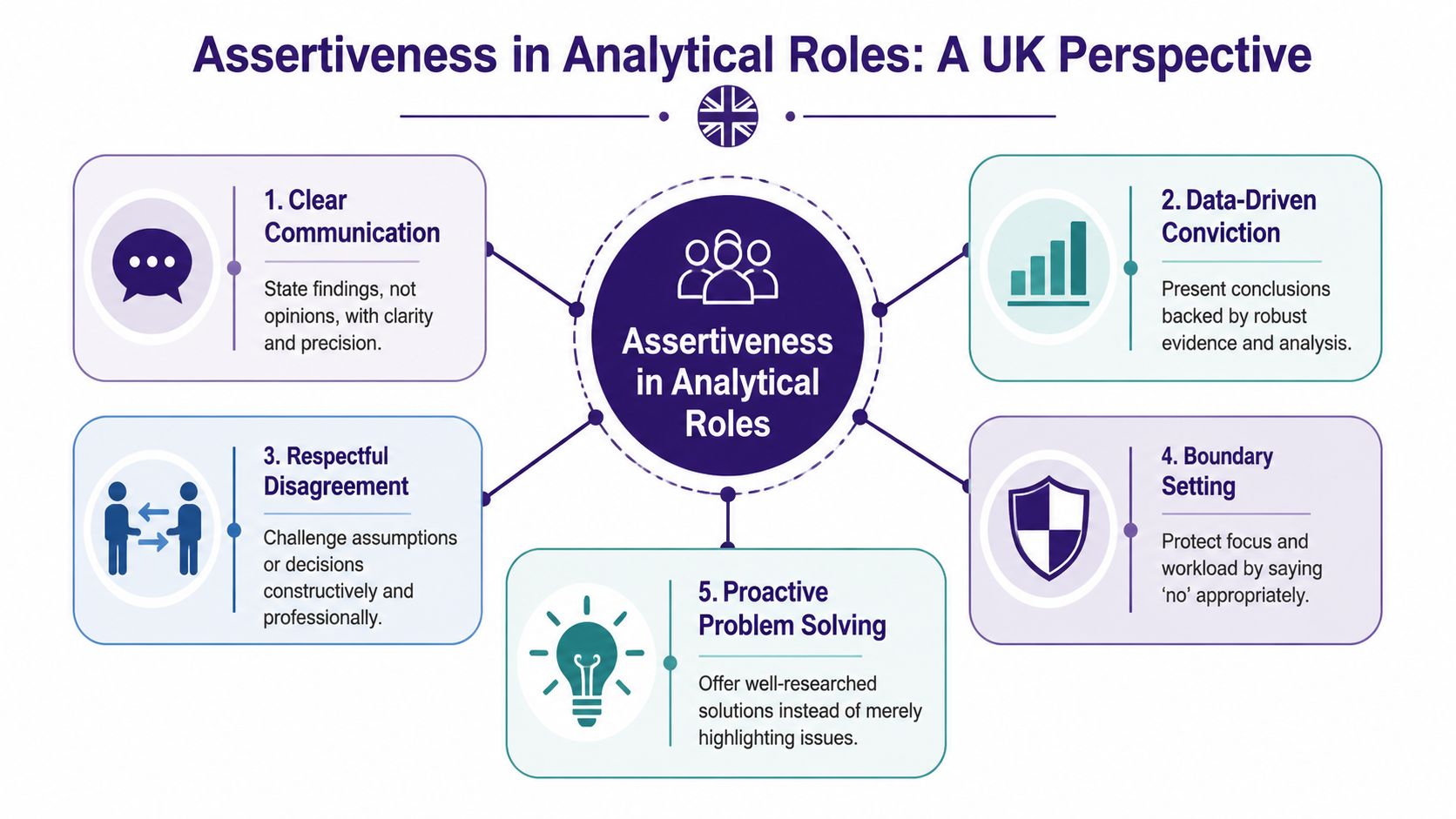
In analytical work, assertiveness means saying the clear thing at the right time, in a calm way, with enough structure that people can act on it.
That’s very different from passivity and very different from aggression. Passive communication avoids friction but often stores up risk. Aggressive communication forces the point but damages trust. Assertive communication protects both the work and the working relationship.
For a UK workplace audience, that distinction matters. Mayo Clinic guidance on assertive communication frames assertiveness as a structured communication intervention that supports boundary-setting, conflict management, and stress regulation. It recommends practical behaviours such as using “I” statements, keeping requests simple and direct, rehearsing scripts, and practising calm body language.
What it looks like at work
A bookkeeper using assertiveness doesn’t say, “This might be wrong, but I’m not sure.” They say, “I’ve checked the entries against the records, and this treatment needs reviewing before submission.”
A payroll professional doesn’t absorb repeated last-minute changes without comment. They say, “I can process this accurately today, or I can process the later amendments tomorrow. I can’t guarantee both without increasing error risk.”
A data analyst doesn’t soften every conclusion until it becomes meaningless. They say, “The data doesn’t support that assumption. If we proceed, we should treat it as a judgement call rather than an evidence-led decision.”
Practical rule: In technical roles, assertiveness is less about sounding confident and more about making the decision path visible.
Why analytical professionals need a different definition
Generic confidence advice often misses the actual job. In finance and data roles, you’re not trying to dominate a room. You’re trying to preserve standards, clarify trade-offs, and stop preventable mistakes.
That’s why I treat assertiveness as a precision tool. It helps you do five things well:
- Protect accuracy by speaking up when figures, assumptions, or process controls don’t hold up.
- Set boundaries when workload, meeting culture, or unclear ownership starts to affect quality.
- Handle disagreement without sounding defensive or combative.
- State requests clearly when you need information, approval, or decisions.
- Reduce escalation by addressing issues early, before frustration turns into conflict.
What assertiveness is not
It isn’t being louder. It isn’t winning every discussion. It isn’t copying the communication style of the most senior person in the room.
It’s learned behaviour. That matters because many people in accounting, payroll, final accounts, business analysis, and data analysis assume they either “have it” or they don’t. In practice, they can learn wording, tone, posture, timing, and refusal scripts, then improve through repetition and feedback.
That’s what good training should build.
Core Skills You Learn in Assertiveness Training
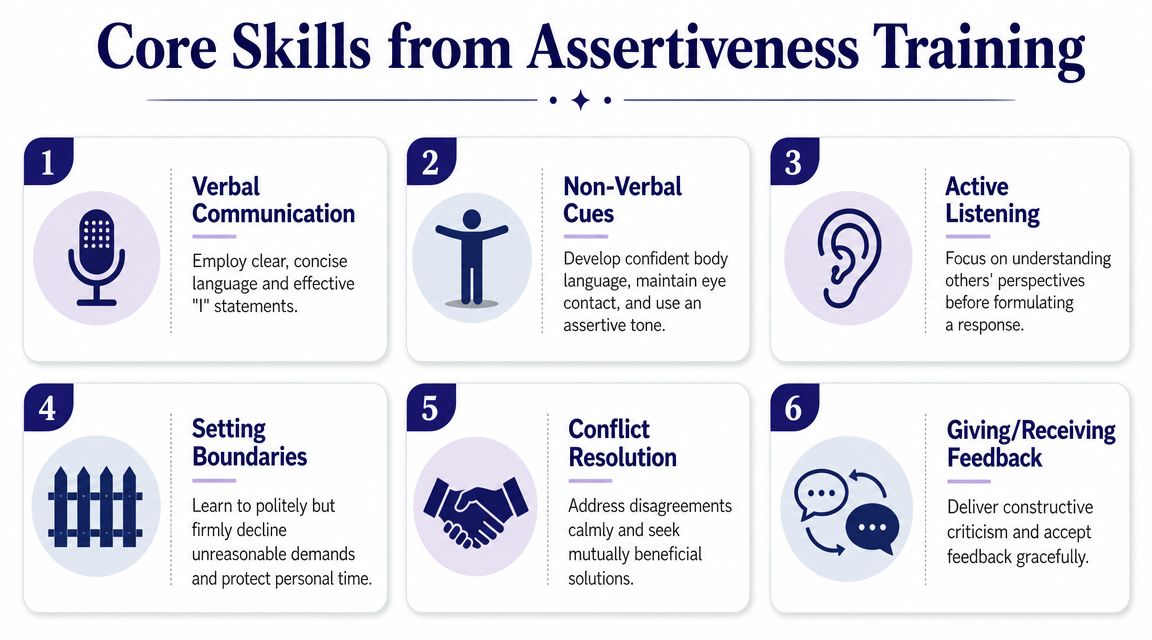
Strong assertiveness training gives you a toolkit, not a pep talk. The best courses teach repeatable behaviours that you can use in emails, meetings, client calls, and difficult one-to-ones.
The mental shift is simple. Instead of asking, “How do I sound more confident?” you start asking, “How do I communicate clearly enough that the next step is obvious?”
The skills that matter most
The clinical rationale is stronger than many people realise. The Association for Behavioral and Cognitive Therapies on assertiveness training notes that assertive communication is linked with lower stress, and describes its use for depression, social anxiety, and problems linked to unexpressed anger. That’s one reason assertiveness training is often treated as a serious development intervention rather than a light “confidence” workshop.
Here are the core skills worth looking for.
-
Clear verbal structure
You learn to keep requests and responses short. That matters in accounting and data work because long explanations often hide the actual point. Good training teaches you how to lead with the conclusion, then add evidence. -
Boundary-setting language
Many professionals know they need to say no, but they only know two versions. Too soft, or too sharp. A useful course teaches middle-ground phrases such as: “I can do that by Friday if we move the reconciliations to Monday” or “I’m not able to take on another report today without affecting the payroll check.” -
Calm non-verbal control
Tone, speed, and posture change how your message lands. If your words are clear but your delivery sounds apologetic, people hear uncertainty. If your tone hardens, they hear resistance.
A good script sounds professional before it sounds brave.
The modules that transfer into real work
Assertiveness becomes more powerful when it overlaps with presentation and speaking skills. If part of your role includes updates to managers or stakeholders, resources on mastering persuasive speeches can help you organise your point so your message is both clear and persuasive.
You’ll often get more from training when it also covers delivery in front of groups, especially if you need to present variance analysis, payroll issues, KPI trends, or process recommendations. In that context, a practical guide to presentation skills training fits naturally alongside assertiveness work.
A solid course should also include:
-
Listening under pressure
This sounds basic, but it isn’t. You need to hear the objection properly before you answer it. -
Feedback handling
Analytical professionals often receive blunt comments on speed, detail, or communication style. Training should teach you how to receive useful feedback without becoming passive or defensive. -
Difficult conversation rehearsal
Rehearsal matters because failure doesn’t usually stem from bad intent. It often arises from improvising under stress. -
Conflict de-escalation
In technical environments, conflict often starts with process friction, not personality. Assertiveness helps you address the process issue without turning the exchange personal.
Assertiveness in Action for Finance and Data Professionals
Assertiveness only becomes real when you can picture yourself using it on a normal Tuesday.
That means in inbox traffic, month-end pressure, payroll deadlines, stakeholder meetings, and awkward conversations where somebody senior is wrong but confident.

Bookkeeping and VAT
A junior bookkeeper notices that a client has mixed personal and business spending in a way that affects the records. The passive response is to tidy the file in silence and hope the issue doesn’t return. The aggressive response is to accuse the client of causing avoidable problems.
The assertive version is cleaner: “I need to flag that these transactions need separating before I finalise the bookkeeping. If we leave them as they are, the records won’t be clear enough for accurate reporting.”
That wording does three jobs. It states the issue. It explains the consequence. Finally, itt sets the next action.
For VAT work, assertiveness matters when clients push for speed over evidence. If supporting paperwork is missing, you need language that protects compliance without turning the conversation confrontational.
“I can review this today, but I can’t confirm the VAT treatment until I’ve seen the supporting documents.”
Advanced payroll and accounts assistant work
Payroll teams often carry hidden communication risk. People ask for last-minute changes, assume exceptions can be squeezed in, or treat deadlines as flexible until the consequences become urgent.
An advanced payroll professional needs to say what is possible, what is not, and what changes the risk level. For example:
| Situation | Passive reply | Assertive reply |
|---|---|---|
| Late amendment request | “I’ll try to fit it in.” | “I can review this today, but if the figures change after approval, I’ll need to move it into the next processing window.” |
| Missing payroll data | “Can you send it when you can?” | “I need the missing data by the agreed cut-off to process this accurately.” |
| Repeated urgent requests | “No problem.” | “I can help with urgent changes occasionally, but repeated late submissions create avoidable errors.” |
Accounts assistants need similar language. Chasing overdue invoices, querying unusual expense claims, or correcting coding issues can feel awkward when the other person is more senior.
The key is to challenge the item, not the person. “This claim needs clarification before I can process it” is stronger and safer than “You’ve done this wrong.”
Final accounts, business analysis, and data analysis
In final accounts work, assertiveness shows up when timelines become unrealistic. If review notes arrive late, you may need to state the impact directly: “If those adjustments land this afternoon, I can update the file, but I won’t be able to complete a full final review today.”
For business analysts, scope creep is the classic test. A stakeholder adds “just one more requirement” after sign-off. The assertive response is not a lecture. It’s a boundary with options: “That change affects both timeline and testing. We can add it now and revise the delivery date, or hold it for the next phase.”
If salary or progression conversations make you tense, learning how to negotiate a salary or job offer can complement assertiveness training well, because the same skills apply. Clear asks, evidence, calm tone, and willingness to discuss trade-offs.
Data analysts face a different version of the same issue. Their challenge is often presenting unwelcome evidence without retreating. If the numbers contradict a preferred narrative, you don’t need to overstate. You do need to stay steady.
A short explainer can help if you want to hear these ideas spoken rather than just read:
One simple script works well in meetings: “The data points in a different direction. I’m happy to explore alternative interpretations, but this is the conclusion supported by the analysis.”
That’s assertiveness in its most useful form. Factual, respectful, and hard to dismiss.
How to Choose the Right Assertiveness Course
Not all courses in assertiveness are built for workplace use. Some stay too general. Others focus on motivation but give you very little practice.
The safest way to choose is to treat the course like any other professional investment. Look for evidence of method, not just promises about outcomes.
What the evidence tells you
Structured training matters. A controlled study published on PubMed Central found that participants who completed assertiveness training had significantly higher assertiveness scores immediately after the intervention (P = 0.03) and again two months later (P = 0.005). The study also reported reductions in stress, anxiety, and depression.
That should change how you assess a provider. You’re not buying a motivational talk. You’re looking for a behaviour-change process with practice and reinforcement.
What to compare before you book
A simple checklist works better than browsing glossy course pages.
| Decision point | What to look for | What to avoid |
|---|---|---|
| Format | Live online, in person, or guided self-study with interaction | Fully passive content with no speaking practice |
| Trainer | Someone who can handle workplace scenarios, not just theory | Generic delivery with no role-specific examples |
| Practice | Role-play, scripts, feedback, replay, reflection | Slides only |
| Audience fit | Examples from finance, operations, client work, or analytics | Vague “build your confidence” wording |
| Follow-up | Notes, action plan, or post-course support | One session with no reinforcement |
Questions worth asking a provider
Before you commit, ask direct questions:
- How much live practice is included?
- Will I rehearse real workplace scenarios from my role?
- Do participants get feedback on wording, tone, and body language?
- Is the course suitable for early-career professionals as well as managers?
- Is there any certificate or CPD recognition?
If a provider can’t answer those cleanly, the course is probably too light.
One factual example in the market is that Professional Careers Training offers an Assertiveness Skills Training course as part of its training options. For learners already developing technical capability in accountancy software, payroll, analysis, or employability support, that kind of combined skills environment can make practical sense. The key point isn’t the brand. It’s whether the course includes realistic rehearsal and feedback.
The best course for you isn’t the one with the broadest promise. It’s the one that matches the conversations you actually need to have.
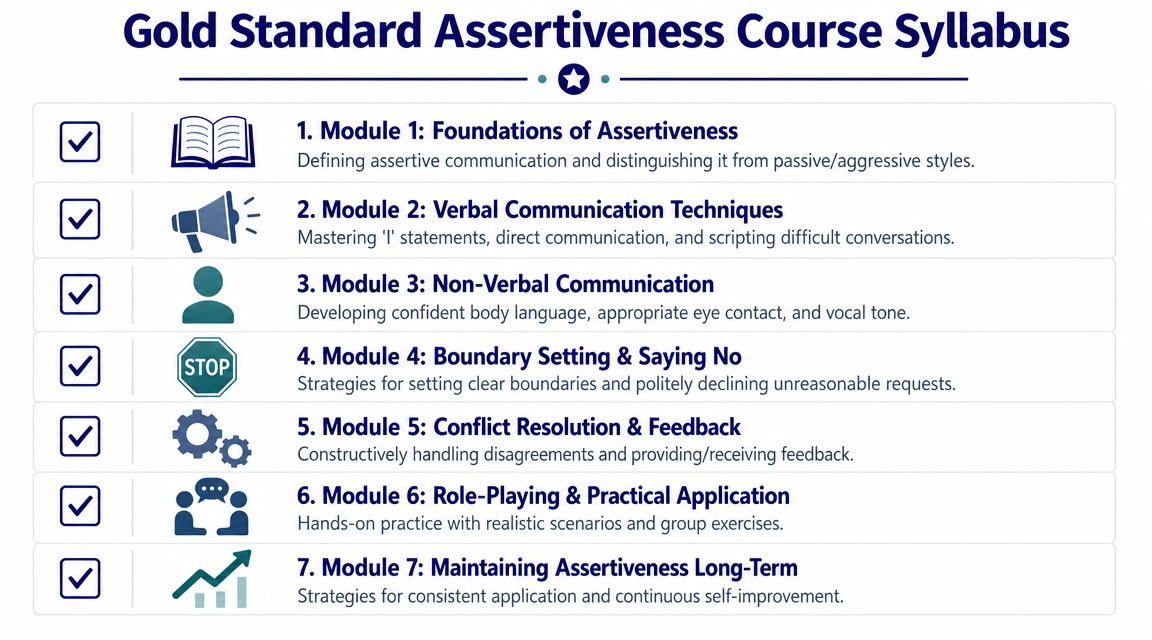
What a High-Quality Course Syllabus Includes
A high-quality syllabus should read like a skills programme, not like a list of positive intentions.
If a course says it will help you “become more confident” but doesn’t show how, keep looking. You need content that turns awkward moments into repeatable communication habits.
The non-negotiable modules
A credible syllabus should include these areas.
-
Foundations of assertiveness
Learners need a clean distinction between passive, assertive, and aggressive communication. Without that, people often overcorrect and become too sharp. -
Direct wording techniques
This should include “I” statements, brief requests, refusals, and ways to state consequences without sounding threatening. -
Non-verbal delivery
Many professionals know what they want to say. Their problem is that their voice drops, they rush, or they look uncertain while saying it. -
Boundary-setting and saying no
This is essential for payroll deadlines, reporting pressure, client demands, and project overload.
What separates strong training from weak training
The middle of the syllabus matters more than the title. Strong programmes include realistic role-play, observed practice, and feedback linked to real work situations.
Weak programmes often stop at theory. You discuss communication styles, maybe complete a self-assessment, then leave without having practised the conversations that prove challenging.
A useful syllabus should also cover:
-
Handling pushback
What do you say when someone interrupts, dismisses your point, or uses seniority to pressure you? -
Giving and receiving feedback
Especially important in accounts teams, analyst roles, and line management pathways. -
Scenario adaptation
Client, colleague, manager, and stakeholder conversations all need slightly different tone control. -
Personal action planning
Without a carry-over plan, many leave with insight but no habit.
Good assertiveness training should make you slightly uncomfortable in the room so you can be more composed outside it.
Putting Your Training into Practice in the UK Workplace
Many people stall at this point. They complete the course, agree with the ideas, and then return to a workplace where the communication culture is more indirect than the training examples suggested.
That’s a real issue in the UK. A 2024 ONS-related analysis hosted on PubMed Central reported that over 80% of UK workers are in jobs requiring social interaction, and it also highlighted the practical gap many learners face: how to apply assertiveness without sounding unprofessional. That question is especially relevant for graduates, career changers, and newcomers adjusting to status-sensitive office norms.
Start with low-risk conversations
Don’t begin with the hardest conversation on your list.
Start with manageable moments:
- Clarifying deadlines when a manager gives a vague brief
- Requesting missing information before you complete an analysis
- Protecting focused work time when meetings spread into every gap
- Correcting small misunderstandings before they become bigger issues
These smaller reps matter because they help you separate assertiveness from confrontation.
Use scripts, then adapt them
In early practice, scripted language is useful. It lowers the mental load and stops you drifting into apology, waffle, or defensiveness.
Try building short templates:
| Situation | Useful script |
|---|---|
| Workload pressure | “I can take this on, but I need to move another deadline to keep the quality consistent.” |
| Disagreement | “I see the logic, but the figures suggest a different conclusion.” |
| Unclear ownership | “Before I proceed, can we confirm who is responsible for the final sign-off?” |
| Boundary-setting | “I’m not able to stay late for this today, but I can pick it up first thing tomorrow.” |
Keep your tone professional, not overexplained
One common mistake in UK workplaces is over-padding. People worry about sounding rude, so they add too much context, too many apologies, and too many escape routes.
That usually weakens the message.
Use this sequence instead:
- State the point.
- Give the reason if needed.
- Offer an option or next step.
- Stop talking.
If you’re naturally cautious, ask a trusted manager, mentor, or colleague to tell you whether your delivery sounds clear or hesitant. The goal isn’t to sound forceful. It’s to sound settled.
The Career Value of Becoming More Assertive
For finance and data professionals, assertiveness multiplies the value of technical skill.</p>
It helps the bookkeeper protect clean records. It helps the payroll professional hold a deadline without creating friction. It helps the accounts assistant query issues earlier. It helps the business analyst challenge scope drift. It helps the data analyst present an unwelcome conclusion without folding the moment somebody senior looks unconvinced.
That matters for career growth because employers don’t only notice who knows the work. They notice who can communicate risk, make clear requests, manage boundaries, and keep discussions productive under pressure. Those are leadership signals.
For some people, assertiveness training also connects with anxiety, especially when speaking up feels loaded rather than awkward. If that’s part of your experience, support that addresses anxiety directly, such as Ben’s anxiety therapy, can sit alongside communication training in a practical way. And if you’re aiming for progression into supervision or team leadership, it’s worth pairing assertiveness with leadership and managerial skills development.
Choose a course that gives you practice, feedback, and role-specific scenarios. Then use it. Technical expertise has more impact when you can state it clearly.
If you want training that supports both technical employability and workplace communication, Professional Careers Training offers accountancy and career-focused development with flexible study options, software training, and recruitment support for learners building roles in finance, bookkeeping, payroll, and analysis.