Imagine having a skill that nearly every single UK business, from a local bakery to a FTSE 100 giant, absolutely needs. That’s the power of...
Your Blueprint for Acing Competency-Based Interviews
Facing a competency-based interview can feel daunting, especially if you are a recent graduate or changing careers. But this guide is designed to cut through the noise and give you a clear path forward.
Employers no longer look only at your qualifications on paper. They want proof that you have the practical skills to handle the job from day one.
We will show you exactly what hiring managers for roles in bookkeeping, payroll, and data analysis are looking for. Think of this as your practical roadmap for turning your experience into convincing, interview-winning stories.
Why Skills Now Trump Qualifications
There has been a major shift in the UK job market. A huge 83% of employers now prioritise skills-based hiring over traditional qualifications like degrees. This is especially true for roles in accountancy, business analysis, and data analytics, where these interviews are the gold standard.
This focus pays off for businesses, too. UK companies using skills assessments report a 30% increase in adoption and a 20% boost in hiring satisfaction.
What does this mean for you? Your ability to demonstrate competencies—not just list them on your CV—is what will get you hired. For those just starting out, our guide on getting into accounting provides the foundational knowledge to build your confidence and vocabulary.
Laying the Groundwork Before the Interview
Your preparation does not start when the interview invitation lands in your inbox. It starts with your application. Learning how to write a cover letter that gets you hired is your first opportunity to catch a recruiter’s eye.
A well-crafted application is your first chance to hint at the competencies an employer wants. For example, in an application for a bookkeeping role, you could briefly mention a time during your training when you spotted an error in a VAT return. This connects your skill to a real, tangible outcome.
A competency-based interview is not a memory test; it is a showcase of your experience. Your goal is to tell a story that proves you can handle the job’s challenges because you have successfully handled similar situations before.
This guide will break down the core competencies you will face, such as analytical thinking and teamwork. We will show you how to use the STAR method as your most powerful storytelling tool. This is your blueprint for success.
Decoding Job Descriptions to Find Hidden Clues

Before you can craft interview answers, you need to play detective. The job description is not just a list of duties. It is your case file, packed with clues that spell out exactly what the employer is looking for. Think of it as a blueprint of their perfect candidate.
Your mission is to dissect it. Go line by line to unearth the core competencies they truly value. This focused approach saves you from wasting hours on generic preparation and ensures every story you tell hits the mark.
Look Beyond the Obvious Job Duties
Many candidates just skim the “Responsibilities” section and call it a day. That is a mistake. The real gold is often hidden in the specific language used throughout the entire document. Keep an eye out for action verbs and descriptive phrases that point to specific skills.
For instance, a posting for an Accounts Assistant might list “processing invoices” as a task. But look closer. Do you see phrases like “resolving supplier queries promptly” or “maintaining accurate financial records”? These are direct hints for competencies like problem-solving and attention to detail.
It is the same for a Business Analyst role. The description might say “gathering requirements,” but the real clue could be “liaising with senior stakeholders to define project scope.” That is a massive flag for communication and stakeholder management.
How to Build Your Competency Checklist
To do this systematically, create a simple checklist. Go through the job description and pull out every keyword and phrase that hints at a competency.
Here are a few common examples you will find in finance and data roles:
- “Data-driven decision making” = Analytical Thinking, Commercial Acumen
- “Collaborate with the payroll team” = Teamwork, Interpersonal Skills
- “Manage multiple deadlines” = Time Management, Planning and Organising
- “Present findings to non-technical audiences” = Communication, Influence
By building this list, you are creating a personalised study guide for your interview. You will know exactly which of your experiences to bring to the forefront. For a clearer picture of what top employers want, exploring the essential financial analyst skills needed can give you a serious advantage.
Think of each competency you identify as a question you are likely to be asked. If the job description repeatedly mentions “process improvement,” you can bet you will get a question like, “Tell me about a time you improved a process.”
Connecting Training to Employer Needs
This is where your practical training becomes your secret weapon. It is the hard evidence that backs up your claims.
When a job advert for an advanced payroll position asks for experience with “complex calculations and compliance,” it is a perfect opportunity. You can prepare a story about how your training on advanced payroll software helped you master statutory payments or year-end processes. If a Business Analyst role requires proficiency in data modelling, your hands-on experience with specific software tools is a direct, tangible answer.
This method completely changes your preparation. Instead of guessing what is important, you are using the employer’s own words to build a targeted strategy that proves you are the perfect fit.
Telling Your Story with the STAR Method
You have probably heard of the STAR method, but here is a secret: most candidates do not use it to its full potential. Mastering this framework is not about just ticking off the letters. It is about turning your experiences into sharp, compelling stories that prove you have what it takes. Get this right, and you will have a huge advantage in any competency-based interview.
The STAR method gives your answers a clear structure, making sure you hit all the key points without rambling. It forces you to be specific, to focus on your contributions, and, most importantly, to show the real-world impact of your work. Let’s break down how to apply it, with examples that make sense for bookkeeping, payroll, and analyst roles.
Situation: Set the Scene (But Keep it Brief)
The Situation is your story’s opening. Your goal is to give the interviewer just enough context to understand what was going on. Keep it short and sweet—this should only take up about 15% of your answer.
Think of a specific project, a challenge you tackled during your training, or a tricky task from a past role. For someone in an advanced payroll course, it might be the chaos leading up to the end of the tax year. For an accounts assistant, it could be the moment you noticed a recurring error in final accounts preparation.
A good situation sets the stage perfectly without getting bogged down in useless details. The interviewer does not need the company’s life story, just the background relevant to your example.
Task: Define Your Mission
Next up is the Task. This is where you explain your specific role or goal in that situation. What were you trying to achieve? What needed to get done? This section is even shorter, making up roughly 10% of your answer.
This part is vital because it clarifies your personal responsibility. It separates what you were tasked with from what the wider team was doing.
- For a Business Analyst: The task might have been to map the current invoicing process to find the bottlenecks causing payment delays.
- For a Bookkeeping Trainee: The task could have been to complete VAT returns for a new client with messy records.
Clarity is everything here. State your objective directly to set up the brilliant actions you are about to describe.
Action: Show, Don’t Just Tell
The Action is the heart of your story and should take up the most time—around 50% of your response. Here, you describe the exact steps you took to complete the task. And the key word is “you.”
Avoid the classic mistake of saying “we did this” or “the team decided that.” The interviewer wants to know what you can do, not what your team did. Own your contributions and use “I” statements.
Key Takeaway: Get specific about the skills you used. Do not just say, “I looked into the data.” Instead, say something like, “I used a VLOOKUP formula in Excel to cross-reference two large spreadsheets, which immediately flagged the mismatched invoice numbers.”
A data analyst could describe the specific SQL queries they wrote to pull information or how they used Power BI to build a dashboard. An accounts assistant might detail the steps they took in Xero to investigate a VAT error. This is your moment to showcase your technical and soft skills in action.
Result: Prove Your Impact with Numbers
Finally, the Result. This is the powerful conclusion to your story, explaining the outcome of your actions. It should take up about 25% of your answer. The best results are always quantified with numbers, percentages, or other concrete outcomes.
This is what separates a decent answer from a memorable one. Instead of a vague statement like, “it made the process better,” give them cold, hard proof.
- “My changes reduced VAT return errors by 15% in the next quarter.”
- “As a result, I cut the time needed for monthly payroll reconciliation by two full days.”
- “The dashboard I built gave the sales team a real-time view of performance, leading to a 5% increase in lead conversion.”
STAR Method Breakdown with Role-Specific Examples
To see how this all comes together, let’s look at some practical examples. The table below breaks down potential STAR answers for questions you might face for different roles, showing you how to tailor your stories to fit the job you are interviewing for.
| Competency Question | Situation | Task | Action | Result |
|---|---|---|---|---|
| “Tell me about a time you improved a process.” (Bookkeeping & VAT Role) |
During my training, I noticed our manual process for preparing VAT returns in Xero was time-consuming and prone to errors. | My task was to find a way to streamline this process to improve accuracy and save time for the team. | I researched Xero’s VAT features, then configured the system to automate calculations and set up rules for recurring transaction codes. I also created a simple checklist for the final review stage. | By implementing this, I reduced the time spent on each VAT return by 30% and eliminated manual data entry errors, leading to more reliable submissions. |
| “Describe a complex problem you solved with data.” (Data Analyst Role) |
A client’s sales data showed an unexpected 15% drop in revenue, but the sales team was unsure of the cause. | My task was to analyse their historical sales data to identify the root cause of the drop and present clear recommendations. | I used SQL to extract three years of sales data and imported it into Power BI. I created visualisations to analyse trends by product, region, and customer segment, which revealed a sharp decline in sales for one key product line in a specific region. | My analysis pinpointed that a competitor had launched a targeted campaign in that region. Based on my findings, the client adjusted their pricing strategy, recovering 10% of the lost revenue within the next quarter. |
| “Give an example of a time you handled a difficult payroll query.” (Advanced Payroll Role) |
An employee was very distressed because they believed their tax code was incorrect, which resulted in a lower net pay. | My objective was to investigate the issue thoroughly, explain the situation clearly to the employee, and resolve the problem to their satisfaction. | I carefully reviewed their payroll record and cross-referenced it with the latest HMRC guidelines. I discovered the correct tax code had been applied but that their personal allowance had changed. I scheduled a call to calmly explain the change, showing them the official documentation. | The employee understood the reason for the change and was grateful for the clear explanation. This resolved their query promptly and maintained a positive relationship, preventing further escalation to management. |
Building a bank of 8-10 of these powerful, quantified stories before your interview is one of the smartest things you can do. Competency-based interviews are now the standard in UK finance and professional services. Preparing strong examples, like “reduced final accounts preparation errors by 25% using automation,” shows you are ready to deliver value. In fact, analysis of 8.9 million applications in the UK revealed that data-driven recruitment leads to hiring cycles that are 40-60% faster. Aligning your preparation with this numerical focus will put you miles ahead.
By carefully crafting your stories with the STAR method, you are not just answering questions—you are providing irrefutable proof of your skills and showing exactly how you can deliver real, measurable results.
Building Your Personal Answer Portfolio
Real interview confidence does not come from winging it—it comes from rock-solid preparation. Once you have pinpointed the key competencies from the job description and got to grips with the STAR method, your next job is to build a personal portfolio of your career highlights. This is not about memorising scripts; it is about knowing your stories so well they become second nature, ready to share naturally when the pressure is on.
Think of it as creating a bank of eight to ten versatile STAR examples that you can pull from and adapt to almost any question that comes your way. This portfolio should showcase a broad range of skills. It should cover everything from teamwork and problem-solving to your technical abilities, like using SQL in a data analyst role or your expertise with payroll software in a finance position. A well-stocked portfolio is your secret weapon.
Curating Your Best Examples
First, let’s brainstorm your most impactful experiences. Do not just focus on your last job. Think back to your training, tricky projects you were part of, or even difficult client situations you handled well. The goal here is to find stories with results you can actually measure.
For every story you are considering, ask yourself these questions:
- What was the specific challenge or goal?
- What exactly did I do to tackle it?
- What was the tangible, measurable outcome of my actions?
Pick the examples that best reflect the competencies you identified earlier. For instance, if you are going for a business analyst role, you will need solid examples of stakeholder management. If you are an aspiring accounts assistant, make sure you have stories that highlight your sharp attention to detail and hands-on experience with software like Xero or Sage.
Polishing and Rehearsing Your Stories
Once you have your core stories, it is time to practise them. This is the step so many candidates skip. They write their examples down but never say them out loud, which is a massive missed opportunity in preparing for competency based interviews.
Rehearsal is not about memorising answers word-for-word. It is about getting so comfortable with the key details of your stories that you can tell them confidently and flexibly, no matter how the interviewer words the question.
One of the most powerful techniques is simply recording yourself. Use your phone to film yourself answering a practice question. When you play it back, check your timing—aim for around three minutes per answer—and listen to your tone. Do you sound confident? Are you using specific “I” statements? It might feel a bit awkward, but it gives you incredibly valuable insight into how you come across.
The diagram below shows the simple, four-step flow of the STAR method. This should be the blueprint for every answer you rehearse.
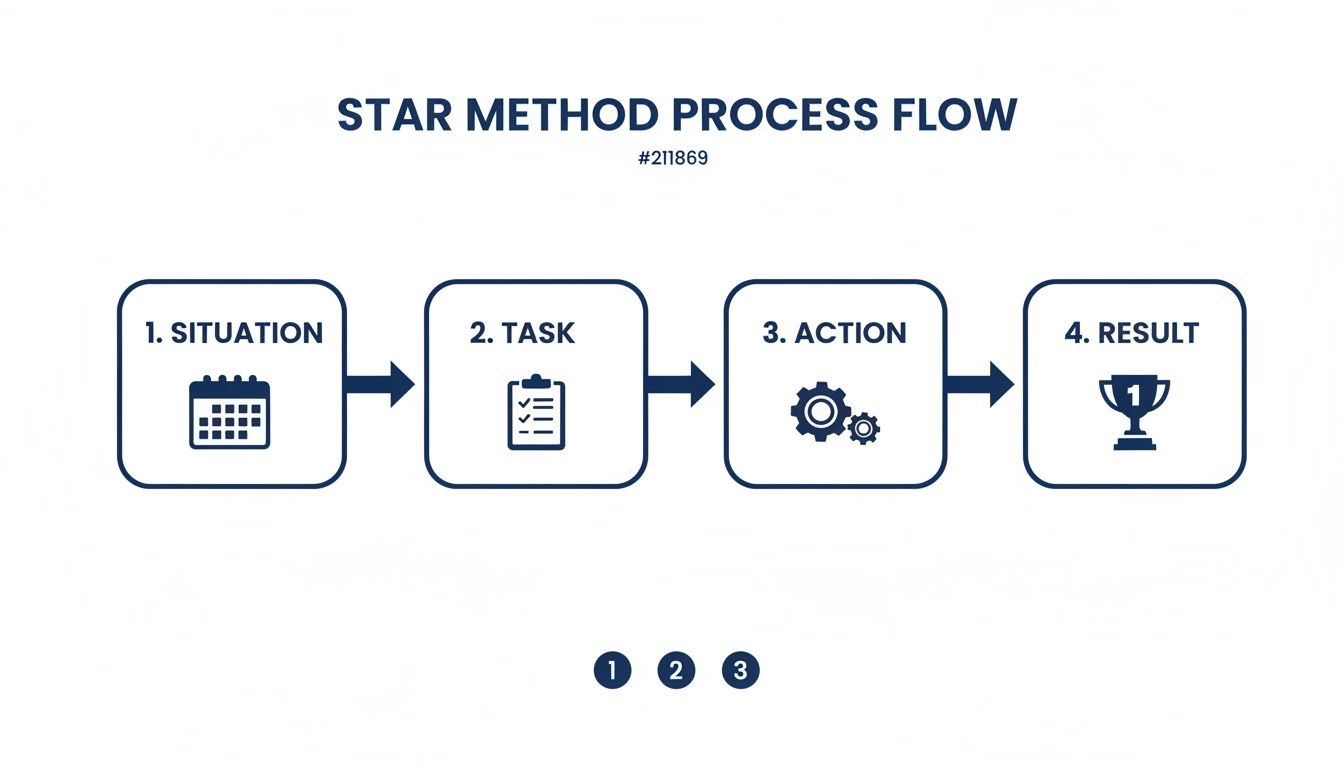
This visual is a great reminder that your answer needs to move logically from setting the scene to the concrete, quantifiable impact of what you did.
The Power of Mock Interviews and Expert Feedback
While practising on your own is a great start, nothing beats the experience of a proper mock interview. It is your chance to feel the pressure of a real interview and get constructive feedback from someone who knows exactly what hiring managers are looking for.
Competency-based interviews are still the most common format in the UK, often mixed with strengths-based and values-based questions. With an average of 340 applicants per role and only four to five candidates reaching the interview stage for mid-level jobs, your answers need to be precise and authentic. At Professional Careers Training, our CPD trainers create these high-stakes scenarios, even using video scoring tools like HireVue that are common in UK finance, to make sure you truly stand out. You can understand the UK candidate evaluation process on kasunsameera.com to learn more about how data is shaping recruitment.
Getting personalised feedback from industry professionals, like our ACCA-qualified trainers, can take your performance from good to exceptional. An expert can spot weaknesses you would miss, help you polish your language, and suggest ways to frame your results for maximum impact. They can guide you on tailoring an example about resolving a VAT discrepancy for a bookkeeping role or optimising a database query for a data analyst position. This targeted coaching is what makes your answers resonate.
Getting the Final Details Right: UK Interview Etiquette
You have prepared your STAR examples and you are ready to prove your skills. That is brilliant, but it is only half the battle. Your professionalism and understanding of workplace culture are what will truly set you apart, especially if you are new to the UK job market.
Getting these final checks right is not just about ticking boxes. It is about showing respect for the interviewer, the company, and the opportunity itself. Mastering how to prepare for a competency-based interview means presenting a polished, cohesive professional image from start to finish. Every detail, from what you wear to the questions you ask, shapes the impression you leave behind.
Making a Great Impression: Communication and Dress Code
UK interview etiquette generally leans towards being professional yet approachable. It is common to engage in a little small talk before diving into the serious questions, but always let the interviewer take the lead. Speak clearly and confidently, and try to avoid overly technical jargon unless it is standard for the role (like in a Data Analyst position).
When it comes to your outfit, the old advice still holds true: dress for the job you want. For roles in accounting and finance, this almost always means smart business attire.
- For in-person interviews: A well-fitting suit in a conservative colour like navy, grey, or black is your safest and most professional bet. Make sure your clothes are clean, ironed, and your shoes are polished.
- For virtual interviews: Do not get complacent just because you are at home. Dress exactly as you would for a face-to-face meeting. Also, check your background—it should be tidy, neutral, and free from any potential distractions.
This attention to detail signals that you are taking the opportunity seriously.
Don’t Skip the Homework: Why Company Research is Crucial
Turning up to an interview without knowing what the company actually does is one of the quickest ways to get rejected. Proper research shows that your interest is genuine and helps you connect your skills to their specific needs.
Go deeper than just their homepage. Look up recent news articles, check out their latest projects, and get a feel for their company values.
Knowing the company’s recent achievements or challenges allows you to ask much more insightful questions. For example, instead of asking “So, what do you do here?”, you could say, “I saw your firm recently launched a new service for VAT compliance. I’m curious how this role would support that initiative.”
This kind of proactive research demonstrates your commercial awareness—a competency that is highly valued in finance and analyst roles. It proves you are not just looking for any job; you are interested in contributing to their business. Preparing a few of these thoughtful questions is a non-negotiable step that immediately separates you from less-prepared candidates.
Keep Your Story Straight: Aligning Your CV and LinkedIn
Finally, do a quick audit of your professional brand. The stories and examples you share in the interview need to line up perfectly with what is on your CV and LinkedIn profile. Inconsistencies, even small ones, can raise red flags.
Before the big day, give both documents a final review to make sure they tell the same compelling story. If you plan to talk about a project where you improved payroll efficiency by 15%, make sure that specific achievement is quantified on your CV.
This consistency builds trust and reinforces your credibility. A cohesive professional narrative makes you a much more memorable and believable candidate. If you want to ensure every part of your job search is perfectly aligned, our expert guidance on guaranteed recruitment support can give you the professional edge you need.
Your Top Competency Interview Questions, Answered
Even after hours of preparation, a few niggling worries can creep in. Knowing how to handle these common curveballs is the final piece of the puzzle, giving you that extra bit of confidence when you walk into the room.
Let’s tackle some of the most frequent questions candidates ask, from recycling your best stories to navigating those tricky “what if” moments.
How Can I Use One Example for Multiple Questions?
This is a great question, and using your strongest stories smartly is a brilliant strategy. A single, powerful example often proves several competencies at once. Think about it: a time you resolved a complex VAT issue for a client could easily showcase problem-solving, attention to detail, and client communication.
The trick is to shift your focus. When the interviewer asks about problem-solving, you will want to zero in on the Action part of your STAR story, describing the exact analytical steps you took. But if the question is about communication, you would highlight how you explained that same complex issue to the client in the Action and Result sections. It is all in the emphasis.
What If I Don’t Have Direct Work Experience?
This is a classic worry for recent graduates or anyone changing careers, but it is honestly not the deal-breaker you think it is. Competencies are all about transferable skills, and you can pull fantastic examples from all corners of your life.
Do not be afraid to draw from:
- Your Training: That complex project you completed in your Advanced Payroll or Business Analyst course? Perfect.
- University Projects: Group assignments are a goldmine for demonstrating teamwork, planning, and even conflict resolution.
- Volunteering: Have you ever managed a small budget or organised an event? That shows responsibility and organisational skills right there.
The interviewer cares far less about where the experience came from and much more about how you handled the situation and what you achieved. Frame your answer with confidence, focusing on the skills you proved.
What’s the Biggest Mistake Candidates Make?
By far, the most common pitfall is being vague about your personal contribution. So many candidates fall into the “we” trap, saying things like “we did this” or “the team decided that.” It leaves the interviewer completely in the dark about what you actually did.
You have to get comfortable using “I” statements. Instead of “We improved the process,” say “I identified the bottleneck, I proposed a new workflow, and I implemented the change.” This shows ownership and makes your personal capability crystal clear.
Ready to turn all this preparation into a job offer? Professional Careers Training gives you the practical skills and expert coaching to stand out. From mastering bookkeeping and VAT rules to nailing your interview technique with our ACCA-qualified trainers, we are here to help you succeed.