Holiday pay is one of the areas payroll teams get wrong most often. It is usually not carelessness. The rules genuinely changed in 2024, and...
The First 100 Words That Define Your Career
A recruiter doesn’t sit down with a cup of tea and study your CV line by line on the first pass. They scan. They look for role fit, software knowledge, evidence of value, and signs that you understand the job you’ve applied for.
Hays Recruitment notes that 75% of hiring managers spend less than 30 seconds initially scanning CVs, which is why the personal statement becomes such an important early decision point after ATS filtering, as outlined in Hays’ guide to writing a personal statement.

That’s why the top of your CV can’t be wasted on vague lines like “hardworking individual seeking a challenging role” or “motivated team player with good communication skills”. Those phrases say almost nothing. They don’t tell the employer whether you can handle sales ledger, bank reconciliations, payroll processing, VAT returns, stakeholder reporting, Excel analysis, or Power BI dashboards.
What recruiters are trying to spot
In accounting and analyst hiring, recruiters usually want fast answers to a short list of questions:
- What level are you at. Graduate, trainee, junior, returner, career changer, or experienced support staff.
- What tools do you know. Sage, Xero, QuickBooks, Excel, Power BI, SQL, Python.
- What area fits you. Bookkeeping, payroll, accounts assistant work, final accounts, business analysis, data analysis.
- Why this role makes sense. Your statement should show direction, not confusion.
Practical rule: if your personal statement could sit on anyone else’s CV, it’s too generic.
A strong statement also helps your CV stay consistent with your wider job search. If your CV says one thing, your LinkedIn says another, and your application email says something else, you create doubt. If you’re refining your profile alongside your CV, this guide on how to get noticed by recruiters on LinkedIn is useful because it reinforces the same principle. Your message must be clear wherever an employer sees you.
What works and what doesn’t
Here’s the trade-off. Many candidates try to sound impressive, so they become abstract. Recruiters prefer specific language. “Completed hands-on training in Sage and Xero” is stronger than “excellent accounting systems knowledge”. “Junior analyst with Power BI and SQL project experience” is stronger than “highly analytical problem solver”.
What works is short, targeted, and believable. What fails is broad, inflated, or copied from the internet.
Use the top of your CV to position yourself quickly. Not to tell your life story. Not to explain every job you’ve ever had. Just to show who you are professionally, what you can do, and where you fit next.
Building the Foundation of Your Personal Statement
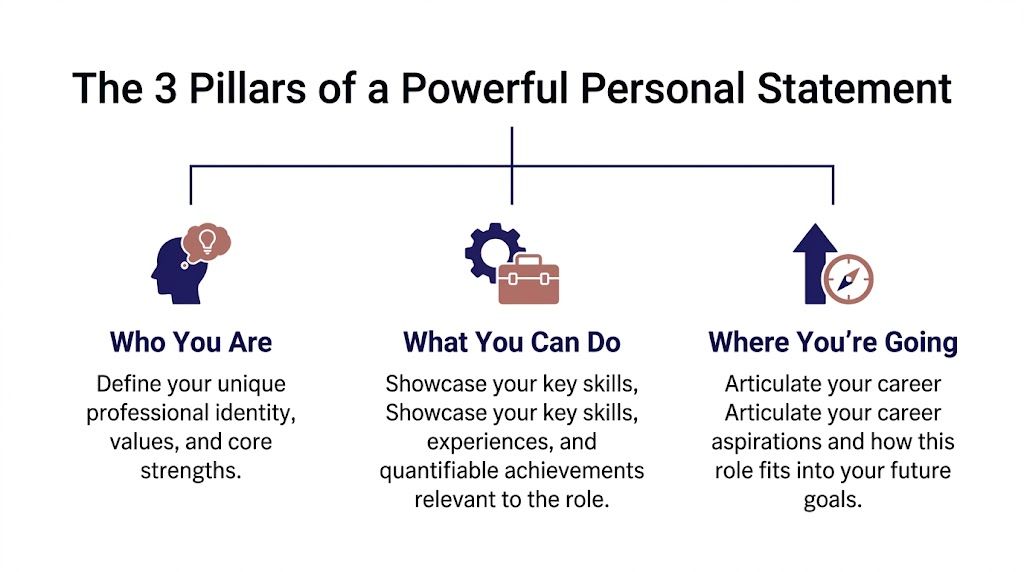
The best personal statements don’t try to do everything. They do three jobs well. They tell the employer who you are, what you offer, and where you want to go. That structure keeps your writing focused and stops the statement turning into a list of soft skills.
A 2025 High Fliers Research survey of 200 top UK employers found that 82% of graduate hires in finance and business analysis had CVs with personal statements explicitly linking skills to job descriptions, often using a three-part structure of introduction, skills, and aspirations, as reported by Prospects.
Start with your professional identity
Your opening line should answer one question. Who are you in the market?
That doesn’t mean your personality. It means your professional identity. For example:
- Accounts assistant trainee with hands-on experience in Sage, bank reconciliations, and purchase ledger tasks
- Bookkeeping and VAT trainee with practical exposure to Xero and invoice processing
- Business analyst candidate with Excel, SQL, and Power BI project training
- Advanced payroll trainee with experience processing payslips and maintaining accurate employee records
This line matters because it sets the lens for everything that follows. If the employer can place you quickly, they can assess you quickly. That’s the whole point.
Add the evidence that proves your fit
The middle of the statement should carry the heaviest weight, mentioning the practical skills, systems, and achievements most relevant to the vacancy.
Don’t try to include every strength you have. Choose the ones that match the role most closely. If the job is for an accounts assistant, mention things like:
- Purchase ledger and sales ledger
- Bank reconciliations
- VAT support
- Sage, Xero, or QuickBooks
- Month-end support
- Accurate data entry and reporting
If the role is in payroll, your statement should sound different:
- Payroll processing
- Pensions and statutory payments
- Accuracy and confidentiality
- HMRC-facing responsibilities
- Payroll software familiarity
- Deadline management
For business analyst and data analyst roles, the language changes again:
- Excel
- Power BI
- SQL
- Data cleaning
- Reporting
- Stakeholder communication
- Requirements gathering
- Dashboard creation
The best statements sound like they belong to one role, not five.
Finish with a realistic direction
The final part should show your next move. Many candidates go wrong at this stage. They become too broad. “Looking to grow in a successful company” adds little. It doesn’t show intent.
A better ending links your direction to the role:
| Weak ending | Better ending |
|---|---|
| Looking for a challenging opportunity | Seeking an accounts assistant role where I can support month-end processes and build further experience in Sage and VAT |
| Keen to progress my career | Looking to develop within a finance team where I can apply bookkeeping training in a practical, compliance-focused setting |
| Want to work in analytics | Seeking a junior data analyst role where I can turn reporting and dashboard skills into commercial insight |
Keep it tight and readable
A personal statement should feel controlled. If it rambles, the reader assumes your thinking rambles too. Keep it under 100 words and write in a professional but natural tone.
A simple working formula is this:
- Identity. Your current level and area.
- Offer. Your strongest relevant skills, systems, and evidence.
- Goal. The role you’re aiming for and how it fits your direction.
Here is a clean example for an accounts path:
ACCA-focused accounts trainee with practical experience in Sage, bank reconciliations, invoice processing, and VAT support. Strong understanding of purchase ledger, sales ledger, and month-end routines, with a careful approach to accuracy and deadlines. Seeking an accounts assistant role where I can contribute to a busy finance team while building deeper experience in management accounts and final accounts preparation.
And one for analysis:
Junior data analyst with practical training in Excel, SQL, Python, and Power BI, supported by project work in reporting, data cleaning, and dashboard development. Confident turning raw data into clear business insight and presenting findings in a structured way. Seeking an entry-level analyst role where I can support decision-making with accurate reporting and strong attention to detail.
If you stick to this foundation, writing becomes much easier. You’re no longer guessing what to say. You’re filling three clear spaces with the evidence that matters most.
Crafting Compelling Sentences with Action-Driven Language
A strong structure gets your statement organised. Strong sentence writing gets it noticed.
Many personal statements fail because they use flat wording. Candidates describe responsibilities instead of value. They say what they were around, not what they handled. In finance and analysis roles, that weakens your credibility fast.
There’s a clear reason to sharpen this. In UK accounting roles, personal statements with quantified impacts secure 2.3 times more interviews for career changers, according to a 2024 StandOut CV analysis referenced in Catherine Pope’s narrative CV resource.
Swap passive wording for active verbs
Start with verbs that sound like real work. Not school essay language. Not empty claims.
For accounting and bookkeeping roles, useful action verbs include:
- Reconciled
- Processed
- Prepared
- Managed
- Maintained
- Recorded
- Supported
- Balanced
- Reviewed
- Resolved
For payroll roles:
- Administered
- Processed
- Checked
- Updated
- Calculated
- Verified
- Maintained
- Handled
For analyst roles:
- Analysed
- Built
- Cleaned
- Automated
- Mapped
- Tracked
- Presented
- Visualised
- Optimised
Compare the difference.
| Weak phrase | Stronger phrase |
|---|---|
| Responsible for invoices | Processed supplier invoices accurately and supported purchase ledger tasks |
| Worked with payroll | Processed payroll data and maintained accurate employee records |
| Good with data | Analysed data sets in Excel and Power BI to support reporting |
| Helped with accounts | Supported reconciliations, ledger maintenance, and month-end routines |
The second version in each case gives the reader something they can picture.
Use numbers only when you can support them
The right metric can lift a sentence. The wrong one can make the whole statement sound invented. If you have a real result from work placement, previous employment, internship activity, or project work, use it. If you don’t, don’t force one.
Good evidence can include:
- Time saved
- Errors reduced
- Reports produced
- Volume handled
- Process improved
- Accuracy maintained
- Compliance support delivered
Here’s the practical test. If an employer asked, “How do you know that?”, could you answer clearly?
Better to be specific and modest than dramatic and vague.
For example:
- “Supported weekly payroll processing with a strong focus on accuracy and deadlines” is credible.
- “Transformed payroll operations” is too inflated for most trainee candidates.
- “Built Power BI dashboards from cleaned Excel data for project reporting” is useful.
- “Revolutionised business intelligence capability” sounds copied.
Turn duties into achievements
A personal statement shouldn’t read like a job description. It should show contribution.
Try this pattern:
Task + context + outcome
Examples:
-
Bookkeeping
“Maintained accurate financial records and supported VAT-related tasks using Xero in practical training scenarios.” -
Payroll
“Processed payroll inputs carefully and checked records for accuracy in deadline-driven environments.” -
Accounts assistant
“Supported bank reconciliations, invoice matching, and ledger updates with a consistent focus on accuracy.” -
Business analyst
“Gathered and organised business data in Excel and Power BI to support reporting and clearer decision-making.” -
Data analyst
“Cleaned and structured data sets using SQL and Excel to improve reporting quality and usability.”
Keep your sentences easy to scan
Dense writing loses recruiters. So does stuffing too many systems and claims into one line.
A good sentence usually does one of these jobs:
- States your identity
- Proves a skill
- Shows direction
That’s enough.
Here are a few before-and-after rewrites.
Before
Hardworking finance candidate with good computer skills and a passion for learning.
After
Finance trainee with practical experience in Sage, Excel, and ledger-based tasks, known for accurate work and a fast learning curve.
Before
I am a great communicator and team player looking for a role in payroll.
After
Advanced payroll trainee with experience handling payroll inputs, maintaining confidential records, and working accurately to deadlines.
Before
I have studied data analysis and would like a role where I can use my skills.
After
Junior data analyst with project-based experience in SQL, Excel, Python, and Power BI, seeking to support reporting and insight generation in a commercial setting.
Words to cut from your draft
Some words weaken a statement because they take space without adding proof.
Cut or reduce these:
- Hardworking
- Passionate
- Dynamic
- Motivated
- Results-driven
- Team player
- Go-getter
These words aren’t banned. They’re just weak if they stand alone. Replace them with evidence. If you’re motivated, show it through training completed, systems learned, or tasks handled.
Tailoring Your Statement for Top UK Finance and Analyst Roles
A personal statement only works when it matches the role in front of it. One version for every application won’t do enough. This is especially true in finance, payroll, compliance-led roles, and analyst vacancies, where the employer often expects certain tools, terminology, and process awareness to appear early on the CV.
There’s also a practical problem in online advice. Generic CV tips often explain how to sound professional, but they rarely explain how to position software training and technical tools properly. There is a recognised gap in guidance on showing hands-on software certifications and technical skills such as Sage, Xero, QuickBooks, SQL, Python, and Power BI as differentiators in the UK’s compliance-heavy sectors, as noted in Indeed’s personal statement guidance.

Accounts assistant and bookkeeping roles
For these jobs, employers usually want confidence with transaction processing, records, and core finance routines. Your statement should sound operational and accurate.
Prioritise words such as:
- Purchase ledger
- Sales ledger
- Bank reconciliations
- Bookkeeping
- VAT
- Sage
- Xero
- QuickBooks
- Invoice processing
- Month-end support
A good statement for this route often works best when it sounds calm and competent. Not flashy.
Example:
Bookkeeping and accounts trainee with practical experience in Sage, Xero, invoice processing, bank reconciliations, and VAT support. Strong understanding of purchase ledger and sales ledger processes, with a careful approach to accuracy and deadlines. Seeking an accounts assistant role where I can contribute to day-to-day finance operations and continue developing in final accounts support.
For more role-specific guidance, it’s worth reviewing practical UK CV writing tips for finance and accountancy roles.
Advanced payroll roles
Payroll employers are often looking for trust, precision, and process awareness. If your statement sounds too general, they may assume you don’t understand the responsibility involved.
Focus on:
- Payroll processing
- Accuracy
- Confidentiality
- Statutory payments
- Pensions
- Employee records
- Compliance
- Deadlines
What not to do. Don’t write your payroll statement like a generic admin statement. Payroll is specialised. Say so.
Example:
Advanced payroll trainee with practical exposure to payroll processing, record maintenance, and deadline-led administrative work. Comfortable working with confidential employee data and checking information carefully for accuracy. Seeking a payroll role where I can support compliant, efficient processing within a structured finance or HR function.
Business analyst roles
Business analyst hiring managers often want a blend of technical thinking and business communication. A statement for this path should show that you can work with data, but also understand process and stakeholder needs.
Strong terms include:
- Requirements gathering
- Stakeholder communication
- Process mapping
- Excel
- Power BI
- Reporting
- Business improvement
- Documentation
- Analysis
A good business analyst statement might read:
Business analyst candidate with practical training in Excel, Power BI, reporting, and process-focused analysis. Able to organise information clearly, support stakeholder discussions, and translate business needs into structured insight. Seeking a junior analyst role where I can contribute to reporting, process improvement, and data-backed decision support.
The video below gives extra context on presenting yourself clearly for this kind of role.
Data analyst roles
Data analyst statements should sound technical, but still readable. Don’t overload the first lines with every tool you’ve touched. Pick the tools most relevant to the vacancy.
Common priorities:
- SQL
- Python
- Excel
- Power BI
- Data cleaning
- Visualisation
- Reporting
- Dashboard creation
- Insight
Example:
Junior data analyst with project-based experience in SQL, Python, Excel, and Power BI. Skilled in cleaning data, building dashboards, and presenting findings in a way that supports business understanding. Seeking an entry-level data analyst role where I can help turn data into accurate, useful reporting and operational insight.
How to mirror the job description without sounding copied
Tailoring doesn’t mean pasting phrases from the advert into your CV. It means reading carefully, spotting repeated requirements, and then reflecting them in your own words.
Use this quick method:
-
Highlight the repeated terms
If “reconciliations”, “VAT”, and “Sage” appear more than once, they matter. -
Mark the essential requirements
These are the tools or responsibilities the employer clearly expects. -
Choose your best overlap
Only include keywords you can support with training or experience. -
Rebuild the statement around that overlap
Put your strongest matches near the start.
If the advert asks for Xero, purchase ledger, and month-end support, and your statement talks mostly about communication and ambition, you’ve missed the target.
The best personalized statements feel precise. They tell the employer, “I understand this role, and my background lines up with it.”
Real-World Examples Before and After Transformation
Most candidates improve fastest when they can see weak writing turned into credible writing. The examples below show what changes in practice when a statement becomes focused, specific, and relevant to UK finance and analyst hiring.
Current online advice gives very little practical help on how career changers should frame a pivot into accountancy. It often skips the hard part, which is showing how earlier experience translates and how training such as ACCA-aligned learning or Sage and Xero proficiency bridges the gap, as discussed in this resource on positioning career transitions.

Example one for a recent accounting trainee
Before
I am a hardworking and motivated individual looking for an opportunity in accounting where I can use my skills and grow within a company.
This fails for three reasons. It’s generic, it doesn’t mention accounting tasks, and it doesn’t tell the employer what kind of accounting role fits.
After
Accounts trainee with practical experience in Sage, bank reconciliations, invoice processing, and purchase ledger tasks. Strong understanding of bookkeeping routines and VAT support, with a careful approach to accuracy and deadlines. Seeking an accounts assistant role where I can contribute to a finance team and continue developing in final accounts work.
Why it works:
- It names the candidate’s area.
- It includes software and task relevance.
- It points to a realistic next step.
Example two for a career changer moving into bookkeeping
Before
Experienced professional with transferable skills seeking a new challenge in finance. Good with people, administration, and organisation.
This is common. It sounds polite, but it leaves too much unsaid. A recruiter still doesn’t know why the career move makes sense.
After
Career changer moving into bookkeeping, bringing strong administrative accuracy and process discipline from previous office-based roles. Practical training in Sage, Xero, bookkeeping, and VAT has built hands-on understanding of ledger work, reconciliations, and financial record keeping. Seeking a junior bookkeeping or accounts assistant role where I can apply transferable organisation skills in a finance setting.
Why it works:
- It names the pivot directly instead of hiding it.
- It shows what transfers from the old career.
- It uses training to bridge the credibility gap.
A career change doesn’t need to be apologised for. It needs to be explained clearly and positioned as a deliberate move.
Example three for an aspiring payroll professional
Before
Looking for payroll work. I am good at admin and have done training in payroll and can work well in a team.
The problem here is flat language. It doesn’t capture the responsibility payroll employers expect.
After
Advanced payroll trainee with practical knowledge of payroll processing, employee record maintenance, and deadline-focused administration. Comfortable handling confidential information accurately and supporting routine payroll tasks in structured environments. Seeking a payroll position where I can contribute reliable processing and continue building compliance-focused experience.
Why it works:
- “Advanced payroll trainee” immediately positions the candidate.
- It highlights trust and precision.
- It sounds suitable for payroll, not generic admin.
Example four for a business analyst entrant
Before
I am interested in business analysis and enjoy solving problems. I have good communication skills and would like to work for a company where I can learn.
This reads like early draft thinking, not a finished statement.
After
Junior business analyst candidate with training in Excel, Power BI, reporting, and process-focused analysis. Able to organise information clearly, support stakeholder communication, and turn business requirements into structured insight. Seeking an entry-level analyst role where I can support reporting, process improvement, and decision-making.
Why it works:
- It names actual tools.
- It shows both technical and business-facing value.
- It replaces “interested in” with “prepared for”.
Example five for a data analyst candidate
Before
Data enthusiast with a passion for numbers and technology looking for a role where I can use my skills.
Nothing here helps a hiring manager assess fit.
After
Junior data analyst with project experience in SQL, Python, Excel, and Power BI. Skilled in cleaning data, building dashboards, and presenting findings clearly for business use. Seeking a data analyst role where I can support reporting, insight generation, and continuous improvement.
Why it works:
- The tools are visible immediately.
- The tasks are practical.
- The ending fits commercial hiring language.
If you want to compare your draft against role-specific formats, these data analyst CV examples are useful because they show how analyst language should look on the page, not just in theory.
What all the strong examples have in common
They don’t all sound identical, but they share a pattern:
- They identify the candidate clearly
- They mention relevant tools or tasks
- They avoid generic adjectives
- They point towards one logical next role
- They sound believable
That last point matters most. Employers don’t expect a trainee to sound like a finance director. They do expect a trainee to sound job-ready, focused, and honest.
Your Final Pre-Submission Checklist and Template
A strong personal statement is rarely written in one go. The better approach is to draft quickly, then edit hard. Most weak statements don’t fail because the candidate lacks something to say. They fail because the final version still contains filler, repetition, and vague language.
Before you send your CV, check the statement against this list.
Your edit checklist
-
Is it under 100 words
If it feels long, it probably is. Tight writing reads as confident writing. -
Does the first line identify you clearly
The reader should know whether you’re targeting bookkeeping, payroll, accounts assistant, business analyst, or data analyst work. -
Have you named relevant tools or systems
Use the software that fits your route, such as Sage, Xero, QuickBooks, Excel, SQL, Python, or Power BI. -
Have you used action-led wording
Replace broad traits with concrete verbs and tasks. -
Does it match the job description
Your statement should reflect the vacancy, not just your general ambitions. -
Have you avoided empty phrases
Cut “hardworking”, “passionate”, and “team player” unless the statement also shows evidence. -
Does the ending point to a realistic next step
Aim for the role you’re applying for, not a distant long-term ambition.
Read your statement out loud once. If you sound unlike yourself, rewrite it.
A fill-in-the-gaps template that actually works
Use this as a starting point, then adapt it to your role.
Template
[Professional identity] with practical experience in [relevant tools, systems, or tasks]. Strong background in [key skills or areas], with a [quality] approach to [accuracy, deadlines, reporting, compliance, or analysis]. Seeking a [target role] where I can [contribute value] and continue developing in [relevant area].
Template examples by role
Bookkeeping and VAT
Bookkeeping trainee with practical experience in Xero, Sage, reconciliations, and VAT-related tasks. Strong understanding of financial record keeping and ledger processes, with a careful approach to accuracy and deadlines. Seeking a junior bookkeeping role where I can support day-to-day finance operations and build further experience in final accounts support.
Accounts assistant
Accounts assistant candidate with practical exposure to purchase ledger, sales ledger, invoice processing, and bank reconciliations. Confident using Excel and accounting software to maintain accurate records and support finance administration. Seeking an accounts assistant role where I can contribute to an organised finance team and continue developing my month-end skills.
Advanced payroll
Advanced payroll trainee with knowledge of payroll inputs, employee records, and deadline-led administration. Reliable in handling confidential data and checking information carefully for accuracy. Seeking a payroll role where I can support efficient processing and build deeper compliance-focused experience.
Business analyst
Junior business analyst candidate with training in Excel, Power BI, reporting, and process analysis. Strong at organising information, supporting stakeholder communication, and turning requirements into structured outputs. Seeking an entry-level business analyst role where I can support reporting and process improvement.
Data analyst
Junior data analyst with practical project experience in SQL, Python, Excel, and Power BI. Skilled in data cleaning, dashboard building, and presenting findings clearly for business use. Seeking a data analyst role where I can contribute accurate reporting and useful insight.
Check the full application, not just the CV
Your personal statement works best when it matches the rest of your application. That includes your LinkedIn profile, application email, and any direct outreach to employers. If you’re contacting hiring managers yourself, it helps to understand the basics of a cold email for job outreach so your message stays consistent with the position your CV presents.
It’s also worth reviewing how your online profile supports your search. This guide on using LinkedIn for job search effectively is useful if you want your CV and LinkedIn to tell the same story.
A good personal statement doesn’t try to impress everyone. It aims to convince the right employer that you fit the role. That’s the standard to aim for. Clear, relevant, and grounded in real skills.
If you want expert help turning your training into a CV that employers shortlist, Professional Careers Training offers practical support in accountancy and analyst career development, including CV preparation, career coaching, job hunting strategy, LinkedIn optimisation, and hands-on training in areas such as bookkeeping, VAT, payroll, Sage, Xero, QuickBooks, Excel, SQL, Python, Power BI, and more.