You're staring at a blank CV and a job advert full of familiar words, requirements gathering, SQL, stakeholder management, Power BI, Agile, and you know...
Strong job interview preparation isn’t about sounding polished. It’s about reducing avoidable mistakes. If you know how to research the employer, shape your examples, and rehearse the technical parts of the role, you give the interviewer something solid to trust.
Your Blueprint for Interview Success
Interview nerves are normal. What matters is whether nerves control your first few minutes. In UK hiring, 69.6% of hiring decisions are made within the first five minutes of an interview, according to Boterview’s interview statistics analysis. That changes how you should prepare.
Most candidates spend too much time worrying about the most difficult question they might get. A better approach is to tighten the opening. Your introduction, tone, eye contact, posture, and first answer shape how the rest of the interview is interpreted. If your early answers sound vague, every later example has to work harder.
What interviewers decide early
They’re not usually making a final technical judgement in those first minutes. They’re deciding simpler things first.
- Can this person communicate clearly
- Do they seem prepared for this specific role
- Do they understand the business context
- Will they be credible with managers, clients, or colleagues
For finance and data roles, this matters even more. A bookkeeper who sounds careless won’t inspire confidence with ledgers or VAT returns. A business analyst who rambles won’t sound ready for stakeholder meetings. A data analyst who can’t explain a simple analysis clearly won’t reassure a hiring manager that they can turn data into decisions.
Practical rule: Prepare your first five minutes more carefully than your fifth answer to a difficult competency question.
A better way to think about preparation
Treat the interview as a trainable skill. That means breaking it into parts.
| Interview area | What works | What usually fails |
|---|---|---|
| Opening introduction | A concise summary tied to the role | A life story with no relevance |
| Behavioural answers | Structured examples with clear action | Long stories with no result |
| Technical discussion | Practice with likely tasks and tools | Saying “I’ll pick it up quickly” |
| Questions for the panel | Specific questions based on research | “No, I think you covered everything” |
There’s good news in that. If interviewing is a skill, you can improve it quickly with focused practice. You don’t need a perfect background. You need a credible plan, evidence that fits the role, and delivery that feels prepared rather than scripted.
That’s especially important if you’re moving into a new area, such as progressing from bookkeeping into accounts assistant work, from payroll support into broader finance operations, or from Excel-heavy admin into a business analyst or data analyst path. Interviewers don’t need perfection. They need proof that you can do the job and grow in it.
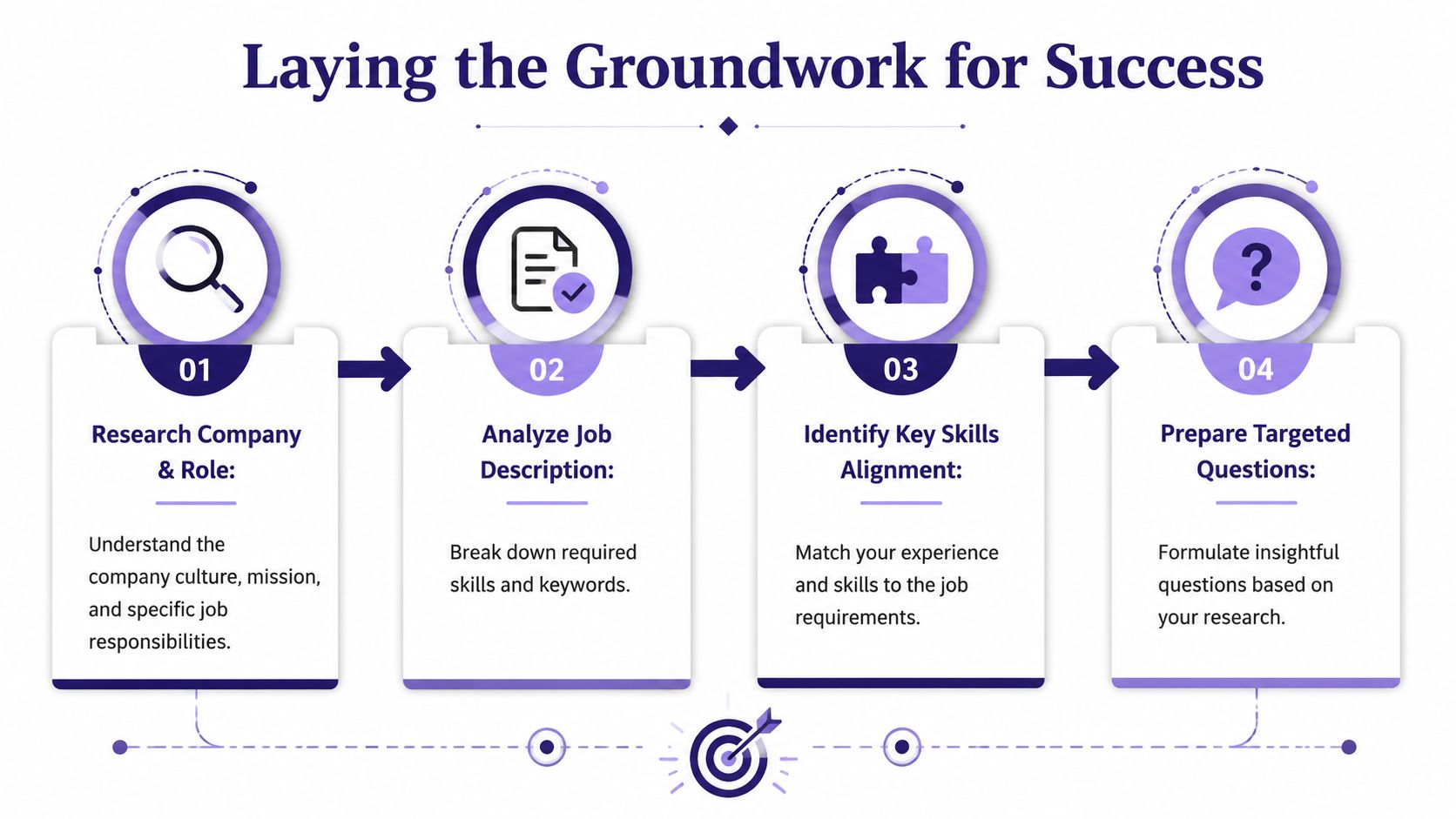
Laying the Groundwork for Success
Good interviews start long before the call or meeting. In the UK, the average interview success rate is 20%, with 47% of candidates failing due to insufficient company research, according to StandOut CV’s job interview statistics. Research isn’t a nice extra. It’s one of the fastest ways to separate yourself from unprepared candidates.
Read the job description like a hiring manager
Don’t skim it. Break it down line by line.
Look for three things:
-
Core tasks
These tell you what the employer needs immediately. For an accounts assistant role, that may be purchase ledger, bank reconciliations, or invoice processing. For an advanced payroll role, it may be payroll accuracy, deadlines, pension handling, or compliance. For a data analyst role, it may be reporting, dashboarding, data cleaning, or stakeholder support. -
Tools and systems
If Sage, Xero, QuickBooks, Excel, SQL, Python, or Power BI appear, assume they matter in practice, not just on paper. -
Language patterns
Words like “accurate”, “proactive”, “commercial”, “analytical”, or “client-facing” signal how the team thinks about performance.
Write the employer’s keywords in one column. In the next column, match your evidence.
Research the organisation beyond the homepage
The basic website isn’t enough. You need a workable view of the business.
For finance roles, check whether the company sells products, delivers services, works on subscription income, or operates across multiple entities. That context changes what bookkeeping, VAT handling, payroll processes, and reporting might look like.
For business analyst and data analyst roles, look for signs of operational complexity. Multiple locations, digital services, varied customer groups, and regulated processes often mean more data challenges and more stakeholder coordination.
A simple research checklist helps:
-
Business model
Understand how the company makes money. -
Recent activity
Read current news, product pages, hiring pages, or public updates. -
Leadership and team structure
Review LinkedIn profiles where available and note likely reporting lines. -
Role fit
Ask yourself what problem they are trying to solve by hiring this person.
Align your CV and profile before the interview
If your CV says one thing and your interview answers say another, the panel notices. Before the interview, revise your CV and LinkedIn so the language reflects the role you’re targeting.
If you need to tighten presentation quickly, a practical option is this free AI resume maker from Kindness Community Foundation. It can help you sharpen wording, but don’t let any tool replace judgement. The final version still needs your own examples, your own software experience, and your own career direction.
Bring your CV into line with the job before you step into the interview. A mismatched profile creates doubt you don’t need.
Prepare questions that show commercial awareness
Strong candidates don’t ask random questions at the end. They ask questions that prove they understand the work.
Try prompts like these:
-
For bookkeeping and accounts roles
“What does a typical month-end look like in this team?” -
For payroll roles
“Which parts of the payroll process are most time-sensitive here?” -
For business analyst roles
“Which stakeholders would this role work with most closely in the first few months?” -
For data analyst roles
“How does the team currently turn reporting into action for the wider business?”
These questions do two things. They show preparation, and they help you judge whether the role is right for you.
Mastering Behavioural Questions with the STAR Method
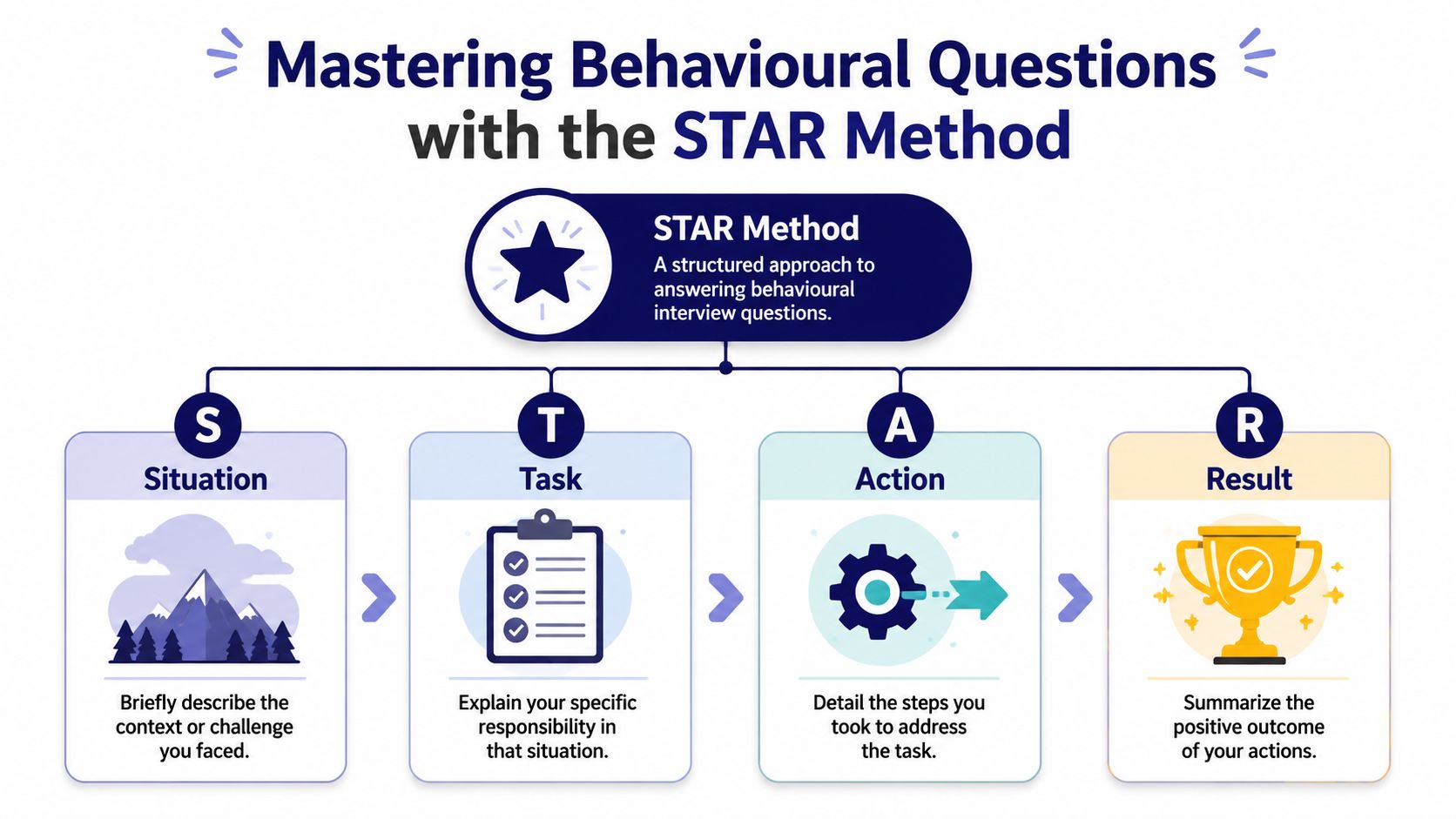
Behavioural questions decide a surprising number of interviews because they show how you think under pressure, how you work with others, and whether your claims on paper stand up in conversation. The cleanest way to answer them is the STAR method: Situation, Task, Action, Result.
Keep your answer structured
Most weak answers fail for one of two reasons. They are either too vague, or they get stuck in the background and never reach the action.
Use this structure:
-
Situation
Give enough context to understand the problem. -
Task
Explain your responsibility. -
Action
Focus on what you did, not what the team did. -
Result
Show what changed, improved, or was learned.
A lot of candidates overfill the first two and rush the last two. Interviewers usually care most about your actions and judgement.
Role-specific STAR examples
For bookkeeping, a strong example could involve spotting an issue before submission.
A candidate might explain that while checking transactions they noticed a VAT coding inconsistency, reviewed the affected entries, corrected the treatment, and flagged the pattern so the same error wouldn’t repeat. That answer shows attention to detail, software confidence, and compliance awareness.
For an accounts assistant role, a good story might centre on month-end pressure. You may have dealt with missing invoices, supplier queries, and reconciliation deadlines at the same time, then created a clearer process for tracking outstanding items.
For advanced payroll, choose examples that show control and discretion. Interviewers often want evidence that you can handle sensitive data, work to strict cut-off points, and stay calm when employees need fast answers.
For final accounts roles, use examples that show precision. Adjustments, supporting schedules, and clear communication with a senior accountant all make strong material when presented well.
Business analyst and data analyst answers need clarity
Analyst interviews often include questions like “Tell me about a time you solved a business problem” or “Describe a time you handled conflicting stakeholder requirements”.
Here, STAR works best when you avoid technical overload. Don’t list every formula, query, or dashboard element unless they ask. Start with the business problem.
A stronger data analyst answer sounds like this in principle:
- there was inconsistent reporting,
- you clarified the reporting requirement,
- you cleaned or checked the data,
- you built a useful output in Excel, SQL, Python, or Power BI,
- you explained the result clearly,
- the team could then act on it.
That sequence shows analytical maturity, not just tool usage.
For extra practice with question styles, RemoteFast’s insights on interviews are useful because they highlight the kinds of responses that come across well in modern interview formats.
A more detailed practice framework for competency answers is also available in this competency-based interview preparation guide.
If you lack formal experience
Many graduates and career changers panic, and they shouldn’t. UK Job Hunters notes that candidates with limited formal history should “prepare examples derived from outside of work” and “articulate the why behind their enjoyment” of activities to connect them to motivation.
That matters for people moving into bookkeeping, payroll, accounting support, business analysis, or data analysis after study, volunteering, family responsibilities, or unrelated work.
Use examples from:
- Academic projects such as a spreadsheet assignment, business case, or data presentation
- Volunteering where you organised records, handled cash, supported events, or improved a process
- Part-time work where you dealt with deadlines, customers, systems, or accuracy
- Personal projects such as building a dashboard, cleaning a dataset, or studying software independently
Don’t apologise for these examples. Frame them properly.
A simple quality check for every STAR story
Before the interview, test each example against this list:
| Check | Good sign |
|---|---|
| Relevance | It matches a skill in the job advert |
| Ownership | Your actions are clear |
| Specificity | The example includes real tasks and decisions |
| Outcome | It ends with a result or lesson |
| Brevity | You can deliver it without rambling |
If your answer sounds polished but doesn’t show judgement, it won’t land. If it shows judgement, structure, and relevance, it usually does.
Demonstrating Your Technical Prowess
Technical preparation is where generic job interview preparation stops being enough. For bookkeeping, accounts, payroll, business analyst, and data analyst roles, employers often test whether you can do the work. Sometimes it’s a formal task, and sometimes it’s a conversational probe. Sometimes it’s both.

For bookkeeping, VAT, payroll and accounts roles
If you’re interviewing for bookkeeping and VAT work, assume they may ask about transaction processing, reconciliations, invoice handling, VAT treatment, and software use. They may also test how you think when records are incomplete or inconsistent.
One useful fact to remember is that UK bookkeeping courses commonly include HMRC VAT schemes alongside software proficiency in Sage, Xero, and QuickBooks, as reflected in FCTraining’s bookkeeping and VAT course information. That tells you something important about employer expectations. Practical VAT handling isn’t optional background knowledge. It sits at the core of job readiness.
What to prepare for finance interviews
A hiring manager may ask:
- how you would check a bank reconciliation,
- what steps you’d take if supplier balances don’t agree,
- how you’d review ledger accuracy before month-end,
- what you’d do if a VAT code appeared inconsistent,
- how comfortable you are using Sage, Xero, or QuickBooks.
You don’t need to turn every answer into a textbook definition. You do need to show sensible process.
Interview habit: When answering technical finance questions, start with control points. Accuracy, review, documentation, and escalation matter as much as software clicks.
Mini prompts to rehearse
| Role | Sample prompt | What the interviewer wants to hear |
|---|---|---|
| Bookkeeping & VAT | “You notice a transaction has been posted with the wrong VAT treatment. What do you do?” | Accuracy, checking source documents, correcting entries, preventing repeat errors |
| Accounts assistant | “A supplier statement doesn’t match your ledger. How would you approach it?” | Methodical matching, query handling, reconciliation logic |
| Advanced payroll | “An employee raises a pay discrepancy close to the payroll deadline. How do you handle it?” | Calm prioritisation, confidentiality, deadline awareness |
| Final accounts | “How do you help ensure records are ready for final review?” | Clean supporting schedules, organised records, attention to adjustments |
For advanced payroll, don’t focus only on software. Employers usually care about judgement. Can you protect confidentiality, follow process, and communicate clearly when someone is anxious about pay? Those are interview-winning signals.
For business analyst and data analyst roles
Analyst interviews often mix business thinking with technical checks. You may be asked to explain how you would approach a business problem, then show enough familiarity with tools to make your answer credible.
Expect discussion around Advanced Excel, SQL, Python, and Power BI. You don’t need to present yourself as senior if you aren’t. But you do need to sound like someone who has used the tools with purpose.
What solid preparation looks like
For Advanced Excel, rehearse tasks such as cleaning raw data, checking duplicates, using lookup functions, summarising trends, and building PivotTables that answer a business question.
For SQL, be ready to explain joins, filtering, aggregation, and how you’d extract data for a clear reporting need. If you’ve written queries before, revise your reasoning as well as syntax.
For Python, prepare for simple data handling conversations. Think about importing data, checking quality, handling missing values, and producing a useful output. Employers often care less about elegant code than whether you understand the steps.
For Power BI, rehearse how you’d structure a dashboard for a manager. Which visuals belong on one page? What would you highlight first? How would you avoid clutter or misleading charts?
A practical set of question types to practise appears in this data analyst interview questions resource.
Don’t separate technical skill from business value
Many candidates underperform; they answer with tool names but not outcomes.
Instead of saying, “I used Excel and Power BI,” say that you used Excel to clean and structure the data, then created a Power BI dashboard that made a recurring reporting issue easier for non-technical stakeholders to interpret.
Instead of saying, “I know SQL,” explain that you’d use SQL to extract the relevant data first, check whether the fields answer the actual business question, and then validate the output before reporting.
That shift matters in business analyst roles too. The employer isn’t hiring a function list. They’re hiring someone who can connect requirement gathering, process understanding, data interpretation, and communication.
What doesn’t work in technical interviews
A few patterns repeatedly hurt otherwise strong candidates:
-
Overclaiming
If you say you’re advanced in Python and then struggle to explain a basic cleaning task, trust drops quickly. -
Speaking only in theory
Employers want examples of how you’ve applied a tool, even in study or practice. -
Ignoring accuracy
In finance roles, technical confidence without checking logic sounds risky. -
Ignoring the audience
In analyst roles, a technically correct answer that no stakeholder could follow isn’t a strong answer.
The best technical answers are calm, specific, and realistic. They show where you’re already capable and where you’re still developing, without sounding unsure.
Perfecting Your Performance and Logistics
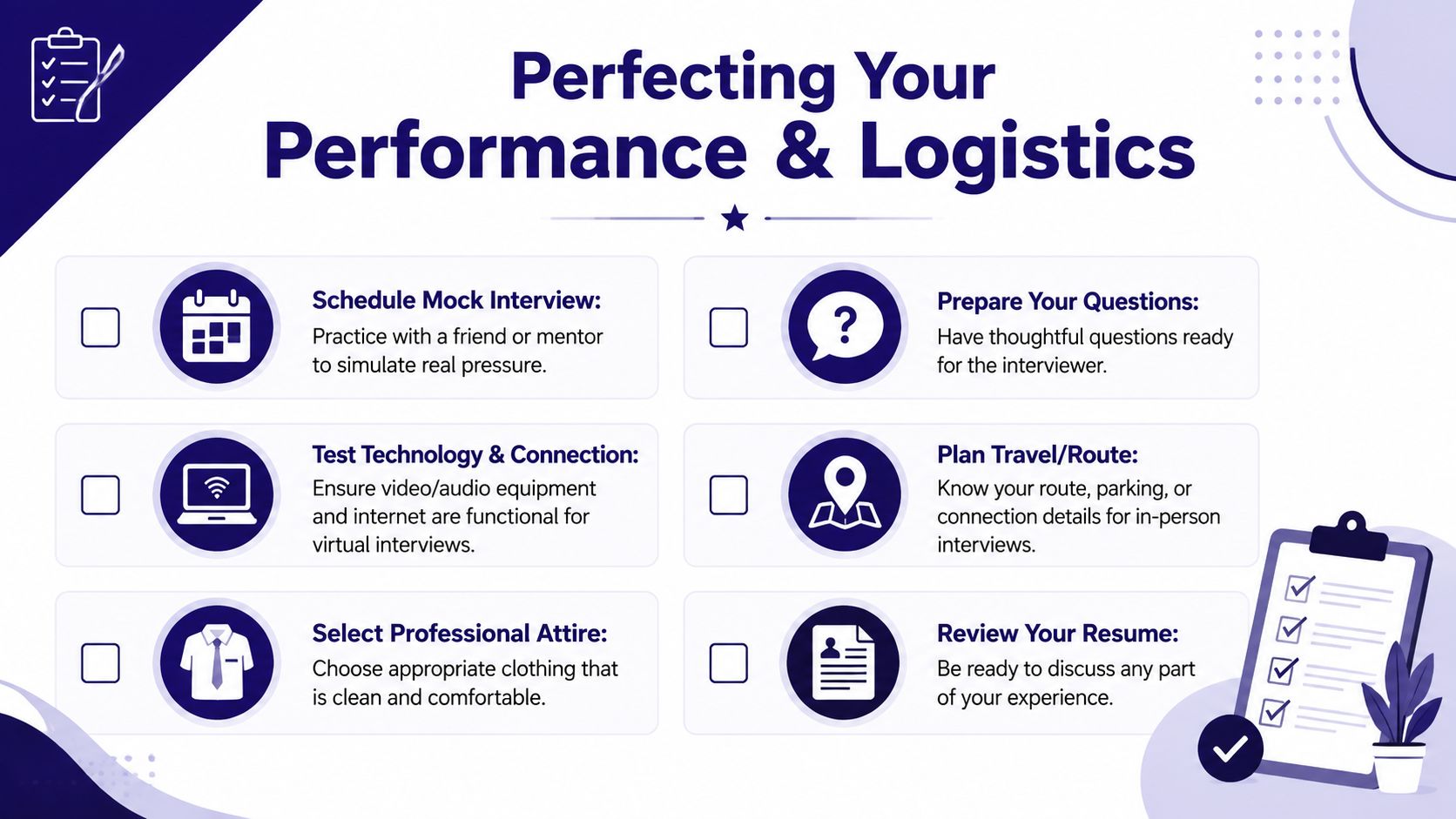
A strong answer can still be undermined by poor delivery or sloppy planning. That’s why the final stage of job interview preparation should focus on performance under realistic conditions.
Remote and in-person interviews need different preparation
Many candidates treat them the same. They aren’t the same.
According to Apollo Technical, candidates who rehearse specifically for virtual interviews, including practising on camera, improving lighting, and using a clean background, receive callback offers at a 30% higher rate than those who treat virtual interviews like in-person ones.
That makes sense in practice. On camera, small issues become larger ones. A weak connection, poor eye line, cluttered background, or bad microphone can make you seem less organised than you are.
Remote interview checklist
-
Test the platform
Open the meeting software in advance and check audio and camera settings. -
Fix your framing
Your face should be clear, centred, and well lit. -
Check your background
Keep it tidy and free from distractions. -
Practise speaking to camera
Eye contact on video feels different. Rehearse it. -
Keep documents nearby
Have your CV, notes, and the job description ready, but don’t read from them.
In-person interview checklist
-
Plan the route
Know your train, parking, building entry, and arrival time. -
Dress one level above casual office wear
Smart, clean, and comfortable usually works well. -
Carry printed copies
Bring your CV and any portfolio material if relevant. -
Manage your waiting room behaviour
Reception staff notice more than candidates assume. -
Use steady body language
Sit upright, avoid fidgeting, and don’t rush your answers.
Small logistics errors rarely lose interviews on their own. But they can weaken the impression created by otherwise good answers.
Mock interviews are worth doing properly
A mock interview only helps if it creates some pressure. Ask someone to question you directly, interrupt where appropriate, and push for detail. Practise your opening, your key examples, your explanation of software experience, and your closing questions.
For finance candidates, this often reveals where answers are too general. For analyst candidates, it shows whether your technical explanations are understandable to a non-technical listener.
Finish with a short set of questions for the employer. Good options include asking about success in the role, common first-quarter challenges, team priorities, or how the role interacts with the wider business. That turns the meeting into a professional conversation, not a one-sided test.
The Follow-Up and Negotiation Blueprint
The interview isn’t finished when you leave the room or log off. The follow-up shows professionalism, and the negotiation stage tests whether you understand your own value.
A short thank-you email works well when it does three things. It thanks the interviewer for their time, briefly reinforces your fit for the role, and references one part of the conversation that felt meaningful. If you want a practical reference point for tone and structure, this Underdog.io guide for job seekers is useful.
A simple follow-up structure
- Thank them for the conversation
- Reconfirm interest in the specific role
- Mention one discussion point that strengthened your interest
- Close professionally without chasing too hard
Keep it concise. Long follow-up emails usually dilute the message.
Negotiation for finance candidates
Salary discussions feel uncomfortable when you haven’t prepared. They feel far more manageable when you anchor them to role level, software capability, and the value you’ll bring.
For bookkeeping roles in the UK, a Professional Careers Training salary reference states that a junior bookkeeper can earn an average salary of £25,000, while a senior bookkeeper can earn up to £35,000 to £40,000 per year. That gives you a realistic benchmark for discussion if you’re moving into bookkeeping and VAT work or stepping up in seniority.
For analyst and broader accounting roles, if you don’t have a verified benchmark to quote, keep the discussion qualitative. Talk about your software capability, reporting responsibilities, stakeholder exposure, and how job-ready your skills are.
A deeper framework for handling offer discussions appears in this salary negotiation resource.
What to say when negotiating
You don’t need an aggressive tone. A calm, evidence-based approach is stronger.
Try this approach:
“I’m very pleased to receive the offer. Based on the responsibilities discussed, my practical experience with the relevant systems, and the value I believe I can bring to the team, I’d like to discuss whether there’s flexibility in the package.”
That keeps the conversation professional and collaborative. It also signals maturity. The goal isn’t to win a battle. The goal is to agree a package that reflects the job and your level.
If you want structured support with job-ready training, interview coaching, CV preparation, and practical skills in bookkeeping & VAT, advanced payroll, accounts assistant work, final accounts, business analysis, and data analysis, explore Professional Careers Training. Their flexible training with accountant-led support can help you build stronger evidence for interviews and move into UK roles with more confidence.