Every payroll professional in the UK has to get one number right every single pay run: the minimum hourly rate a worker is legally owed....
Every payroll professional in the UK has to get one number right every single pay run: the minimum hourly rate a worker is legally owed. Get it wrong and it is not just an awkward conversation with an employee, it is a compliance failure that HM Revenue and Customs can chase back six years and fine an employer for.
This guide sets out exactly what the National Minimum Wage and National Living Wage are, the rates that apply from April 2026, who is and is not covered, and the mistakes that trip up otherwise careful payroll teams most often.
What Are the National Minimum Wage and National Living Wage?
The National Minimum Wage (NMW) is the legal minimum hourly rate almost all workers in the UK must be paid. The National Living Wage (NLW) is simply the name given to the top rate of the National Minimum Wage, paid to workers aged 21 and over. They are set and enforced under the same law, the National Minimum Wage Act 1998, and reviewed every year on the recommendation of the independent Low Pay Commission.
Both rates are reviewed annually and normally take effect on 1 April, which means payroll teams have a fixed date every year when every affected pay rate has to move, whether or not an individual employee’s pay review is due.
National Minimum Wage and National Living Wage Rates From April 2026
The government accepted the Low Pay Commission’s recommendations at the Autumn Budget on 26 November 2025, and the following rates took effect from 1 April 2026, as confirmed on GOV.UK’s official minimum wage rates page.
| Category | Rate from April 2026 | Increase on 2025/26 |
|---|---|---|
| National Living Wage (21 and over) | £12.71 per hour | +50p (4.1%) |
| 18 to 20 year old rate | £10.85 per hour | +85p (8.5%) |
| 16 to 17 year old rate | £8.00 per hour | +45p (6.0%) |
| Apprentice rate | £8.00 per hour | +45p (6.0%) |
| Accommodation offset (daily rate) | £11.10 per day | +44p (4.1%) |
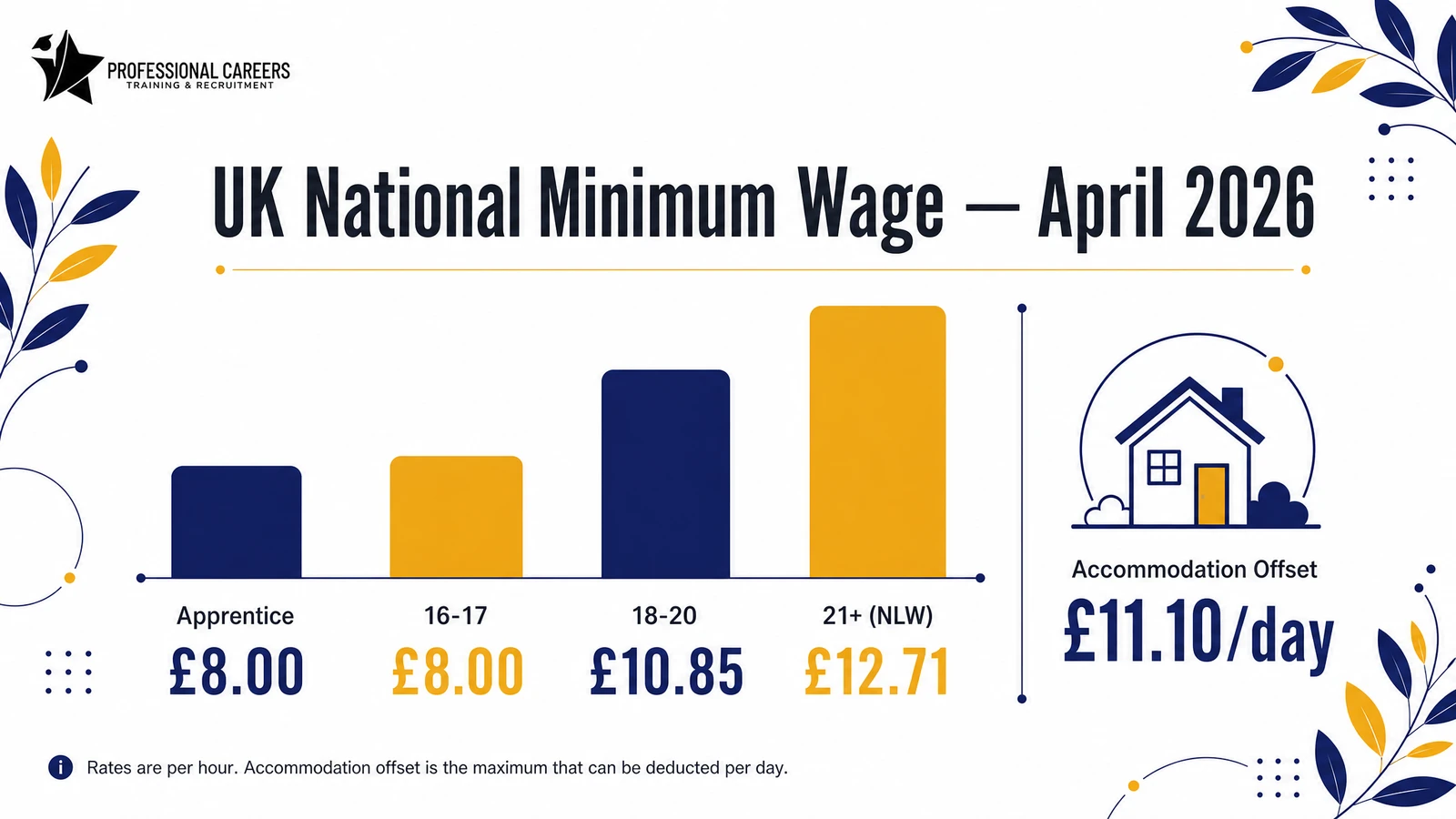
The 18 to 20 rate rose by the largest percentage this year, continuing a government policy of narrowing the gap between the youth rates and the National Living Wage over time. Payroll software should update these automatically, but the change still needs checking against every affected employee’s actual pay, not assumed.
Five rates apply depending on age and apprentice status, and all five change every April. A payroll system update handles the rate itself, but someone still has to confirm every worker is sitting on the correct one.
Who Is Entitled to the National Minimum Wage
The National Minimum Wage applies to almost every worker in the UK, not just employees on a standard contract. It covers full-time and part-time staff, agency workers, casual and zero-hours workers, home workers, and most apprentices. Age determines the exact rate: 21 and over gets the National Living Wage, under 21 gets the relevant National Minimum Wage band, and apprentices have their own rate under separate conditions.
This matters for payroll teams handling a mixed workforce, because a single pay run can easily include several different rates side by side. A retail business running weekend shifts, for example, might be paying the National Living Wage, the 18 to 20 rate, and an apprentice rate all in the same week, each one needing to be tracked and uprated independently.
Who Is Exempt
A small number of categories fall outside minimum wage law entirely. The genuinely self-employed running their own business are not covered, because the law applies to workers and employees, not independent contractors. Company directors with no separate contract of employment, volunteers and voluntary workers for a charity or similar organisation, and some family members working in a family business are also excluded. Work experience placements and internships can be exempt too, but only in narrow circumstances, so this is not a category to rely on without checking the specific rules first.
How the Apprentice Rate Works
The apprentice rate is the one most often applied incorrectly, because eligibility depends on two separate conditions rather than age alone. A worker qualifies for the apprentice rate if they are either under 19, or 19 or over but still in the first year of their current apprenticeship.
The moment an apprentice turns 19 and has already completed their first year, or reaches the second year of the apprenticeship regardless of age, they move onto their normal age-related rate, not the apprentice rate. This is a date-driven change, not something that happens automatically at contract renewal, so it needs its own trigger in the payroll calendar rather than being bundled into the annual April uprating.
How Minimum Wage Pay Is Actually Calculated
Minimum wage compliance is not simply a question of the hourly rate written on a payslip. HMRC checks total pay for the reference period against total hours worked in that period, which means both sides of the calculation matter.
Pay Reference Periods
A pay reference period is the block of time pay is checked against, and it follows how often a worker is actually paid: weekly if paid weekly, monthly if paid monthly. This becomes a genuine compliance gap for salaried workers on a fortnightly or four-weekly payroll, because the salaried hours work rules only formally recognise weekly and monthly reference periods. Employers running fortnightly or four-weekly payrolls need to check how their pay reference period is being treated, rather than assuming it lines up neatly with the regulations by default.
What Counts as Working Time
Working time includes more than time spent actively doing the job. Training required by the employer, time spent travelling between work assignments during the working day, and time spent on call at the workplace can all count. Unpaid trial shifts, mandatory unpaid overtime, and time spent on security checks or changing into required uniform at the start or end of a shift are common areas where employers under-record hours without necessarily intending to.
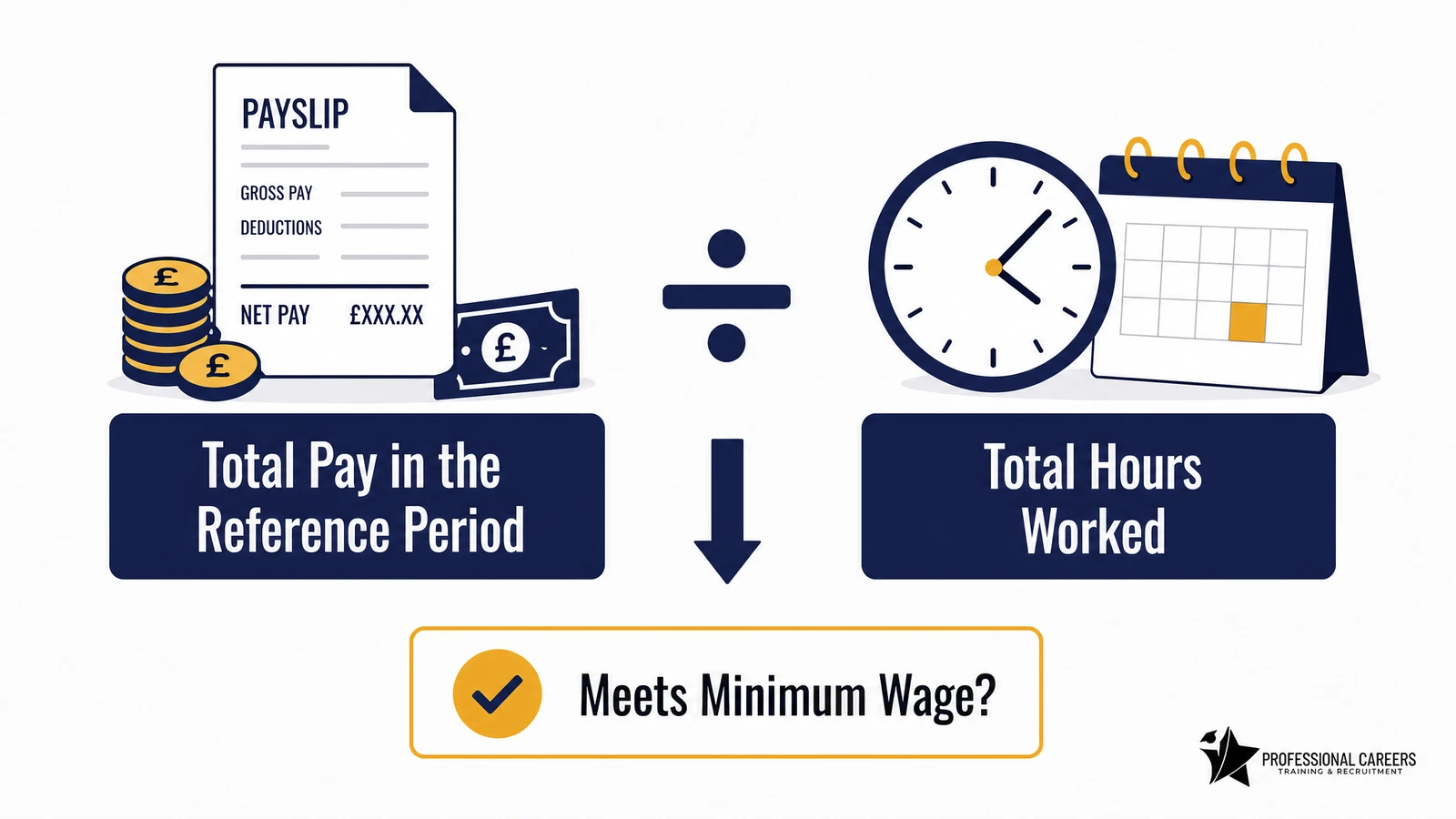
Minimum wage compliance is a calculation, not just a rate. Total pay in the reference period has to cover total working time in that period, and both sides of that sum can be miscounted.
Common Payroll Mistakes That Break Minimum Wage Law
Most National Minimum Wage breaches are not deliberate underpayment. They are calculation and process errors that a careful payroll process is specifically designed to catch.
- Deductions that count against the worker’s pay. Deductions for the employer’s own use or benefit, such as uniform costs or till shortages, reduce a worker’s pay for minimum wage purposes even if the worker agreed to them in writing.
- Missing the annual April uprate. Failing to apply the new rates from 1 April, even for a single pay run, is one of HMRC’s most commonly identified compliance failures.
- Missing an age or apprenticeship milestone. A worker turning 18, 21, or completing the first year of an apprenticeship needs their rate updated from that date, not from the next scheduled pay review.
- Unclear salaried-hours calculations. Using an inconsistent annual hours divisor, or failing to check total hours worked against contracted hours when an employee works more than their contract or leaves partway through the year.
- Unrecorded working time. Unpaid training, travel between assignments, and time spent on pre-shift security or uniform checks are frequently left off timesheets, which understates hours worked and can push effective pay below the minimum.
- Accommodation charged above the offset limit. Charging an employee more than the accommodation offset rate for employer-provided housing reduces their pay for minimum wage purposes by the excess amount.
Payroll software will apply the correct headline rate automatically. None of it will catch a missed birthday, an unrecorded shift, or a deduction that should not have been made, which is why this stays a manual review point even on a fully automated payroll run.
Record-Keeping Requirements for Employers
Employers must keep records that show minimum wage pay has been calculated correctly for every worker, and these records need to be kept for at least six years. That figure is not arbitrary: it matches the maximum period HMRC can go back when issuing a Notice of Underpayment, which means a gap in record-keeping can leave an employer with no way to prove compliance for the exact years it might be challenged on.
In practice this means keeping payslips, timesheets, contracts, and any record of hours worked in a form that can be produced on request, not just relying on whatever the payroll software happens to retain by default. Workers also have the right to see the records relating to their own pay, so these need to be accessible, not just archived.
What Happens If an Employer Underpays
Where HMRC identifies underpayment, the consequences are deliberately significant, because minimum wage enforcement is treated as a serious compliance area rather than a light-touch one.
- HMRC can issue a Notice of Underpayment covering arrears going back up to six years.
- A financial penalty applies on top of the arrears, calculated as a percentage of the underpayment, with a minimum of £100 and a maximum of £20,000 per worker affected.
- In serious cases HMRC can pursue criminal prosecution, separately from the civil penalty.
- Employers can be named publicly by the Department for Business and Trade as part of the naming scheme.
A worker who believes they have been underpaid has to choose between two routes: raising a complaint with HMRC, which can be made anonymously or by a third party, or bringing an employment tribunal claim, which allows up to two years of back pay to be claimed within a three-month time limit. Dismissing or otherwise penalising a worker for asserting their minimum wage rights is automatically unfair in law. Acas sets out the full process for workers and employers on both routes.
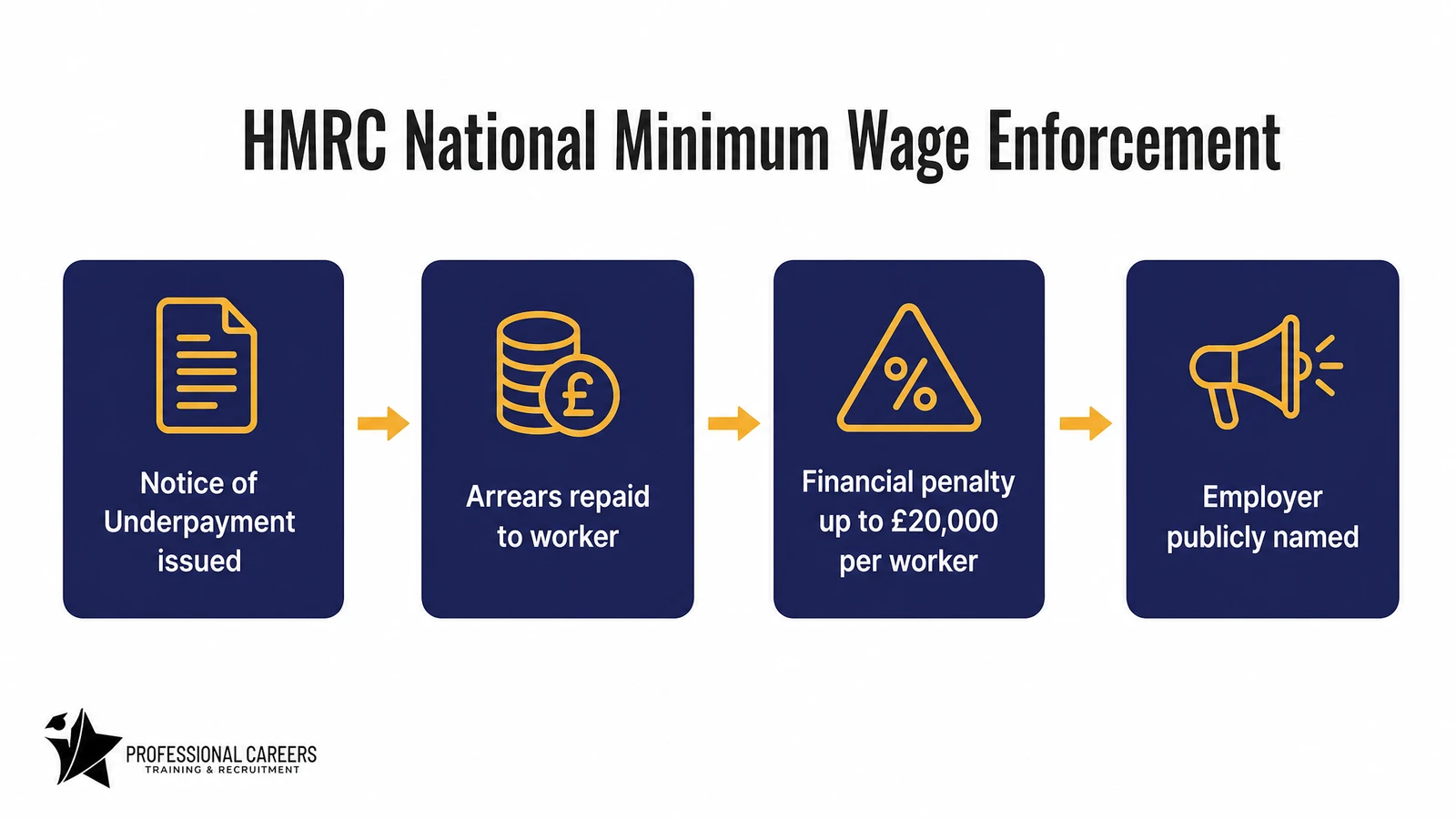
Underpayment does not need to be deliberate to trigger enforcement. HMRC can go back six years, fine up to £20,000 per worker, and refer serious cases for prosecution, on top of the arrears themselves.
Why This Matters If You Work in Payroll
National Minimum Wage compliance sits right alongside PAYE and National Insurance and workplace pension auto-enrolment as one of the core legal responsibilities a UK payroll function carries. It is also one of the more commonly audited areas, because HMRC actively targets sectors with higher rates of non-compliance, including hospitality, retail, and social care.
For anyone building a career in payroll, understanding minimum wage rules properly, not just the headline hourly rate but the reference periods, deductions, and age-band triggers behind it, is exactly the kind of practical knowledge that separates someone who can run payroll software from someone an employer can trust to keep the business compliant. It sits alongside statutory payments like Statutory Sick Pay and parental pay as core payroll knowledge that a structured course covers properly rather than leaving to be picked up on the job.
PC Training’s Advanced Payroll Training course covers National Minimum Wage compliance as part of a full, practical grounding in UK payroll, backed by guaranteed recruitment support once you qualify. If you are earlier in your research, our guide to payroll training for beginners is a good place to start.
What is the difference between the National Minimum Wage and the National Living Wage?
The National Living Wage is simply the name for the top rate of the National Minimum Wage, paid to workers aged 21 and over. Younger workers and apprentices are covered by the National Minimum Wage at lower, age-related rates. They are the same legal scheme, not two separate laws.
When do National Minimum Wage rates change each year?
Rates normally change on 1 April each year, following the Low Pay Commission’s recommendations, which the government typically accepts at the Autumn Budget the previous November. Payroll teams should build the April uprate into their annual compliance calendar as a fixed date.
Can an employer pay an apprentice below the National Living Wage rate?
Yes, but only if the apprentice is under 19, or 19 or over and still in the first year of their current apprenticeship. Once either condition stops applying, the apprentice must move onto their normal age-related rate.
Do deductions for uniforms or training count against the National Minimum Wage?
Deductions made for the employer’s own use or benefit, including uniform costs, reduce a worker’s pay for minimum wage purposes, even where the worker has agreed to them. This is a common source of accidental underpayment.
What can HMRC do if an employer underpays the National Minimum Wage?
HMRC can issue a Notice of Underpayment covering up to six years of arrears, apply a financial penalty of up to £20,000 per worker, pursue criminal prosecution in serious cases, and refer employers for public naming.