If you work in payroll, or you're training to, "statutory payments" is one of those phrases that sounds dry until you realise how much rests...
That gap feels frustrating because it isn’t always obvious what’s missing. Many people assume they need another degree, more applications, or more luck. In reality, employers often want proof that you can do the job in a UK workplace, not just explain the theory behind it.
That’s where understanding professional qualification meaning becomes useful. A professional qualification is often the bridge between what you know and what an employer needs you to do on day one. In finance, payroll, bookkeeping, and analyst roles, that bridge matters because the work is practical, process-driven, and tied to specific tools.
From University to Your First UK Role
A common problem shows up after graduation or during a career change. You can talk about financial principles, business models, or data concepts, but the interview turns practical very quickly. The hiring manager asks whether you can post sales invoices in Sage, reconcile a bank account in Xero, process payroll adjustments, assist with final accounts, or build a clean report in Excel or Power BI.
That’s why many applicants feel stuck. They aren’t unqualified in the general sense. They’re just not yet qualified in a way that clearly matches the role.
Where the mismatch usually happens
In most UK entry-level finance and data roles, employers hire for tasks, not broad interest. An Accounts Assistant isn’t hired because they understand business in general. They’re hired because they can support purchase ledger, sales ledger, bank reconciliation, and month-end routines accurately. A Business Analyst isn’t hired because they like problem-solving. They’re hired because they can gather requirements, document processes, and communicate clearly with stakeholders.
Employers usually read a CV through the lens of immediate usefulness. They want to see evidence that you can step into the workflow they already run.
This is especially important for people aiming at roles such as:
- Bookkeeper with working knowledge of VAT and cloud accounting software
- Payroll Specialist who can process pay, deductions, and reporting accurately
- Accounts Assistant who can support the finance team with daily transaction work
- Final Accounts assistant who understands adjustments, accruals, prepayments, and reporting
- Business Analyst who can translate business needs into documented requirements
- Data Analyst who can clean data, analyse trends, and present findings clearly
Why professional qualifications matter here
Professional qualifications are built around job competence. They focus on procedures, software, standards, and work-ready skills. That makes them useful for recent graduates, career changers, and people entering the UK labour market for the first time.
Research on UK professional qualifications also highlights a practical competency gap, where academic knowledge doesn’t always match the specific job-ready skills employers seek. Professional qualifications are designed to close that gap by showing you can perform procedural best practice with tools such as Sage, Xero, and advanced Excel, in practice across UK accounting and finance roles.
What Exactly Is a Professional Qualification
A professional qualification is a credential that shows you can perform in a specific occupation or professional area. It usually focuses on applied knowledge, workplace tasks, and recognised industry standards.
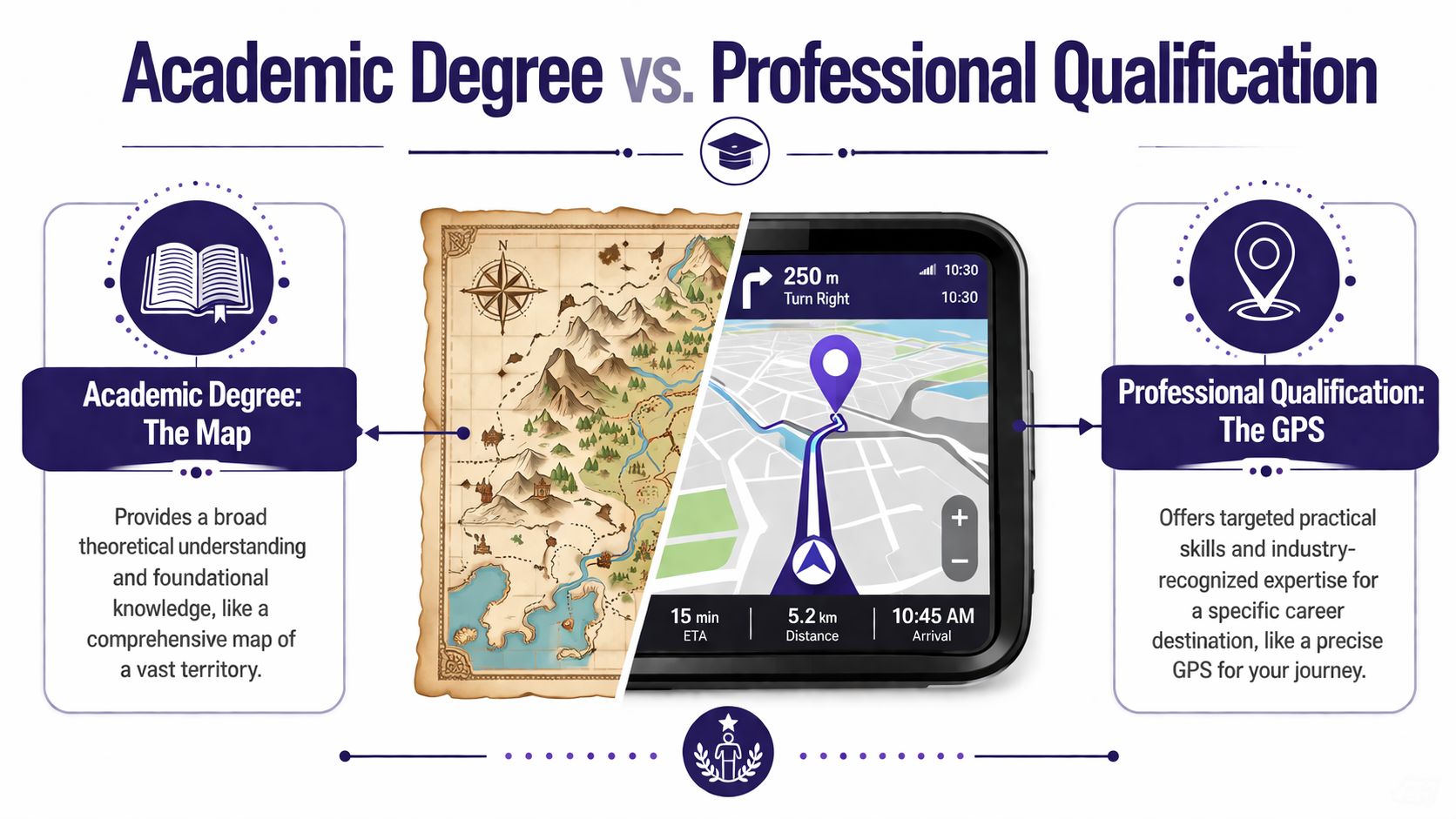
Think of it this way. A university degree is often like a map. It shows you the theories, the background, and the wider context. A professional qualification is more like a GPS. It helps you follow a specific route to a specific destination.
The plain-English definition
If you’re searching for the simplest professional qualification meaning, here it is:
A professional qualification is formal training and assessment designed to prepare you for a particular job or profession.
That job might be bookkeeping, payroll, accounting, financial reporting, business analysis, or data analysis. The key point is that the learning is tied closely to what people do at work.
In the UK, professional qualifications are often part of a recognised structure. Professional qualifications operate within an 8-level framework aligned with the European Qualifications Framework, and Levels 6 and 7 are typical for specialised certifications such as Chartered Accountant or Chartered Financial Analyst pathways, according to Nexibee’s explanation of professional qualification levels. That matters because it shows these qualifications aren’t informal short courses with no standing. Many sit within a recognised progression route.
How they differ from degrees
The confusion usually starts because both degrees and professional qualifications involve study, exams, and effort. But they are not trying to do the same job.
| Attribute | Academic Degree (e.g., BSc in Accounting) | Professional Qualification (e.g., AAT, ACCA, Sage Certified) |
|---|---|---|
| Main purpose | Build broad theoretical understanding | Build job-specific competence |
| Focus | Concepts, principles, wider subject knowledge | Practical tasks, standards, procedures, software |
| Assessment style | Essays, exams, academic assignments | Competency-based work, applied exams, practical scenarios |
| Employer signal | “This person has studied the field” | “This person can perform in the role” |
| Typical outcome | Foundation for many directions | Clearer route into a defined career path |
Why employers value them
A finance manager hiring an Accounts Assistant often needs someone who can help with invoice processing, reconciliations, and month-end support. A payroll manager needs someone who understands payroll routines and can work accurately with payroll software. A commercial team hiring a Data Analyst wants evidence that the candidate can handle spreadsheets, reporting tools, and structured analysis.
That’s why professional qualifications can carry real weight. They show direct relevance.
For example, in the UK, professional qualifications are commonly regulated credentials awarded by bodies such as ACCA, CIMA, and ICAEW, with an emphasis on practical competence rather than academic theory. One useful example is explained in this article on what the ACCA qualification is, which outlines why employers often see it as a practical route into accountancy.
The easiest way to remember it
Use this quick test when you’re comparing courses.
- If it teaches you about a subject broadly, it leans academic.
- If it trains you to perform a role directly, it leans professional.
- If employers list it or the software skills alongside job adverts, it’s probably highly practical and career-focused.
That distinction matters because your next step should match your goal. If you want a specific UK job soon, practical training usually matters more than adding more broad theory.
Explore Qualifications for Top Finance and Data Careers
The best way to understand professional qualification meaning is to connect it to real jobs. Once you do that, the picture becomes much clearer. You stop asking, “What qualification sounds impressive?” and start asking, “What training helps me get hired for the role I want?”

Bookkeeping and VAT
A Bookkeeper keeps financial records organised and accurate. In a small business, that may include sales invoices, purchase invoices, bank reconciliation, credit control, VAT entries, and software-based record keeping. In a larger business, the role may sit inside a finance team and focus on one area of the ledger.
A useful qualification path here is practical bookkeeping training combined with software exposure. Sage, Xero, and QuickBooks matter because these are the tools businesses use. VAT knowledge matters because employers need people who understand how to record transactions correctly and support VAT returns.
If a job advert asks for “bookkeeping experience,” it often means the employer wants someone who can:
- Use accounting software confidently
- Post transactions correctly
- Handle bank reconciliation
- Understand VAT treatment on common transactions
Advanced payroll
Payroll is specialised work. It rewards accuracy, confidentiality, and consistency. A Payroll Specialist or Payroll Administrator may process salaries, overtime, statutory pay, pension deductions, and payroll reports. The role also requires comfort with deadlines because payroll runs to a fixed schedule.
Good payroll training usually focuses on process. You learn how payroll is calculated, how records are updated, and how to avoid common errors. This is one of the clearest examples of a professional qualification being directly tied to a real job. Employers often care less about broad theory and more about whether you can process payroll correctly.
Practical rule: If the job involves repeated compliance-sensitive tasks, role-specific training becomes more valuable because employers need accuracy from the start.
Accounts assistant
The Accounts Assistant role is one of the most common entry points into finance in the UK. It often includes a mix of sales ledger, purchase ledger, petty cash, bank reconciliations, credit control, and support for month-end routines.
This is a strong route for people who want broad finance exposure before moving into management accounting, financial accounting, or professional accountancy. The best qualification path here usually combines accounting fundamentals with software training and routine finance tasks.
A hiring manager for this role often looks for signs that you can handle the daily rhythm of a finance department. That means understanding journals, basic double entry, reconciliations, and the flow of source documents through a finance system.
For readers comparing options, this guide to the best accounting qualifications in the UK can help you match a role such as Accounts Assistant or Bookkeeper to the qualification type that fits.
Final accounts
Final accounts work sits a step further into the accounting process. Here, you move beyond day-to-day transaction entry and start working with adjustments and reporting. That can include accruals, prepayments, depreciation, trial balance review, and support for year-end accounts preparation.
This path suits people who enjoy structure, detail, and the logic of financial statements. A qualification in this area becomes useful because it proves you understand not just data entry, but the accounting treatment behind it. Employers hiring for junior accounts preparation roles want people who can move from raw transactions to meaningful reports.
A candidate with practical final accounts training often stands out because they can talk about the workflow, not just the definitions.
Business analyst
A Business Analyst works between business teams and technical or delivery teams. The role is less about bookkeeping and more about understanding processes, identifying business needs, gathering requirements, and helping teams improve systems or operations.
This surprises many graduates. They assume the role is mainly theoretical because the word “analyst” sounds academic. In practice, it’s highly applied. Employers want someone who can document processes clearly, map current and future workflows, run requirement discussions, and communicate without confusion.
Training for this route often includes:
- Requirements gathering
- Process mapping
- Documentation
- Stakeholder communication
- Excel and reporting skills
A professional qualification here proves you can work with business problems in a practical way.
Data analyst
A Data Analyst turns raw data into useful information. That might mean cleaning spreadsheets, writing SQL queries, building dashboards, producing reports, or spotting patterns that support decisions. In many UK entry roles, advanced Excel is still essential, even when Power BI, SQL, or Python are also used.
This is another area where graduates often hit a wall. They may understand statistics or data concepts, but employers want to see tools and outputs. Can you clean a messy dataset? Can you build a dashboard? Can you explain what the data suggests to a non-technical manager?
That’s why practical analyst training matters. A strong qualification path in data analysis shows that you can:
| Role | Typical tasks | Useful qualification focus |
|---|---|---|
| Bookkeeper | Ledger work, reconciliations, VAT | Bookkeeping, VAT, Sage, Xero |
| Payroll Specialist | Pay runs, deductions, records | Advanced payroll training, payroll software |
| Accounts Assistant | Ledger support, journals, month-end help | Accounting basics, software, reconciliations |
| Final Accounts assistant | Adjustments, reporting, year-end support | Final accounts, financial statements |
| Business Analyst | Requirements, process improvement | Documentation, process mapping, Excel |
| Data Analyst | Data cleaning, reporting, dashboards | Advanced Excel, SQL, Power BI, Python |
The value of a professional qualification becomes obvious when the qualification and the job speak the same language.
How Qualifications Boost Your UK Employability and Salary
Practical training matters because employers often use qualifications as a shortcut for trust. If a role involves finance, reporting, compliance, or business-critical analysis, the employer wants reassurance that the person they hire can perform accurately.

Qualifications can improve employability
For accountancy in particular, the employer signal can be strong. According to the verified summary provided, 87% of UK employers rated ACCA-qualified accountants as highly employable, with the claim attributed to a 2023 ACCA Careers Report in the verified data set. The same verified summary also states a 25% salary premium, with £52,000 average starting pay compared with £41,000 for graduates without, citing 2024 ONS labour market data within that verified data summary. Because these figures were supplied in the verified material, they can be used here as provided.
For many employers, a professional qualification reduces uncertainty. It tells them the candidate has followed a recognised training path and has been tested against practical standards.
That same verified summary explains that UK professional qualifications awarded by bodies like ACCA, CIMA, and ICAEW place strong emphasis on practical competence, including applied case-style work and ethics-based training.
Qualifications align with stronger sectors
The wider labour market context also matters. According to ONS analysis of qualification levels by industry, the professional, scientific and technical activities sector had the highest qualification index score at 3.49 out of 4, with 70.2% of staff holding Level 4 and above qualifications. The information and communication sector followed with a 3.41 index score and 64.8% of workers holding higher education qualifications. The same ONS analysis notes that, within professional services, the pharmaceutical industry had 65.8% of workers holding higher education qualifications, compared with the manufacturing sector average of 32.4%.
Those figures matter for career planning because they show where qualifications cluster. Sectors that rely on specialist knowledge often expect stronger evidence of capability.
A short video can help you think about how career progress connects to skill-building and employability.
Why salary and progression often follow
When someone gains a professional qualification, the benefit isn’t only the certificate itself. It’s the combination of tested competence, industry recognition, and role readiness. In accounting, that may support movement from junior finance work into more responsible tasks. In data and business analysis, it may make it easier to move from reporting support into analytical ownership.
Here’s the practical effect employers often look for:
- Lower training risk because the new hire already understands key workflows
- Faster contribution because software and processes are more familiar
- More trust in regulated or accuracy-sensitive tasks
- Clearer progression into more specialised roles over time
This is why qualifications often influence both employability and earning potential. They make your skills easier to recognise and easier to match to a vacancy.
Understanding UK Entry Routes and Recognition
A lot of readers worry about the wrong thing at the start. They assume they need the perfect background before they can begin. In many cases, that isn’t true.
You don’t always need a degree
For practical finance routes such as bookkeeping, payroll, and accounts support, many learners start without an accounting degree. Employers often care more about whether you can perform the tasks than whether your university subject was directly related.
Awarding bodies and training routes vary. Some qualifications are broad and progressive. Others are software-based and role-focused. Some people begin with bookkeeping or accounts assistant training, then move into larger professional pathways later.
If you’re trying to understand where an entry route begins, AAT Level 2 accounting is a useful example of a beginner-friendly accounting path because it introduces core finance concepts in a structured way.
Recognition works through relevance
In the UK, recognition comes from two things working together. First, the qualification itself must be understood by employers or linked to real software and workplace tasks. Second, your CV must show how that qualification connects to the role you want.
Many people often undersell themselves. They list the certificate but don’t explain the practical capability behind it. If you’re preparing job applications, it also helps to understand the difference between a CV and a resume so you present your experience in the right UK-relevant format. This guide from StoryCV on resume vs. CV is useful for that.
A qualification gets attention when the employer can quickly see what work you’re now able to do because of it.
Exemptions and fast-tracking
If you already hold a related degree, you may not need to start from the very beginning of a longer qualification route. Some awarding bodies offer exemptions for prior study. That means certain papers or units may be recognised based on what you’ve already completed.
This is one area where learners often get confused, especially international students and career changers with overseas qualifications. The safest approach is to check each awarding body’s current exemption rules and compare them against your transcript or prior study.
A simple way to think about entry routes is this:
- Choose the target role
- Identify the practical tasks in that role
- Match those tasks to a qualification or software credential
- Check whether your previous study gives you exemptions
- Build your CV around proven competence, not vague interest
That makes the process far less overwhelming.
How to Choose the Right Qualification Path
Choosing well starts with honesty. Not honesty about ambition, but honesty about where you are now. The right qualification for a future Financial Accountant isn’t always the right starting point for someone who first needs an Accounts Assistant role. The right route for a Data Analyst isn’t always the right route for a Business Analyst either.

Start with the job, not the course title
Many learners begin by browsing course names. That can be misleading. “Accounting”, “business”, and “analysis” are broad labels. A better approach is to start with the work itself.
Ask yourself these questions:
-
Do I want transaction-based finance work?
Bookkeeping, payroll, and accounts assistant routes are often the best fit. -
Do I want reporting and year-end work?
Final accounts and broader accountancy study may suit you better. -
Do I want to solve business process problems?
Business analysis training is likely the more relevant path. -
Do I want to work with datasets and dashboards?
Data analysis with Excel, SQL, Power BI, or Python may be the better route.
Close the practical competency gap
Many graduates face what has been described as a practical competency gap, where academic knowledge doesn’t match the job-ready skills employers seek. Professional qualifications are designed to close that gap by giving evidence that you can perform procedural best practice using tools such as Sage, Xero, and advanced Excel, across UK accounting and finance roles.
That idea is useful because it changes how you choose. You’re not only asking, “What should I learn?” You’re also asking, “What will help me prove I can do the work?”
A simple decision framework
Use this three-part filter.
Match your current level
If you’re new to finance, start with operational skills. Learn bookkeeping, VAT, payroll, and accounting software before jumping straight to advanced professional exams. If you already understand accounting basics, you may be ready for final accounts or a broader chartered pathway.
Match your working style
People who enjoy routine, accuracy, and process often do well in payroll and bookkeeping. People who like structured problem-solving may prefer business analysis. People who enjoy numbers, patterns, and reporting tools may prefer data analysis.
Match your time horizon
Some qualifications help you get job-ready quickly. Others are longer-term professional pathways. Neither is automatically better. It depends on whether your immediate goal is to enter the job market fast or build toward a senior professional role over time.
The best qualification is the one that helps you do the target job well and prove that to an employer clearly.
A practical course with visible software skills can often do more for an entry-level application than a broad qualification that doesn’t yet connect to the role.
Your Action Plan for Career Success in 2026
A career plan works better when it’s specific. “Get into finance” is too broad. “Qualify for an Accounts Assistant role with bookkeeping, VAT, Sage, and Xero skills” is something you can act on.
Five practical next steps
-
Choose one target role
Pick the clearest match for your interests and current level. Bookkeeper, Payroll Specialist, Accounts Assistant, Final Accounts support, Business Analyst, or Data Analyst. -
Read real UK job adverts
Look at the required tasks, not just the title. Write down the software, processes, and skills that appear repeatedly. -
Pick the qualification that matches those tasks
If the adverts mention VAT, reconciliations, and cloud accounting, choose training that covers those directly. If they mention dashboards, SQL, and reporting, choose analyst training built around those tools. -
Build evidence while you study
Keep samples of your work where appropriate. That might include spreadsheet exercises, report examples, reconciliations, process maps, or dashboard screenshots. -
Present yourself as job-ready
Update your CV and LinkedIn profile with the language employers use. Don’t just name the course. State the tasks and tools you can now handle.
What success usually looks like
Career progress rarely comes from collecting random certificates. It comes from building a clear story. Your story might be: “I trained in bookkeeping, VAT, Sage, and Xero, and I’m ready for a Bookkeeper or Accounts Assistant role.” Or: “I’ve built skills in Excel, SQL, and Power BI, and I’m targeting junior Data Analyst roles.”
That clarity helps employers understand your value faster.
If 2026 is your target year for a move, the smartest approach is to make your learning route look as close as possible to the role itself.
Frequently Asked Questions
Do I need previous experience to start a bookkeeping or payroll course
Usually, no. Many entry routes in bookkeeping, VAT, payroll, and accounts support are designed for beginners. What matters most is willingness to learn, comfort with detail, and consistent practice.
How long does it take to get a professional qualification
It depends on the qualification type. A software-focused or role-focused course can often be completed much faster than a full professional accountancy pathway. Longer routes such as chartered qualifications take more time because they involve multiple stages and broader professional development.
Are professional qualifications better than a degree
They’re different, not better in every case. A degree gives broad subject knowledge. A professional qualification gives clearer evidence of job-specific competence. For many entry-level UK finance and data roles, that practical evidence is what helps candidates move forward.
Can I study if I’m changing career
Yes. Career changers often do well because they’re focused on a specific outcome. The main thing is to choose training that maps directly to the job you want, rather than learning unrelated material.
What does 1-to-1 training support usually help with
It often helps with pace, confidence, and application. Personal support can make it easier to understand difficult topics, practise software properly, stay on schedule, and connect your learning to real job applications.
I’m new to the UK job market. Where should I start
Start with role clarity. Pick the job you want, learn the tasks and software that role requires, then shape your CV around practical competence. UK employers respond well when your training, tools, and target role line up clearly.
If you want structured help turning training into a real job outcome, Professional Careers Training offers practical routes in accountancy, bookkeeping, payroll, business analysis, and data analysis, with 1-to-1 support, flexible study options, software certification, and career coaching designed for the UK job market.