
If you're training to become a business analyst, or you already work as one, you've probably noticed AI tools turning up in more of your...
That’s why the question matters so much. “What does AAT stand for?” sounds simple, but for most learners it really means something bigger: Will this qualification help me get a job? Will employers recognise it? Is it the right route for me?
In the UK, AAT matters because it is built around practical work. It isn’t just theory. It teaches the kind of tasks employers need someone to handle, such as bookkeeping, VAT, payroll processes, accounting software, and final accounts. For many learners, that makes it a more direct route into work than a purely academic course.
It also sits in an important middle ground. AAT can help you move into entry-level finance roles quickly, but it can also act as a stepping stone towards chartered qualifications later on. That makes it useful for recent graduates, career changers, and people who already work in finance but want formal recognition.
An Introduction to AAT
When people ask what does AAT stand for, the direct answer is the Association of Accounting Technicians. According to the AAT about page, it was founded in the UK in 1980 and has grown to approximately 130,000 members worldwide.
That background matters because AAT isn’t a random training label. It’s a long-established professional body with a UK focus, and that gives employers confidence. If you want to work in British finance teams, that practical UK grounding is one of the main reasons AAT keeps appearing in job descriptions.
Why employers pay attention to AAT
AAT is known for work-ready accounting skills. Its qualifications are designed around real finance tasks rather than broad academic theory, so learners build confidence with day-to-day responsibilities such as:
- Bookkeeping work: recording transactions accurately and keeping financial records organised
- VAT processes: understanding how VAT fits into routine accounting tasks in the UK
- Accounts support: helping with ledgers, reconciliations, and finance administration
- Software use: working with common accounting systems such as Sage, Xero, and QuickBooks
- Final accounts preparation: building the technical foundation needed for more advanced reporting work
Practical rule: If a qualification helps you do the job from day one, employers usually find it easier to value.
That practical reputation is a big reason AAT appeals to people who want movement, not just study. If you’re changing careers, returning to work, or trying to turn an accounting, finance, business analyst, or data analyst background into something more employable, AAT gives you a structured route.
AAT is a career route, not just an acronym
AAT also matters because it helps answer a common problem. Lots of learners know they want to work in finance, but they don’t know where to start. University can feel broad. Chartered qualifications can feel advanced. AAT often fills that gap.
For roles such as accounts assistant, bookkeeper, payroll support, or finance-based business analyst work, employers often want proof that you can handle practical tasks accurately. That’s exactly where AAT fits.
The AAT Qualification Levels Explained
AAT is built as a progression. You don’t need to understand everything at once. The qualification develops step by step, which is one reason many learners find it less intimidating than jumping straight into higher-level professional study.
According to the official AAT qualification levels guide, the pathway has four distinct levels, with Level 2 equivalent to GCSE grades 9-4, Level 3 equivalent to two A-levels, and Level 4 equivalent to a Higher National Certificate.
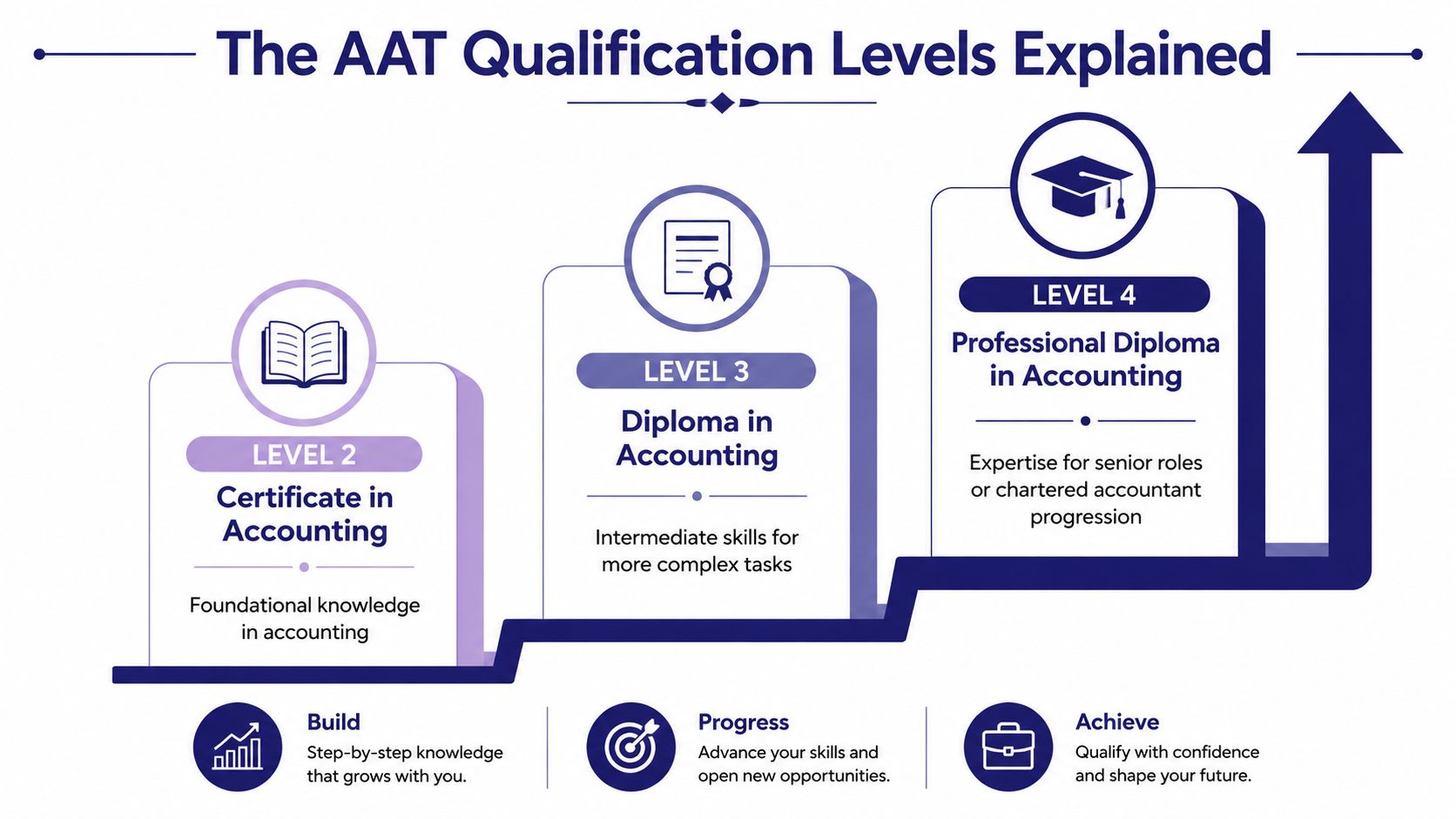
Level 2 for the basics
Level 2 is where many beginners start. It builds the core habits of finance work: accuracy, process, and confidence with numbers. If you’re new to accounting, this is usually the point where things become less abstract.
You’ll typically meet topics such as bookkeeping, costing, and accounting software. That makes Level 2 relevant for entry routes into accounts assistant and junior bookkeeping roles.
Level 3 for broader responsibility
Level 3 takes you further into the work employers expect in active finance teams, making bookkeeping and VAT more important and enabling learners to begin handling more complex records and reporting tasks.
For someone aiming at roles like assistant accountant, payroll-related support work, or finance administration with greater responsibility, Level 3 often feels like the point where study starts to look very close to the job itself.
A good way to think about Level 3 is this: you’re no longer just learning finance language, you’re learning how to use it in routine business situations.
Level 4 for final accounts and progression
Level 4 is the professional stage. It prepares learners for more advanced work, including final accounts. That means moving beyond transaction processing and into the interpretation and preparation of fuller financial information.
The Level 4 overview from Professional Careers Training is helpful if you want to see how this stage connects with more senior responsibilities.
The AAT Level 4 Diploma in Professional Accounting includes work on Final Accounts, requiring learners to prepare complete sets of accounts for limited companies and sole traders, including profit and loss statements, balance sheets, and cash flow forecasts in line with the Companies Act 2006 and FRS 102. That matters for people interested in senior finance support, business analyst work in finance settings, or roles involving more complex reporting.
AAT qualification levels at a glance
| AAT Level | Equivalent To (UK) | Key Skills Covered | Prepares You For Roles Like |
|---|---|---|---|
| Level 2 | GCSE grades 9-4 | Bookkeeping, costing, accounting software | Accounts Assistant, Junior Bookkeeper |
| Level 3 | Two A-levels | VAT, advanced bookkeeping, final accounts basics | Assistant Accountant, Finance Administrator, Payroll support |
| Level 4 | Higher National Certificate | Final accounts, professional accounting, financial analysis | Senior accounts roles, finance-based Business Analyst support |
| Level 5 | Professional diploma | Higher-level professional development | Progression towards broader professional pathways |
Who Should Study for an AAT Qualification
Not everyone needs AAT. But for the right person, it can be one of the clearest ways into a finance career.
The strongest fit is often someone who wants a practical route into work. That includes recent graduates who studied a related subject but still feel underprepared for real finance tasks. It also includes career changers who need a recognised qualification that employers understand quickly.

Recent graduates who need practical skills
A degree can give you useful theory, but many graduates still find that entry-level roles ask for hands-on skills they haven’t used much yet. Employers may want confidence with ledgers, VAT routines, accounts software, payroll processes, or financial reporting support.
That’s why AAT often appeals to graduates in accounting, finance, business, business analysis, and data analysis. It can make your CV look more job-ready because it signals applied skills, not just subject knowledge.
Career changers who need structure
Career changers often do well with AAT because the pathway is clear. You can see where you start, what you’ll learn, and which kinds of roles each level supports.
This is especially useful if you’re moving from administration, customer service, retail, operations, or another office-based role into finance. AAT gives a recognised route into job titles such as:
- Accounts Assistant: ideal if you want to support finance teams with invoices, reconciliations, and daily processing
- Bookkeeper: suitable if you enjoy accurate record-keeping and regular transaction work
- Advanced payroll support: useful for learners who want payroll-related responsibility alongside finance admin
- Finance-based Business Analyst support: relevant where reporting, data interpretation, and finance systems overlap
- Junior Data Analyst in finance environments: helpful if you want to work with financial data, reporting tools, and structured analysis
A realistic comparison with degree routes
AAT is valuable, but it helps to be realistic about what it is and what it isn’t. According to the Reed article referencing the UK Department for Business and Trade 2024 report, only 34% of UK employers actively recognise AAT Level 4 as equivalent to a university degree for hiring purposes.
That doesn’t make AAT weak. It means you should view it correctly. For many roles, AAT is a stepping stone that improves employability and gives you access to practical finance work. It’s often strongest when used as part of a wider career plan.
If your goal is a hands-on finance role soon, AAT can be a smart starting point. If your goal is high-level chartered status, AAT often works best as the first stage rather than the final one.
Career Paths and Benefits with AAT
AAT becomes much easier to understand when you stop thinking about it as a qualification title and start thinking about the jobs it can support. Its primary value is not the letters themselves. It’s the doors they can help open.
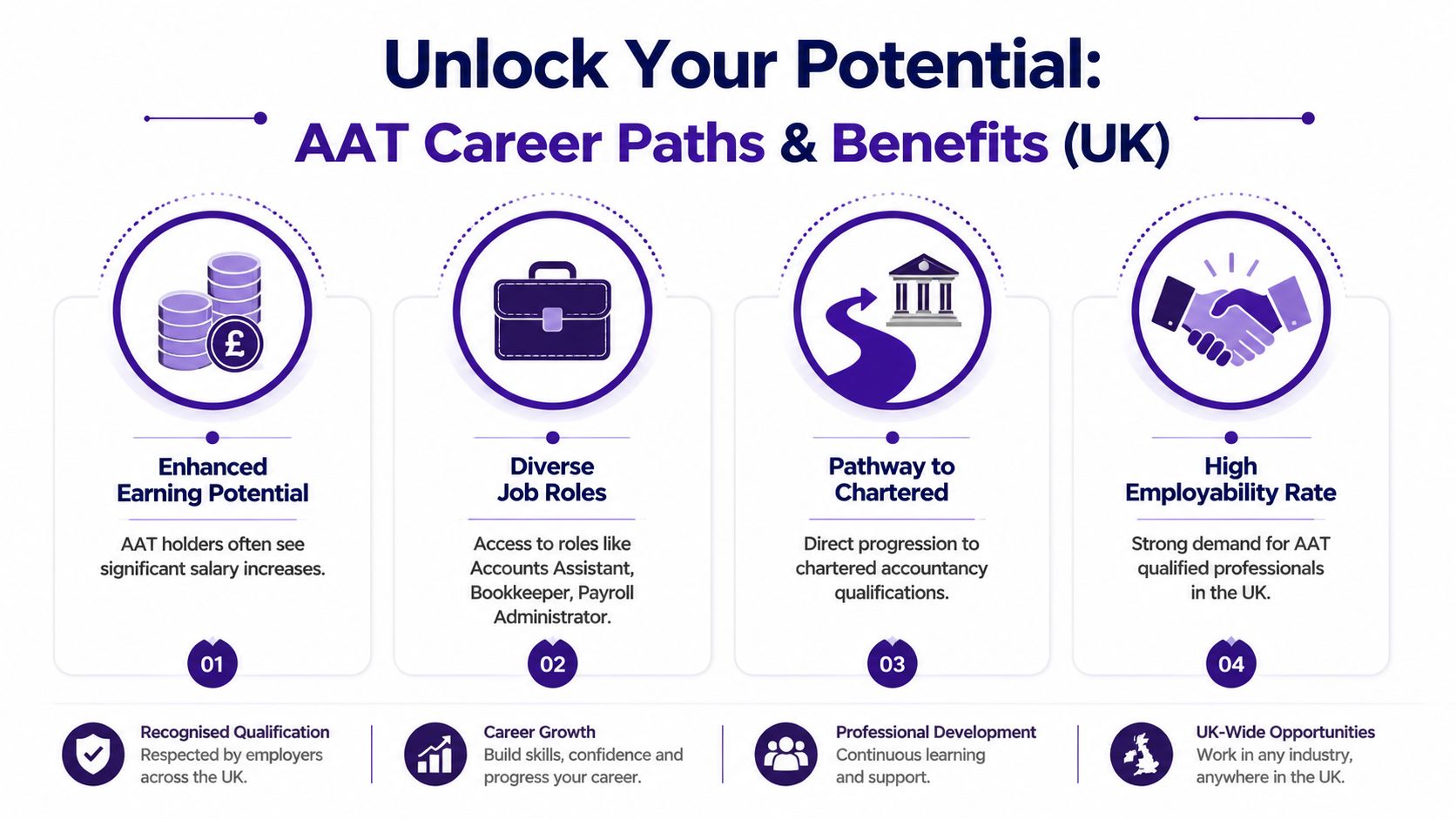
AAT is especially relevant for roles that sit close to daily finance operations. These are the kinds of jobs where employers need someone who can step into the team and handle practical work with care.
Roles AAT can support
Some of the most obvious routes include:
- Bookkeeping and VAT roles: recording transactions, checking entries, and supporting VAT-related processing
- Accounts assistant work: helping with invoices, ledgers, reconciliations, and routine finance administration
- Advanced payroll support: contributing to payroll tasks alongside wider accounts responsibilities
- Final accounts support: assisting with the preparation of more complete financial information as your level rises
- Business analyst work in finance teams: using financial data to support reporting and decisions
- Data analyst support in finance settings: working with structured financial information, software outputs, and reporting tools
AAT can also support gradual progression. Someone might begin in an accounts assistant role, move into broader bookkeeping or payroll responsibility, and later grow into work linked to reporting, analysis, or senior finance support.
For a closer look at entry routes, the guide to jobs for AAT Level 2 gives a useful picture of how learners often start.
What the numbers say about employability
The strongest quantitative case for AAT is employability. According to AAT and your career, AAT-qualified technicians are 30% more likely to secure permanent roles in finance compared to non-qualified peers, and Level 4 holders often command salaries between £28,000 and £35,000 in major UK cities.
That doesn’t mean every learner will walk straight into that outcome. Your experience, location, software skills, interview performance, and role target still matter. But it does show that employers place real value on vocational accounting training.
Before looking at progression routes, this short video gives a useful overview of the career side of AAT.
The biggest career advantage of AAT is that it helps you prove you can do finance work, not just talk about it.
How AAT Compares to ACCA and CIMA
Many learners get stuck here. They see AAT, ACCA, and CIMA mentioned together and assume they all do the same thing. They don’t.
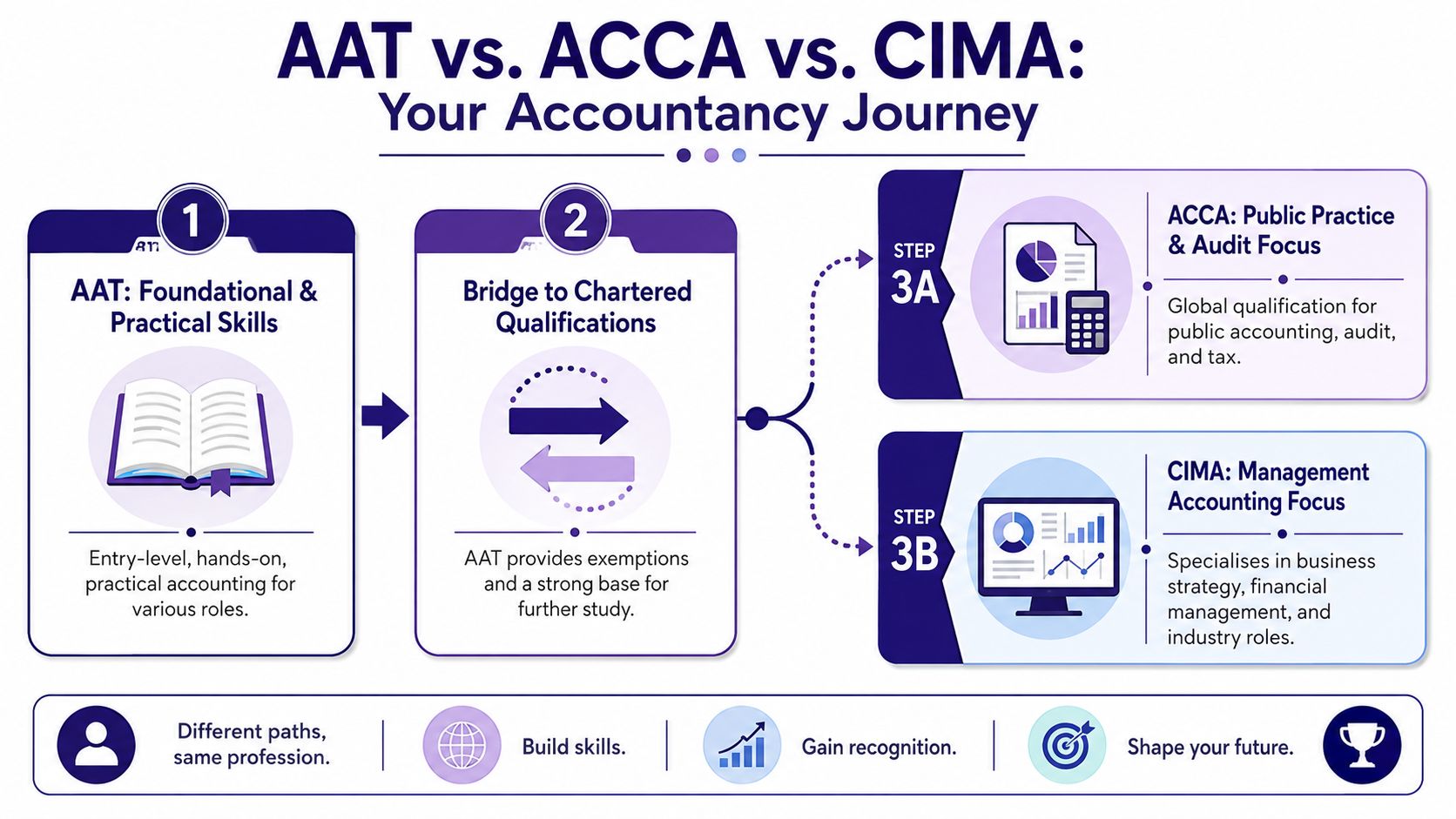
AAT is usually the practical foundation. ACCA and CIMA are chartered routes that move further into professional and strategic territory. So the better question isn’t “Which one is best?” It’s “Which one fits my stage?”
AAT for foundations
AAT is strongest at the start of a career. It teaches practical accounting processes, software familiarity, and technical habits that help people succeed in roles such as accounts assistant, bookkeeper, payroll support, and final accounts support.
For many learners, this practical start makes later study easier. You aren’t trying to learn advanced professional concepts without first understanding how finance work operates in real businesses.
ACCA and CIMA for chartered progression
ACCA and CIMA suit learners who want to move further towards chartered accountancy. ACCA is commonly associated with broader accountancy, audit, and public practice routes. CIMA is often associated with management accounting, business strategy, and commercial decision-making.
AAT fits in well here because it can shorten the path. According to ICAEW 2025 data, AAT Level 4 holders gain exemptions for up to 4 of the 15 ACCA Foundation modules, and UK recruitment trends show a 12% increase in job postings for “AAT + Exempted ACCA” candidates.
That’s important for two reasons:
- You may save time by not repeating early-level content.
- You may look more strategic to employers if your CV shows both practical AAT study and a route towards chartered status.
The guide to the best accounting qualifications in the UK is useful if you’re deciding where AAT sits in a longer plan.
AAT and ACCA or CIMA are not opposites. For many people, AAT is the base that makes chartered progression more realistic.
Your Next Steps to an AAT Qualification
If you’ve been asking what does AAT stand for, you’ve probably been asking a second question too. Could this be the route that gets me into a proper finance role? For many people, the answer is yes.
AAT works best when you connect the qualification to a clear outcome. Don’t choose it just because it sounds recognised. Choose it because you want the skills behind it. That could mean bookkeeping and VAT, advanced payroll, accounts assistant work, final accounts, or finance-based business analyst and data analyst responsibilities.
Start by choosing the right entry point
Your first step is deciding where you fit in the pathway. If you’re new to finance, Level 2 often makes sense. If you already have some accounting knowledge or workplace exposure, a higher starting point may be more suitable.
Think about your target role as well. Someone aiming for entry-level accounts work needs a different study plan from someone using AAT as a bridge towards chartered status.
Pair the qualification with software and job search skills
AAT is strongest when it sits alongside practical tools. Employers don’t just want exam passes. They want people who can work with the systems and processes used in real finance teams.
That’s why it helps to build confidence in tools such as Sage, Xero, and QuickBooks, and to strengthen reporting skills that support analyst-style work. If you’re interested in business analyst or data analyst routes within finance, your ability to interpret figures clearly can be just as important as passing the qualification itself.
Treat AAT as part of a career plan
AAT can help you enter the market, build confidence, and create momentum. For some learners, it’s enough to secure stable finance work. For others, it’s the first major step before ACCA or CIMA.
Either way, the most effective approach is simple. Pick the right level, build hands-on skills, and keep your job target in view from the start.
If you want support turning AAT study into real job opportunities, Professional Careers Training can help you build both the qualification and the employability around it. Their training includes 1-2-1 support with ACCA qualified Chartered Accountants and CPD approved trainers, flexible timetables with weekend and evening options, and official certification training in Sage, Xero, and QuickBooks. They also support the job search side with CV preparation, LinkedIn optimisation, career coaching, job hunting strategy, software support, and employer referrals, which is especially useful if you want more than exam success and need a clearer route into work.