If you're training to become a business analyst, or you already work as one, you've probably noticed AI tools turning up in more of your...
A recent graduate might open a job board and see ten roles that all sound related but ask for different software, different qualifications, and different day-to-day skills. A career changer might know they’re good with numbers and detail, but still feel stuck on one simple question: where do I start?
That confusion matters, because what is accounts and finance isn’t just a classroom question. It’s a UK career map. Once you can read that map, job titles make more sense, courses make more sense, and your next step becomes much easier to choose.
Your Starting Point on the UK Career Map
Let’s take a common situation. You search for entry-level office roles and find three adverts side by side.
One asks for bookkeeping and VAT knowledge. Another wants payroll experience. A third says it needs an Accounts Assistant who can reconcile bank transactions, process invoices, and use Xero. All three sit under the broad label of accounts and finance, but they don’t ask for exactly the same thing.
That’s where many people get lost. They assume accounts and finance is one single subject, when in practice it’s a family of roles. Some jobs focus on recording the numbers correctly. Some focus on paying people and suppliers on time. Some turn raw data into business decisions.
A simple way to anchor your thinking is this. Accounts usually looks backwards. It records what has happened. Finance usually looks forwards. It helps a business decide what to do next.
That sounds basic, but it’s powerful. Once you understand that split, job titles stop feeling random.
Practical rule: If the role is about invoices, ledgers, payroll, VAT, reconciliations, or final accounts, you’re usually closer to accounts. If it’s about budgets, forecasting, trends, planning, or decision support, you’re usually closer to finance.
Accounting can also be thought of more broadly as the language businesses use to understand performance, risk, and control.
For readers who want the first practical step into the field, this guide to getting into accounting in the UK is also helpful because it turns a vague career idea into a more realistic starting plan.
Why this matters for your job search
If you don’t separate the field into parts, you can end up applying for roles that don’t match your skills. You might train in payroll when the jobs you like are in bookkeeping. Or you might spend months reading theory when employers want software confidence and practical processing skills.
The better approach is to see accounts and finance as a route map with several lanes:
- Bookkeeping and VAT for recording daily transactions and keeping tax records in order
- Accounts Assistant work for supporting the finance function with invoices, reconciliations, and admin
- Advanced Payroll for wages, deductions, compliance, and deadlines
- Final Accounts for preparing year-end financial information
- Business Analyst and Data Analyst roles for turning financial and operational data into insight
Once you know the lane, the right course becomes much easier to spot.
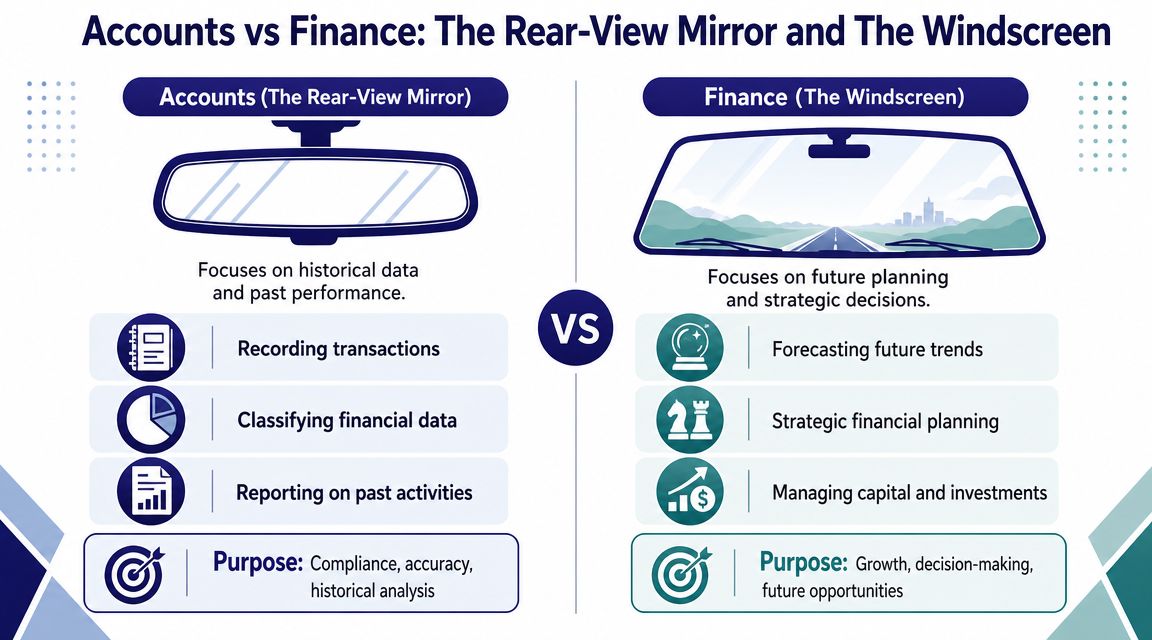
Accounts vs Finance The Rear-View Mirror and The Windscreen
The easiest way to understand the difference is to think of a car.
Accounts is the rear-view mirror. It shows what has already happened.
Finance is the windscreen. It helps you see where you’re going.
What accounts actually does
Accounts is about recording, checking, classifying, and reporting financial activity. A business buys stock, pays rent, invoices a customer, runs payroll, collects VAT, or pays a supplier. Someone has to make sure those transactions are entered correctly and supported by records.
That work becomes the financial history of the business.
In a UK company, this isn’t optional admin. It’s tied to law and regulation. The UK accounting framework described here notes that the Companies Act 2006 requires most companies to keep adequate accounting records, and that IFRS became mandatory for consolidated financial statements of EU-listed companies in 2005, which helped standardise reporting for capital markets. That legal structure is one reason accounting careers in the UK are so qualification-led and process-driven.
Typical accounts tasks include:
- Bookkeeping: recording sales, purchases, receipts, and payments
- VAT work: keeping digital records and helping prepare VAT returns
- Accounts payable: processing supplier invoices and arranging payment
- Accounts receivable: raising invoices and chasing overdue customer balances
- Final accounts support: helping prepare year-end reports from accurate records
What finance actually does
Finance takes reliable accounting information and uses it to support decisions. If accounts says what happened last month, finance asks what that means for next month.
A finance professional might look at revenue trends, compare costs, test scenarios, help set budgets, or assess whether a project looks affordable. The mindset is different. Instead of asking, “Was this transaction recorded correctly?” they often ask, “What should we do with this information?”
A simple comparison helps:
| Area | Main focus | Typical question |
|---|---|---|
| Accounts | Accuracy, records, reporting | What happened? |
| Finance | Planning, analysis, decisions | What should happen next? |
Reliable finance decisions depend on accurate accounts. If the records are weak, the planning will be weak too.
Where people often mix them up
The confusion usually comes from the word finance being used as a department label. In many businesses, the whole back-office money function is called “finance”, even if much of the team is doing accounting operations.
So an “accounts and finance” vacancy might really be one of these:
- A practical processing job, such as Accounts Assistant
- A compliance-focused role, such as bookkeeping, VAT, or payroll
- A planning role, such as analyst work or budgeting support
That distinction matters because the training is different. Someone who wants to move into final accounts needs a different skill set from someone aiming for business analysis or data analysis.
A Day in the Life Core Accounting Roles and Tasks
When people ask what accounts and finance means, they often want to know what the work looks like on a Tuesday morning.
For many entry roles, the answer is practical, structured, and deadline-led. You’re not sitting around discussing abstract theory. You’re checking invoices, correcting errors, matching payments, updating software, and making sure records support what the business needs to do next.

Accounts Assistant work in real life
An Accounts Assistant is often the engine-room support role inside a finance team. It suits people who like routine, accuracy, and visible progress.
A typical week might include:
- Processing purchase invoices: checking supplier bills, coding them, and entering them into software
- Raising sales invoices: helping the business bill clients correctly and on time
- Bank reconciliations: matching transactions in the accounting system to the bank statement
- Credit control support: following up unpaid invoices professionally
- Filing and record checks: making sure documents back up the numbers
This role teaches the flow of money through a business. You start seeing how sales, purchases, cash, VAT, and payroll connect.
Bookkeeping and VAT
Bookkeeping is one of the clearest entry points into accounts. It’s about keeping orderly, accurate records of what a business spends and earns.
Think of bookkeeping as keeping the business’s financial diary. If the diary is messy, everything built on top of it becomes harder. VAT, reporting, cash flow checks, and year-end preparation all depend on clean bookkeeping.
That matters even more now because UK tax administration is increasingly digital. HMRC’s Making Tax Digital system already requires most VAT-registered businesses to use compatible software for records and filing, and the next phase is due from April 2026 for many self-employed people and landlords. In practical terms, that means bookkeeping isn’t just about paper receipts and spreadsheets anymore. It means digital records, software confidence, and compliant workflows.
If you can post transactions accurately, reconcile a bank account, and understand VAT treatment, you’re building skills employers can recognise quickly.
Advanced Payroll
Payroll is often underestimated until someone has to run it properly.
This is sensitive work. People expect correct pay, correct deductions, and correct timing. Payroll teams deal with wages, pension contributions, statutory pay, leave, and reporting processes. One mistake can cause stress for staff and extra work for the employer.
That makes Advanced Payroll a strong specialist path for organised people who are calm under pressure and careful with confidential information.
A payroll-focused role often suits someone who likes:
- Routine with responsibility: deadlines repeat, but the work matters every cycle
- Rules and detail: deductions and calculations need care
- People impact: payroll directly affects employees’ day-to-day lives
Later in the workflow, the records from bookkeeping, payroll, and transaction processing feed into final accounts. That’s where the business’s financial year is pulled together into a structured set of reports.
To see how the moving parts connect in a business setting, this short video gives a useful overview:
Where analyst roles fit
Not everyone who starts in accounts stays in transaction processing. Some people discover they enjoy patterns, reporting, and trends more than daily posting work.
That can lead towards Business Analyst or Data Analyst pathways. In those roles, the focus shifts from entering financial information to interpreting it. You might compare departments, study customer behaviour, spot process bottlenecks, or build reports in Excel, SQL, Python, or Power BI.
The key point is this. Analysts still benefit from understanding accounting basics. If you don’t know what the numbers represent, analysis becomes shallow very quickly.
Essential Skills and Software for the Modern UK Market
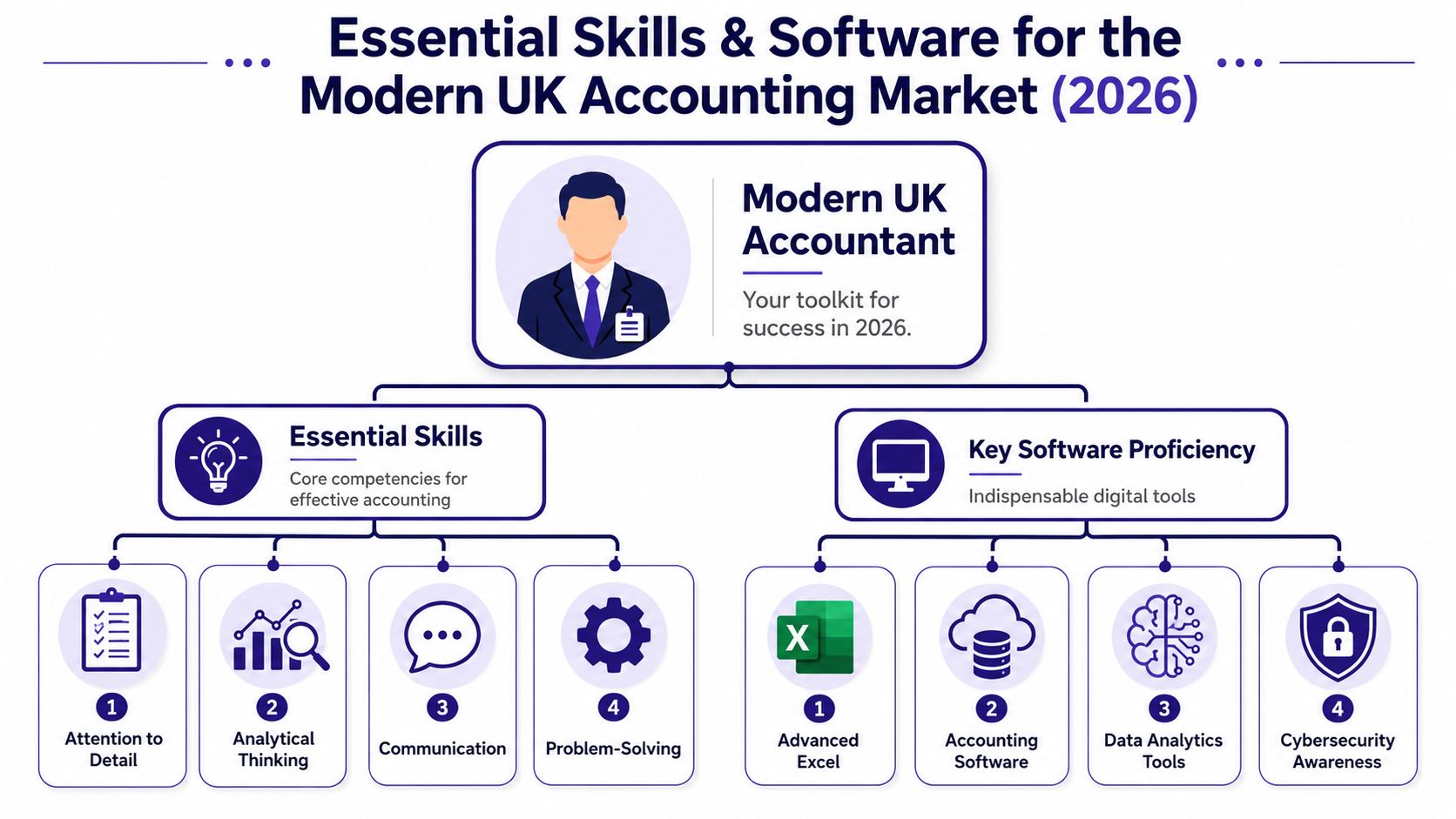
The UK market now expects more than manual bookkeeping knowledge. Employers want people who can work with systems, follow digital processes, and handle financial information in a way that fits modern compliance rules.
That change is partly regulatory and partly practical. Businesses want fewer manual errors, cleaner records, and faster reporting. HMRC’s digital requirements have pushed that further. As noted in HMRC-related coverage of Making Tax Digital and its planned April 2026 expansion, software fluency isn’t a bonus skill anymore. For many roles, it’s part of the job itself.
Software that shows up again and again
In entry and mid-level UK roles, three names come up constantly: Xero, Sage, and QuickBooks. If you’re aiming for SMEs, practice firms, or local businesses, it helps to be comfortable moving around these systems.
Then there’s Excel. Even when a company uses cloud accounting software, Excel still matters for checks, imports, reporting, and analysis. If your career goal leans towards finance, business analysis, or data analysis, spreadsheet confidence becomes even more important.
A practical software stack often looks like this:
- Xero: popular for cloud bookkeeping, bank feeds, invoicing, and reporting
- Sage: common in many UK businesses and training pathways
- QuickBooks: widely used for bookkeeping and small business finance
- Excel: essential for reconciliations, analysis, and reporting support
- Power BI or similar tools: useful for analyst pathways and dashboard reporting
For a plain-English look at how digital tools are reshaping the profession, this article on technology for accounting careers is a useful read.
Knowledge that sits underneath the software
Software makes work faster, but it doesn’t replace understanding.
If you don’t know why a transaction goes to one ledger instead of another, clicking buttons won’t help much. The strongest junior candidates usually combine system confidence with a few core principles:
- Double-entry awareness: knowing that transactions affect more than one side of the books
- VAT understanding: recognising that tax treatment can change how entries are posted
- Reconciliation habits: checking records against bank activity or supporting documents
- Month-end discipline: understanding cut-off, accuracy, and deadlines
Soft skills employers notice quickly
Plenty of applicants can say they’ve “used accounting software”. Fewer can show the habits that make them reliable in a real finance team.
A hiring manager often notices these skills fast:
| Skill | Why it matters |
|---|---|
| Attention to detail | Small errors can affect pay, tax, or reporting |
| Communication | You may need to ask suppliers, clients, or colleagues for missing information |
| Discretion | Payroll and finance records can be sensitive |
| Problem-solving | Unmatched payments and coding issues need calm investigation |
Strong accounts staff don’t just enter data. They spot when something doesn’t look right and know when to ask questions.
For Business Analyst and Data Analyst routes, add one more layer. You need to explain numbers clearly to people who aren’t finance specialists. That’s where storytelling with data becomes valuable. The technical result matters, but the ability to turn it into a useful business message matters just as much.
Building Your Career Pathways Qualifications and Salary
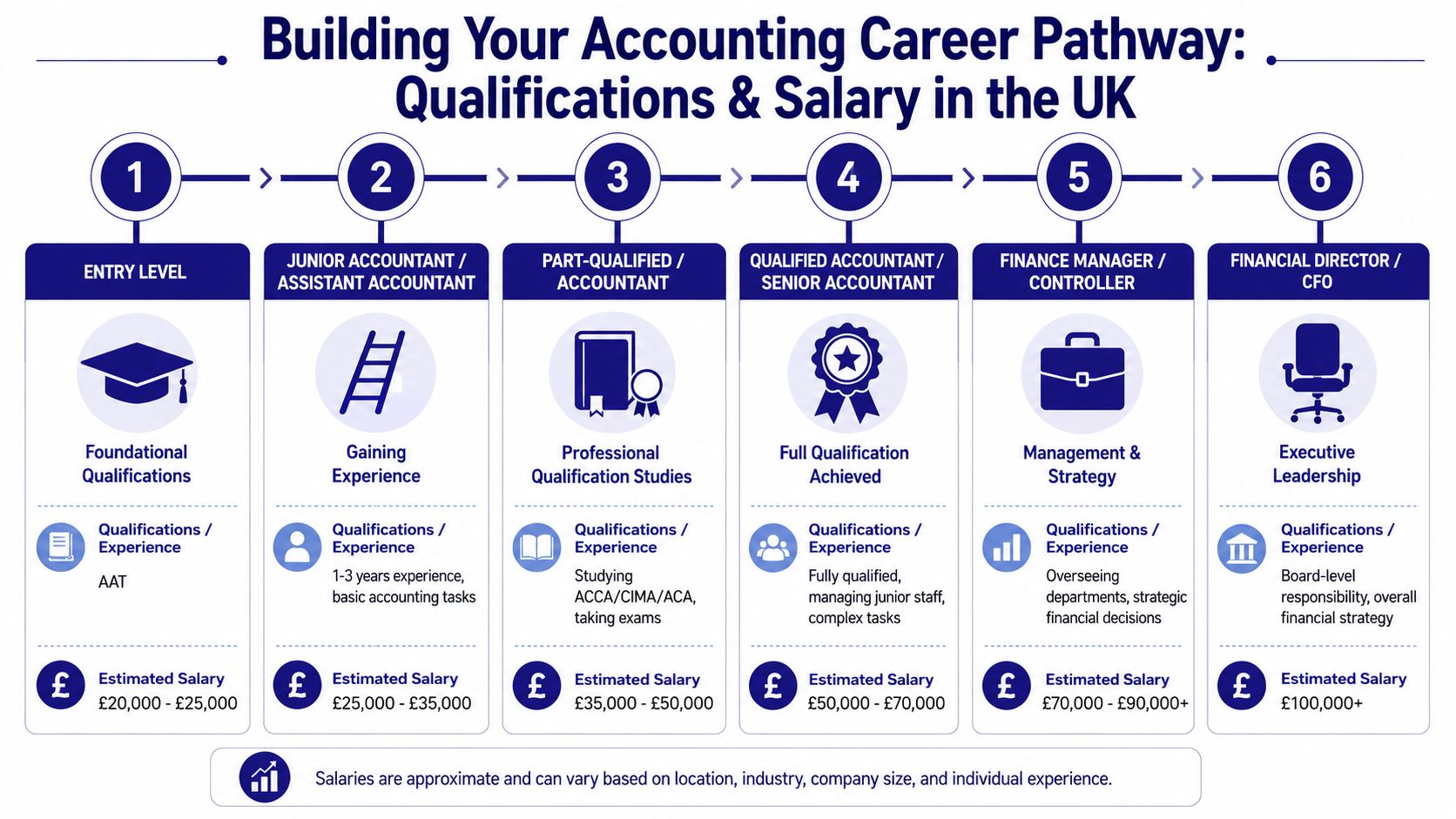
Many people worry that accounts and finance is closed off unless they already hold the perfect degree. In practice, the field is more structured than that. It has recognised stages, common entry roles, and clear qualification routes.
That structure is one reason the profession appeals to career changers. You don’t need to guess what progress looks like. There are established ladders from junior processing work into qualified and strategic roles.
The UK labour market is large enough to support those pathways. This UK accounting overview notes that around 330,000 people worked in accountancy-related roles in the UK in 2024, and that accountants and auditors had a median annual pay of £41,000 in 2024. It also notes that the role typically needs a degree and professional qualification, which helps explain why training choices matter so much.
Common route into the profession
For many beginners, AAT is the most approachable starting point. It gives structure to the basics and helps people understand bookkeeping, controls, accounts preparation, and practical finance processes.
From there, people often move into roles such as:
- Accounts Assistant
- Bookkeeper
- Payroll Administrator
- Assistant Accountant
After that, the pathway can branch. Some continue towards chartered qualifications such as ACCA, ACA, or CIMA. Others deepen their specialism in payroll, VAT, or management reporting. Some move sideways into analysis-heavy work.
How different ambitions change the route
Not every learner wants the same end point.
If you enjoy process, order, and deadline-led work, a route through bookkeeping, VAT, payroll, and final accounts can suit you well. If you’re more interested in strategy and reporting, you may eventually prefer analyst roles.
A simple comparison helps:
| If you enjoy… | You may prefer… |
|---|---|
| Structured routines and clean records | Bookkeeping, Accounts Assistant, payroll |
| Year-end logic and reporting | Final accounts, assistant accountant work |
| Trends, reporting, and business insight | Finance analysis, business analysis, data analysis |
If you’re still building your academic base, it can also help to strengthen your wider business understanding. For some learners, studying economics alongside finance concepts improves commercial awareness. That’s why resources such as earn an A-Level Economics qualification online can be relevant, especially for those who want stronger grounding before moving towards analytical or strategic roles.
Qualifications are useful, but direction matters more
A qualification only helps if it matches the kind of work you want.
Someone aiming for Advanced Payroll doesn’t need the same first step as someone aiming for Data Analyst work. Someone who wants a practical Accounts Assistant role may benefit more from hands-on transaction training than from staying too long in theory.
The smarter move is to choose your route based on the job you want to do first, then work backwards to the training and qualifications that support it.
For a clearer view of recognised UK routes, this guide to the best accounting qualifications in the UK helps compare the options.
From Theory to Job Offer Your Practical Training Plan
One of the biggest frustrations for graduates and career changers is this: they understand the vocabulary, but they still don’t feel job-ready.
They know what bookkeeping is. They know what payroll means. They may even understand financial statements. But the moment a job advert asks for Xero, Sage, reconciliations, VAT returns, payroll processing, or month-end support, confidence drops.
That isn’t just a personal feeling. It reflects a wider hiring problem. The UK government’s Employer Skills Survey, cited in this discussion of practical skills gaps, found that 59% of vacancies were hard to fill in 2022, and 36% of those hard-to-fill vacancies were due to a lack of candidates with the right skills, qualifications or experience. That tells you something important. Employers don’t only want theoretical knowledge. They want people who can do the work.
What a sensible training plan looks like
A practical route into accounts and finance usually works best when it follows the job itself.
For example:
- Start with bookkeeping and VAT if you want a broad operational base
- Add accounts assistant tasks such as purchase ledger, sales ledger, and bank reconciliation
- Specialise in payroll if you like process-heavy work with recurring deadlines
- Build towards final accounts if you want stronger year-end understanding
- Layer in Excel, SQL, Python, or Power BI if you’re heading for business analyst or data analyst roles
That order works because each stage builds on the last. You learn how transactions are recorded before you try to analyse them.
What helps employers say yes
Hiring managers usually want evidence in three areas:
- Can you use the software? Xero, Sage, QuickBooks, Excel
- Can you handle real tasks? invoices, reconciliations, VAT, payroll, reports
- Can you present yourself well? CV, interview answers, clear explanation of your skills
The third point gets overlooked. Good candidates often lose out because they can’t translate training into employer language. That’s where seeing examples of professional accountant resume samples can be helpful. Not to copy them blindly, but to understand how finance skills are presented clearly and professionally.
Employers rarely hire on enthusiasm alone. They hire when your skills look usable from day one.
If you’re serious about entering the field, focus on job-ready practice. Learn the workflows. Learn the software. Learn how to talk about your experience in a way that matches the vacancy.
Launch Your Future in Accounts and Finance
Accounts and finance can look confusing from the outside, but it becomes much clearer once you see it as a practical career map. Accounts records and reports what has happened. Finance uses that information to support future decisions.
Inside that broad field, there are real routes for different strengths. Bookkeeping and VAT suit people who like order and accuracy. Advanced Payroll suits people who can handle deadlines and sensitive information. Accounts Assistant and Final Accounts work build solid accounting careers. Business Analyst and Data Analyst pathways suit people who want to turn numbers into action.
The UK market values practical skill, software confidence, and recognised training. If you’re ready to stop browsing job titles and start building a path into one of them, your next move should be hands-on learning that matches the role you want.
If you’re ready to turn interest into action, Professional Careers Training offers practical UK-focused training in bookkeeping and VAT, advanced payroll, accounts assistant work, final accounts, business analysis, and data analysis, with flexible study options, software training, and career support designed to help you move towards a real job rather than just another certificate.