If you're training to become a business analyst, or you already work as one, you've probably noticed AI tools turning up in more of your...
A lot of strong professionals in bookkeeping, VAT, advanced payroll, final accounts, business analysis, and data analysis realise the next move isn’t another spreadsheet skill. It’s learning how organisations make people decisions, how managers shape performance, and how workforce strategy affects results. If that sounds like you, cipd course level 5 is one of the most practical ways to move from technical specialist to strategic people professional.
Moving Beyond the Spreadsheet Your Next Career Step
An accounts assistant often starts by owning the basics. Then they move into reconciliations, journals, payroll support, VAT submissions, and month-end tasks. A business analyst may begin with reporting packs, SQL queries, process maps, and stakeholder meetings. A data analyst may spend years producing insight that other teams use to make decisions.
At some point, the same question appears. Do you want to keep producing information, or do you want to shape what the business does with it?
That question matters because strategic roles rarely sit inside one technical lane. Senior positions ask you to connect numbers to behaviour. You need to explain why a team underperforms, why retention has changed, why a reward structure creates the wrong incentives, or why a manager’s capability affects output. HR at that level isn’t soft. It’s commercial, evidence-based, and closely tied to business performance.
Why analytical professionals often fit HR better than they expect
People from finance and analysis backgrounds usually underestimate how relevant their current skills are. If you’ve worked in payroll, you already understand confidentiality, compliance, and the impact of policy on employees. If you’ve worked in final accounts, you know how business decisions show up in reporting. If you’ve built dashboards in Power BI or handled large datasets in Excel or SQL, you already think in patterns, root causes, and evidence.
Those strengths transfer well into strategic HR roles such as people analyst, HR business partner, reward analyst, or learning and development partner.
Strong HR work often starts with the same instinct that drives good analysis. Ask better questions, test assumptions, and link activity to outcomes.
There’s also a practical reason this route appeals to career changers. HR now overlaps with systems, data, compliance, operations, and change management. That gives analytical professionals a real edge. You’re not starting from zero. You’re adding a new lens to skills you already use.
Why the move is happening now
Professionals in technical functions often want work that has broader impact and more visible influence. They also want flexibility. If you’re exploring remote jobs, you’ll notice that many modern people roles now expect comfort with systems, reporting, and digital collaboration, not just employee relations. That makes the transition more realistic than many assume.
If you’re still unsure whether a career change makes sense, practical guidance for advice for career changers can help you assess your experience in a more useful way. The key is to stop describing yourself only by job title. Start describing yourself by the business problems you solve.
What Exactly Is the CIPD Level 5 Qualification
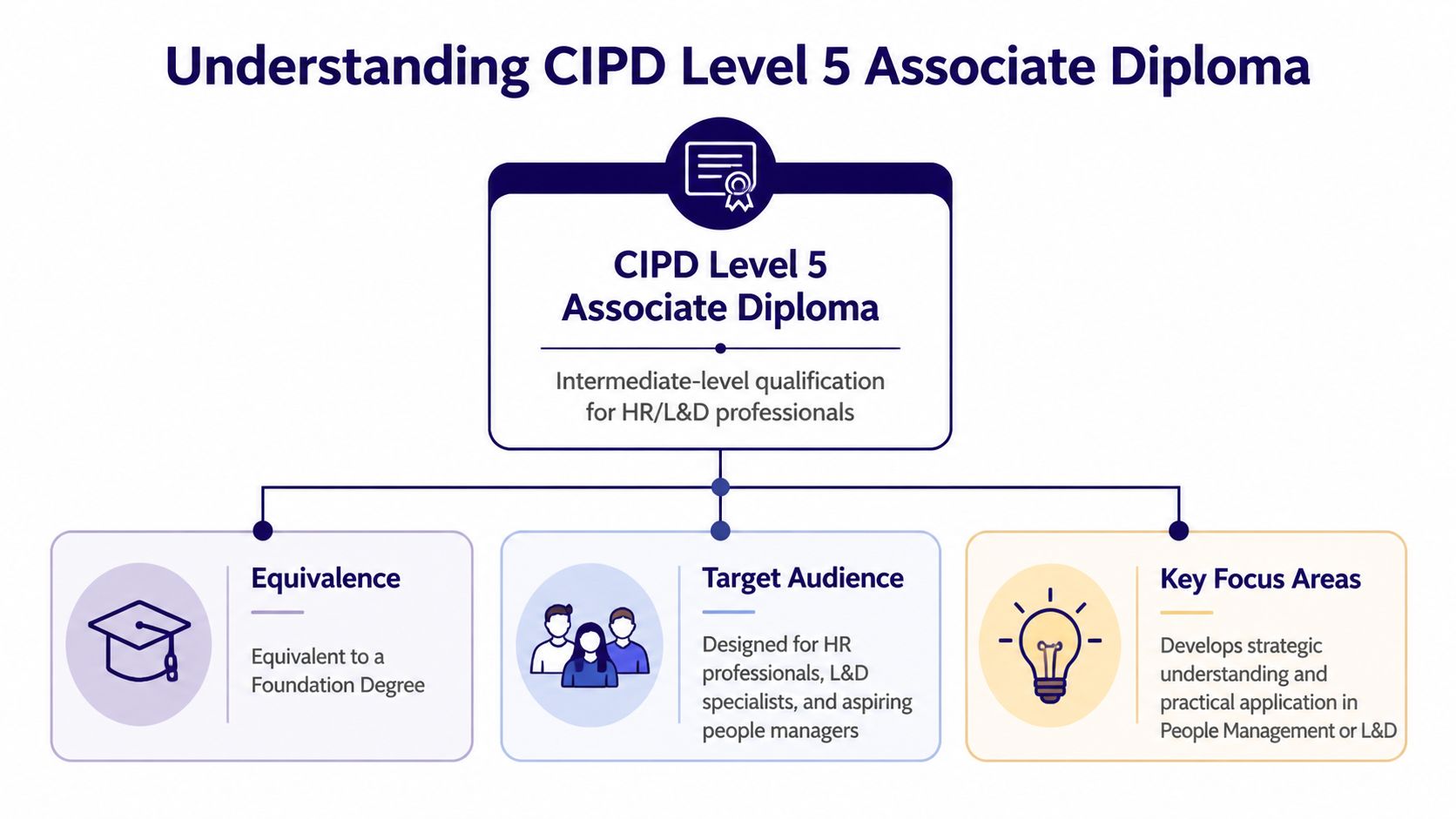
CIPD Level 5 Associate Diploma sits in the middle of the professional ladder. It’s not the entry-level version of HR training, and it’s not the most senior strategic qualification either. It’s the stage where you move from carrying out HR activity to understanding how and why people practices affect organisational outcomes.
For many career changers, that middle position is exactly what makes it useful.
The qualification is equivalent to a foundation degree, leads to Associate CIPD membership, and is recognised within the UK framework as a professional qualification for people management and learning and development. According to this CIPD Level 5 overview, the Associate Diploma in People Management is regulated at RQF Level 5, requires seven units, totals 42 credits, and includes a minimum of 175 guided learning hours and 420 total qualification time hours.
Where it sits between Level 3 and Level 7
A simple way to think about it is this:
| Qualification | Best seen as | Main career use |
|---|---|---|
| Level 3 | Learning the basics | Entry into HR or L&D |
| Level 5 | Managing and advising | Progression into mid-level and strategic support roles |
| Level 7 | Leading at senior level | Preparation for high-level people leadership |
Level 3 teaches the language of HR. Level 7 focuses on advanced strategic leadership. Level 5 is where you learn to translate business goals into practical people decisions.
That matters for analysts and accountants. You already know how to interpret operational or financial information. Level 5 helps you apply that thinking to workforce planning, culture, performance, reward, and organisational capability.
Who it’s designed for
This qualification suits people who are already in HR, but it also works well for professionals moving across from adjacent fields. That includes:
- Payroll professionals who want to move beyond processing and into reward, policy, or employee experience
- Bookkeepers and accounts staff who understand cost control and want a role with more advisory influence
- Business analysts who want to work on organisation design, process change, and people impact
- Data analysts who want to pivot into people analytics or strategic workforce insight
A good test is this. If you enjoy identifying why performance changes, and you want to influence what managers do next, cipd course level 5 is likely to fit.
For readers comparing routes, this guide on what a professional qualification means is useful because it frames the difference between academic study and applied career credentials. That distinction matters. Employers often want proof that you can use knowledge in practice, not just discuss it in theory.
Decoding the Modules and Learning Outcomes
A finance analyst reviewing labour costs already asks the right commercial questions. Why is turnover rising in one team? Why are overtime costs concentrated in one function? Why does one manager retain people while another keeps replacing them? CIPD Level 5 gives those questions an HR framework, then shows you how to turn them into practical recommendations.
According to the CIPD qualification structure for the Associate Diploma in People Management, the programme combines core learning with specialist study and an optional unit. That matters for career changers because the structure is broad enough to build professional credibility, but focused enough to let you apply existing strengths in analysis, reporting, budgeting, and stakeholder management.

Core units through an analytical and commercial lens
The core units are often the point where accountants and analysts realise they are not starting from zero.
-
Organisational performance and culture in practice
This unit connects business results to management behaviour, team norms, and organisational design. If you have worked with margin pressure, missed deadlines, error rates, or inconsistent service levels, you already know people issues show up in performance data. The HR step is learning how to diagnose the causes and recommend action that managers will use. -
Evidence-based practice
This is usually the strongest crossover point for technical professionals. You assess sources, test assumptions, interpret data, and present a reasoned case. In practical terms, it is close to writing a business case, building a performance report, or explaining why one option carries lower cost or risk than another. -
Professional behaviours and valuing people
This unit stretches people who are used to working mainly through systems, controls, and technical accuracy. Good HR work still needs precision, but it also requires judgement, ethics, inclusion, and credibility in difficult conversations. That is often a key skills gap in a career change, and it is one reason structured support and 1 to 1 coaching matter.
Specialist modules shape the kind of HR role you can move into
If you choose the People Management pathway, the specialist units usually cover areas such as employee relations, talent management, and reward. For someone from payroll, finance, or management reporting, reward often becomes the most obvious bridge into strategic HR. Pay structures, benefits cost, internal equity, retention risk, and incentive design all need commercial judgement, not just administration.
If you choose the Organisational Learning and Development route, the focus shifts toward capability, performance improvement, and how learning creates business value. That route tends to suit professionals who enjoy process improvement, skills analysis, and change projects. The CIPD learning outcomes for the Associate Diploma in Organisational Learning and Development show how closely the course links development activity to organisational need, not just course delivery.
That distinction is useful.
People Management usually fits candidates who want to advise on workforce decisions, employee issues, performance, and reward. Organisational Learning and Development usually fits candidates who want to improve capability, support change, and measure whether learning interventions worked.
How the modules translate into work you already know
The strongest assignments usually come from direct application, not textbook repetition.
An accounts or payroll professional might map the course content to work like this:
- Reward modules connect to pay analysis, payroll accuracy, benefits cost, and pay fairness
- Employee relations connects to policy interpretation, risk awareness, and handling sensitive queries
- Performance and culture connects to absenteeism costs, turnover patterns, and manager accountability
- Evidence-based practice connects to audit thinking, reporting discipline, and recommendation writing
A data or business analyst might see a different fit:
- Evidence-based practice connects to dashboard analysis, trend identification, and source evaluation
- Performance and culture connects to process bottlenecks, service quality, and root-cause analysis
- Talent management connects to workforce planning, retention data, and succession risk
- Learning and development connects to capability gaps, intervention design, and outcome measurement
This is also where specialist tools start to matter. If you are interested in recruitment, workforce planning, or talent analysis, exposure to practical systems shortens the gap between theory and execution. A good example is reviewing the top AI powered recruitment tools to understand how hiring teams now use automation, screening support, and decision data in live environments.
What good learning looks like at this level
Treating the modules as isolated theory slows people down. The better approach is to attach each topic to a live business problem, then work out what an HR professional would need to recommend, influence, or change.
I have seen analytical professionals do well on CIPD Level 5 when they stop trying to sound like textbook HR and start writing like commercially aware advisers. Clear diagnosis, evidence, trade-offs, and practical recommendations usually produce stronger work than broad statements about people strategy.
That is also why provider support matters. Career changers from accountancy or analysis rarely struggle with discipline or written assignments. They are more likely to need help with HR judgement, language, and application. A support model that combines software, structured feedback, and 1 to 1 coaching helps bridge that gap faster than self-study alone.
Understanding Entry Requirements and Assessments
One of the most practical features of cipd course level 5 is that you don’t always need to come from a formal HR background. For many providers, the route in is based on a mix of previous study, relevant work experience, or a degree in a related subject.
According to this provider overview of CIPD Level 5 in People Management, learners typically qualify for entry if they have completed CIPD Level 3, have relevant HR or L&D experience, or hold a university degree in a related subject. That matters for career changers because analytical and finance roles often provide the professional context needed to handle the course.
Why the assessment style suits technical professionals
The same source notes that there are no traditional exams. Assessment is entirely assignment-based. Course pricing typically falls between £2,160 and £2,699.97, with structured programmes usually completed in 14 to 18 months and requiring around 8 to 10 hours of study per week.
That format is often a better fit for professionals in accounting, payroll, and analysis than a timed exam model.
Think about the kind of work you already do:
- You prepare reports with evidence
- You explain recommendations
- You reference data and policy
- You write for decision-makers
- You work to deadlines across multiple priorities
That’s close to the discipline required for CIPD assignments. Each unit usually ends with a substantial written task. In broad terms, you’re expected to apply concepts to a workplace scenario, support your reasoning, and show that you understand the impact on the organisation.
What study commitment looks like in real life
If you work full-time, the challenge isn’t usually intellectual difficulty. It’s consistency.
A realistic approach looks like this:
-
Block fixed study time each week
Evening sessions, early mornings, or a weekend half-day tend to work better than hoping for spare time. -
Use your current job as your case material
Payroll issues, reporting gaps, onboarding problems, or manager capability issues can all help you think through assignments. -
Treat assignments like professional deliverables
Draft early, edit clearly, and keep your references organised.
Most learners don’t struggle because the course is impossible. They struggle because busy workweeks push study into leftover time.
If you’re moving towards a more modern HR path, it’s also worth understanding how technology is affecting recruitment and people operations. A practical roundup of top AI powered recruitment tools can help you see how digital hiring processes now intersect with data, screening, and candidate experience.
Your Career After CIPD Level 5 Salary and Roles
A typical career changer I speak to is already doing work that overlaps with HR. The management accountant who spots a turnover problem in payroll data. The business analyst who maps a broken onboarding process. The reporting analyst who can show why absence is rising in one team but not another. CIPD Level 5 helps turn that evidence-based thinking into a recognised people practice profile.

The qualification is widely treated as a strong step for people aiming at mid-level HR and L&D roles. It can support progression into jobs where you advise managers, contribute to policy, improve workforce processes, and connect people decisions to business performance. For professionals coming from finance, payroll, operations reporting, or business analysis, that matters because it gives structure to experience you may already have, but have not yet presented in HR terms.
Roles that suit accountants and analysts especially well
The best move is not always straight into a generalist HR Manager post. In practice, hybrid roles often make more sense first because they let you use your existing technical strengths while building wider HR judgement.
| Your current background | Likely HR direction | Why it fits |
|---|---|---|
| Payroll or accounts | Reward, HR operations, HR business partnering | You already understand pay, compliance, process, and commercial impact |
| Business analysis | HR project work, people change, HRBP roles | You can map processes, gather requirements, and support transformation |
| Data analysis | People analytics, workforce insight, talent reporting | You know how to turn messy data into decisions |
| Bookkeeping and finance support | HR advisory, employee relations support, people operations | You’re used to detail, confidentiality, and operational discipline |
That route is often faster than forcing a full reinvention.
I regularly advise career changers to target roles such as People Analyst, Reward Analyst, HR Project Coordinator, Talent Reporting Specialist, or HR Advisor in a data-heavy environment. These jobs give employers a clear reason to hire you. They can see the immediate value of your previous experience instead of trying to guess how it applies.
What salary and progression usually depend on
Job title alone does not determine earning potential. Employers usually pay more when you can show a mix of HR knowledge, commercial awareness, and evidence-based decision-making.
That creates a real advantage for analysts and accountants. You already know how to work with sensitive information, explain trends, challenge assumptions, and produce recommendations that stand up to scrutiny. In HR, those skills are useful in workforce planning, reward analysis, organisational change, employee relations case preparation, and people reporting.
The trade-off is straightforward. You may need to accept a sideways move in title at the start if it gives you better long-term access to strategic HR work. A payroll professional who moves into reward or HR operations may progress faster than someone who insists on applying only for generic HR Manager jobs without direct HR experience.
Why this combination stands out with employers
Hiring managers often see plenty of applicants who understand HR theory and fewer who can apply it with commercial discipline. Someone with CIPD Level 5 plus a background in finance or analysis can add value early.
That value shows up in practical ways. You can cost a retention problem properly. You can question whether a policy is solving the right issue. You can build a dashboard that helps a manager act, rather than just admire the numbers. That is closer to strategic HR than many career changers realise.
For career changers, a strong understanding of unlocking transferable skills can help you position this mix properly. Recruiters need a clear explanation of how your past work supports better people decisions, not a complete career history.
Your public profile also needs to reflect the move you are making. Practical advice on how to use LinkedIn for HR career change job searching can help you present your experience with more clarity and credibility.
A short explainer can also help you picture where the qualification leads in practice.
What tends to work after qualification
The strongest post-qualification moves usually share three qualities:
-
A clear transition story
“I moved from payroll and accounts into reward and people strategy” is specific and credible. -
Proof of analytical value
Dashboards, reporting packs, policy analysis, process improvement, forecasting, or project delivery all help employers see what you can do. -
Focused applications
Apply for roles where your previous background gives you an obvious edge, rather than treating all HR vacancies as interchangeable.
Associate CIPD membership gives you recognised credibility. Your analytical or financial background gives you a point of difference. Used together, they put you in a stronger position for strategic HR roles than a generic career change pitch ever will.
How Professional Careers Training Supports Your Transition
A career move like this rarely fails because someone lacks potential. It usually stalls because the gap between current skills and target role feels too wide, too vague, or too difficult to explain to employers.
That gap is smaller when training includes direct support rather than just course access.

Why structured support matters for career changers
People moving from accountancy, business analysis, or data work often need help in four areas.
-
Translating experience
A payroll professional may already understand reward logic, policy impact, and employee records, but may not know how to present that in HR language. -
Building confidence with assignments
Writing for a CIPD context is different from writing a finance report, even if the analytical discipline is similar. -
Connecting software skills to HR use cases
Tools such as Advanced Excel, SQL, and Power BI become much more powerful when applied to people analytics, workforce reporting, and performance insight. -
Navigating the UK job market
Career changers often need support with CVs, interview framing, LinkedIn positioning, and employer expectations.
These needs become even more important for learners who are new to the UK labour market. According to this CIPD page on the associate diploma in organisational learning and development, international students and newcomers to the UK make up a significant portion of learners, and specialised support is critical because there is a disparity in completion rates and job outcomes. The same source states that 1-to-1 coaching and recruitment support directly help with assignment localisation and UK-specific job market expectations.
The bridge between finance skills and strategic HR work
A support model built around practical coaching makes a real difference. Accountants and analysts don’t need generic motivation. They need someone to show them how their current capability maps to a new role.
That bridge is strongest when training includes:
| Support area | Why it matters in a transition |
|---|---|
| 1-to-1 coaching | Helps you turn prior experience into a credible HR story |
| Flexible timetable options | Makes study possible around full-time work, family, or shift patterns |
| Software training | Supports moves into people analytics and reporting-heavy HR roles |
| CV and job search guidance | Improves how employers read your transition |
| Recruitment support | Gives structure to applications, interviews, and market targeting |
For someone with experience in Sage, Xero, QuickBooks, payroll systems, Excel, or reporting tools, the advantage is obvious. You’re not learning business discipline from scratch. You’re redirecting it into workforce and people decisions.
What usually works best
The smoother transitions tend to follow a simple pattern:
- Keep your technical identity, but widen it
- Learn the HR framework properly
- Build examples that show strategic thinking
- Apply for roles where your previous background is an asset, not a detour
A bookkeeping or accounts professional might move first into HR operations or reward. A business analyst might target people change projects. A data analyst might focus on people analytics. The qualification gives structure. Coaching makes the move believable.
Frequently Asked Questions About the CIPD Level 5
Is CIPD Level 5 the same as a Master’s degree in HR
CIPD Level 5 is a professional HR qualification aimed at applied practice. A Master’s degree is an academic postgraduate degree. For someone moving from accounting, payroll, or analysis into HR, that difference matters because employers often want evidence that you can apply people frameworks at work, not just discuss them in theory.
I usually advise career changers to judge the option by role fit and speed to market. If you want to move into HR advisor, people operations, reward, L&D, or HR business partnering work, CIPD Level 5 often gives a clearer route.
Can I pay in instalments
Many providers offer instalment plans, but the better question is what you get for the total fee.
Low cost can look attractive until you need tutor feedback, assignment guidance, flexibility around work deadlines, or career support that helps you present your previous experience properly. For analysts and finance professionals, the return on investment is not just course completion. It is whether the training helps you convert existing commercial and reporting skills into a credible HR profile.
I work full-time in accounting. What’s a realistic study commitment
A steady routine works better than an ambitious one you cannot sustain.
If you are studying part-time alongside a full-time job, expect regular weekly study and written assignments for each unit. The workload is manageable for working professionals, but it does require planning, especially if your month-end, audit, reporting, or project deadlines already take a lot of energy. Assignment length and pace vary by provider, so check the teaching model before enrolling and ask to see how deadlines are structured.
The people who cope best usually block out two or three fixed study sessions each week and protect them as seriously as they protect work meetings.
Do I need HR experience before I start
No, but you do need relevant transferable experience and the discipline to learn a new professional language.
That is good news for accountants, payroll staff, and analysts. You already work with confidentiality, risk, process control, reporting accuracy, stakeholder communication, and evidence-based decisions. In HR, those strengths carry real weight. The gap is usually not capability. It is context. You need to show that you can apply sound judgement to people issues, not only financial or operational ones.
This is also where good support matters. A provider that offers one-to-one coaching can help you translate your background into HR examples that make sense to employers and assessors.
Which route is best if I like data more than employee relations
HR is broader than employee relations, and that suits analytical professionals well.
If your strengths sit in data, systems, forecasting, or performance reporting, look closely at roles in people analytics, reward, workforce planning, HR systems, and change support. CIPD Level 5 helps you add the HR framework to strengths you already have. That combination is often attractive because many HR teams need people who can interpret trends, improve reporting, and support business decisions with evidence.
For someone coming from accountancy or business analysis, that can be a smart entry point into strategic HR work.
If you want structured support while making that shift, Professional Careers Training offers flexible study, one-to-one coaching, software training, and job search guidance designed for career changers who want to move from technical or analytical roles into HR.